Kenya Cryptocurrency Regulation: VASP Rules, Licensing and Compliance 2026
Explore Kenya’s 2026 cryptocurrency regulations, including VASP licensing, capital requirements, compliance obligations, regulators, fees and key rules for crypto businesses.

On this page
Kenya’s cryptocurrency industry now operates under a formal regulatory framework.
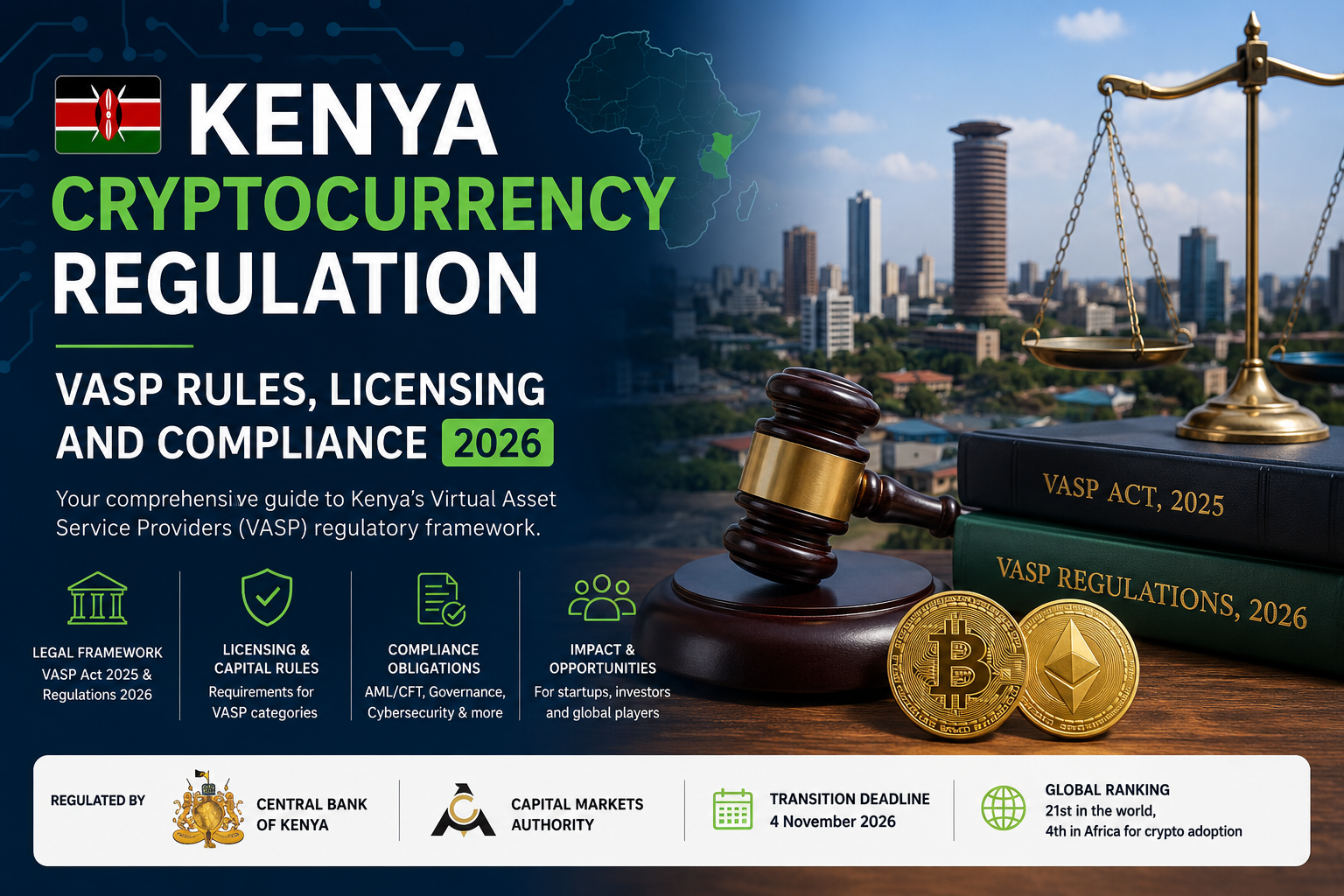
The Virtual Asset Service Providers Act, 2025 took effect in November 2025, and the final Virtual Asset Service Providers Regulations, 2026 were published in July 2026.
The framework brings exchanges, wallet providers, payment processors, brokers, stablecoin issuers and other virtual-asset businesses into a defined licensing regime.
The timing is significant.
Kenya ranked 21st globally in Chainalysis’ 2025 Global Crypto Adoption Index, up from 28th in 2024, and fourth in Africa.
The new rules therefore apply to an active market rather than an industry waiting to emerge.
Let's look at Kenya’s cryptocurrency regulation, who needs a VASP licence, which regulators oversee different activities, the latest capital requirements, licensing fees, compliance obligations and the November 4, 2026 transition deadline.
What Is the VASP Framework in Kenya?
The Virtual Asset Service Providers framework is Kenya’s main legal structure for regulating businesses that provide services involving virtual assets. The VASP Act establishes the legal perimeter. The 2026 Regulations provide the detailed licensing and operational requirements.
The framework covers financial integrity, consumer protection, market conduct and responsible innovation. It also addresses money laundering, terrorism financing, cybersecurity, custody, liquidity and cross-border risks.
The framework uses a dual-regulator model involving the Central Bank of Kenya and the Capital Markets Authority. Their responsibilities depend on the type of virtual-asset activity involved.
When Did Cryptocurrency Regulation Become Effective in Kenya?
The VASP Act, 2025 became effective on November 4, 2025. The final implementing regulations were gazetted in July 2026, completing the detailed framework for licensing and supervision.
Existing operators have a transition period that runs until November 4, 2026. This is the key date for businesses already operating in the Kenyan virtual-asset market to move into the new licensing framework.
Businesses should not wait until the deadline. They need to identify the correct licence category, prepare applications, meet capital requirements and establish the required governance and compliance systems.
This final regulations have caused significant local debate; you can read our ongoing analysis of how the Final 2026 Virtual Assets Rules Could Reshape the Industry
Which Regulator Oversees Cryptocurrency in Kenya?
Kenya uses a dual-regulator model. The Central Bank of Kenya and the Capital Markets Authority share responsibility for the virtual-asset sector, with the regulator involved depending on the service.
The framework broadly separates activities as follows:
The Central Bank of Kenya oversees payment and monetary-related virtual-asset activities, including relevant stablecoin and wallet functions.
The Capital Markets Authority oversees activities connected to exchanges, investment and capital-markets functions.
Businesses with multiple activities should assess each activity separately because one licence does not automatically authorise every service.
Which Crypto Businesses Need a VASP Licence?
The 2026 Regulations create several licence categories. The category depends on what a business actually does. The framework covers businesses such as: 1. Virtual asset exchange providers 2. Virtual asset wallet providers 3. Virtual asset payment processors 4. Virtual asset brokers 5. Virtual asset managers 6. Virtual asset investment advisers 7. Initial coin offering providers 8. Token issuance platforms 9. Virtual asset tokenisation providers 10. Stablecoin issuance providers
A company should define its actual services before choosing a licence. Branding a product as a wallet, exchange or payment platform does not by itself determine the legal category.
Kenya VASP Capital Requirements in 2026
Capital is one of the most important changes for existing and prospective crypto businesses. The final regulations use different minimum paid-up and liquid-capital requirements according to the licence category.Current minimum paid-up capital includes:
- 1KSh300 million — stablecoin issuance
- 2KSh150 million — virtual asset wallet providers
- 3KSh100 million — virtual asset exchanges
- 4KSh20 million — virtual asset managers
- 5KSh20 million — initial coin offering providers
- 6KSh20 million — token issuance platforms
- 7KSh10 million — virtual asset tokenisation providers
- 8KSh10 million — virtual asset payment processors
- 9KSh10 million — virtual asset brokers
- 10Nil — virtual asset investment advisers
Treasury reduced several proposed capital requirements by as much as 40 percent after industry consultation. The stablecoin-issuance threshold fell from KSh500 million to KSh300 million.
Liquid Capital Requirements Also Apply
Paid-up capital is not the only financial requirement. Certain licence categories must also maintain liquid capital. This creates an additional buffer against liabilities and operating risks.
- 1Stablecoin issuance: KSh60 million or 100% of current liabilities for at least 30 days, whichever is higher.
- 2Wallet providers: KSh30 million or 100% of current liabilities for at least 30 days, whichever is higher.
- 3Exchanges: KSh20 million or 8% of total liabilities, whichever is higher.
- 4Virtual asset managers: KSh4 million or 8% of total liabilities, whichever is higher.
- 5Tokenisation providers: KSh2 million or 8% of total liabilities, whichever is higher.
The detailed thresholds are set out in the Fifth Schedule to the 2026 Regulations. Businesses should confirm the requirement for their exact category before budgeting or applying.
How Much Does a VASP Licence Cost in Kenya?
The financial cost of entering the regulated market extends beyond paid-up capital. The regulations also prescribe application, licence and renewal fees.
- 1Virtual asset exchange licence: KSh1 million.
- 2Stablecoin issuance licence: KSh2 million.
- 3Wallet provider licence: KSh500,000.
- 4Initial coin offering licence: KSh500,000.
- 5Token issuance platform licence: KSh500,000.
- 6Tokenisation licence: KSh500,000.
- 7Payment processor licence: KSh200,000.
- 8Broker licence: KSh100,000.
- 9Investment adviser licence: KSh50,000.
Renewal fees can depend on turnover, revenue or assets under management. For example, an exchange pays KSh500,000 or 0.5 percent of the previous year’s gross revenue, whichever is higher.
What Are the Main VASP Compliance Requirements?
Obtaining a licence is only the beginning. Licensed virtual-asset providers must maintain controls appropriate to their activities.
Key compliance areas include:
- 1Anti-money laundering and counter-terrorism financing controls
- 2Customer due diligence and identity verification
- 3Record keeping and regulatory reporting
- 4Cybersecurity and technology controls
- 5Risk management
- 6Governance and fit-and-proper requirements
- 7Consumer protection and complaints handling
- 8Asset and custody controls where applicable
- 9Disclosure and market-conduct requirements
The objective is to move cryptocurrency businesses toward standards expected of regulated financial-service providers while recognising technology-specific risks.
Kenya’s Crypto Rules and AML/CFT
Anti-money laundering and counter-terrorism financing are central to the VASP framework. Virtual assets can move across borders quickly and may use pseudonymous addresses.
Licensed businesses therefore need risk-based customer due diligence, transaction monitoring, suspicious-transaction controls and appropriate reporting processes.
Strong AML/CFT controls can also make regulated virtual-asset businesses more credible to banks, payment providers, institutional investors and international partners.
- You can buy crypto like BTC with M-pesa in Kenya on a platform with robust AML policy like Finlazo.
What Changed in the Final 2026 VASP Regulations?
The final regulations differ from the earlier draft in several important ways. The changes followed public participation and industry submissions. Notable changes include:
- 1The stablecoin capital requirement fell from KSh500 million to KSh300 million.
- 2The stablecoin liquid-capital requirement fell from KSh100 million to KSh60 million.
- 3The proposed 33.3% ownership cap for certain VASPs was removed.
- 4The initial exchange licence fee was reduced from the proposed KSh2 million to KSh1 million.
- 5Paid-up and liquid-capital requirements for virtual asset investment advisers were removed.
- 6Businesses can hold multiple virtual-asset licences under one entity.
- 7Removing the proposed 33.3 percent ownership cap gives founders, venture capital investors and strategic investors greater flexibility. Significant ownership changes remain subject to notification or approval requirements.
Why Kenya’s Crypto Capital Rules Are Controversial
The strongest industry criticism has focused on capital requirements.
At least five Kenyan crypto startup founders told Business Daily they were considering South Africa or Mauritius if they could not raise the required funds before November 4.
The concern is especially strong among early-stage companies. A startup may have a working product and users but still lack the balance sheet required by a fixed capital threshold. Taran App, for example, would need KSh100 million for an exchange licence. Tando, a Bitcoin-to-M-Pesa payment startup, faces a KSh10 million requirement for a payment-processor licence.
Regulators have a competing concern. Capital requirements can help ensure that firms holding customer assets or providing important financial services have enough resources to absorb losses and operate safely.
The policy question is therefore not whether Kenya should regulate cryptocurrency. It is whether the requirements are calibrated well enough to protect consumers without eliminating competition and local innovation.
Kenya’s Crypto Market Is Already Significant
Kenya ranked 21st globally in Chainalysis’ 2025 Global Crypto Adoption Index, improving seven places from 28th in 2024. It ranked fourth in Africa.
Kenya’s Parliament also cited substantial on-chain activity during debate on the VASP legislation. In June 2025, lawmakers said Kenya ranked third in Africa by on-chain weighted transaction volume and cited approximately US$2 billion in activity across decentralised protocols, liquidity aggregation and synthetic platforms during the preceding year.
These are different measures of market activity. Adoption rankings and on-chain transaction figures should not be combined into one market-size estimate.
See more about other African regulation framework in Africa's Crypto Regulation Landscape
What the New Rules Mean for Kenyan Startups
Regulation now needs to be built into the business model from the beginning. Capital requirements affect fundraising. Licensing affects timelines. Compliance affects staffing and technology costs.
A startup planning to operate an exchange cannot treat KSh100 million as an afterthought. It needs a realistic capital plan before the licensing stage.
The same applies to stablecoin businesses. A KSh300 million paid-up capital requirement can materially change the amount of investment needed before launch.
The final rules also give businesses more flexibility than the earlier draft. The ownership-cap removal and the elimination of capital requirements for investment advisers may make some business models easier to finance.
These legal entry barriers have caused significant local debate; read our ongoing analysis of how Kenya’s Crypto Startups Face a Race Against Time as KSh100 Million Exchange Rule Looms
What Happens After November 4, 2026?
November 4, 2026 is the key transition date for existing operators. Businesses already serving the Kenyan market need to understand their regulatory category and meet the applicable licensing requirements.
Some companies will raise capital and obtain licences. Others may restructure, combine activities or seek partnerships with better-capitalised financial institutions. Some may consider alternative jurisdictions.
The outcome will show whether Kenya’s new framework creates a smaller but stronger regulated industry or whether some local innovation moves offshore.
Is Kenya Becoming More Crypto-Friendly or More Restrictive?
The answer is more complicated than either label suggests. Kenya is becoming more restrictive because crypto businesses can no longer operate around an undefined licensing perimeter.
Formal regulation can also make the market more attractive to serious investors and financial institutions. Clear rules can reduce uncertainty and create a pathway for compliant companies to work with banks, payment providers and institutional partners.
The framework therefore represents a transition from regulatory uncertainty to regulated competition. Its implementation will determine whether that transition strengthens Kenya’s position in African digital finance.