How to Buy Cryptocurrency in Kenya in 2026: M-Pesa, Banks and Costs
How to buy cryptocurrency in Kenya using M-Pesa, Airtel Money, PesaLink, banks, cards or P2P. Compare exchanges, KSh costs, wallets and 2026 VASP rules.

On this page
Sub-Saharan Africa recorded the world's fastest growth in cryptocurrency activity during the year to June 2026, according to Chainalysis' September 2026 Geography of Cryptocurrency report. Strong peer-to-peer (P2P) activity helped drive that growth.
Kenya is part of that market. During a June 2025 parliamentary debate, Finance Committee chair Kuria Kimani cited approximately 6.1 million crypto users. That was a lawmaker's estimate in 2025, not a verified 2026 count of individual people or wallets.
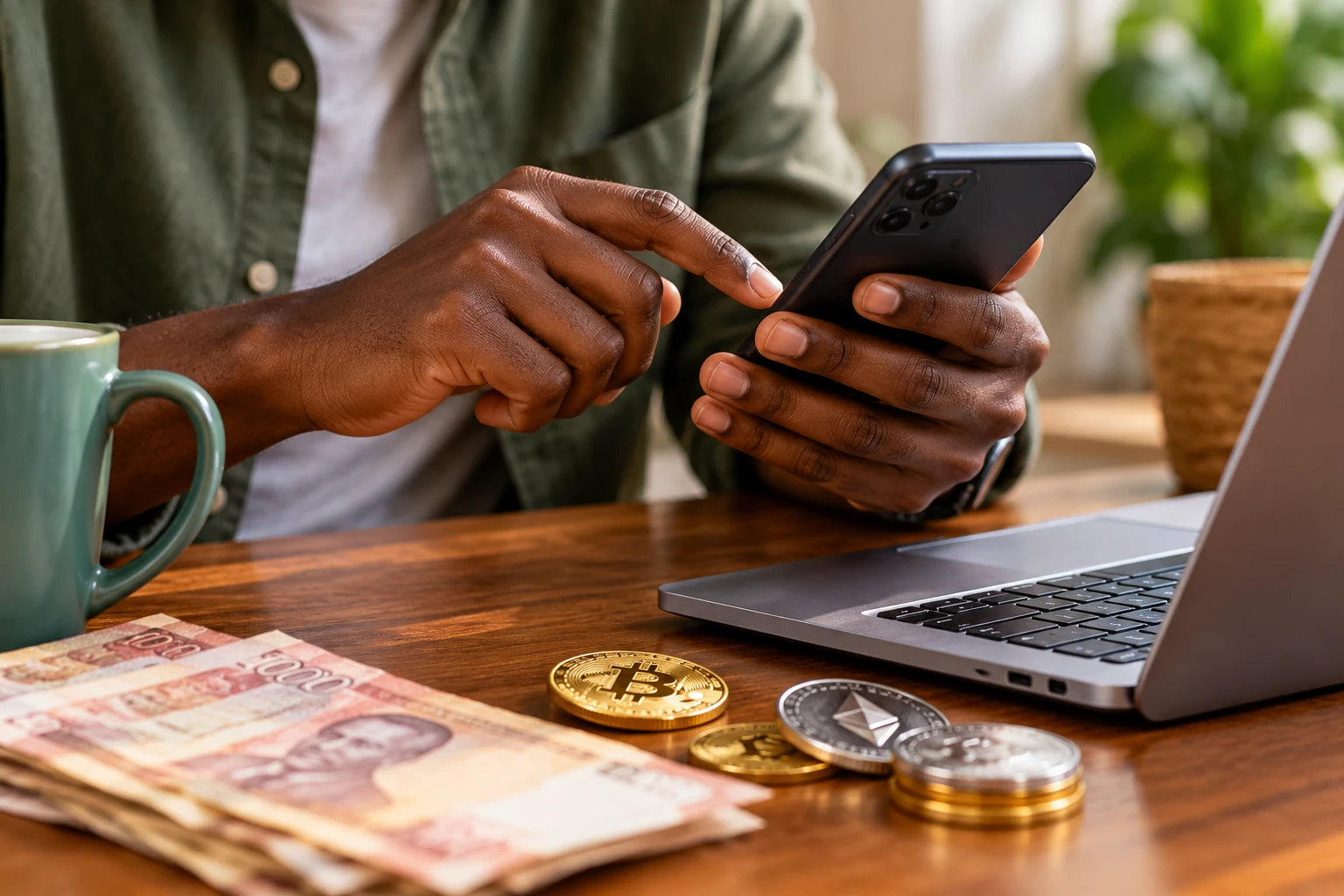
For Kenyan buyers, the immediate question is practical: which exchange accepts shillings, and how much Bitcoin, Ether or USDT will the money buy? Options include M-Pesa, Airtel Money, PesaLink, other bank transfers, cards and P2P offers. Availability and charges vary by exchange.
Kenya's final Virtual Asset Service Providers Regulations, 2026 were gazetted in July. Buyers should check an exchange's payment methods, costs and regulatory position before placing an order.
How to buy cryptocurrency in Kenya: six steps
Start with the exchange and its current payment options. Check M-Pesa, Airtel Money, PesaLink or bank transfers inside the order; not every exchange supports every method.
How to buy cryptocurrency in Kenya using a supported KES payment method
Six checks from selecting a provider to confirming the purchased asset and withdrawal options.
Choose a crypto exchange and KES payment method
Check that the exchange accepts M-Pesa, Airtel Money, PesaLink, bank transfer or card. For P2P, check the seller's listed payment method.
Complete the required identity checks
Verify your identity through the exchange's official account flow. Use a payment account in your own name.
Select the exact crypto asset and destination
Check the exact coin, network and whether it will reach an exchange wallet or your own address.
Set a KSh budget and compare the executable quote
Compare the full KSh charge and how much crypto you will get. Check the minimum order.
Make the payment under the issued instructions
Check the merchant, amount and reference. Keep the M-Pesa or bank receipt.
Confirm crypto delivery and exit options
Make sure the crypto has arrived. Check the exchange's withdrawal fee and KES cash-out options.
You might buy Bitcoin (BTC), Ether (ETH), Solana (SOL) or a stablecoin such as USDC or USDT. Check the ticker before paying. They are different assets, with different prices and withdrawal networks.
Where can you buy cryptocurrency in Kenya?
Several exchanges and crypto buying services describe Kenyan shilling payment routes. They work differently:
- Finlazo has a Buy Crypto page and dedicated Bitcoin with M-Pesa and Bitcoin with PesaLink pages. Check the current quote and payment availability before placing an order.
- Binance announced direct M-Pesa purchases and sales of supported crypto for eligible Kenyan users on 13 October 2026. This is separate from Binance's P2P marketplace.
- VALR documents mobile-money crypto purchases in KES through Onafriq. Its help page lists a US$300 limit per mobile-money transaction. Check the current limit and eligibility in the account.
- OKX explains how Kenyan customers can buy USDT through M-Pesa P2P offers. You buy from a marketplace seller, not directly from OKX at one published exchange rate.
These are examples, not an exchange ranking or a statement that each business holds a Kenyan licence. Verify the legal entity, current service, applicable rules and cash-out options. An exchange that accepts KES may still have restrictions on withdrawals.
Compare M-Pesa, PesaLink, bank transfers, cards and P2P
A lower payment fee does not always mean a cheaper crypto purchase. Compare the total KSh paid with the crypto received.
| Buying route | What happens | Main things to check |
|---|---|---|
| M-Pesa checkout | Pay through an exchange's supported mobile-money flow | Final crypto rate, merchant, payment charge and order limit |
| Airtel Money | Pay via Airtel Money only where the exchange or an in-platform P2P offer explicitly accepts it | Accepted recipient, wallet-name match, Airtel Money charge and final crypto rate |
| PesaLink | Send money from a participating bank through an accepted transfer route | Bank fee, beneficiary, reference and exchange crediting |
| Other bank transfer | Deposit using the exchange's stated bank instructions | Rail, processing time, account-name match and conversion |
| Debit or credit card | Buy through an exchange's supported card checkout | Card charge, foreign-exchange rate and issuer restrictions |
| P2P | Pay another trader under a marketplace order | Seller's rate, escrow, payment recipient and dispute terms |
An ordinary bank transfer is not automatically PesaLink. A direct M-Pesa or Airtel Money checkout also differs from paying an individual P2P seller using mobile money.
There is a second question: Does the exchange credit a hosted wallet or send crypto to your own address? Those outcomes carry different withdrawal steps and costs.
Buying Bitcoin with M-Pesa
The Central Bank of Kenya recorded 95.31 million registered mobile-money accounts in August 2026 across Kenyan operators. That is a count of registered accounts, not unique people or crypto buyers.
Safaricom separately reported 40.99 million one-month-active M-Pesa customers in Kenya for the financial year ended March 2026, up 14.5% from the prior year. This measures active M-Pesa customers, not the CBK's broader registered-account total. The figures cannot be added together.
Safaricom publishes a standard KSh 250,000 per-transaction limit and KSh 500,000 daily limit for eligible ordinary M-Pesa payments. Its limit announcement covers Send Money, Buy Goods and PayBill.
These are M-Pesa payment limits, not Bitcoin purchase limits. An exchange may impose a lower amount. Your available balance and verification level also matter.
A supported checkout may send an STK push to your phone. Check the amount and merchant before entering your PIN. If the prompt fails, don't immediately repeat the payment. First check your M-Pesa balance and order status.
Read our focused guides to M-Pesa Bitcoin limits, failed STK pushes and what an M-Pesa Bitcoin purchase really costs.
Can you buy cryptocurrency using Airtel Money in Kenya?
Airtel Money Kenya is another mobile-money option for sending shillings. But Airtel Money availability for crypto purchases depends on the exchange or P2P seller. A buyer must see that payment method in the current checkout or marketplace order.
For a direct purchase, use only the recipient, amount and instructions supplied inside the exchange's verified order. For P2P, filter the KES offers for Airtel Money, if listed, and confirm the seller's terms before paying. Do not assume a seller who accepts M-Pesa will also accept Airtel Money.
Compare Airtel Money's applicable transfer charge with the exchange's rate and fees. A low mobile-money fee cannot compensate for an unfavourable crypto quote. Airtel's official mobile-money information explains its payment service; it does not guarantee crypto buying support at a specific exchange.
Buying cryptocurrency with PesaLink or a bank transfer
PesaLink says its network supports transfers up to KSh 999,999 per transaction. Your bank may set a lower limit. Its charges depend on the bank.
First, confirm that the exchange accepts PesaLink. Then use its exact beneficiary details and payment reference. A transfer can reach the receiving account before your crypto order is completed.
Other bank deposits may use a different payment rail. Check how long funds take to appear and whether the exchange credits KES or buys the crypto immediately.
For a closer comparison, see M-Pesa vs PesaLink when buying Bitcoin in Kenya.
Can you buy crypto with a Kenyan bank card?
Some exchanges accept debit or credit cards. Acceptance depends on the exchange, card issuer and payment processor.
A card transaction can carry a processing fee and a currency-conversion charge. Ask a simple question before confirming: What will leave my bank account, and how much crypto will I receive?
A card decline does not mean every Kenyan bank blocks cryptocurrency. Your exchange or bank may have its own restrictions.
What about buying crypto through P2P?
On a P2P marketplace, a trader publishes a crypto offer. You select the seller and pay using the permitted method.
The seller sets the price. Compare the amount of BTC or USDT you will receive for your KSh budget. An attractive advertised rate is useless if the order is outside your budget or unavailable.
Keep every step inside the marketplace. Check escrow and the seller's payment details. Do not release funds, or mark an unpaid order as paid, based on messages outside the platform.
Our M-Pesa vs P2P comparison covers seller risks and order handling in greater detail.
How much does a KSh 5,000 crypto purchase cost?
A crypto purchase can involve a payment fee, an exchange charge and a spread. The spread is the difference between the exchange's buying price and its reference or selling price. You may also pay a fee to withdraw crypto later.
To compare exchanges, keep the total payment fixed at KSh 5,000. Then compare the crypto credited.
The figures below are illustrative, invented quotes. They are not current Bitcoin prices or real Finlazo, Binance, VALR, M-Pesa or PesaLink fees.
| Example | Quote A | Quote B | Quote C |
|---|---|---|---|
| Total KSh spent | 5,000 | 5,000 | 5,000 |
| Fees deducted | 0 | 70 | 135 |
| Assumed KSh price per BTC, including spread | 10,200,000 | 10,000,000 | 10,050,000 |
| BTC received | 0.00049020 | 0.00049300 | 0.00048408 |
| Category | Value (satoshis) |
|---|---|
| Quote A | 49020 |
| Quote B | 49300 |
| Quote C | 48408 |
Every example spends KSh 5,000 in total. The chart does not include any later withdrawal fee.
Source: Finlazo illustrative arithmetic; assumed exchange rates and fees, not live quotes.
Quote B delivers 280 more satoshis than A. It has a KSh 70 fee, but its better buying rate makes up for it. That's why the final amount of crypto matters more than a "zero fee" headline.
For a KSh 100 or KSh 1,000 order, fixed fees can have a bigger effect. Read our small Bitcoin purchases guide.
What verification does a Kenyan buyer need?
Crypto exchanges may ask for identity documents and account details. Checks depend on the exchange, the payment route and Kenyan law.
The VASP Act, 2025 and the final 2026 regulations set obligations for covered crypto businesses.
Use your own bank or mobile-money account when buying through Finlazo. Finlazo does not accept third-party funding for personal crypto purchases. The payment account must match the verified customer.
Never share an M-Pesa PIN, account password or wallet recovery phrase. See our guide to Bitcoin scams in Kenya.
Is buying cryptocurrency legal in Kenya in October 2026?
The Virtual Asset Service Providers Act, 2025 took effect on 4 November 2025. Kenya published the final 2026 regulations on 22 July 2026.
The Act regulates businesses offering covered crypto services. It does not make buying Bitcoin for your own account a licensed exchange business.
Section 47 gives existing covered businesses one year from commencement to comply. That places the transition date at 4 November 2026. It is not an automatic licence for every exchange.
The CBK and Capital Markets Authority (CMA) oversee different regulated activities. Check official information before assuming an exchange is licensed. An old notice saying no licences had been issued in 2025 cannot establish the position in October 2026.
Our Kenya VASP guide explains the rules. For the payment-specific question, read is buying Bitcoin with M-Pesa legal in Kenya?.
Where does your crypto go after payment?
An M-Pesa message confirms a payment step. It does not prove that the exchange has delivered BTC.
Check the order status and wallet balance. If you plan to withdraw, confirm the correct network, address, minimum amount and network charge.
Also check how to sell later. Does the exchange support KES withdrawals to a bank or M-Pesa account? Are there minimums or separate conversion charges? A working buy route does not guarantee a working cash-out route.
For more detail, see where Bitcoin goes after an M-Pesa purchase.
What to check before you buy
The best exchange for one customer may not be the cheapest for another. Order size, payment method and withdrawal plans matter.
Before paying, check five things: the exchange and its legal status, the full KSh cost, the crypto quantity, the wallet destination and the way you can withdraw or sell.
A practical buying guide should end with those decisions. The rest belongs in the exchange's live quote, not in promises about prices or settlement times.
Sources and methodology
- Chainalysis: 2026 Global Crypto Adoption Index — 2025–26 study period; Sub-Saharan Africa's leading growth and P2P activity. Earlier 2025 regional figures are not described as current.
- Kenyan Parliament: Virtual Asset Service Providers Bill debate, 2025 — lawmaker's historical estimate of 6.1 million crypto users, not an official 2026 wallet census.
- Safaricom FY26 Results Booklet — 40.99 million one-month-active M-Pesa customers in Kenya for the year to March 2026.
- Airtel Kenya: Airtel Money — mobile-money service and current provider information. Crypto payment acceptance is exchange-specific.
- Central Bank of Kenya: Mobile Payments — August 2026 mobile-money accounts, not unique users.
- Safaricom: M-Pesa limits — standard payment ceilings.
- PesaLink: FAQs — maximum network transfer and bank-level conditions.
- CMA: VASP Act, 2025 and 2026 Regulations — Kenya's legal framework.
- Official exchange guides: Binance M-Pesa, VALR mobile money and OKX M-Pesa P2P.
Exchange access, fees, payment rails and licensing status can change. The KSh 5,000 examples are invented to explain cost comparisons.