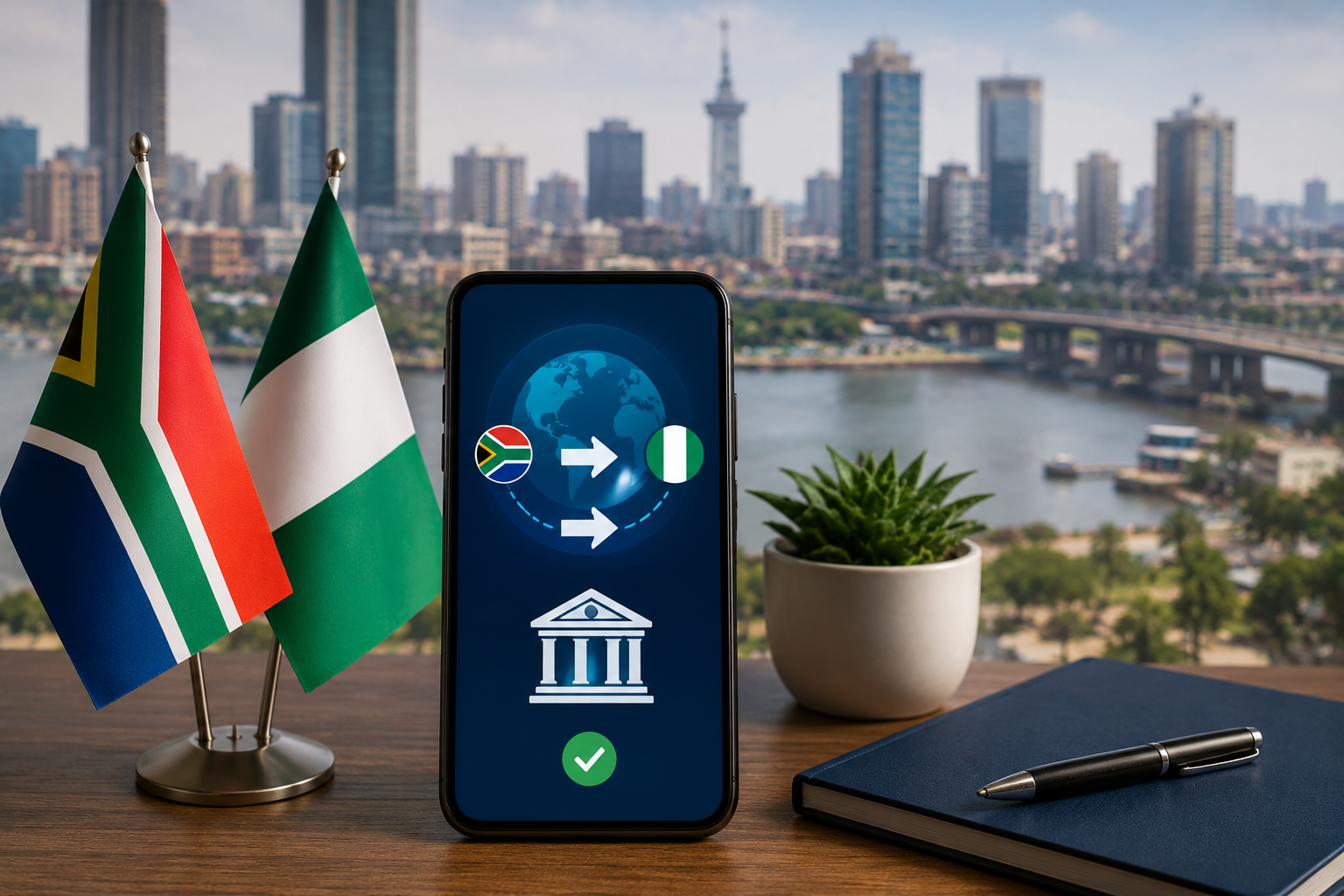
Why Stablecoins Could Transform Cross-Border Payments in Africa
Stablecoins could reshape cross-border payments in Africa by enabling faster settlement between currencies, banks, mobile money networks and digital payment platforms. Explore how stablecoin infrastructure could make African payments more efficient, accessible and connected.

On this page
Africa is entering a new phase of digital finance.
Across the continent, people and businesses are increasingly able to move money through mobile wallets, instant payment systems and digital financial platforms. Yet cross-border payments remain one of the biggest obstacles to seamless commerce.
Sending money from one African country to another can still involve multiple currencies, banks, intermediaries, foreign-exchange conversions and settlement systems. The result can be higher costs, slower settlement and a payment experience that feels out of step with the rest of the digital economy.
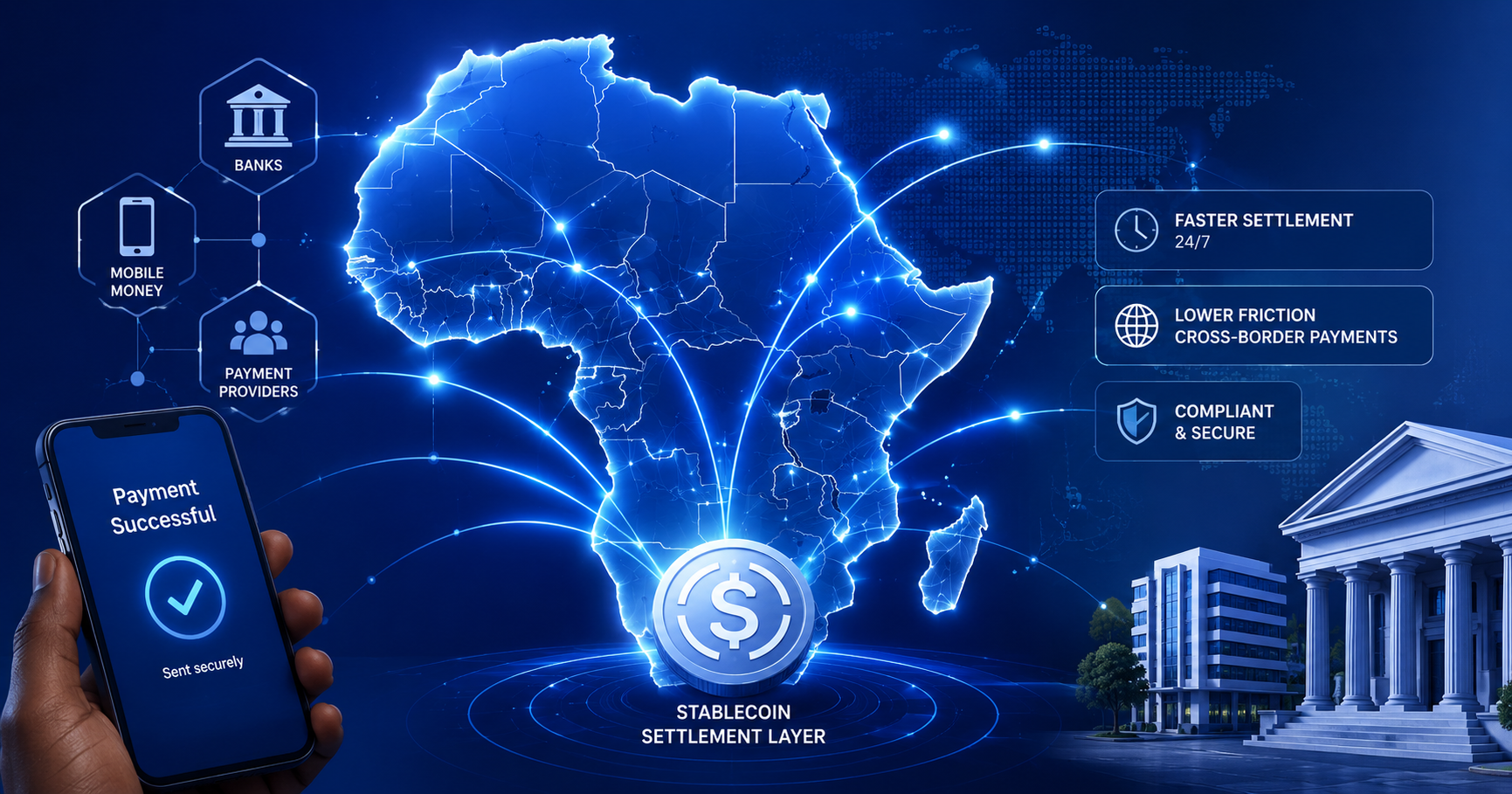
Stablecoins could help change that.Rather than replacing banks, mobile money networks or local currencies, stablecoins can provide an additional settlement layer connecting different financial systems.
Africa's Cross-Border Payment Problem
Africa is not one financial market. The continent has more than 40 national currencies, different regulatory environments and a fragmented collection of payment infrastructures.
The African Development Bank's 2026 African Economic Outlook notes that this fragmentation complicates cross-border settlement and liquidity management. It also estimates that nearly half of intra-African payments are routed through correspondent banks outside Africa, often using the U.S. dollar or euro as settlement currencies.
This creates several challenges.
A business in Kenya paying a supplier in Nigeria, for example, may need to navigate different currencies, banking relationships and settlement processes. A person sending money across borders may encounter foreign-exchange spreads, transfer fees and delays.
These challenges become even more significant as African businesses increasingly operate across borders.
A digital business can acquire customers in several countries almost instantly. Its payment infrastructure, however, may still depend on systems designed around banking relationships that were established decades ago.
It is against this backdrop that stablecoins have begun to gain real traction across Africa. Rather than being used solely for speculation, dollar-pegged digital assets are increasingly serving practical financial needs.
Businesses and individuals are using stablecoins to preserve value, settle transactions, and move money across borders with greater speed, flexibility, and predictability.
Stablecoins are becoming an increasingly important part of Africa's digital-asset economy.
Chainalysis estimates that they represent around 43% of cryptocurrency transaction volume across Sub-Saharan Africa. Nigeria is one of the continent's largest markets, recording nearly $22 billion in stablecoin transactions over a 12-month period.
These figures point to growing demand for stablecoins not only as digital assets, but also as practical tools for payments, savings, and cross-border transfers.
What Are Stablecoins?
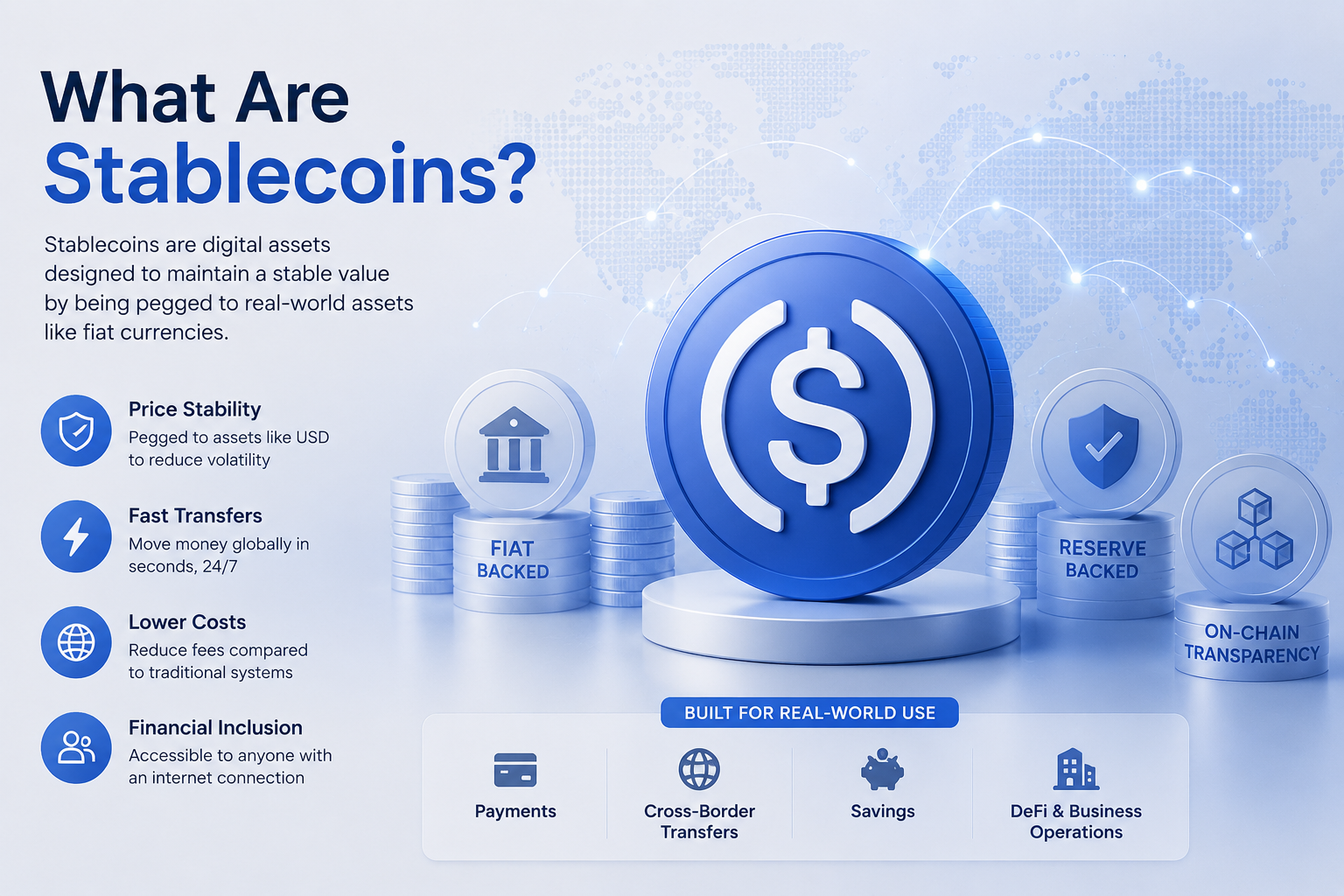
Stablecoins are digital assets designed to maintain a relatively stable value, commonly by referencing a fiat currency such as the U.S. dollar. Examples include USD Coin (USDC) and Tether (USDT).
Unlike Bitcoin or other highly volatile crypto assets, stablecoins are primarily designed to provide a digital representation of relatively stable value. That makes them particularly interesting for payments.
Research from the Federal Reserve Bank of Kansas City suggests that stablecoins are still used primarily within the crypto ecosystem.
Around 48.8% of stablecoin activity is associated with trading, while 29.3% relates to broader blockchain transfers and treasury movements. By comparison, traditional retail and consumer-to-business payments account for only about 0.7% of usage.
A company does not necessarily need to use Bitcoin to move value across borders. It can potentially use a dollar-denominated stablecoin as a settlement asset while the recipient ultimately receives local currency through a regulated payment provider.
This distinction is important. The future of crypto payments may be less about asking consumers to use cryptocurrency and more about using blockchain infrastructure behind the scenes to move money more efficiently.
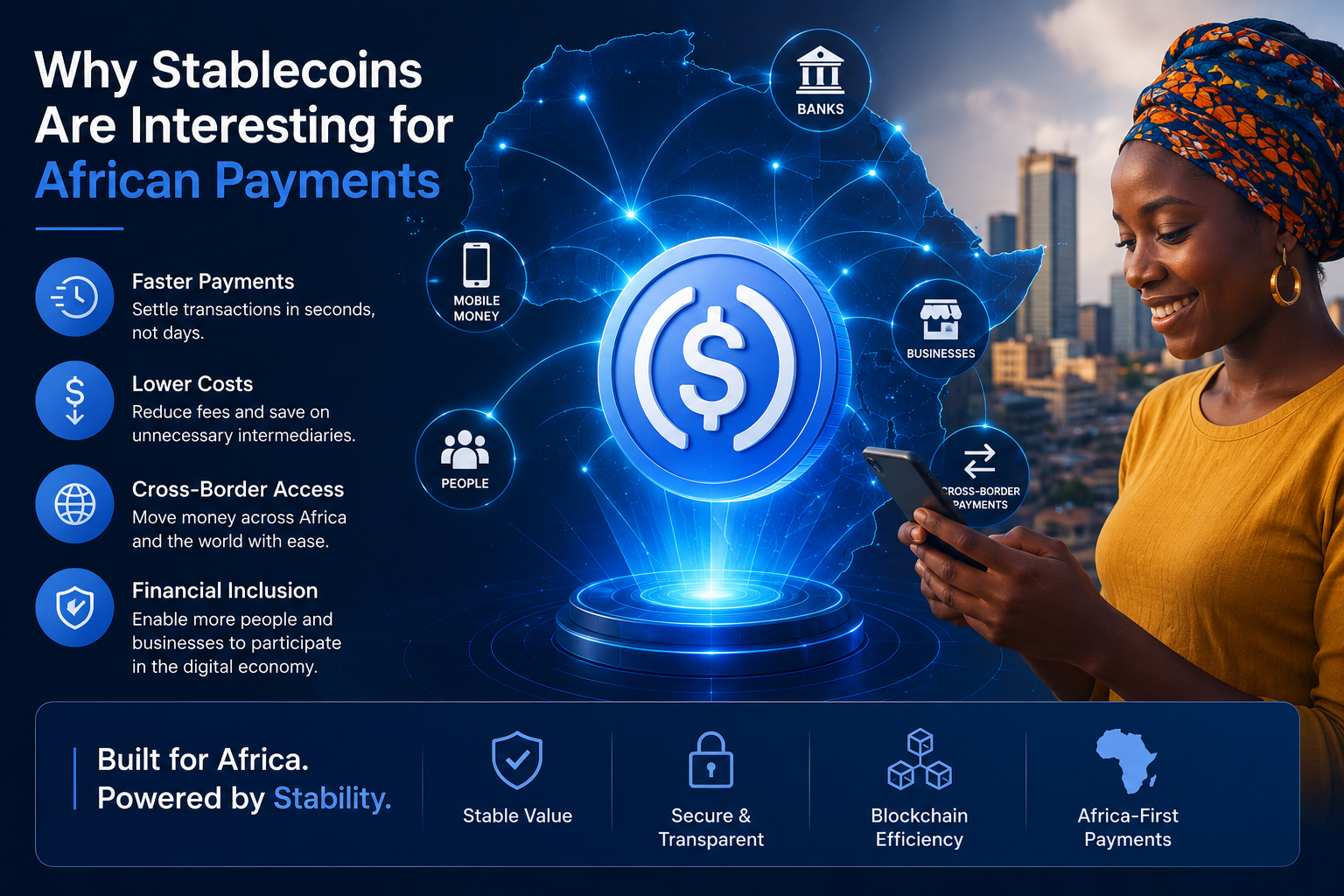
Why Stablecoins Are Interesting for African Payments
Faster Settlement
Traditional cross-border payments can involve multiple intermediaries and operating hours.
Settlement times vary depending on the payment route, correspondent banks, compliance processes and local banking systems. Blockchain networks operate continuously.
Blockchain networks operate continuously.
A stablecoin transaction can be transmitted onchain at any time, potentially allowing financial institutions and payment providers to settle value outside traditional banking hours.
The technology does not automatically eliminate every delay — the on-ramp, off-ramp, compliance checks and local payout can still take time — but the underlying settlement layer can operate continuously.
Financial infrastructure companies are already exploring this model. Circle, for example, has developed infrastructure designed to allow participating financial institutions to use USDC for cross-border settlement.
Lower Settlement Friction & Fee
Traditional banks and wire services charge significantly more through hidden exchange rate markups and intermediary deductions.
Their cross-border payments can become expensive because value may pass through multiple institutions before reaching the final recipient. The World Bank reported that the average cost of sending $200 to African countries was 7.9% in the fourth quarter of 2023, while costs varied substantially between individual corridors.
Stablecoins can provide a common digital settlement asset between participants. Instead of maintaining large amounts of liquidity in numerous currencies and accounts, a payment provider may be able to use a stablecoin as part of its treasury and settlement infrastructure.
Stablecoin-based cross-border payments can reduce some settlement friction, but the final cost still depends heavily on the on-ramp, off-ramp, foreign-exchange conversion, network fees and local payout method
Circle's 2025 review highlighted partnerships using USDC as an always-on settlement asset for cross-border payment networks, reducing the need for some traditional prefunding arrangements.
The actual cost for a customer will still depend on the complete payment journey, including blockchain fees, foreign-exchange conversion, compliance and local payout costs. But the underlying settlement mechanism can become considerably more efficient.
A Common Settlement Layer
Africa's currency fragmentation is one of the continent's biggest payment challenges. A business operating across five African markets may need to interact with five currencies and multiple financial infrastructures.
A stablecoin can potentially act as a neutral settlement asset between payment providers. For example: Kenyan Shilling → Stablecoin → Nigerian Naira
The customer may never see the stablecoin. It can simply function behind the scenes as the bridge between two local financial systems. This is one of the most interesting applications of blockchain technology in payments.
24/7 Financial Infrastructure
Traditional financial systems often operate according to banking schedules and settlement windows. Blockchain networks do not have weekends. They do not close for public holidays.
A payment infrastructure built around stablecoins can therefore operate continuously, while local fiat settlement can occur through regulated financial institutions and payment providers. For businesses operating internationally, that can have significant implications for treasury management and working capital.
Stablecoins Are Already Being Used in Africa
This is no longer purely theoretical.
In June 2026, the International Monetary Fund published research on stablecoins in Nigeria and described them as a growing cross-border payment channel.
The IMF reported that stablecoins accounted for more than 65% of crypto inflows into Nigeria in 2024, according to its analysis, with USDT and USDC dominating dollar-denominated stablecoin activity. Stablecoin activity in Nigeria spans individuals, small businesses and larger companies, including cross-border transfers and international supplier payments.
Other African payment companies are also moving toward stablecoin infrastructure. In 2025, Onafriq announced a partnership with Circle to use USDC for remittances and cross-border payments across its African payment network.
In March 2026, Circle announced a collaboration with Sasai Fintech to explore USDC applications across African enterprise and consumer payment corridors.
These developments suggest that stablecoins are increasingly being evaluated not simply as crypto investment products, but as potential components of mainstream payment infrastructure.
The Mobile Money Connection
One of Africa's greatest advantages is its mobile-first financial infrastructure.
Mobile money has already demonstrated that consumers do not necessarily need traditional bank accounts to participate in digital payments. Kenya's M-Pesa is one of the world's best-known examples. Safaricom had 40.66 million M-Pesa customers in the year ended March 2026, according to company data reported by Business Daily.
Stablecoins could complement this infrastructure rather than replace it. Consider a simplified payment: Sender's local currency → Payment provider → Stablecoin settlement → African payment provider → Recipient's local currency → Mobile money or bank account.
The recipient does not necessarily need a crypto wallet. The sender does not necessarily need to understand blockchain technology. The blockchain can remain largely invisible while serving as the settlement infrastructure underneath the payment. That is where stablecoins could become particularly powerful.
Stablecoins Could Help African Businesses Go Global
The opportunity extends beyond remittances. African businesses increasingly purchase software, equipment, inventory and services from companies outside their home markets. At the same time, African companies are selling products and services internationally.
Cross-border payment infrastructure therefore affects:
- Importers
- Exporters
- Freelancers
- Remote workers
- Online businesses
- Technology companies
- International suppliers
- Remittance companies
- Marketplaces
- Financial institutions
For a small business, receiving or sending international payments quickly can directly affect cash flow. For a larger company, faster settlement can reduce the amount of capital tied up in payment corridors.
For payment providers, stablecoins could potentially provide a more programmable settlement layer between existing financial networks.
Stablecoins Do Not Eliminate the Need for Regulation
The opportunity is significant, but stablecoins are not a regulatory shortcut. Cross-border payments involve money transmission, foreign exchange, consumer protection, sanctions compliance, anti-money-laundering controls and other regulatory obligations.
The regulatory environment also differs substantially from one African country to another. We can see this among Uganda Cryptocurrency Regulation, Crypto Regulation in South Africa, Kenya Cryptocurrency Regulation, and Cryptocurrency Regulation in Nigeria
A stablecoin transaction may occur on a blockchain within seconds, but a compliant financial service still needs to answer important questions:
- 1Who is handling the customer's money?
- 2Who converts the local currency?
- 3Who performs customer verification?
- 4Who provides the payout?
- 5Which entity is licensed in each jurisdiction?
- 6How are suspicious transactions detected and reported?
These questions become increasingly important as stablecoins move from crypto-native markets into mainstream financial services.
A May 2026 paper from the MIT Digital Currency Initiative examining stablecoins in Africa emphasizes that regulation needs to account for an ecosystem that is already active, particularly in areas such as remittances, peer-to-peer transfers and trade settlement.
The strongest future payment platforms are therefore likely to combine blockchain infrastructure with regulated financial institutions and payment providers.
The Future May Be Hybrid
The most realistic vision for African payments is probably not banks disappear or mobile money disappears or everyone starts paying directly with cryptocurrency. Instead, the future may be hybrid.
Traditional banks can continue providing accounts and fiat settlement. Mobile money networks can continue serving millions of consumers. Payment processors can provide local collection and payout. Stablecoins can provide an always-on digital settlement layer between participating institutions. Blockchain networks can provide programmable infrastructure.
And compliance systems can connect the entire ecosystem.
In this model, the customer experience can remain familiar while the infrastructure underneath becomes dramatically more efficient.
What This Could Mean for Africa
Africa's fragmented financial landscape is often described as a disadvantage.
But fragmentation can also create an enormous opportunity for infrastructure companies capable of connecting different systems. A successful cross-border payment platform does not necessarily need to replace every existing financial network. It needs to connect them.
That could mean connecting banks + mobile money, fiat + stablecoins, local currencies + global currencies, businesses + suppliers, consumers + remittance networks, and African markets + the global economy.
Stablecoins may become one of the technologies that makes those connections possible.
The Bottom Line
Stablecoins are unlikely to solve every problem in African payments.
They do not remove foreign-exchange risk, regulatory requirements, liquidity challenges or the need for trusted local payment infrastructure. But they introduce something that traditional cross-border systems have struggled to provide: a programmable, always-on digital settlement layer.
As African economies become increasingly digital and cross-border commerce continues to expand, that layer could become increasingly important. The biggest opportunity may not be to build another cryptocurrency company. It may be to build the infrastructure that makes digital assets, banks, mobile money networks and local currencies work together.
That is where the next generation of African payment innovation could emerge. Africa does not need to choose between traditional finance and blockchain. It may ultimately need both.