Kenya's Crypto Market Is Open — But the Final 2026 Rules Could Reshape the Industry
Kenya's final 2026 VASP regulations are reshaping the country's crypto industry, introducing new licensing, capital, governance and compliance requirements for exchanges, wallets, payment processors and stablecoin issuers.


On this page
Kenya's cryptocurrency market has grown into a multibillion-dollar financial ecosystem, just as the country has completed its new regulatory framework.
Between July 2024 and June 2025, Kenya recorded approximately US$19 billion in cryptocurrency inflows, while estimates put the number of Kenyans holding digital assets at around 6 million in 2026.
Kenya's Parliament has also described the country as third in Africa by on-chain weighted transaction volume, with approximately US$2 billion traded across decentralised protocols, liquidity aggregation and synthetic platforms during the preceding year.
Now the rules have caught up with the market.
Kenya's Virtual Asset Service Providers Act, 2025 established the statutory framework for regulating virtual-asset businesses. The Act became effective on 4 November 2025, while the Central Bank of Kenya (CBK) and Capital Markets Authority (CMA) stated that licensing would begin once the implementing regulations were issued.
That final step has now happened.
The Virtual Asset Service Providers Regulations, 2026 were finalised and are now listed in the CMA's official regulatory framework. The CMA's published document was created on 27 July 2026.
For an industry handling billions of dollars in annual crypto activity, the implications are substantial. The question is no longer simply whether Kenya wants to regulate cryptocurrency. It is which businesses can afford to operate under the new rules.
Why Kenya's Crypto Market Matters
Kenya's crypto economy is not limited to trading. Virtual assets are increasingly connected to payments, remittances, investment and cross-border transfers, making regulation relevant to the wider financial system.
Kenya's National Treasury has identified money laundering, terrorist financing, consumer protection and cross-border transaction risks among the key concerns requiring regulatory oversight.
That is why the new framework goes beyond exchanges. It covers wallet providers, payment processors, brokers, investment advisers, asset managers, tokenisation platforms and stablecoin issuers.
Kenya is not simply regulating cryptocurrency. It is building rules around an emerging financial-services industry.
From Regulatory Uncertainty to a Formal Framework
For years, Kenya's crypto industry developed faster than its dedicated regulatory framework. The government and regulators issued warnings about virtual assets while policymakers assessed how the sector should be treated.
That changed with the Virtual Asset Service Providers Act, 2025.
The Act created the statutory basis for licensing and supervising VASPs and designated the CBK and CMA as the principal regulators. It also established obligations relating to money laundering, terrorist financing and proliferation financing.
But the Act did not immediately open the licensing window.
In its November 2025 public notice, CBK and CMA explicitly stated that no VASPs had yet been licensed under the Act and that licensing would commence after the implementing regulations were issued.
That distinction is important when looking at Kenya's regulatory timeline. The Act created the legal framework. The 2026 Regulations make the operating requirements much more concrete.
The 2026 Regulations Are Now Final
In March 2026, CBK and CMA published draft VASP Regulations for public consultation. This draft document you may still see referenced online should not be confused with the final rules.
The CMA's current regulatory framework now lists the Virtual Asset Service Providers Regulations 2026 as a final regulation, while its separate draft-regulations page continues to identify the March document as the consultation draft.
The final document was created on 27 July 2026.
That means businesses researching Kenya's licensing requirements should use the final Regulations when determining their current obligations. 1. The March draft remains useful for understanding how the framework developed and which proposals changed during consultation.
But it should not be presented as the current final rule.
For a comprehensive, step-by-step breakdown of application fees, liquid capital buffers, and licensing steps, read our definitive master guide to Kenya Cryptocurrency Regulation 2026
Ten Categories of Virtual-Asset Activity
The final framework creates a broad regulatory perimeter covering different types of virtual-asset businesses. Reported categories include:
- Virtual-asset wallet services
- Virtual-asset exchanges
- Payment processing
- Brokerage
- Investment advisory
- Virtual-asset management
- Initial coin offering issuance
- Real-world asset tokenisation
- Token-issuance platforms
- Stablecoin issuance
This matters because “crypto company” is not a single regulatory category. An exchange has different risks from a stablecoin issuer. A wallet provider has different operational requirements from an investment adviser. A payment processor interacts with the financial system differently from a tokenisation platform.
The regulatory question therefore begins with: What exactly does the business do?
The Capital Question Could Reshape Kenya's Crypto Industry
This may be the biggest issue for startups. The final framework introduces different paid-up-capital requirements according to the VASP activity. Reported requirements include:
Kenya VASP Capital Requirements
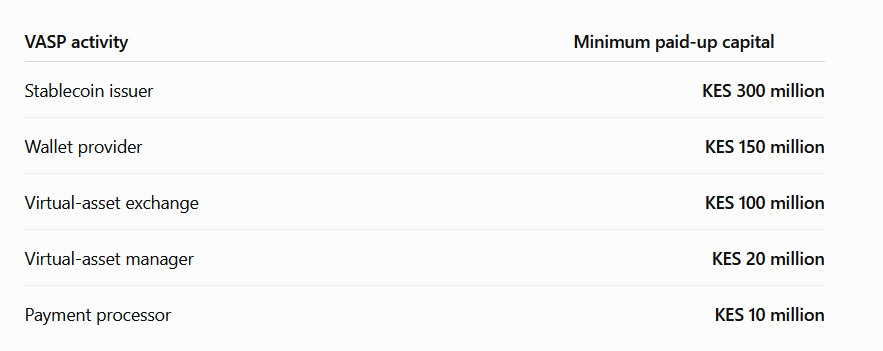
The figures make one thing obvious: Obtaining a Kenyan crypto licence is no longer simply a paperwork exercise.
A startup seeking an exchange licence, for example, must think about KES 100 million in paid-up capital before considering the additional costs of compliance, technology, staffing, cybersecurity, audit and governance.
And stablecoin issuance sits at the top of the capital hierarchy, with a reported KES 300 million requirement.
Regulation Could Create Winners and Losers
The new framework could produce a more credible and institutional Kenyan crypto market. But it could also create a divide between companies that can afford compliance and those that cannot.
A multinational financial institution may view KES 100 million as manageable. A venture-backed fintech may need another funding round. A bootstrapped startup may find the requirement prohibitive.
- That could encourage:
- Capital raising
- Strategic partnerships
- Mergers and acquisitions
- Licensing partnerships
- Consolidation
The result could be a smaller but more heavily capitalised crypto sector. Whether that ultimately improves competition will depend on how the regulators apply the framework.
The Final Rules Changed During Consultation
This is one of the more interesting aspects of Kenya's 2026 regulatory story. The final framework is not simply the March consultation document reproduced word-for-word.
One example concerns ownership. The draft framework had proposed restrictions that would have prevented an individual or entity from controlling more than 33.3% of certain VASP businesses. That proposal was removed from the final framework, opening more room for founders, venture-capital investors and strategic investors to hold controlling stakes.
This is important because it shows that Kenya's regulatory framework was not developed in isolation. Industry consultation changed the final rules. That makes the distinction between draft and final regulations particularly important for anyone researching the market.
Kenya's Regulators Are Building an Activity-Based Framework
The framework gives responsibilities to both the CBK and CMA. The division reflects the different types of activities being regulated.
Payment-related and monetary-system activities naturally fall closer to the central bank's mandate, while capital-market and investment-related activities fall within the CMA's regulatory sphere.
The framework therefore does not treat every VASP as if it were an identical business. For founders, that means regulatory classification should happen before product launch.
Stablecoins Face the Highest Capital Threshold
Stablecoins deserve particular attention. They can be used for:
- Payments
- Cross-border transfers
- Settlement
- Trading
- Treasury management
- Digital-dollar access
But issuing a stablecoin introduces questions about reserves, redemption, liquidity and customer protection. Kenya's final framework reportedly requires stablecoin issuers to maintain KES 300 million in paid-up capital, the highest threshold among the regulated categories.
That figure tells us something about the regulator's view of stablecoin issuance. A company issuing a token designed to maintain a stable value is being treated as a substantially more consequential financial activity than simply providing certain advisory or brokerage services.
Cross-Border Crypto Activity Will Be Especially Important
Kenya's geographic position makes the cross-border dimension difficult to ignore. Crypto and stablecoins can potentially facilitate:
- Remittances
- Regional commerce
- Freelancer payments
- International settlements
- Treasury transfers
But cross-border activity also increases compliance complexity. A company serving customers across Africa may need to consider multiple jurisdictions simultaneously.
That means a Kenyan licence is potentially only one piece of a much larger regulatory architecture. For companies such as Finlazo, operating across African payment and crypto markets, this distinction is particularly important.
Foreign Companies Need to Pay Attention
The final framework also has implications for international businesses.
Recent legal analysis of the Regulations says their reach can extend to businesses that target Kenyan consumers or derive economic benefit or income from Kenya, even where the business does not maintain a conventional physical presence in the country.
That means an overseas crypto company should not automatically assume: “We're incorporated somewhere else, therefore Kenya doesn't apply to us.” The actual business model matters. Companies need to consider:
- Who are the customers?
- What services are being provided?
- Is Kenya being targeted?
- Is the business generating economic benefit from Kenyan users?
Those questions can become central to regulatory analysis.
Compliance Is Becoming Part of the Business Model
The capital requirement is only one part of the cost. A regulated VASP may also need to invest in:
- AML/KYC
- Transaction monitoring
- Cybersecurity
- Risk management
- Governance
- Audit
- Consumer protection
- Reporting
- Business continuity
- Customer-asset protection
That changes how founders need to think about building crypto companies. The question is no longer simply: Can we build the technology? It becomes: Can we build the technology, finance the regulatory structure and operate it safely at scale?
The Transition Period Is Now Critical
Existing operators need to pay particular attention to the implementation timeline. Legal analysis of the final framework reports that existing VASPs have until 4 November 2026 to comply with the licensing requirements.
That creates a relatively short transition window for companies already serving Kenyan customers. They need to determine:
- Which regulatory category applies
- Which regulator they fall under
- Whether they meet the capital requirement
- Whether their governance structure qualifies
- Whether their AML systems are adequate
- Whether their cybersecurity controls are sufficient
- Whether their business model needs restructuring
For established crypto companies, this is no longer a theoretical regulatory exercise. It is a deadline.
Kenya's Crypto Market Has Entered Its Regulatory Era
Kenya has gone from having a rapidly growing crypto market with limited dedicated regulation to having a formal framework covering licensing, capital, governance, AML, cybersecurity and consumer protection.
The scale of the underlying market makes the transition significant.
US$19 billion in crypto inflows. Around 6 million estimated digital-asset holders. US$2 billion in on-chain activity cited by Parliament. And now a regulatory framework designed to determine which companies can operate inside that market.
The final 2026 Regulations could therefore do more than regulate Kenya's crypto industry. They could reshape its competitive structure. Well-capitalised businesses may find greater certainty. Institutional investors may find the market easier to assess. Smaller startups may face difficult financing decisions. And consumers may gain greater protection.
The next chapter of Kenya's crypto story will be determined not by whether the country has regulation, but by how businesses, investors and regulators operate within it.