Sending Money from South Africa to a Bank Account in Nigeria in 2026
Learn how to send money from South Africa to a Nigerian bank account, including transfer costs, exchange rates, delivery times, supported banks and sending limits.

On this page
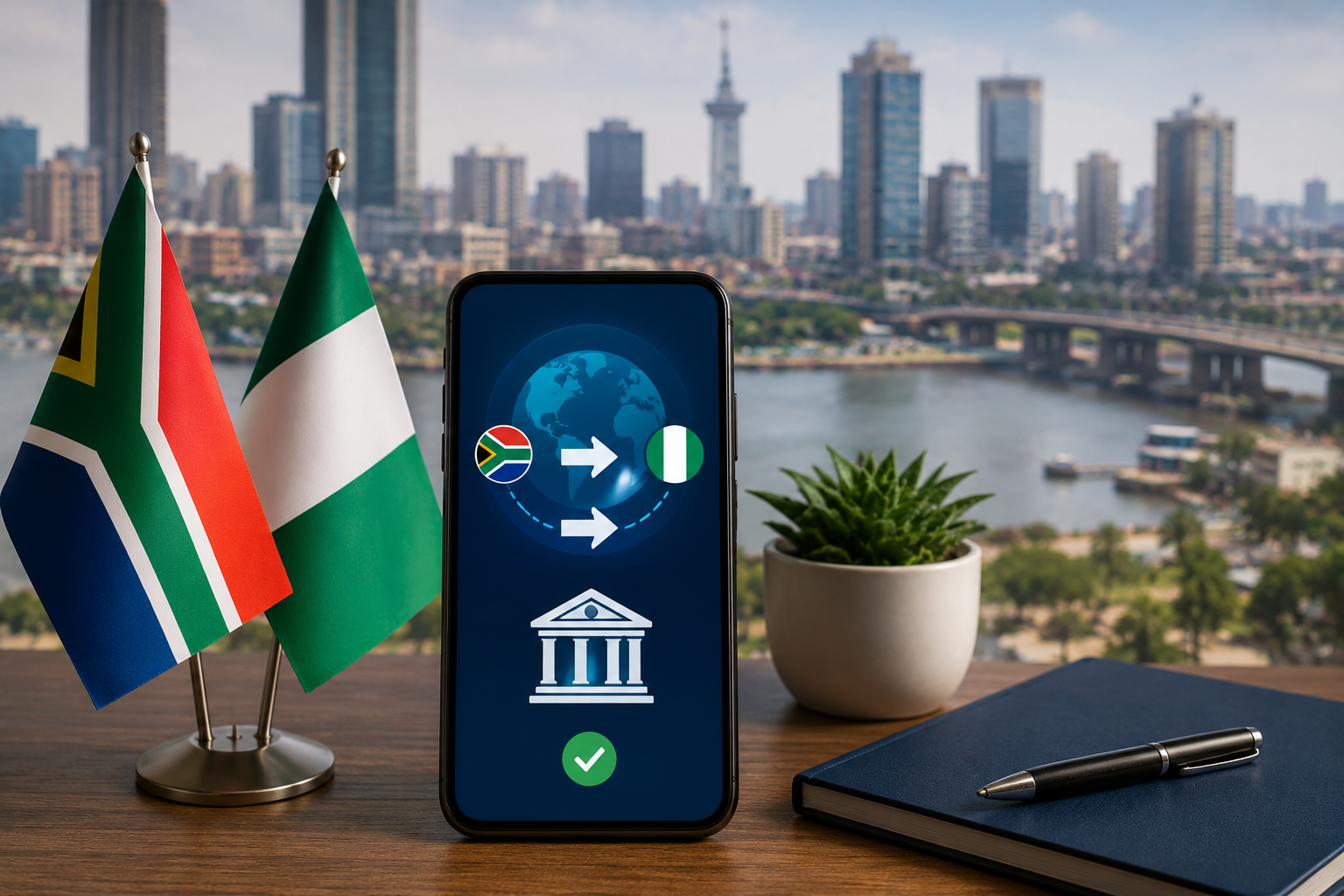
Sending money from South Africa to a bank account in Nigeria is possible through licensed international money-transfer operators and other supported payment channels.
The Central Bank of Nigeria maintains a list of licensed International Money Transfer Operators that can provide inward remittance services in Nigeria.
Nigeria's remittance market is substantial. The latest annual World Bank data show US$21.293 billion in personal remittances received by Nigeria in 2024.
More recent CBN balance-of-payments data show US$5.24 billion in workers' remittance inflows in Q3 2025.
The payment infrastructure on the Nigerian side is also highly developed.
The Central Bank of Nigeria's fintech report says close to 11 billion electronic transactions were processed in Nigeria in 2024, while more than 25% of electronic transactions were processed through real-time payment channels and the NIBSS NIP platform. CBN Fintech Report
For someone sending money from South Africa, the practical questions are straightforward.
Which provider accepts South African senders?
Which Nigerian bank can receive the payment?
How much naira will arrive?
How long will the transfer take?
What fee and exchange-rate margin will apply?
See our institutional review on Nigeria's digital dollar vs. eNaira adoption rates to analyze the underlying infrastructure handling current market volumes.
South Africa to Nigeria Bank Transfer at a Glance
- US$21.293 billion — Nigeria's personal remittance receipts in 2024.
- US$5.24 billion — Nigerian workers' remittance inflows in Q3 2025.
- US$5.30 billion — Nigerian workers' remittance inflows in Q2 2025.
- US$42.77 billion — Nigeria's external reserves at end-September 2025.
- US$4.60 billion — Nigeria's overall balance-of-payments surplus in Q3 2025.
- 11 billion — electronic transactions processed in Nigeria in 2024, according to the CBN fintech report.
- More than 25% — share of electronic transactions processed through real-time payment channels and NIP in 2024.
- 14.65% — average total cost for South Africa-to-Nigeria remittances in the World Bank's Q3 2025 corridor dataset.
- 3.20% — average exchange-rate margin in the same Q3 2025 corridor dataset.
- ZAR156.88 — average sender fee recorded in that corridor dataset.
- ZAR1,370 — standard comparison amount used by the World Bank.
- ZAR3,410 — second standard comparison amount used by the World Bank.
- R2 million a year — annual sending limit Mukuru currently states for South African nationals under its Max account.
- 12 times monthly income a year — limit Mukuru currently states for foreign nationals under its Max account, based on proof of income.
These figures come from different datasets.
They should not be added together as though they represent one cross-border payment total.
Can You Send Money from South Africa to a Nigerian Bank Account?
Yes.
A supported remittance provider can receive the sender's funds in South Africa and arrange a bank payout in Nigeria.
WorldRemit's current Nigeria bank-transfer service says users can select Nigeria, choose bank transfer as the payout method and provide the recipient's bank details.
Mukuru's current South Africa-to-Nigeria service also advertises direct bank-account delivery to Nigeria.
The available route depends on the provider and the current corridor configuration.
What Are the Main Ways to Send Money?
There are three broad routes worth understanding.
Remittance App or Website
The provider handles the cross-border payment and Nigerian payout.
Bank-Linked Remittance Service
The sender funds the transfer from a South African bank account, while the provider handles the Nigerian bank deposit.
Agent-Based Service
The sender creates an order and pays through an approved branch or retail partner.
Specific pages for these methods can be built separately.
For the broader market, see South Africa to Nigeria money transfers.
How to Send Money from South Africa to a Nigerian Bank Account
The exact screens differ by provider.
The basic process is similar.
1. Choose a supported provider
Confirm that the provider accepts customers in South Africa.
Then confirm that Nigeria is available.
Finally, check that bank-account delivery is supported for your recipient's bank.
The CBN's licensed IMTO list is useful when checking the Nigerian side of the service.
2. Create an account
Enter your personal details.
The provider will normally verify your identity before allowing transfers.
The required documents depend on your South African residency or nationality and the provider's compliance procedures.
3. Select Nigeria
Choose Nigeria as the receiving country.
Select bank transfer as the receiving method where available.
4. Enter the recipient's bank details
WorldRemit currently asks for the recipient's name, address, phone number and bank information, including the bank name and account details. WorldRemit — Bank Transfers to Nigeria
Use the exact beneficiary information supplied by the recipient.
5. Enter the amount in rand
Enter the amount you want to send in ZAR.
The provider should show the expected naira payout.
This is where you should compare exchange rates.
6. Review the complete cost
Look at the transfer fee.
Look at the exchange-rate margin.
Look at the final naira amount.
The World Bank defines total remittance cost as the sender fee plus the exchange-rate margin.
7. Pay for the transfer
The funding method depends on the provider.
WorldRemit says South African customers can fund a transfer by bank-account transfer. WorldRemit — Sending from South Africa
Mukuru also supports bank-account funding through online or telephone banking. Mukuru — Send Money
8. Track the payment
Keep your transaction reference.
Use it to follow the transfer if it is delayed or held for review.
Which Nigerian Banks Can Receive the Money?
The exact list varies by provider.
WorldRemit's current Nigeria bank-transfer page lists Access Bank, Ecobank, FCMB, Fidelity, First Bank, GT Bank, UBA, Union Bank and Zenith Bank.
That list belongs to WorldRemit's service.
It should not be treated as a universal list of every Nigerian bank supported by every remittance operator.
Can You Send Money to Access Bank Nigeria?
Yes, where the selected provider supports Access Bank.
WorldRemit currently includes Access Bank among the Nigerian banks available for bank transfers. WorldRemit — Bank Transfers to Nigeria
Enter the beneficiary's details exactly as provided by the bank.
Can You Send Money to GTBank Nigeria?
Yes, where the provider supports GT Bank.
WorldRemit currently lists GT Bank among its supported Nigerian bank-transfer destinations. WorldRemit — Bank Transfers to Nigeria
Can You Send Money to UBA Nigeria?
Yes, where the provider supports UBA.
WorldRemit's current Nigeria bank-transfer page lists UBA among its supported banks. WorldRemit — Bank Transfers to Nigeria
Can You Send Money to FirstBank Nigeria?
Yes, where the provider supports First Bank.
WorldRemit lists First Bank among its current supported bank-transfer destinations in Nigeria. WorldRemit — Bank Transfers to Nigeria
Can You Send Money to Zenith Bank Nigeria?
Yes, where the provider supports Zenith Bank.
WorldRemit's Nigeria bank-transfer page lists Zenith Bank among the supported destinations. WorldRemit — Bank Transfers to Nigeria
Can You Send Money to a Nigerian Business Bank Account?
This depends on the provider and account type.
Some services support business-account delivery.
The sender should use the correct beneficiary information and payment purpose.
For business payments, keep the transaction record for accounting and reconciliation.
For the wider African payment infrastructure, see digital payment infrastructure in Africa.
How Much Does It Cost to Send Money from South Africa to Nigeria?
There is no single fee for the entire corridor.
The World Bank's latest South Africa-to-Nigeria corridor data were collected from 16 to 22 August 2025.
The Q3 2025 corridor average total cost was 14.65%.
The same dataset recorded an average fee of ZAR156.88.
The average exchange-rate margin was 3.20%.
These are corridor-level averages.
A particular provider can be cheaper or more expensive.
They are not live August 2026 quotes.
Why the Exchange Rate Matters
The exchange rate can have a major effect on the final naira payout.
A provider can advertise a low fee and still give a less competitive exchange rate.
The World Bank's methodology therefore includes both the fee and exchange-rate margin in the total remittance cost.
On the South Africa-to-Nigeria corridor, the latest World Bank dataset recorded a 3.20% average exchange-rate margin.
A World Bank Provider Example
The World Bank's corridor data illustrate how provider pricing can differ.
A Western Union observation in the dataset showed a ZAR450 fee and a 0.67% exchange-rate margin for the relevant transaction configuration.
The total cost for that observation was 33.52%.
The unusually high total-cost percentage reflects the specific standard transaction and fee structure used in the database.
It should not be presented as a universal Western Union fee.
The observation was collected in August 2025.
Another Provider Example
The same corridor dataset shows an ABSA observation with a ZAR450 fee and a 1.75% exchange-rate margin.
The total cost in that configuration was 34.60%.
Again, that is a historical observation.
It demonstrates why the sender should compare the full transaction rather than the headline fee.
What Is the World Bank's Standard Transfer Amount?
The World Bank uses standard comparison amounts when collecting corridor data.
For South Africa-to-Nigeria, the standard amounts are ZAR1,370 and ZAR3,410.
The amounts are used to compare providers.
They are not mandatory transfer amounts.
They are also not limits imposed by Nigerian banks.
How Long Does a Bank Transfer Take?
Delivery speed depends on the provider.
WorldRemit's current Nigeria bank-transfer page says bank transfers can take up to one hour to arrive.
The provider also says it may request additional information before processing the transaction.
That means one hour is a provider estimate, not a guarantee for every payment.
Mukuru similarly advertises fast bank and cash-transfer services from South Africa to Nigeria. Mukuru — Nigeria
Can the Transfer Arrive the Same Day?
It can, depending on the provider and the transaction.
The World Bank's South Africa-to-Nigeria corridor data contain provider observations with transfer-speed categories including less than one hour, same day, next day and two days.
The specific delivery time depends on the service selected and whether additional verification is required.
What Can Delay a Bank Transfer?
A transfer can be delayed because of identity checks.
The provider may request additional documents.
Beneficiary information can also cause problems.
A compliance review can hold the payment.
The sending bank may need to complete the funding payment before the remittance provider processes the order.
Use the transaction reference when contacting support.
What Information Does the Recipient Need to Provide?
The provider normally needs the recipient's full name and bank details.
WorldRemit currently asks for the recipient's name, address, phone number, bank name and bank-account details. WorldRemit — Bank Transfers to Nigeria
The exact requirements depend on the provider and bank.
The safest approach is to copy the details directly from the recipient.
Do You Need the Recipient's BVN?
A provider may ask for additional Nigerian banking information where required.
WorldRemit explains that the Bank Verification Number, or BVN, is a Nigerian banking identifier designed to reduce fraud and illegal transfers. WorldRemit — Bank Transfers to Nigeria
Whether it is required for your specific transfer depends on the provider and receiving bank.
Is There a Maximum Amount You Can Send?
There is no single universal South Africa-to-Nigeria bank-transfer limit.
The provider can have a sender-side limit.
The funding method can have its own limit.
The Nigerian receiving channel can also apply its own conditions.
Mukuru currently says its Max account allows South African nationals to send up to R2 million per year.
For foreign nationals, Mukuru currently states a limit of 12 times monthly income per year, based on proof of income.
Those are Mukuru account limits.
They are not universal South African or Nigerian remittance limits.
What If You Need to Send a Large Amount?
Start by checking the provider's account tier.
Additional verification may be required.
The sender may need proof of income or source of funds.
The transfer may also be reviewed for compliance.
For very large commercial payments, a bank or business-payment service may be more appropriate than a retail remittance product.
Can You Fund the Transfer From a South African Bank Account?
Yes.
WorldRemit currently accepts bank-account transfers as a funding method for South African customers. WorldRemit — Sending from South Africa
Mukuru also supports online or telephone banking as a payment method. Mukuru — Send Money
The provider normally gives you its payment instructions after you create the transfer.
Use the transaction reference exactly as instructed.
Can You Use a South African Card?
That depends on the provider.
Some providers support debit or credit-card funding.
WorldRemit's general international-transfer information says card funding can be available, although the exact options depend on the sending country and transaction. WorldRemit — Payment Methods
Check the funding options displayed on the provider's South Africa service before relying on card payment.
Bank Transfer Versus Cash Pickup
Bank transfer is useful when the recipient already has a Nigerian bank account.
Cash pickup can be useful when the recipient needs immediate access without using a bank account.
Mukuru currently offers Nigeria transfers for cash collection or direct bank-account delivery.
The cost and delivery time can differ between the two methods.
Bank Transfer Versus Mobile Wallet
Mobile-wallet delivery can be convenient for everyday spending.
Bank deposits are often more suitable when the recipient needs to keep the money in the formal banking system.
Availability depends on the provider.
This article focuses on bank-account delivery.
The specific mobile-wallet methods can be covered in separate Finlazo pages.
Why Nigeria's Payment Infrastructure Matters
The receiving bank sits inside one of Africa's largest real-time payment ecosystems.
The CBN's fintech report says close to 11 billion electronic transactions were processed in Nigeria in 2024.
The same CBN report says more than 25% of electronic transactions were processed through real-time payment channels and NIP in 2024.
That infrastructure helps make domestic Nigerian transfers fast once the international money has reached the local payment system.
NIP and Instant Bank Transfers
NIBSS Instant Payments, or NIP, is Nigeria's account-based instant-payment infrastructure.
The CBN lists NIP as part of Nigeria's electronic payment system.
The system allows account-to-account transfers through digital banking and other payment channels.
This is the domestic layer.
The international remittance provider handles the cross-border leg.
The Nigerian banking and payment system handles the local receiving leg.
Nigeria's Remittance Rules Changed in 2026
The CBN introduced additional operational measures in March 2026.
In a 24 March 2026 circular, the Bank reminded IMTOs and authorised dealer banks of requirements under the Revised Guidelines for International Money Transfer Services.
The CBN said IMTOs must open designated naira settlement accounts with authorised dealer banks in Nigeria.
The Bank also said remittance-related transactions, including payments to beneficiaries and settlements, must be processed through those designated accounts.
This is important for the infrastructure behind South Africa-to-Nigeria transfers.
Why the 2026 Rule Matters
A sender may not notice the change.
The user experience can remain simple.
You create the transfer.
You pay in South Africa.
The provider converts the funds.
The recipient receives naira.
Behind that transaction, the IMTO must comply with Nigeria's settlement rules.
This is one reason regulated providers matter.
Nigeria's Foreign-Exchange Market and Remittances
The exchange rate is central to the recipient's final payout.
The CBN has been strengthening its foreign-exchange market framework.
The Bank's 2025 Macroeconomic Outlook says the CBN introduced the Electronic Foreign Exchange Matching System and the Nigeria Foreign Exchange Code as part of its reforms.
The same report said the gap between the Nigerian Foreign Exchange Market and BDC rates had narrowed to 2.11% as of 9 December 2025, compared with 62.23% in May 2023.
That is a macroeconomic market-gap figure.
It is not the exchange-rate margin charged by a remittance provider.
Why the Naira Amount Is the Key Number
The sender thinks in rand.
The recipient thinks in naira.
The provider therefore sits between two currencies.
A fee can be low and still produce a weak payout.
An exchange rate can be competitive even when a visible fee is higher.
Compare the final naira amount.
That is the simplest way to judge the transaction.
South Africa-to-Nigeria Remittances in Context
Nigeria received US$21.293 billion in personal remittances in 2024.
The CBN later recorded US$5.24 billion in workers' remittance inflows in Q3 2025.
Q2 2025 was US$5.30 billion.
These figures measure Nigeria's overall remittance inflows.
They do not measure South Africa alone.
For the South Africa corridor, the World Bank's corridor dataset is the better source.
What Makes a Good South Africa-to-Nigeria Bank Transfer?
A good transfer should make the important information visible.
The sender should see the fee.
The sender should see the exchange rate.
The sender should see the expected naira payout.
The sender should know the delivery estimate.
The sender should know the transfer limit.
The recipient should know which bank account will receive the funds.
The transaction should also provide a reference that can be used for support.
Safety and Fraud Prevention
Use the provider's official website or application.
Do not send money to unofficial agents.
Double-check the beneficiary's bank details.
Do not share passwords, PINs or one-time authentication codes.
Keep the transaction reference.
For Nigerian providers, verify regulatory status through the CBN's licensed IMTO list.
What If the Recipient's Name Does Not Match?
Do not assume the payment will complete successfully.
Bank-account transfers generally require beneficiary information to be accurate.
A mismatch can trigger a delay, rejection or review.
Correct the details before confirming the payment whenever possible.
Can I Send Money to My Own Nigerian Bank Account?
This depends on the provider.
Some remittance services support transfers to the sender's own account.
Where available, select the self-transfer option and make sure the account details match your identity information.
Additional verification may be required for some transactions.
South Africa to Nigeria Bank Transfer Statistics
- US$21.293 billion — Nigeria's personal remittance receipts in 2024.
- US$5.24 billion — workers' remittance inflows in Q3 2025.
- US$5.30 billion — workers' remittance inflows in Q2 2025.
- 11 billion — electronic transactions processed in Nigeria in 2024.
- More than 25% — share of electronic transactions processed through real-time payment channels and NIP in 2024.
- 14.65% — South Africa-to-Nigeria average total remittance cost in Q3 2025.
- 3.20% — average exchange-rate margin in Q3 2025.
- ZAR156.88 — average corridor fee in Q3 2025.
- ZAR1,370 — first World Bank standard comparison amount.
- ZAR3,410 — second World Bank standard comparison amount.
- R2 million a year — Mukuru Max annual limit stated for South African nationals.
- 12 times monthly income a year — Mukuru Max annual limit stated for foreign nationals, based on proof of income.
- 2.11% — NFEM-to-BDC rate gap reported by the CBN as of 9 December 2025.
Frequently Asked Questions
Can I send money from South Africa to a bank account in Nigeria?
Yes. International money-transfer operators and other supported payment providers can arrange bank-account delivery into Nigeria.
Which Nigerian banks can receive money from South Africa?
The available banks depend on the provider. WorldRemit currently lists Access Bank, Ecobank, FCMB, Fidelity, First Bank, GT Bank, UBA, Union Bank and Zenith Bank for its Nigeria bank-transfer service.
How much does it cost to send money from South Africa to Nigeria?
The latest World Bank South Africa-to-Nigeria corridor dataset shows a 14.65% average total remittance cost in Q3 2025. Individual provider quotes vary.
How long does a transfer take?
WorldRemit's current Nigeria bank-transfer page says bank transfers can take up to one hour. Other providers and payment methods can have different delivery estimates.
Can I send money from a South African bank account?
Yes. WorldRemit and Mukuru both currently support bank-account funding from South Africa.
Can I send money to a Nigerian business account?
Yes, where the selected provider supports business-account delivery. Check the provider's account-type and transaction-purpose requirements before sending.
Is there a maximum amount I can send?
There is no single universal South Africa-to-Nigeria limit. Provider and funding-method limits apply. For example, Mukuru currently states R2 million a year for South African nationals using its Max account.
What should I compare before sending?
Compare the transfer fee, exchange rate, final naira amount, delivery estimate, funding method, supported Nigerian bank and sender limit.
The Bottom Line
Sending money from South Africa to a Nigerian bank account is a straightforward use case for regulated remittance infrastructure.
Nigeria's overall remittance market is large.
The World Bank recorded US$21.293 billion in personal remittance receipts in 2024.
The CBN's more recent figures show US$5.24 billion in workers' remittance inflows in Q3 2025.
The domestic payment side is also substantial.
The CBN says close to 11 billion electronic transactions were processed in Nigeria in 2024.
The key issue for the sender is pricing.
The World Bank's South Africa-to-Nigeria corridor recorded a 14.65% average total remittance cost in Q3 2025.
That is a benchmark, not a live August 2026 quote.
The final naira amount should therefore guide the comparison.
Check the fee.
Check the exchange rate.
Check the delivery time.
Check the provider's limit.
Then confirm the beneficiary's bank details.
Nigeria's remittance framework is also becoming more structured.
The CBN's March 2026 directive requires IMTOs to use designated naira settlement accounts with authorised dealer banks.
That strengthens the regulated settlement layer behind international transfers.
For the wider market, see South Africa to Nigeria money transfers and cross-border payments in Africa.