Malawi Cryptocurrency Regulation: Current Rules, VASP Risk Assessment and the Road to a Formal Framework
Malawi is still developing a dedicated framework for virtual assets despite growing crypto activity. Explore the country's regulatory gaps, VASP risks, P2P trading, AML concerns and the path toward formal regulation.

On this page
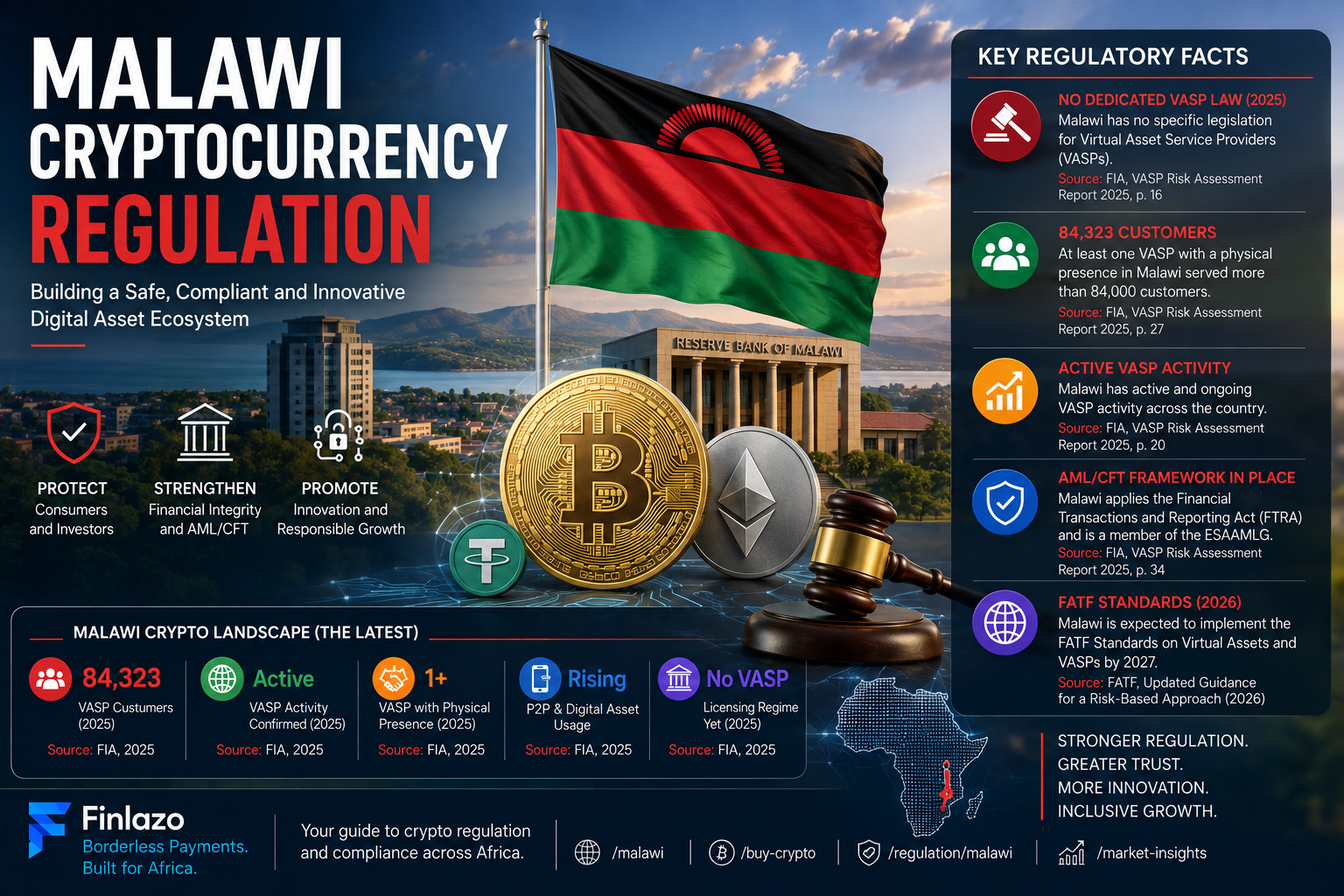
Malawi does not yet have a dedicated cryptocurrency licensing framework.
The 2025 Virtual Assets and Virtual Asset Service Providers Risk Assessment, published by the Financial Intelligence Authority, says Malawi had no legislative regime to regulate and supervise VASPs when the assessment was conducted.
Yet the market is not empty.
The same assessment confirmed one VASP with a physical presence and 11 online platforms where users could access wallets, exchanges and investment services.
The physically present VASP had registered more than 84,000 customers and reported US$2.4 million in transaction volume for the year ending April 2025.
The assessment rated Malawi's overall ML/TF/PF exposure from virtual assets and VASPs as high.
That combination is important.
There is visible user activity.
There are VASP operations.
But there is still no dedicated market-entry and supervisory framework.
The government is now studying how to close that gap.
Malawi Cryptocurrency Regulation at a Glance
- No dedicated VASP legislative regime — the 2025 national assessment found that Malawi did not have legislation specifically regulating and supervising VASPs.
- 1 physical VASP — one unlicensed VASP with a physical presence was identified during the assessment.
- 11 online platforms — additional online platforms identified for wallet, exchange and investment access.
- 84,000+ customers — customers registered by the physically present VASP for the year ending April 2025.
- US$2.4 million — transaction volume reported by that VASP for the year ending April 2025.
- 262 survey responses — total responses used in the national virtual-asset risk-assessment questionnaire.
- 188 public responses — responses from members of the public.
- 7 electronic money issuers — entities identified in Malawi's payment sector.
- 2 payment gateways — payment gateways identified in the assessment.
- 8 commercial banks — commercial banks described in the assessment.
- 59% — overall threat assessment for virtual-asset exchanges.
- 61% — overall threat assessment for virtual-asset wallet providers.
- 83% — vulnerability rating for platform operators.
- High — overall national ML/TF/PF risk rating for virtual assets and VASPs.
These figures come from the national assessment.
They describe conditions captured during the assessment rather than a live August 2026 licence register.
Does Malawi Regulate Cryptocurrency?
Malawi's current position is better described as unregulated and warned against, rather than as a mature licensing market.
The Financial Intelligence Authority's 2025 risk assessment explicitly states that Malawi had no legislative regime to regulate and supervise VASPs at the time of the assessment.
The assessment also says Malawi had no market-entry and AML/CFT/CFP legislation applicable specifically to the virtual-asset ecosystem.
That is a major difference from countries that have introduced VASP licensing laws.
For comparison, see Mauritius cryptocurrency regulation and Seychelles cryptocurrency regulation.
Is Cryptocurrency Legal Tender in Malawi?
Cryptocurrency is not legal tender in Malawi.
The Reserve Bank of Malawi has publicly warned that virtual assets are not recognised as legal tender and that the RBM does not regulate, license or supervise virtual-asset activities.
The latest publicly documented regulatory position is reflected in the RBM's public stance on virtual assets.
The practical point is simple.
A cryptocurrency can exist as a digital asset used by individuals without being recognised as official money.
Users should not assume that buying or holding a digital asset gives it the legal status of the Malawi kwacha.
Does Malawi Have a VASP Licence?
There is no dedicated VASP licensing regime in operation under a comprehensive virtual-asset law.
The 2025 FIA risk assessment says VASPs were operating without licensing, oversight and enforcement regimes specific to the sector.
The assessment also records that the Reserve Bank had received some applications for formal licensing of VASPs.
That detail is important.
It shows regulatory interest existed before a dedicated legal framework was in place.
An application is not the same thing as an issued licence.
Who Regulates Cryptocurrency in Malawi?
The Reserve Bank of Malawi is the principal financial-sector regulator for banking and payment-system matters.
The Financial Intelligence Authority is responsible for financial-intelligence and AML/CFT functions.
The 2025 VASP risk assessment was coordinated by the Ministry of Finance and Economic Affairs, the Reserve Bank of Malawi and the FIA.
That institutional structure matters.
Virtual assets cross several regulatory boundaries.
A crypto exchange can interact with banks.
A wallet can interact with mobile money.
A payment product can raise foreign-exchange questions.
A token investment product can raise securities questions.
Malawi's First National Virtual-Asset Risk Assessment
Malawi completed its first dedicated virtual-asset and VASP ML/TF/PF risk assessment in 2025.
The FIA published the assessment after the exercise was conducted between April and June 2025.
The assessment was led by officials from the Ministry of Finance and Economic Affairs, the Reserve Bank of Malawi and the FIA.
It was designed to identify the country's virtual-asset ecosystem, assess associated risks and identify gaps in regulatory and institutional capacity.
This was an important step.
Without reliable information, regulation can be built around assumptions.
The assessment gives policymakers a much clearer picture.
What the 2025 Assessment Found
The report found that virtual-asset activity already existed in Malawi.
One physically present VASP was identified.
Eleven online platforms were also identified.
The assessment says the physically present VASP registered more than 84,000 customers and recorded US$2.4 million in transaction volume for the year ending April 2025.
The report also notes that users accessed virtual assets through wallets, exchanges, P2P transfers, investment platforms and other online channels.
The market was therefore larger than the formal regulatory footprint suggested.
How Large Is the User Base?
There is no authoritative national census of Malawian crypto users.
The best domestic figure in the latest assessment is the more than 84,000 customers reported by the single physically present VASP for the year ending April 2025.
That figure is not the same as the number of unique cryptocurrency users in Malawi.
Some users can have several accounts.
Others can use international platforms.
Others can use self-custody wallets without a local VASP relationship.
The FIA assessment itself warns that the sector's lack of regulation creates data limitations.
What Crypto Services Exist in Malawi?
The assessment identifies three broad VASP types.
They are virtual-asset wallet providers.
Virtual-asset exchanges.
Virtual-asset investment providers.
The FIA's 2025 report maps five broad service areas across these VASP types.
These include custodial wallets, non-custodial wallets, P2P and P2B transfers, fiat-to-virtual conversion, virtual-to-fiat conversion and virtual-to-virtual conversion.
This matters because "crypto business" is not one activity.
Different products create different risks.
P2P Trading Is Especially Important
Peer-to-peer trading is one of the most important channels in Malawi's virtual-asset market.
The national assessment specifically examined P2P and P2B transfer services.
It rated the P2P channel as high vulnerability.
The speed of P2P transfers was rated very high risk.
That does not mean P2P trading is inherently criminal.
It reflects the regulator's concern about rapid settlement, cross-border portability, limited intermediary involvement and enforcement challenges.
P2P and Cross-Border Activity
Virtual assets can move across borders almost immediately.
The FIA assessment says Malawi's VASPs can facilitate P2P and P2B transfers between accounts or individuals in different jurisdictions.
It also identifies transactions involving foreign VASPs operating without relevant legal frameworks as a high vulnerability.
That makes international crypto platforms a major regulatory issue.
A Malawian customer can interact with a company incorporated elsewhere.
The blockchain transaction then crosses borders without following the same route as a traditional bank transfer.
Banks and Crypto Businesses in Malawi
The relationship between banks and VASPs is limited but not completely absent.
The 2025 risk assessment says banks process some incoming and outgoing VASP-related transfers through bank accounts and cards.
The report says customer transactions to VASPs were often routed through P2P mechanisms or card rails.
It also says some banks provide services such as accounts and cards to VASPs.
At the same time, the assessment found that banks had adopted a conservative approach because of the absence of clear regulation and the evolving nature of virtual assets.
Mobile Money Plays a Role
Mobile money is also part of the crypto ecosystem.
Malawi's payment sector included seven electronic money issuers in the assessment.
The same report identified two payment gateways.
The FIA found that electronic-money wallets were a key funding source for customers interacting with VASPs.
Customers could transfer funds from mobile wallets to platforms to acquire virtual assets.
This is significant for regulatory analysis.
The fiat side can pass through a regulated payment channel.
The virtual-asset side may then move onto an unregulated platform or external wallet.
The Legal Boundary Becomes Unclear After the On-Ramp
The FIA's assessment specifically says the regulatory boundary becomes less clear once customers move funds from regulated payment systems into VASPs or external wallets.
This is one of the central policy problems.
A payment provider may comply with its own rules.
The crypto platform may be outside Malawi's formal supervisory perimeter.
The user can still complete the transaction.
That creates a gap between the regulated fiat system and the digital-asset ecosystem.
What Are Malawi's Main Crypto Regulatory Risks?
The national assessment rates the country's overall ML/TF/PF exposure from virtual assets and VASPs as high.
It attributes that exposure to several factors.
There are regulatory gaps.
There are limited supervisory capabilities.
There are foreign platforms.
There are rapid transactions.
There is cross-border portability.
There are challenges tracing activity involving external wallets.
The assessment says these factors collectively increase the exposure of the financial system.
Exchange Risk Is High
The overall threat assessment for virtual-asset exchanges was 59%.
The report assessed transfer and conversion services together.
P2P and P2B transfers were included.
Fiat-to-virtual, virtual-to-fiat and virtual-to-virtual conversion were also included.
The report found that speed of P2P transfer was rated very high risk.
This helps explain why exchange activity is receiving regulatory attention.
Wallet Risk Is Also High
Wallet providers received an overall threat assessment of 61%.
The assessment says this was driven partly by the possible use of wallets for transferring, collecting and spending funds, as well as dark-web access.
The lack of a dedicated legislative framework also increased concern around exchange-control circumvention and the movement of criminal proceeds.
The report did not say every wallet user is engaging in illegal activity.
It was assessing exposure to potential misuse.
Platform Operators Had the Highest Vulnerability
The assessment rated investment platform operators at 83% vulnerability.
The report linked the high score to anonymity, ease of access, rapid settlement, cross-border transfers and limited domestic regulatory oversight.
That is a useful finding.
The risk does not come from blockchain technology alone.
It comes from the interaction between the technology, the business model and the regulatory environment.
Malawi's Existing AML Framework Is Not Enough
Malawi already has a general AML/CFT architecture.
But the 2025 VASP assessment concluded that there was no dedicated market-entry and AML/CFT/CFP legislation for the virtual-asset sector.
The report rated overall mitigating measures as very low.
Government mitigation was rated 17%.
VASP mitigation measures were rated 33%.
Financial-institution and DNFBP mitigation measures were rated 50%.
These percentages come from the assessment's scoring methodology.
They are not percentages of compliant firms.
The Assessment Recommends a Clear Policy Choice
The most important recommendation is straightforward.
Malawi needs to decide whether it will allow or prohibit virtual assets and VASPs.
The FIA assessment recommends that the country define a clear policy stance and create the necessary legislative environment in line with international standards and practices.
That would be the foundation for a future licensing or registration system.
The report also recommends stronger institutional capacity.
FATF Standards Matter
Malawi's policy development is taking place within the FATF framework.
FATF Recommendation 15 requires countries to assess and mitigate risks connected with virtual assets and VASPs.
The FATF's 2026 targeted update says jurisdictions continue to face gaps in translating rules into effective licensing, supervision and enforcement.
The update also highlights P2P transactions through unhosted wallets, stablecoins and offshore VASPs as important risk areas.
Malawi's 2025 assessment identifies many of the same issues.
Malawi's Regulatory Direction
The evidence points toward eventual formalisation.
The FIA assessment recommends a legislative environment for VAs and VASPs.
The Reserve Bank and government have been studying the sector.
But no comprehensive dedicated VASP licensing framework was identified in the sources reviewed for this article as being in force in August 2026.
That means businesses should not treat Malawi as though it already has the licensing certainty found in Mauritius or Seychelles.
Tax Treatment of Cryptocurrency
Malawi does not have a dedicated crypto tax code in the sources reviewed for this article.
However, cryptocurrency-related income can raise ordinary income-tax questions depending on the nature of the activity.
A trader, company or service provider should distinguish investment gains from income derived in the ordinary course of business.
The Malawi Revenue Authority remains the relevant tax authority.
Because no comprehensive crypto-tax framework was identified in the reviewed primary sources, tax treatment should be confirmed with the authority or a qualified Malawian tax adviser before a business relies on a particular interpretation.
Consumer Protection Is a Major Gap
The absence of dedicated VASP regulation also affects consumer protection.
The FIA risk assessment highlights fraud, loss of funds, cyber risks and the difficulty of supervising foreign platforms.
A user may not know whether an online exchange has any Malawi-facing authorisation.
That can make recovery difficult after a dispute.
The RBM has therefore repeatedly warned the public about the risks of virtual assets.
What Should Users Check Before Using Crypto?
Users should verify who operates the platform.
They should understand whether the service is locally authorised.
They should confirm the payment method.
They should protect their wallet credentials.
They should be cautious about investment promises.
They should understand that digital-asset prices can move sharply.
The FIA's national assessment emphasises the need for public awareness and financial literacy around virtual-asset risks.
What Should Crypto Businesses Watch?
Businesses looking at Malawi should monitor several areas.
Dedicated VASP Legislation
The most important development would be legislation establishing clear market-entry rules.
RBM Policy
The central bank's position matters for exchanges, payments, foreign exchange and banking relationships.
FIA Guidance
AML/CFT requirements will likely form a major part of any future framework.
Foreign-Exchange Rules
Businesses moving between kwacha and foreign-denominated digital assets need to understand Malawi's exchange-control environment.
Cross-Border VASP Supervision
The 2025 assessment specifically recommends stronger international cooperation because virtual-asset transactions can move across borders quickly.
Malawi and Other African Regulatory Models
Malawi is still at an earlier stage than several African markets.
Mauritius has five VASP licence categories. See Mauritius cryptocurrency regulation.
Seychelles has a dedicated VASP framework. See Seychelles cryptocurrency regulation.
Botswana has also moved into VASP licensing and AML/CFT supervision. See Botswana cryptocurrency regulation.
Zimbabwe introduced a VASP registration framework in 2026. See Zimbabwe cryptocurrency regulation.
Malawi's position remains different.
The country has completed the risk-assessment stage.
The next question is legislative action.
Malawi and the Wider African Crypto Market
Malawi's market sits within a fast-changing African ecosystem.
The FIA assessment notes that stablecoins have become important across Sub-Saharan Africa where local currencies are volatile and access to U.S. dollars is limited.
The report says stablecoins represented approximately 43% of Sub-Saharan Africa's total crypto transaction volume as of July 2024.
That is a regional statistic.
It is not a Malawi-specific stablecoin share.
For more context, see crypto and stablecoins in Africa.
Why Stablecoins Matter to Malawi's Policy Debate
Stablecoins can be useful for trading.
They can also support value transfer and cross-border transactions.
The FIA's 2025 assessment specifically points to their use for storing value, international payments and cross-border trade across the region.
That makes them relevant to Malawi.
The country needs to decide not only whether cryptocurrency is permitted.
It also needs to decide how specific digital-asset products should fit into its financial system.
The Road Ahead for Malawi
A future Malawi framework could take several forms.
It could permit VASPs under a licensing system.
It could require registration under the AML framework.
It could impose restrictions on specific activities.
It could create different requirements for exchanges, custodians, wallet providers and investment platforms.
The FIA assessment does not prescribe one final commercial model.
It recommends a clear policy stance and the necessary legislative environment.
That leaves room for policymakers to design the framework around Malawi's own financial-system risks.
Malawi Cryptocurrency Regulation: Key Numbers and Dates
- April–June 2025 — period during which Malawi conducted its first dedicated VASP risk assessment.
- 84,000+ customers — customer registrations reported by the physically present VASP for the year ending April 2025.
- US$2.4 million — transaction volume reported by that VASP for the year ending April 2025.
- 11 online platforms — online wallet, exchange and investment platforms identified by the assessment in addition to the physically present VASP.
- 1 physical VASP — unlicensed VASP with a physical presence identified in the assessment.
- 262 — total risk-assessment questionnaire responses.
- 59% — overall threat assessment for VA exchanges.
- 61% — overall threat assessment for VA wallet providers.
- 83% — vulnerability rating for investment-platform operators.
- 17% — government mitigation-measures score.
- 33% — VASP mitigation-measures score.
- 50% — financial-institution and DNFBP mitigation-measures score.
- 43% — estimated share of Sub-Saharan Africa's crypto transaction volume represented by stablecoins as of July 2024.
- High — overall Malawi ML/TF/PF risk rating for virtual assets and VASPs.
Frequently Asked Questions
Is cryptocurrency legal in Malawi?
Cryptocurrency is not legal tender in Malawi, and Malawi does not currently have a comprehensive dedicated VASP regulatory framework. The Reserve Bank of Malawi has warned that virtual assets are unregulated and should be used at the participant's own risk.
Does Malawi have a VASP licence?
There is no dedicated VASP licensing regime currently identified in force in the primary sources reviewed for this article. The 2025 national risk assessment found VASPs operating without a sector-specific licensing and supervision framework.
Who regulates cryptocurrency in Malawi?
The Reserve Bank of Malawi is central to banking, payment-system and foreign-exchange regulation, while the Financial Intelligence Authority leads AML/CFT financial-intelligence functions. The 2025 virtual-asset assessment was coordinated by the RBM, FIA and Ministry of Finance and Economic Affairs.
How many crypto users are there in Malawi?
There is no authoritative national count of cryptocurrency users. The 2025 national assessment recorded more than 84,000 customers for one physically present VASP during the year ending April 2025, but that figure should not be treated as the total number of Malawian crypto users.
Is P2P crypto trading used in Malawi?
Yes. The national risk assessment identified P2P and P2B transfers as part of Malawi's virtual-asset ecosystem. It rated P2P transactions as a high-risk channel because of rapid settlement, cross-border portability and limited regulatory oversight.
Are stablecoins used in Malawi?
Stablecoins are part of the virtual-asset ecosystem considered by Malawi's authorities. The 2025 national assessment notes their use across Sub-Saharan Africa for value storage, international payments and cross-border trade.
Can crypto exchanges operate in Malawi?
Virtual-asset activity exists in Malawi, including exchange services, but the country did not have a dedicated licensing framework at the time of the 2025 national assessment. Businesses should not assume that operating online from another country removes Malawi-facing regulatory considerations.
Is Malawi planning to regulate cryptocurrency?
The 2025 national risk assessment recommends that Malawi define a clear policy position and create the necessary legislative environment for virtual assets and VASPs. However, no comprehensive VASP framework was identified in the primary sources reviewed for this article as being in force by August 2026.
The Bottom Line
Malawi is an important example of the gap that can exist between crypto adoption and crypto regulation.
The market already exists.
The formal framework is still incomplete.
The 2025 national risk assessment identified one physically present VASP and 11 online platforms.
That same assessment recorded more than 84,000 customers for the physically present VASP and US$2.4 million in transaction volume for the year ending April 2025.
The regulator did not describe the sector as harmless.
The overall ML/TF/PF risk was rated high.
Exchange activity was assessed at 59% threat.
Wallet providers were assessed at 61%.
Platform operators had an 83% vulnerability rating.
Those findings help explain why Malawi's policy debate has moved from general warnings toward formal risk assessment.
The next step is legislation.
The FIA recommends a clear policy stance and a legal environment for virtual assets and VASPs.
For businesses, the message is equally clear.
Malawi should not be treated as though it already has a mature VASP licensing market.
The opportunity may be significant.
The regulatory framework is still being built.