Crypto and Stablecoins in Africa: From Speculation to Financial Infrastructure
Africa's crypto economy is expanding beyond speculation, with stablecoins increasingly used for cross-border payments, dollar access and digital settlement. Explore the data, opportunities and risks shaping Africa's crypto future.

On this page
Africa's relationship with cryptocurrency is changing.
For years, the dominant narrative around African crypto was trading, speculation and peer-to-peer markets. But the numbers increasingly point toward something broader. Cryptocurrency is becoming part of how individuals and businesses move value, access dollars, conduct cross-border transactions and participate in digital finance.
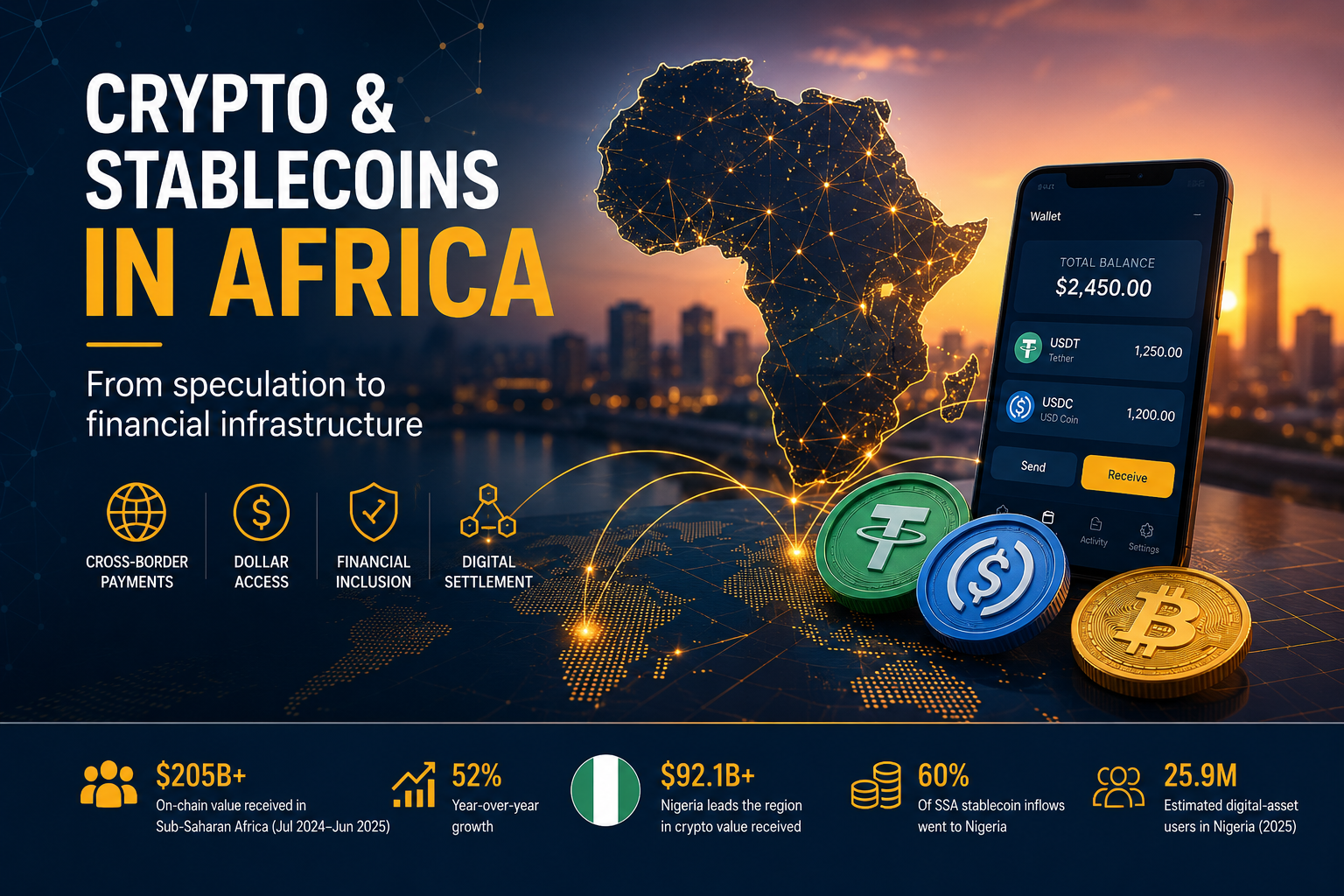
Between July 2024 and June 2025, Sub-Saharan Africa received more than $205 billion in on-chain cryptocurrency value, representing approximately 52% year-over-year growth. Chainalysis ranked the region as the third-fastest-growing crypto market globally, behind Asia-Pacific and Latin America.
Nigeria alone accounted for more than $92.1 billion of that activity, nearly three times the value received by the next-largest market, South Africa. Ethiopia, Kenya and Ghana completed the region's top five markets by transaction value.
And increasingly, one category of digital asset is becoming particularly important: stablecoins. The story of African cryptocurrency may therefore be moving from: “Can Africans use crypto?” to: “What financial infrastructure can Africans build with crypto?”
Africa's Crypto Economy Is Growing for Practical Reasons
Africa's cryptocurrency adoption is often misunderstood when viewed through the lens of speculative investment alone. In many developed markets, cryptocurrency is frequently discussed in terms of portfolio allocation, ETFs and institutional investment.
African markets have developed different use cases. People use digital assets for:
- Cross-border transfers
- Remittances
- Access to U.S.-dollar-denominated value
- International commerce
- Savings
- Payments
- Treasury management
- Peer-to-peer transactions
- Digital investment
Chainalysis found that Sub-Saharan Africa's crypto economy received more than $205 billion in on-chain value during the July 2024–June 2025 period. It also found that transactions below $10,000 represented more than 8% of transferred value in the region, compared with about 6% elsewhere.
That is important. It suggests cryptocurrency is not simply an institutional phenomenon. A meaningful portion of the activity involves retail and smaller-value transactions.
Nigeria Has Become a Major African Crypto Market
Nigeria provides perhaps the clearest example of the continent's shift toward practical cryptocurrency use. Chainalysis recorded more than $92.1 billion in crypto value received by Nigeria between July 2024 and June 2025. The country's position is even more interesting when stablecoins are isolated.
The International Monetary Fund estimates that Nigeria received approximately $59 billion in crypto-asset inflows between July 2023 and June 2024. It also found that stablecoin inflows into Nigeria were the largest in Sub-Saharan Africa, accounting for approximately 60% of the region's stablecoin inflows from late 2019 through early 2025. By 2024, stablecoins represented more than 65% of Nigeria's crypto inflows, according to the IMF's analysis.
That is a remarkable shift. Bitcoin remains important, but for many cross-border use cases, users increasingly appear to prefer digital assets whose value is linked to a major fiat currency.
Why Stablecoins Matter So Much in Africa
A stablecoin is a crypto asset designed to maintain a relatively stable value relative to an underlying asset, commonly a fiat currency such as the U.S. dollar. For African users, that feature can be particularly important.
Many African currencies experience periods of significant volatility. A person earning local currency may want exposure to a digital dollar without opening a traditional foreign-currency bank account. A business receiving international payments may want to receive dollar-denominated value without waiting several banking days for an international settlement. A company paying a foreign supplier may want a settlement mechanism that operates around the clock. Stablecoins can potentially provide that functionality.
The IMF describes stablecoins in Nigeria as an increasingly meaningful cross-border payments channel, noting that they can reduce payment friction while creating new policy challenges.
This is an important distinction. Stablecoins aren't necessarily being used because users want to speculate on another cryptocurrency. They can be used because users want digital access to stable value.
Nigeria's Stablecoin Economy Is Already Significant
The IMF estimates that Nigeria had approximately 25.9 million digital-asset users in 2025, equivalent to around 12% of the country's population. The report also notes a strong preference for U.S.-dollar-denominated stablecoins, particularly USDT and USDC.
This creates an interesting financial phenomenon. A Nigerian user doesn't necessarily need to think: “I am using cryptocurrency.” The user may simply think: “I need dollars.” The blockchain becomes the delivery mechanism. That distinction could become increasingly important as African digital finance develops.
Stablecoins Can Function as Settlement Infrastructure.
The most interesting future use of stablecoins may not be consumer-facing wallets. It may be settlement infrastructure underneath financial products. Imagine: Kenyan customer → KES payment → regulated payment provider → stablecoin settlement → Nigerian payment provider → NGN payout.
The customer doesn't necessarily need to hold Bitcoin or understand blockchain technology. The stablecoin simply provides a settlement mechanism between two financial systems. That is conceptually different from cryptocurrency speculation. It turns blockchain infrastructure into something closer to a financial utility layer.
Africa's Existing Payment Systems Make This Especially Interesting
Africa has already demonstrated that consumers will adopt financial technology when it solves a real problem. Mobile money is the obvious example. The region has built enormous mobile-money ecosystems despite having relatively fragmented banking infrastructure.
Now the next opportunity may involve connecting:
- Mobile money
- Banks
- Fintechs
- Instant payment systems
- Stablecoins
- Cross-border settlement
Instead of replacing existing payment infrastructure, blockchain technology can potentially operate behind it. That could be particularly important for companies building cross-border payment products.
Stablecoins Are Growing Globally Too
Africa's stablecoin development is happening against a much larger global trend. A recent Brookings analysis notes that global stablecoin supply grew from approximately $6.8 billion in 2020 to about $273 billion in 2026, while annual stablecoin transaction volumes have reached approximately $10.9 trillion.
The numbers help explain why financial institutions and regulators are increasingly treating stablecoins as more than a niche cryptocurrency product. They are becoming part of the conversation about:
- Payments - Banking - Monetary policy - Dollarization - Cross-border settlement - Financial infrastructure Africa is participating in that transformation from a position of unusual technological readiness.
Africa Does Not Have to Follow the Traditional Banking Path
One of Africa's biggest advantages may be its willingness to leapfrog. The continent moved rapidly from limited traditional banking access to: Mobile phones → mobile money → digital wallets → fintech, without every consumer first becoming a conventional bank customer.
Crypto could follow a similar pattern. Instead of: Bank account → international wire → correspondent bank → recipient bank , some transactions could increasingly become: Local wallet → regulated digital-asset infrastructure → local payout. The technology underneath the transaction can change while the customer's experience becomes simpler.
But Crypto Adoption Does Not Mean Crypto Is Risk-Free
Rapid adoption should not be confused with universal acceptance or safety. Crypto users face risks including:
- Price volatility
- Fraud
- Hacks
- Wallet loss
- Counterparty failure
- Platform shutdowns
- Regulatory changes
- Sanctions exposure
- Poor liquidity
- Irreversible transactions
The recent shutdown of NoOnes illustrates the importance of this last point. The platform said it had served more than 2.5 million users before winding down its P2P marketplace in August 2026. It attributed the operational crisis to sanctions-related issues that affected essential partners and caused blockchain-monitoring providers to classify NoOnes-related wallets and transactions as high risk.
That episode demonstrates that technology alone cannot guarantee financial continuity. A crypto platform depends on an ecosystem.
Regulation Is Catching Up With Adoption
The growth of cryptocurrency is forcing African regulators to answer increasingly sophisticated questions. The first question was: Should cryptocurrency be legal? The next questions are considerably harder:
- Who should license crypto businesses?
- How should stablecoins be treated?
- What constitutes custody?
- How should exchanges be supervised?
- How should crypto transactions be taxed?
- How should cross-border transfers be monitored?
- How should sanctions screening work?
- How should consumer assets be protected?
South Africa provides one of the continent's most developed examples. Its FSCA licensing framework treats qualifying crypto-asset services as regulated financial activity, while the Financial Intelligence Centre applies AML/CFT requirements to qualifying CASPs.
Nigeria is also developing a more formal regulatory environment. Its Investments and Securities Act 2025 formally recognized digital assets within the securities framework, while regulators have continued developing oversight of virtual-asset businesses.
Kenya has also moved toward a formal digital-asset framework, with its Virtual Asset Service Providers legislation and subsequent regulatory development becoming increasingly important to the country's crypto industry.
The direction is clear: African cryptocurrency markets are moving from largely informal adoption toward increasingly structured financial markets.
Regulation Could Actually Accelerate Institutional Adoption
Regulation is often portrayed as a threat to cryptocurrency. But clear regulation can also create the conditions for larger institutions to participate. A bank may be reluctant to integrate with an unregulated crypto platform. A payment provider may hesitate to process transactions without clear compliance standards.
An institutional investor may require:
- Licensing
- Audited controls
- AML programmes
- Custody standards
- Governance
- Consumer protections
Once those requirements become clearer, larger financial institutions can participate with greater confidence. This is one reason South Africa's CASP licensing framework is significant. Regulation can reduce uncertainty even when it increases the compliance burden.
The African Crypto Market Is Becoming More Institutional
Chainalysis' 2025 analysis found substantial institutional activity in Nigeria and South Africa and noted that much of the activity appeared connected to a growing B2B sector facilitating cross-border payments. That is an important development.
The next phase of African crypto may increasingly involve: Businesses → stablecoins → payment providers → banks → settlement infrastructure, rather than simply: Individual → exchange → speculative trading. The distinction matters because institutional use can create much larger and more predictable transaction flows.
Stablecoins Could Become a Bridge Between Local Currencies
Africa's fragmented currency environment creates a particularly interesting use case. Imagine a business in Kenya paying a supplier in Nigeria. The sender has: KES. The recipient wants: NGN
Traditional infrastructure may require multiple intermediaries and currency conversions. A regulated settlement provider could potentially use a stablecoin as an intermediate settlement asset: KES → stablecoin → NGN.
The stablecoin doesn't replace either currency. It simply provides a common digital settlement layer. That could become especially useful where direct liquidity between two African currencies is limited.
But Stablecoins Create New Policy Questions
The same characteristics that make stablecoins useful also create regulatory challenges. If millions of people hold dollar-linked digital assets, policymakers have to consider:
- Could stablecoins reduce demand for local currency?
- Could they affect monetary policy?
- How should issuers be supervised?
- How should reserves be managed?
- How should illicit transactions be monitored?
- What happens if a major stablecoin experiences a liquidity crisis?
The IMF specifically highlights these trade-offs in its analysis of Nigeria. This means African regulators are not simply deciding whether to “allow crypto.” They are increasingly designing rules around specific functions and risks.
The Difference Between Bitcoin and Stablecoins Matters
It is tempting to group all cryptocurrencies together. That can hide important differences. Bitcoin is primarily a decentralized crypto asset with a floating market price. Stablecoins are designed around a relatively stable reference value. Their use cases can therefore be very different.
Chainalysis found that Bitcoin still represented 89% of crypto purchases made with fiat in Nigeria and 74% in South Africa during its 2025 analysis.
At the same time, stablecoins are increasingly important in high-value transfers and cross-border settlement. The market is therefore not simply choosing one asset. Different assets are being used for different purposes.
Africa Could Become a Major Stablecoin Settlement Market
The opportunity is particularly interesting because Africa already has the payment infrastructure needed for the final step. Consider Kenya. A customer may already have: M-Pesa or access to a bank account or PesaLink.
The missing component isn't necessarily another wallet. It may be a regulated system capable of converting and settling value between: local fiat → digital settlement asset → local fiat. This is where stablecoins could become infrastructure rather than simply a consumer product.
The Biggest Opportunity May Be Cross-Border Commerce
Remittances are important. But business payments could become even more significant. African companies increasingly need to pay:
- International suppliers - Remote employees - Contractors - Software providers - Logistics companies - Exporters - Importers If stablecoins can provide compliant 24/7 settlement, they could reduce some of the friction involved in international commerce.
Chainalysis has already identified [multi-million-dollar stablecoin transfers connected to energy and merchant payments across Africa](The Biggest Opportunity May Be Cross-Border Commerce), the Middle East and Asia. That is very different from the old narrative of crypto being primarily a retail trading phenomenon.
What Happens Next?
The next five years could be critical for Africa's digital-asset industry. Several trends are likely to develop simultaneously: - More regulation - Countries will establish clearer licensing and AML frameworks. - More stablecoin use - Businesses and consumers may increasingly use dollar-linked digital assets for transfers and settlement. - More institutional participation - Banks, payment providers and fintech companies will integrate digital assets into existing products. - More interoperability - Crypto infrastructure will increasingly connect with mobile money, banking and instant-payment systems. - More competition - African and international companies will compete to provide settlement, custody, liquidity and compliance infrastructure. - More scrutiny - As transaction volumes grow, regulators will pay greater attention to consumer protection, financial stability and illicit-finance risks.
What Africa's Crypto Future Could Look Like
The future may not be: Banks versus crypto. It may not even be: Fiat versus cryptocurrency. Instead, the financial system could become a combination of both.
A customer could pay in Kenyan shillings. A business could settle internally using a dollar-linked stablecoin. A Nigerian recipient could receive Naira. The transaction could happen within seconds. The customer might never know that a blockchain was involved. That is perhaps the most important evolution in cryptocurrency. The technology becomes less visible as the utility becomes more important.
Conclusion
Africa's cryptocurrency market is no longer simply a story about speculation. The numbers show an increasingly significant digital-asset economy. Sub-Saharan Africa received more than $205 billion in on-chain cryptocurrency value between July 2024 and June 2025, growing approximately 52% year over year. Nigeria alone received more than $92.1 billion.
Nigeria's stablecoin market is particularly striking. The IMF estimates approximately $59 billion in crypto-asset inflows between July 2023 and June 2024, while stablecoins accounted for more than 65% of crypto inflows in 2024 and around 60% of Sub-Saharan Africa's stablecoin inflows during the period analyzed.
These numbers suggest that digital assets are increasingly being used to solve practical financial problems. The next stage will depend on whether Africa can build the infrastructure around them. That means:
- Regulated exchanges.
- Reliable custody.
- Local fiat on- and off-ramps.
- Stablecoin liquidity.
- Payment interoperability.
- AML and compliance infrastructure.
- Cross-border settlement.
- Consumer protection.
The biggest opportunity may therefore not be creating another cryptocurrency. It may be building the infrastructure that allows African currencies, payment systems and digital assets to work together. Africa has already shown the world what it can do with mobile money. The next question is whether it can do the same with digital assets and stablecoin-powered financial infrastructure.