Seychelles Cryptocurrency Regulation: VASP Licensing, Capital Requirements and Compliance
Seychelles has introduced a dedicated framework for virtual asset businesses, covering VASP licensing, capital, client-asset protection, AML controls and operational substance. Explore how the rules are shaping the country's crypto industry.

On this page
Seychelles has moved from having no dedicated virtual-asset licensing regime to operating under a specific Virtual Asset Service Providers Act.
The change is significant. The Virtual Asset Service Providers Act, 2024 created the legal foundation for licensing virtual asset businesses in or from Seychelles.
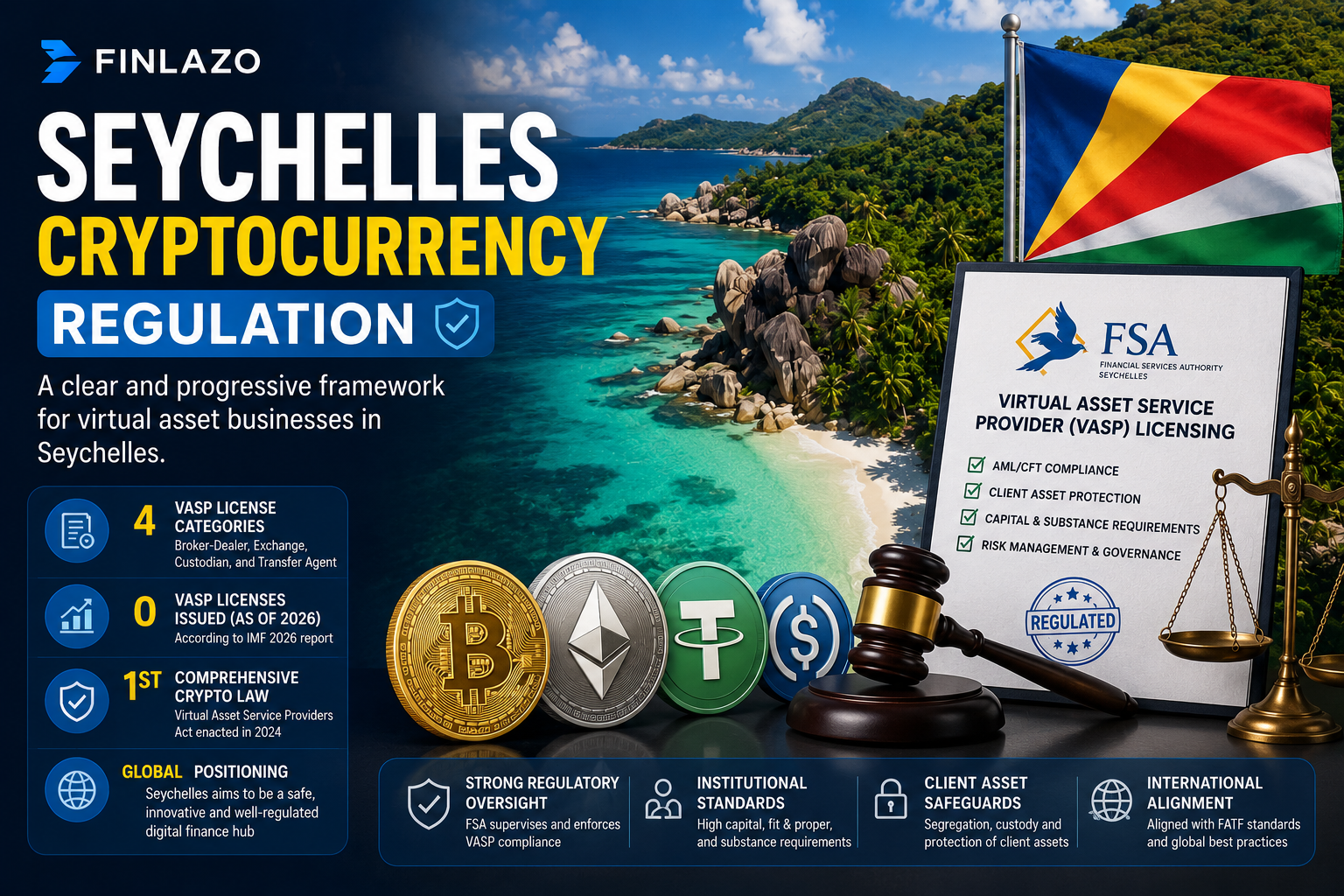
Yet the market is not being opened with a light-touch registration system. As of the IMF's May 2026 review, the Financial Services Authority had issued no VASP licences.
At the same time, crypto-related financial activity is already material within Seychelles' wider securities sector. The IMF's 2026 country report said about 105 of 190 licensed securities dealers, or approximately 56%, offered crypto-CFD products.
That distinction is important.
Crypto-CFD activity under a securities dealer licence is not the same thing as operating as a VASP under the 2024 Act.
The regulatory framework is therefore developing while a significant part of the country's crypto-related financial activity remains outside the VASP licensing population.
The framework is not simply about attracting crypto companies. It is also about deciding which activities are allowed, which businesses need licences and how much substance a regulated operator must maintain in Seychelles.
These days, I spend a lot of time researching cryptocurrency regulation across Africa. Seychelles keeps coming up because it has built one of the continent's clearest dedicated legal frameworks for virtual asset businesses.
I am originally from Middle East. I first visited Seychelles in 2023, and the trip changed the way I looked at the country. I loved Seychelles.
While I was there, I enrolled in a legal course, and I ultimately decided to remain in Seychelles rather than return to Middle East. Since January 2025, I have also supported startups that have established operations in Seychelles, helping them understand the VASP regulatory framework and navigate the licensing process.
Seychelles Cryptocurrency Regulation at a Glance
- 0 VASP licences — the IMF reported that no VASP licence had been granted as of end-January 2026.
- 105 of 190 securities dealers — approximately 56% were reported to offer crypto-CFD products.
- 3% — business tax rate applying to licensed securities dealers.
- 1.5% — preferential business tax rate discussed for VASP-licensed operations in the IMF's 2026 analysis.
- SCR 353.4 million — business tax collected from licensed securities dealers in 2024.
- SCR 586.5 million — business tax collected from licensed securities dealers from January to October 2025.
- SCR 75,000 — VASP licence application fee.
- SCR 22,500 — registration application fee.
- US$100,000 — minimum initial paid-up capital for a new virtual asset exchange.
- US$75,000 — minimum initial paid-up capital for a new virtual asset wallet provider.
- US$50,000 — minimum initial paid-up capital for a new virtual asset broking provider.
- US$25,000 — minimum initial paid-up capital for a new virtual asset investment provider.
- SCR 50,000 — threshold at which VASPs must report virtual-asset transfers to the Financial Intelligence Unit.
The figures describe different parts of Seychelles' financial and regulatory environment.
They should not be combined into a single estimate of the country's crypto market.
What Is the Seychelles Virtual Asset Service Providers Act?
The Virtual Asset Service Providers Act, 2024 is Seychelles' dedicated legal framework for virtual asset businesses.
It establishes a licensing system.
It also gives the Financial Services Authority responsibility for supervising relevant virtual asset activities.
The Act covers more than cryptocurrency exchanges.
It provides for:
- Virtual asset wallet providers.
- Virtual asset exchanges.
- Virtual asset broking.
- Virtual asset investment providers.
- Registration of certain Initial Coin Offerings.
- Registration of certain Non-Fungible Token offerings.
- Ongoing supervision.
- Client-asset protection.
- Cybersecurity requirements.
- Financial requirements.
- Advertising rules.
- AML/CFT obligations.
The framework also distinguishes between licensed VASP activities and activities that are not permitted.
When Did Seychelles' VASP Framework Take Effect?
The VASP framework was enacted in 2024.
The relevant legislation and regulations were published during September 2024, including the Virtual Asset Service Providers Act commencement notice and the supporting regulations.
The transition period was important.
Existing businesses already providing virtual asset services when the Act came into force were given until 31 December 2024 to submit a complete application.
The FSA stated that businesses which failed to submit a complete application could not continue operating after that deadline.
From 1 January 2025, the position became much stricter for businesses operating without the required licence or registration.
Who Regulates Cryptocurrency Businesses in Seychelles?
The Financial Services Authority of Seychelles is the main regulator for VASP activity.
The FSA oversees licensing and supervision.
It also publishes information about authorised entities and enforcement actions.
That public register has become particularly important because incorporation in Seychelles does not automatically mean that a company is licensed to provide virtual asset services.
The FSA has repeatedly warned about this distinction.
Being Incorporated in Seychelles Is Not the Same as Being Licensed
This is one of the most important points for anyone researching Seychelles crypto regulation.
A company can be incorporated in Seychelles and still have no authority to provide VASP services.
The FSA has repeatedly warned the public about companies that use Seychelles incorporation as though it were evidence of regulatory approval.
Its public advisory on VASPs makes clear that incorporation alone does not amount to a VASP licence.
The FSA was still issuing similar warnings in 2026.
On 10 March 2026, it warned that an entity associated with HitBTC had no authorisation under the VASP Act.
The message is straightforward.
A Seychelles company number is not a VASP licence.
What Activities Require a VASP Licence?
The FSA identifies four principal licence categories.
Virtual Asset Wallet Provider
This category covers businesses providing wallet-related virtual asset services.
The service can involve holding or controlling client assets.
That makes custody a major regulatory concern.
Virtual Asset Exchange
A virtual asset exchange provides exchange services involving virtual assets.
This is one of the core VASP activities under the Act.
The financial and technology requirements are therefore substantial.
Virtual Asset Broking
A virtual asset broker can act between clients and virtual asset markets.
The licence category exists separately from the exchange category.
The distinction matters because regulatory requirements can depend on the actual business model.
Virtual Asset Investment Provider
This category covers qualifying virtual asset investment services.
The FSA therefore does not treat every crypto business as though it performs the same function.
The licence must match the activity.
Seychelles VASP Licence Fees
The FSA's current VASP FAQs set out the application and annual licensing fees.
The VASP licence application fee is SCR 75,000.
The registration application fee is SCR 22,500.
A successful licence holder also pays a base annual fee of SCR 75,000.
Activity-specific annual fees apply on top of that base amount.
The current fees listed by the FSA are:
- Virtual Asset Wallet Provider — SCR 300,000.
- Virtual Asset Exchange — SCR 375,000.
- Virtual Asset Broking — SCR 150,000.
- Virtual Asset Investment Provider — SCR 75,000.
The fees are only one part of the cost.
A serious applicant also has to meet capital, technology, staffing, substance, governance and compliance requirements.
Capital Requirements for Seychelles VASPs
The financial requirements are more substantial than the application fee.
The Virtual Asset Service Providers (Capital and other Financial Requirements) Regulations, 2024 specify minimum paid-up capital for new entities.
For a new virtual asset exchange, the minimum initial paid-up capital is US$100,000.
For a new virtual asset wallet provider, it is US$75,000.
For virtual asset broking, the minimum is US$50,000.
For a virtual asset investment provider, the minimum is US$25,000.
These are minimum regulatory capital figures.
They are not estimates of the total amount required to build and operate a compliant VASP.
Client Assets Must Be Fully Covered
The financial regulations go beyond minimum capital.
A licensed VASP must maintain reserve assets or money equivalent to 100% of liabilities owed to clients in respect of client assets held by the licensee.
That is a major safeguard.
The objective is to ensure that client assets are not simply treated as ordinary corporate funds.
The client-asset safeguarding regulations also require systems and controls for the safekeeping and management of those assets.
Substance Requirements in Seychelles
The Seychelles framework expects real operational substance.
The FSA's VASP licensing guidelines state that core income-generating activities must be undertaken in a physical office in Seychelles.
The framework requires:
- At least one resident director.
- A fully manned office.
- Adequate qualified staff.
- Records accessible from the office.
- Complaint handling in Seychelles.
- At least two board meetings in Seychelles each year.
- At least four management meetings in Seychelles each year.
This is important for offshore structures.
A VASP cannot simply incorporate a company in Seychelles and run the entire business somewhere else while claiming local substance.
Fit and Proper Requirements
The regulator also examines the people behind the business.
The FSA's Code for Fit and Proper for Virtual Asset Service Providers addresses the knowledge, skills, experience, integrity and financial standing expected of key persons.
The assessment can cover directors and principal officers.
It can also extend to compliance and other key functions.
The objective is straightforward.
The people responsible for a regulated VASP need to be suitable to perform those roles.
AML and CFT Rules for Seychelles VASPs
Virtual asset businesses are reporting entities under Seychelles' AML/CFT framework.
That means compliance is not optional.
A VASP must have systems for identifying and managing money-laundering and terrorist-financing risks.
The FSA's VASP FAQ also states that businesses need to comply with the Anti-Money Laundering and Countering the Financing of Terrorism framework.
Controls can include:
- Customer identification.
- Customer due diligence.
- Risk assessment.
- Transaction monitoring.
- Suspicious transaction reporting.
- Record keeping.
- Sanctions screening.
- Compliance oversight.
The actual control environment should reflect the size and complexity of the VASP.
Seychelles Virtual Asset Reporting Threshold
Seychelles has a specific reporting threshold for virtual asset transfers.
The VASP Act amended the AML/CFT framework so that VASPs must report virtual asset transfers of SCR 50,000 or more in equivalent value.
The FSA's current FAQ says the threshold report is submitted to the Financial Intelligence Unit every business day by midnight Seychelles time.
This is a reporting obligation.
It is separate from suspicious transaction reporting.
A transfer can therefore cross the reporting threshold without automatically being treated as suspicious.
Cybersecurity Requirements
Crypto regulation is also technology regulation.
The Seychelles framework includes dedicated cybersecurity requirements for VASPs.
The FSA's legal framework lists the Virtual Asset Service Provider Cyber Security Requirements Regulations, 2024.
The FSA's licensing guidance also expects applicants to demonstrate appropriate technology and controls.
This can include systems for monitoring virtual asset transfers and transactions.
For businesses handling client assets, cyber risk is particularly important because a compromise can affect both operational systems and customer funds.
Advertising and Promotion Rules
The VASP framework also regulates advertising.
The FSA lists Virtual Asset Service Provider Advertisements Regulations, 2024 among the applicable rules.
The purpose is not simply to restrict marketing.
Advertising can influence how investors perceive risk, returns and regulatory status.
A regulated VASP therefore has obligations around how its services are presented.
ICO and NFT Registration
Seychelles does not only regulate service providers.
The Act also creates a framework for registering certain Initial Coin Offerings and Non-Fungible Token offerings.
The FSA FAQ says an ICO referring to digital assets that can be purchased, traded or exchanged on a public blockchain or exchange must be registered under the Act.
The framework treats closed-loop tokens differently.
A token that exists only inside a platform and cannot be traded or used outside that ecosystem is treated differently from a publicly tradeable token.
That distinction matters for token issuers.
Prohibited Activities
The Seychelles VASP framework expressly prohibits certain activities.
The FSA states that the Act prohibits:
- Mining facilities.
- Mixers.
- Tumblers.
Existing operators undertaking those activities were required to cease by the end of 2024.
The restriction is significant because Seychelles is not trying to become a jurisdiction for every type of crypto infrastructure.
Some activities are simply outside the permitted framework.
The Latest Seychelles VASP Licensing Position
The current licensing picture is unusual.
The FSA publishes entities that are in the assessment stage.
As of the latest FSA list reviewed in August 2026, the assessment-stage list included five distinct applicants:
- Bequant Prime Limited T/A BEQUANT.
- Bybit Technology Limited T/A BYBIT.
- Thecorio Ltd.
- BTG Technology Holdings Limited.
- Etoro (Seychelles) Ltd.
The FSA page identifies these entities as being in Assessment, not as fully licensed VASPs.
That distinction is critical.
The FSA licensed VASP list explains that these entities submitted complete applications and may continue operating under transitional arrangements while the FSA determines their applications.
The IMF's May 2026 report separately stated that no VASP licences had yet been issued.
The two sources therefore point to the same broad conclusion.
Seychelles has an active VASP authorisation process, but the licensing pipeline had not yet resulted in an issued VASP licence by the IMF's reporting date.
Enforcement Is Becoming More Visible
The FSA's 2026 notices show that the regulator is actively enforcing the new framework.
On 6 August 2026, the FSA announced enforcement action against MX Global Ltd, identifying it as the Seychelles-incorporated company operating the MEXC cryptocurrency exchange without the required VASP licence.
The regulator instructed the company to cease the relevant activity.
The FSA has also issued warnings involving other platforms, including HitBTC and WOO X.
That tells businesses something important.
The law is not only theoretical.
The regulator is using it.
Crypto-CFDs Are a Separate Regulatory Story
Seychelles has a significant crypto-related securities business.
The IMF's 2026 Seychelles report said 105 of 190 licensed securities dealers, about 56%, offered crypto-CFD products.
These businesses operate under the securities-dealer framework.
They should not automatically be described as VASPs.
The distinction matters because the VASP Act and securities rules regulate different activities.
A company can also face more than one regulatory framework depending on what it does.
The Tax Picture
The IMF's 2026 report provides an unusual measure of crypto-related financial activity in Seychelles.
Business tax collections from licensed securities dealers totalled SCR 353.4 million in 2024.
From January to October 2025, collections reached SCR 586.5 million.
The IMF said approximately 56% of licensed securities dealers offered crypto-CFD products.
Those figures are not VASP tax receipts.
The same report said Seychelles had not yet recorded tax revenue attributable to VASP-licensed operations because no VASP licences had been issued at the time of the reporting period.
That distinction should be preserved.
What Does the Seychelles Framework Mean for Foreign Crypto Companies?
A foreign-facing digital business cannot assume that incorporation in Seychelles is enough.
The FSA's FAQ states that licensing can be required simply because an entity is registered or incorporated in Seychelles, regardless of where its virtual asset services are actually performed.
Once licensed, the business must meet the substance requirements.
Foreign businesses also need to consider the rules in the countries where their customers are located.
A Seychelles VASP licence does not automatically authorise a business to provide regulated services everywhere else.
What Does This Mean for Crypto Startups?
The Seychelles framework creates a real compliance burden.
A startup seeking authorisation may need:
- The correct corporate structure.
- A defined VASP activity.
- Minimum capital.
- A resident director.
- A physical office.
- Qualified personnel.
- Compliance officers.
- Cybersecurity systems.
- Client-asset controls.
- AML/CFT systems.
- Insurance.
- Audit and record-keeping arrangements.
The result is a higher barrier to entry.
It also creates a clearer distinction between a serious regulated operator and a company that simply uses Seychelles incorporation as a marketing claim.
Why Seychelles Is Still Relevant to the Crypto Industry
Seychelles remains relevant because it already hosts a substantial financial-services sector.
Crypto-related securities activity is significant.
The country also now has a dedicated VASP framework.
At the same time, the licensing process is demanding.
The result is a market that is becoming more formal rather than simply more permissive.
For businesses, the question is no longer just whether Seychelles is a crypto-friendly jurisdiction.
The better question is whether the business can satisfy the actual regulatory requirements.
How Seychelles Compares With Other African Crypto Markets
African crypto regulation is moving in different directions.
Rwanda introduced its dedicated virtual asset law in 2026. See Rwanda cryptocurrency regulation for the country's approach.
Zambia is developing its own framework around VASPs and financial-crime controls. See Zambia cryptocurrency regulation for the latest position.
South Africa uses a financial-services licensing model for crypto asset service providers. Finlazo's South Africa crypto regulation pillar covers that structure.
Seychelles is different.
Its dedicated VASP Act is paired with explicit capital rules, substance requirements, client-asset protections and an active enforcement programme.
The common theme is stronger oversight.
Seychelles Cryptocurrency Regulation: Key Numbers and Dates
- 2024 — Virtual Asset Service Providers Act enacted.
- 31 December 2024 — deadline for qualifying existing operators to submit complete VASP applications under the transition.
- 1 January 2025 — unlicensed qualifying operators that had not completed the application process could no longer continue the regulated activity.
- 0 — VASP licences issued as reported by the IMF in 2026.
- 5 — distinct applicants shown on the FSA assessment-stage list reviewed in August 2026.
- 56% — approximate share of Seychelles licensed securities dealers offering crypto-CFD products.
- 105 of 190 — securities dealers offering crypto-CFD products according to the IMF.
- SCR 75,000 — VASP licence application fee.
- SCR 22,500 — registration application fee.
- SCR 375,000 — annual fee for a virtual asset exchange activity.
- SCR 300,000 — annual fee for a wallet-provider activity.
- US$100,000 — minimum initial paid-up capital for a new virtual asset exchange.
- US$75,000 — minimum initial paid-up capital for a new wallet provider.
- US$50,000 — minimum initial paid-up capital for a new broker.
- US$25,000 — minimum initial paid-up capital for a new investment provider.
- 100% — reserve-assets requirement against client liabilities for client assets held.
- SCR 50,000 — virtual-asset transfer reporting threshold.
- SCR 353.4 million — securities-dealer business tax collected in 2024.
- SCR 586.5 million — securities-dealer business tax collected from January to October 2025.
Frequently Asked Questions
Is cryptocurrency regulated in Seychelles?
Yes. Seychelles introduced the Virtual Asset Service Providers Act in 2024, together with regulations covering licensing, capital, custody, cybersecurity, advertising and other requirements.
Who regulates cryptocurrency in Seychelles?
The Financial Services Authority is the main regulator for VASP activities in Seychelles.
Does a Seychelles company automatically have a crypto licence?
No. Incorporation is not the same as regulatory authorisation. A company can be registered in Seychelles without being licensed to provide virtual asset services.
How many VASP licences has Seychelles issued?
The IMF reported that the FSA had issued no VASP licences as of its 2026 reporting period. The FSA, however, maintains an assessment-stage list of applicants that have submitted complete applications.
What types of VASP licences are available in Seychelles?
The FSA identifies four principal categories: virtual asset wallet provider, virtual asset exchange, virtual asset broking and virtual asset investment provider.
How much does a Seychelles VASP licence cost?
The FSA lists a SCR 75,000 licence application fee. Annual fees depend on the authorised activity and include SCR 375,000 for an exchange and SCR 300,000 for a wallet provider, in addition to a SCR 75,000 base fee.
What is the minimum capital for a Seychelles crypto exchange?
A new virtual asset exchange must have minimum initial paid-up capital of US$100,000 under the 2024 capital requirements regulations.
Does Seychelles require a physical office for a VASP?
Yes. The FSA's licensing guidance requires core income-generating activities to be undertaken in a physical office in Seychelles. The framework also requires at least one resident director and appropriately qualified staff.
Does Seychelles regulate stablecoins?
Stablecoins can fall within the virtual asset framework depending on the activity and business model. Businesses involving custody, exchange, transfers or other regulated virtual asset services need to assess the relevant VASP requirements.
Are crypto exchanges allowed in Seychelles?
Yes, but operating a qualifying virtual asset exchange requires the appropriate VASP authorisation. The legal framework distinguishes between an authorised exchange and a company that is merely incorporated in Seychelles.
Does Seychelles regulate crypto-CFD platforms?
Crypto-CFD activity can fall within the securities-dealer framework rather than the VASP framework. The IMF reported that 105 of 190 licensed securities dealers in Seychelles offered crypto-CFD products.
Can a foreign crypto company use a Seychelles company to serve customers worldwide?
Not automatically. A Seychelles-incorporated entity may need a VASP licence for qualifying activities in or from Seychelles, and it must also consider the laws of the countries where its customers are located.
What happens if a company provides VASP services without authorisation?
The FSA has issued warnings and enforcement actions against companies providing virtual asset services without the required authorisation. Businesses can be instructed to cease operations and may face further enforcement measures.
The Bottom Line
Seychelles has moved decisively toward formal cryptocurrency regulation.
The 2024 VASP Act created a dedicated licensing framework.
The rules cover exchanges, wallets, brokers and investment providers. They also cover capital, custody, cybersecurity, AML/CFT and operational substance.
The latest numbers show how demanding the framework is.
The IMF reported zero VASP licences issued as of its 2026 reporting period. Meanwhile, the FSA's assessment list showed several applicants moving through the authorisation process.
Crypto-related activity is already significant in another part of the market.
About 56% of licensed securities dealers were reported to offer crypto-CFD products.
That does not make them VASPs.
The distinction matters.
For businesses, Seychelles is no longer a jurisdiction where incorporation alone carries regulatory credibility.
The regulator expects capital.
It expects substance.
It expects compliance.
And in 2026, the FSA is actively enforcing those requirements.