Botswana Cryptocurrency Regulation: VASP Licensing, AML Rules and the 2026 Regulatory Position
Botswana has built a formal framework for virtual assets covering VASP licensing, AML/CFT, customer due diligence and regulatory supervision. Explore the rules shaping its growing digital-asset sector.

On this page
Botswana has one of the more established virtual-asset regulatory frameworks in Southern Africa.
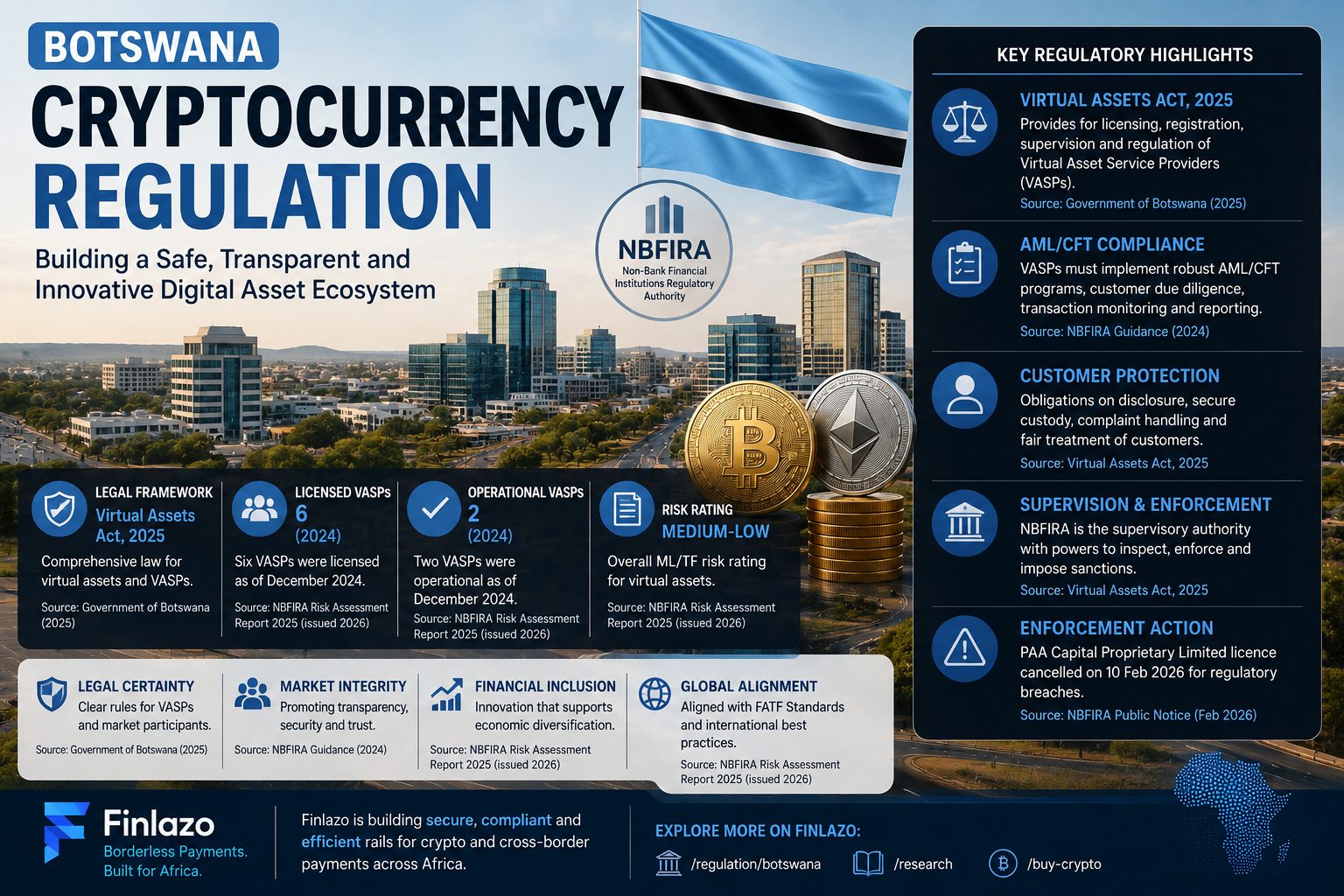
The current framework is built around the Virtual Assets Act, 2025, which commenced on 24 January 2025 and replaced the earlier 2022 Act.
The latest national risk assessment adds important market context. Botswana's 2025 Money Laundering and Terrorist Financing National Risk Assessment found that six VASPs had been licensed by NBFIRA as of 2024.
Only two had commenced operations.
The same assessment found that Yellow Card accounted for more than 85% of the market.
By December 2024, the sector had recorded more than BWP169 million in transaction volume.
The regulatory picture has continued to evolve.
In February 2026, NBFIRA cancelled PAA Capital's licence under the 2025 Act. The regulator said the company could no longer offer exchange, transfer, custody, brokerage or other regulated virtual-asset services. The NBFIRA notice is an important indicator that the framework is being enforced rather than simply written into law.
Botswana Cryptocurrency Regulation at a Glance
- 24 January 2025 — commencement date of the Virtual Assets Act, 2025.
- 6 licensed VASPs — number licensed by NBFIRA as of 2024 in the national risk assessment.
- 2 operating VASPs — licensed providers that had commenced operations as of 2024.
- More than 85% — Yellow Card's share of the Botswana VASP market in the assessment.
- More than BWP169 million — VASP transaction volume recorded by December 2024.
- 3 February 2026 — date of NBFIRA's PAA Capital licence-cancellation decision.
- 20-year — record-retention period under Botswana's Financial Intelligence Act for specified-party transaction and customer-due-diligence records.
- BWP10,000 — threshold at which qualifying cross-border transactions must be reported under the AML/CFT framework.
- 55% — percentage of firms in the broader assessment that did not provide role-specific training to customer-facing staff; this is not a VASP-only statistic and should not be used as a VASP-sector rate.
The licensing figures above describe the market position captured by the national risk assessment.
They should not be treated as the exact current licence count in August 2026 because NBFIRA later cancelled at least one licence and the current public register should be checked for any subsequent approvals.
What Is the Virtual Assets Act, 2025?
The Virtual Assets Act, 2025 is Botswana's operative virtual-asset statute.
It replaced the Virtual Assets Act, 2022.
The National Risk Assessment says the 2025 Act strengthened the framework and gave NBFIRA the mandate to supervise and license VASPs.
The Act covers businesses operating into or from Botswana.
That is important for foreign platforms.
A company does not avoid the framework simply because its technology or operations are physically located outside Botswana.
The 2025 Act also defines virtual assets broadly while excluding certain legal tender, securities and other assets already regulated under the Bank of Botswana Act or Securities Act.
Who Regulates Cryptocurrency in Botswana?
NBFIRA is the main regulator for VASPs.
The Virtual Assets Act established the regulator's role under the earlier framework, and the 2025 Act maintains NBFIRA's licensing and supervisory function.
The Bank of Botswana also has an important role where virtual assets interact with payment services, banks and monetary infrastructure.
This creates a shared regulatory environment.
A crypto company may need to deal with NBFIRA as a VASP.
A payment product may also engage the Bank of Botswana.
A securities-related token may create separate questions under the capital-markets framework.
Does Botswana Have a VASP Licence?
Yes.
The NBFIRA licensing framework requires a VASP to apply for a licence.
The 2025 Act prohibits a person from carrying on virtual-asset business without the required licence.
The same framework also covers issuers of initial token offerings.
Botswana therefore uses a licensing model rather than a simple company-registration approach.
That distinction matters.
A company incorporated in Botswana is not automatically authorised to provide virtual-asset services.
What Counts as a VASP?
The 2025 Act defines VASP activity broadly.
The 2025 national risk assessment summarises the scope to include:
- Exchange between virtual assets and fiat currencies.
- Exchange between different virtual assets.
- Transfer of virtual assets.
- Safekeeping or administration of virtual assets.
- Certain financial services connected with an issuer's offer or sale of a virtual asset.
The definition also reaches dealers acting on their own account.
That includes market makers, liquidity providers, blockchain-based virtual liquidity systems and automated market makers.
The breadth is important for modern crypto businesses.
A company does not need to look like a traditional exchange to fall within the regulatory perimeter.
Botswana's Latest VASP Market Data
The most recent national sector data come from the 2025 risk assessment, which was issued in 2026.
The assessment says six VASPs had been licensed by NBFIRA as of 2024.
Only two were operating.
Yellow Card held more than 85% of the market.
The sector had recorded more than BWP169 million in transaction volume by December 2024.
The assessment also says the combined active customer base across Yellow Card and Express Minds exceeded 1,200 users.
These numbers are useful.
They also show that Botswana's market remained small and highly concentrated during the period measured.
The Market Is Concentrated
Market concentration is one of the clearest findings.
The Botswana risk assessment says Yellow Card accounted for more than 85% of market share.
That left the rest of the market comparatively small.
Express Minds had a different operating model.
The assessment says it focused mainly on virtual-asset ATM services, purchases of assets such as USDT and over-the-counter purchases of large virtual-asset orders.
This suggests Botswana's market is not dominated by identical business models.
Different providers have targeted different customer needs.
P2P and Retail Crypto Activity
The national risk assessment identifies individuals as the primary target group for virtual-asset services in Botswana.
The assessment says retail clients are interested in buying, selling, sending and receiving cryptocurrencies.
It also identifies P2P transfers as part of the market.
The presence of P2P activity matters for regulation.
Peer-to-peer transactions can move value quickly.
They can also take place through platforms based outside Botswana.
That makes supervision more difficult.
Botswana's 2025 Risk Assessment Gives the Sector a Medium-Low Risk Rating
The national risk assessment assessed the overall ML/TF risk of the virtual-assets and VASP sector as Medium-Low.
The assessment said this reflected the sector's early stage of development and the limited scale and complexity of virtual-asset activity within Botswana.
That does not mean the regulator sees no serious risks.
Several individual vulnerabilities were rated higher.
The assessment identified digital onboarding, foreign platforms, cross-border activity, limited transaction data and gaps in blockchain-analytics capacity as important concerns.
Foreign Platforms Are a Major Regulatory Challenge
The risk assessment says most virtual-asset transactions occur through unregistered foreign platforms operating outside Botswana's domestic supervisory perimeter.
The assessment says this creates exposure to high-risk jurisdictions and international layering schemes.
This is one of the hardest problems for national crypto regulators.
A user may live in Botswana.
The exchange may be incorporated elsewhere.
The wallet may be self-hosted.
The blockchain transaction may involve several jurisdictions.
A domestic licence can improve oversight, but it cannot eliminate the cross-border nature of digital assets.
AML/CFT Requirements for VASPs
Botswana integrates VASPs into its Financial Intelligence Act framework.
NBFIRA's 2025 AML/CFT guidance for VASPs sets out six broad compliance duties:
- Governance.
- Risk management and controls.
- Training.
- Customer due diligence.
- Transaction monitoring and reporting.
- Record keeping.
These are not optional compliance recommendations.
They are part of the regulatory environment applicable to specified entities.
Customer Due Diligence
VASPs are expected to identify and verify their customers.
The NBFIRA guidance says customer due diligence includes verifying the identity of natural and legal persons and beneficial owners.
Higher-risk customers may require enhanced due diligence.
The guidance also expects VASPs to understand source of funds where required and monitor transactions continuously.
This is important for businesses serving customers across borders.
Customer onboarding cannot be treated as a one-time identity check.
Transaction Monitoring and Reporting
Botswana's AML framework also requires reporting of suspicious activity.
NBFIRA's VASP AML/CFT guidance says suspicious-transaction reports must be submitted within five working days.
The same guidance says qualifying cross-border transactions equivalent to or above BWP10,000 must be reported.
The BWP10,000 threshold is a reporting rule.
It is not a prohibition on making a transaction above that amount.
Record Keeping Is Long Term
Botswana's record-keeping requirement is substantial.
The Financial Intelligence Act requires specified parties to keep records relating to domestic and international transactions for 20 years.
The same 20-year period applies to records connected with reports filed with the Financial Intelligence Agency under the Financial Intelligence Regulations.
For a VASP, this has direct technology implications.
Customer records must remain accessible.
Transaction data must remain retrievable.
Backups and security become regulatory requirements rather than simple IT preferences.
The Travel Rule
The Travel Rule is increasingly important for crypto regulation.
Botswana's NBFIRA AML/CFT guidance addresses Travel Rule information requirements for qualifying virtual-asset transfers.
The FATF's 2026 targeted update also identifies the Travel Rule as a major area of implementation globally.
The purpose is to improve the information available about the sender and recipient of a transfer.
This becomes particularly important when transactions cross borders.
Physical Presence in Botswana
The 2025 Act strengthens the local-presence requirement.
Section 12 requires a licensed VASP to maintain a physical office in Botswana.
The Virtual Assets Act, 2025 should therefore be read alongside the operational requirements issued by NBFIRA.
For international businesses, this makes Botswana different from a simple remote-registration jurisdiction.
The regulator expects local substance.
Fit and Proper Requirements
Licensing is also about who controls the business.
The Virtual Assets Act gives NBFIRA powers to assess the suitability of people connected with a VASP.
The national risk assessment says the licensing process involves fit-and-proper assessments of beneficial owners, shareholders and key management.
This creates a barrier to anonymous ownership structures.
It also strengthens accountability.
Capital Requirements: An Important Caution
Botswana's 2025 Act contains a section on minimum capital requirements.
However, I would not publish a specific minimum capital amount without a current Botswana legal instrument or NBFIRA publication stating the figure.
NBFIRA's published materials reviewed for this article do not provide a current capital number that can be confidently treated as the operative requirement.
That is worth stating openly.
A regulatory article is more useful when it distinguishes a confirmed requirement from an amount that appears in an outdated draft or secondary commentary.
The 2022 Regulations Need Careful Treatment
NBFIRA still hosts a document titled Virtual Assets Regulations, 2022.
The document itself is marked as a draft.
The operative statute is now the Virtual Assets Act, 2025.
That means old 2022 provisions should not be presented automatically as though they are the complete current subsidiary framework.
Botswana's 2025 Act gives the Minister power to make regulations under the new Act.
Businesses should therefore rely on current NBFIRA notices, the 2025 Act and any valid subsidiary legislation actually in force.
Enforcement Became Visible in 2026
The regulatory framework is not merely theoretical.
In February 2026, NBFIRA cancelled PAA Capital's VASP licence under section 15(b) of the Virtual Assets Act, 2025.
The regulator said the company could no longer offer exchange, transfer, custody, brokerage or other regulated services.
The notice also required arrangements to protect and return or lawfully transfer customer assets and funds.
This is significant.
It shows that NBFIRA is prepared to use its enforcement powers where it considers a licence holder non-compliant.
Unlicensed Providers Are Also a Concern
NBFIRA has warned about unlicensed virtual-asset providers since the original 2022 framework.
Its 2022 public notice said the regulator had not yet licensed any VASPs at that stage and warned the public against entities falsely claiming to be licensed.
The environment has changed since then.
By 2024, the national risk assessment recorded six licensed VASPs.
The same assessment also found that only two had commenced operations.
The lesson remains relevant.
Users should verify a provider's licence status directly with NBFIRA.
Stablecoins Are Becoming More Important
Botswana's regulatory institutions are paying closer attention to stablecoins.
The Bank of Botswana's Fintech Analytical Assessment Framework recognises stablecoins and global stablecoins as an area with implications for payments, investment services, financial stability and monetary policy.
The framework says stablecoins could become more important in online platforms, P2P and micropayments, as well as cross-border transactions.
That creates potential overlap between the Bank of Botswana and NBFIRA.
For a broader African view, see crypto and stablecoins in Africa.
Botswana and CBDC Research
The Bank of Botswana is also studying central bank digital currency.
Its 2024 Annual Report says the Bank established a multidisciplinary CBDC working group to assess feasibility, infrastructure, legal frameworks and potential impacts before making a decision on adoption.
A CBDC is not a cryptocurrency.
It is central-bank money.
But the research shows that Botswana is considering several forms of digital money at the same time.
Private virtual assets are being regulated.
Stablecoins are being analysed.
CBDC infrastructure is being studied.
What Does Botswana's Framework Mean for Crypto Startups?
For a startup, the first task is to map the product.
Will the company exchange crypto for fiat?
Will it transfer virtual assets?
Will it provide custody?
Will it run a marketplace?
Will it issue tokens?
Will it provide payment services involving stablecoins?
The answers determine the regulatory analysis.
A founder should then establish the required Botswana structure.
The VASP regime expects local presence.
AML/CFT obligations must be built into the operating model.
Banking and payment requirements may apply separately.
Botswana Compared With Mauritius and Seychelles
Botswana is part of a wider African movement toward formal crypto oversight.
Mauritius has a five-category VASP licensing model. See Mauritius cryptocurrency regulation.
Seychelles has a dedicated VASP regime with separate licence categories and capital requirements. See Seychelles cryptocurrency regulation.
Botswana uses a different architecture.
Its current 2025 Act provides for a VASP licence and an issuer of virtual token offerings licence, while NBFIRA supervises the sector.
The emphasis on AML/CFT is particularly strong.
What Is the Future of Crypto Regulation in Botswana?
Botswana's next stage is likely to focus on implementation.
The 2025 national risk assessment identifies areas where supervisory capacity still needs strengthening.
These include better transactional data, stronger blockchain-analytics capability and deeper risk-based supervision.
The Bank of Botswana is also considering how stablecoins interact with payments and financial stability.
The result is a regulatory system that is becoming more sophisticated.
The market is still small.
The legal framework is not.
Botswana Cryptocurrency Regulation: Key Numbers and Dates
- 24 January 2025 — Virtual Assets Act, 2025 commenced.
- 6 VASPs — licensed by NBFIRA as of 2024.
- 2 operating VASPs — providers operating as of 2024.
- More than 85% — Yellow Card market share in the 2024 market snapshot.
- More than BWP169 million — VASP transaction volume recorded by December 2024.
- More than 1,200 users — combined active customer base of Yellow Card and Express Minds in the assessment.
- 20 years — specified-party record-retention period under the Financial Intelligence Act.
- 5 working days — period stated by NBFIRA for suspicious-transaction reporting.
- BWP10,000 — threshold for qualifying cross-border transaction reporting.
- 3 February 2026 — date of NBFIRA's PAA Capital licence-cancellation decision.
Frequently Asked Questions
Is cryptocurrency legal in Botswana?
Yes, virtual assets are regulated in Botswana. The current framework is the Virtual Assets Act, 2025, which requires captured virtual-asset businesses to obtain the appropriate licence and comply with applicable laws.
Who regulates cryptocurrency in Botswana?
NBFIRA is the principal regulator for VASPs. The Bank of Botswana can also become relevant where virtual-asset activities intersect with banking and payment services.
Does Botswana have VASP licences?
Yes. The national risk assessment recorded six VASPs licensed by NBFIRA as of 2024. However, only two had commenced operations at that time, and NBFIRA subsequently cancelled PAA Capital's licence in February 2026.
How big is Botswana's crypto market?
The latest national risk assessment found that more than BWP169 million in VASP transaction volume had been recorded by December 2024. It also described the sector as small, highly concentrated and still developing.
Does Botswana regulate stablecoins?
Stablecoins are included in Botswana's broader virtual-asset policy and fintech analysis. The Bank of Botswana has identified stablecoins and global stablecoins as having implications for payments, investment services, financial stability and monetary policy.
What AML requirements apply to Botswana VASPs?
VASPs must implement governance, risk management, training, customer due diligence, transaction monitoring, suspicious-transaction reporting and record-keeping controls under Botswana's AML/CFT framework.
How long must VASPs keep records in Botswana?
The Financial Intelligence Act requires specified parties to retain relevant domestic and international transaction records for 20 years.
Can a foreign crypto exchange serve Botswana customers without a Botswana licence?
A foreign location does not automatically remove the business from Botswana's regulatory perimeter. The Virtual Assets Act applies to VASP business carried on into or from Botswana, subject to the Act's scope and exemptions.
The Bottom Line
Botswana has moved beyond the early stage of simply deciding whether cryptocurrency should be regulated.
It now has an operative Virtual Assets Act, an established regulator and a growing body of AML/CFT guidance.
The latest national risk assessment shows a small but functioning market.
Six VASPs had been licensed as of 2024.
Only two were operating.
Yellow Card held more than 85% of the market.
More than BWP169 million in transaction volume had been recorded by December 2024.
The figures are historical market snapshots.
The regulatory framework, however, has continued to evolve.
The Virtual Assets Act, 2025 replaced the earlier law.
NBFIRA cancelled PAA Capital's licence in February 2026.
That enforcement action is important.
It shows that licensing in Botswana carries real supervisory consequences.
The next phase will be about depth rather than simply more registrations.
Botswana needs better market data.
It needs stronger blockchain-analysis capability.
It also needs to keep pace with stablecoins, DeFi, P2P markets and foreign platforms.
For businesses, the lesson is straightforward.
Do not treat Botswana as an unregulated crypto market.
Do not assume incorporation is enough.
Do not assume a VASP licence replaces every other regulatory approval.
The country's framework is becoming more structured.
For the broader African comparison, see Botswana cryptocurrency once the market pillar is published.