Mauritius Cryptocurrency Regulation: VASP Licensing, Capital Requirements and 2026 Rules
Mauritius has built a detailed framework for virtual assets, covering VASP licensing, capital requirements, AML/CFT controls, custody, stablecoins and token offerings. Explore the rules shaping its digital-asset industry.

On this page
Mauritius has built a dedicated legal framework for virtual assets.
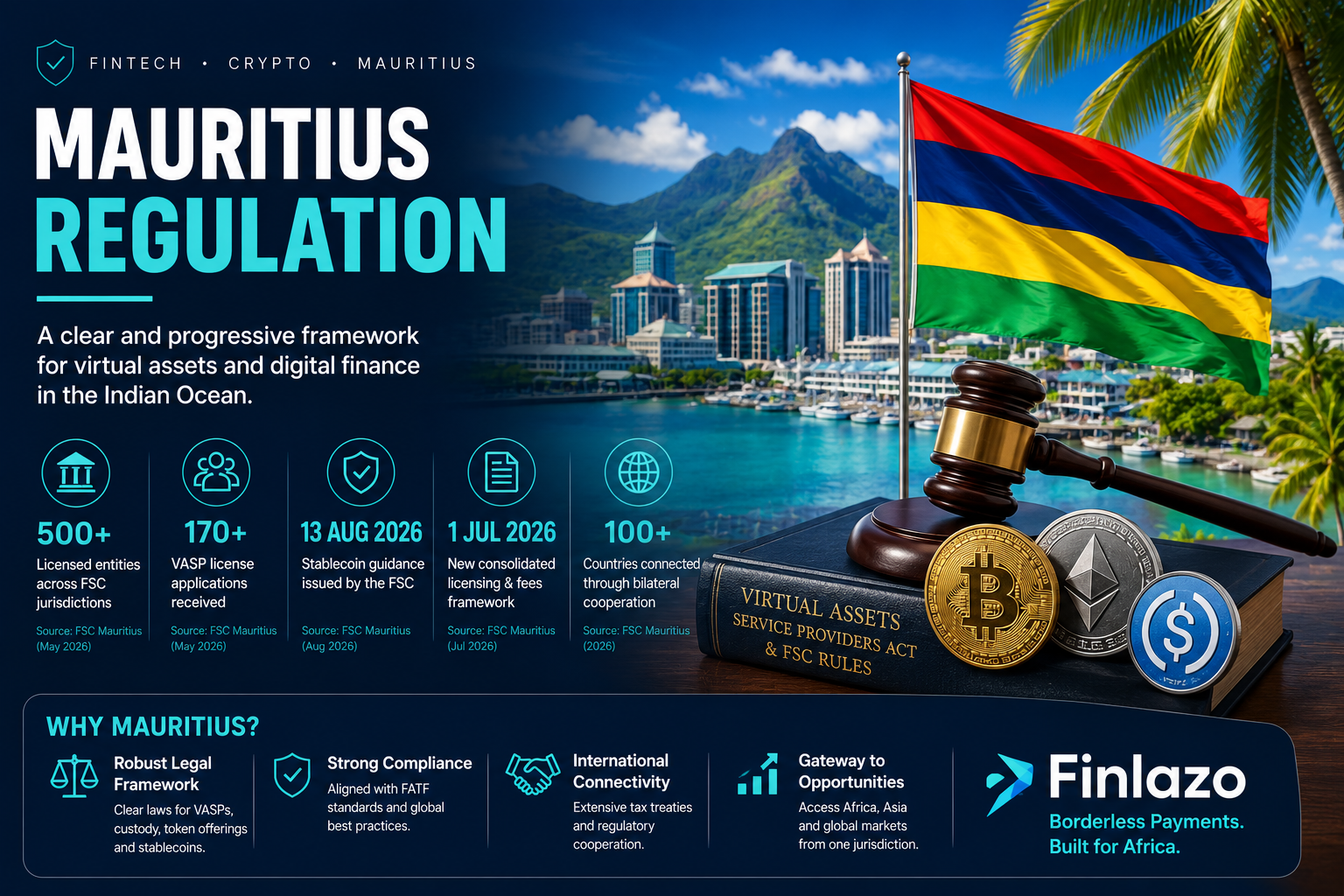
The Virtual Asset and Initial Token Offering Services Act 2021 came into force on 7 February 2022. It gave the Financial Services Commission (FSC) responsibility for regulating and supervising virtual asset service providers and issuers of initial token offerings.
The framework has continued to evolve.
On 1 July 2026, the FSC published the Financial Services (Consolidated Licensing and Fees) (Amendment) Rules 2026, updating the consolidated licensing and fee framework.
On 13 August 2026, the FSC also issued Guidance Notes on Stablecoins, covering the regulatory treatment of stablecoin-related activities.
The current FSC codified licensing list contains five VASP categories: Virtual Asset Broker-Dealer, Virtual Asset Wallet Services, Virtual Asset Custodian, Virtual Asset Advisory Services and Virtual Asset Marketplace.
The same FSC schedule lists processing fees ranging from MUR 45,000 to MUR 135,000, depending on the VASP activity.
Fixed annual fees range from MUR 85,000 for Class O wallet services to MUR 220,000 for Class I advisory services and Class S virtual asset marketplace activities.
These fees are only one part of the compliance burden. VASPs must also meet applicable capital, custody, cybersecurity, risk-management and AML/CFT requirements under the wider Mauritius regulatory framework.
Capital requirements, custody, cybersecurity, risk management, AML/CFT and ongoing reporting all form part of the regulatory framework.
Mauritius Cryptocurrency Regulation at a Glance
- 5 VASP licence categories — Mauritius regulates virtual asset broker-dealers, wallet services, custodians, advisory services and virtual asset marketplaces.
- MUR 45,000 — processing fee for a Class M broker-dealer or Class O wallet-services application.
- MUR 70,000 — processing fee for a Class R virtual asset custodian application.
- MUR 135,000 — processing fee for a Class I advisory or Class S marketplace application.
- MUR 85,000 — fixed annual fee for a Class O wallet-services licence.
- MUR 110,000 — fixed annual fee for a Class R custodian licence.
- MUR 220,000 — fixed annual fee for Class I advisory and Class S marketplace licences.
- 7 February 2022 — date the VAITOS Act came into force.
- 13 August 2026 — date of the FSC's latest stablecoin guidance.
- US$2 million — minimum unimpaired capital for a Class M virtual asset broker-dealer under the 2022 capital rules.
- MUR 5 million — minimum unimpaired capital for a Class R virtual asset custodian.
- MUR 6.5 million — minimum unimpaired capital for a Class S virtual asset marketplace.
The framework should not be read as a single licence for "crypto".
The required authorisation depends on what the business actually does.
A First-Hand Reason I Started Looking at Mauritius
I remember relaxing after work one day and reading a report in the Daily Business press.
It said that some Kenyan startups were considering relocating to Mauritius because of the high capital requirements associated with regulation in Kenya.
That caught my attention.
I wanted to understand what Mauritius actually required.
The more I researched the country, the more interesting the regulatory structure became.
Mauritius was not simply advertising itself as a fintech destination.
It had specific laws, licence categories, capital requirements and supervisory rules.
That distinction matters when a founder is deciding where to build.
A jurisdiction can look attractive from a distance.
The real question is what the regulator actually requires once the application begins.
What Is the VAITOS Act?
The Virtual Asset and Initial Token Offering Services Act 2021 is the main law governing VASP activity in Mauritius.
It came into force on 7 February 2022.
The FSC is responsible for regulating and supervising VASPs and issuers of initial token offerings.
The Act is designed around financial-crime controls and international standards.
It is therefore broader than a licensing law.
It creates the legal foundation for supervision, compliance, client protection and enforcement.
Why Mauritius Built a VASP Framework
Virtual assets can create new financial products.
They can also create new money-laundering and terrorist-financing risks.
The Mauritius virtual-asset risk assessment identified multiple VASP channels touching the banking, non-bank financial and informal sectors.
The assessment identified virtual-asset exchanges, wallet providers, virtual-asset broking and other channels.
The point was not to stop innovation.
It was to understand where the risks sit.
That risk-based approach became part of the regulatory architecture that followed.
Who Regulates Cryptocurrency in Mauritius?
The Financial Services Commission is the regulator for VASPs operating in or from Mauritius.
The FSC's role covers licensing and supervision.
It also publishes regulatory rules, licensing information, public notices and enforcement-related material.
The Bank of Mauritius remains relevant to the wider financial system.
That distinction matters because a crypto business can have both virtual-asset and payment-related dimensions.
A company should therefore assess its full operating model rather than assume that one approval covers every activity.
What VASP Licences Are Available in Mauritius?
The FSC's current codified list contains five VASP licence categories.
Class M — Virtual Asset Broker-Dealer
A Class M licence covers exchange activity involving virtual assets and fiat currencies, as well as exchanges between different virtual assets.
The FSC currently lists a MUR 45,000 processing fee and a MUR 90,000 fixed annual fee.
The capital requirement is much higher than the application fee.
The 2022 capital rules require a new Class M operator to maintain minimum unimpaired paid-up capital of MUR 2 million or its equivalent.
Class O — Virtual Asset Wallet Services
Class O covers wallet services, including qualifying virtual-asset transfer activity.
The current FSC fee schedule lists a MUR 45,000 processing fee and an MUR 85,000 fixed annual fee.
The financial requirement is different from a broker-dealer.
The rules focus on sufficient working capital to continue the business for 12 months based on realistic forecasts under different market conditions.
Class R — Virtual Asset Custodian
A Class R custodian safeguards and administers virtual assets or instruments that enable control over them.
The current FSC fee schedule lists a MUR 70,000 processing fee and an MUR 110,000 fixed annual fee.
The capital rules require minimum unimpaired paid-up capital of MUR 5 million for a new Class R operator.
Custody is one of the highest-risk functions in the sector.
A loss of private-key control can directly affect client assets.
Class I — Virtual Asset Advisory Services
Class I covers advisory services connected with virtual assets.
The FSC's current codified list shows a MUR 135,000 processing fee and MUR 220,000 fixed annual fee.
The capital rules are designed around the applicant's ability to meet liabilities as they fall due.
The exact obligations depend on the business model.
Class S — Virtual Asset Marketplace
Class S is the marketplace category.
It covers the operation of a virtual-asset marketplace.
The current fee schedule lists a MUR 135,000 processing fee and MUR 220,000 fixed annual fee.
The capital rules require minimum unimpaired paid-up capital of MUR 6.5 million.
The higher threshold reflects the broader infrastructure and operational risks associated with running a marketplace.
Seychelles vs Mauritius
Mauritius and Seychelles both have dedicated VASP frameworks.
Their structures are different.
Mauritius uses five VASP licence categories under the VAITOS Act.
For comparison, see Seychelles cryptocurrency regulation, where the regulatory model includes separate VASP activities, capital requirements and substance obligations.
The comparison is useful for founders evaluating African jurisdictions.
A company should compare the actual licence, capital, substance, compliance and tax requirements rather than relying on the reputation of the jurisdiction alone.
Mauritius' Latest Stablecoin Rules
One of the most important recent developments came on 13 August 2026.
The FSC issued its Guidance Notes on Stablecoins.
The guidance recognises the growing role of digital assets in financial services and payment systems.
It addresses:
- Stablecoin issuance.
- Distribution.
- Facilitation of stablecoin transactions.
- Reserve-asset management.
- Redemption rights.
- Governance.
- Risk management.
- Custody.
- Disclosure.
- Prudential safeguards.
This is significant because stablecoins are increasingly used beyond crypto trading.
They can form part of payment, settlement and liquidity models.
The FSC's new guidance shows that Mauritius is trying to bring those activities into a defined regulatory framework.
Stablecoins Are Not Automatically Payment Instruments
The existence of stablecoin guidance does not mean every stablecoin is treated as legal tender or an ordinary payment instrument.
The FSC guidance sits within the FSC's legal mandate and has to be read with the VAITOS Act and other applicable laws.
The regulatory treatment therefore depends on the asset and the activity.
A business should identify exactly what it is issuing, holding, distributing or facilitating.
AML and CFT Requirements
AML/CFT compliance is central to the Mauritius framework.
The FSC's AML/CFT guidance for VASPs and initial token issuers explains the measures regulated entities should apply to prevent money laundering and terrorism financing.
The framework connects VASP obligations with Mauritius' broader AML legislation.
A compliance programme can involve:
- Customer due diligence.
- Beneficial-owner identification.
- Risk assessment.
- Transaction monitoring.
- Suspicious transaction reporting.
- Record keeping.
- Sanctions and financial-prohibition controls.
The exact controls should match the business and its risk exposure.
Cybersecurity and Client Asset Protection
The Mauritius framework does not treat cybersecurity as a technical side issue.
The FSC has separate rules covering cybersecurity and custody.
The custody rules apply to VASPs that hold client assets.
A wallet or custodian must be able to demonstrate how client assets are safeguarded.
The rules also recognise the importance of private keys.
For a business holding customer crypto, key management is therefore part of regulatory compliance.
Client Disclosure and Risk Management
The FSC also maintains separate rules on client disclosures and risk management.
That reflects a basic principle.
Customers need meaningful information about the services they are using.
They also need to understand the risks.
A VASP should not present a volatile digital asset as though it were equivalent to cash.
The same principle applies to stablecoins.
A stable value target does not remove issuer, reserve, custody or market risks.
Initial Token Offerings in Mauritius
Mauritius also regulates initial token offerings.
The VAITOS Act provides for the registration of issuers of initial token offerings.
The FSC's framework distinguishes token issuance from VASP service activities.
That means a company creating a token may face different requirements from a company operating an exchange.
The business model must therefore be mapped before an application is prepared.
What Happens If a Business Operates Without a Licence?
The law treats unauthorised VASP activity seriously.
The FSC's proclamation notice states that carrying out VASP business in or from Mauritius without the appropriate licence is an offence.
The Act provides for a fine of up to MUR 5 million and imprisonment of up to 10 years on conviction.
The penalty should not be treated as a business cost.
It is a criminal consequence for unauthorised activity.
Mauritius' Wider Financial Services Sector
The VASP regime sits within a large financial-services industry.
The FSC Annual Statistical Bulletin 2025 reports that total assets for financial-services entities covered by its overview reached MUR 90.3 billion in 2024.
Total income reached MUR 14.6 billion.
The sector employed 11,315 people directly in 2024.
These figures are not crypto-market figures.
They show the financial infrastructure around the VASP framework.
Why Mauritius Attracts Fintech Businesses
Mauritius has spent decades developing its international financial-centre model.
Its government describes financial services as contributing 13.4% of GDP and directly employing more than 19,000 professionals.
The country also launched a 2025–2030 financial-services strategy focused on modernising products, improving the ease of doing business and expanding international markets.
Crypto regulation fits into that broader strategy.
The goal is not simply to permit digital assets.
It is to place them inside a wider financial-services ecosystem.
What Does Mauritius' Framework Mean for Crypto Startups?
A founder should start with the business model.
Ask:
- Will the company exchange crypto for fiat?
- Will it operate a wallet?
- Will it custody customer assets?
- Will it run a marketplace?
- Will it provide advisory services?
- Will it issue tokens?
- Will it handle stablecoins?
The answers can determine the licence category.
The next step is the financial model.
Capital requirements can be substantial.
The business also needs compliance, governance, technology and operational substance.
Is Mauritius Crypto Regulation Strict?
It is better described as structured than simply strict.
The framework provides defined licence categories.
It also creates rules for capital, custody, cybersecurity, risk management and AML/CFT.
At the same time, the FSC continues updating its framework.
The 2026 stablecoin guidance is a good example.
The regulatory model is therefore evolving alongside the market.
Mauritius Cryptocurrency Regulation: Key Numbers and Dates
- 7 February 2022 — VAITOS Act came into force.
- 5 — VASP licence categories in the FSC's current codified framework.
- MUR 45,000 — Class M processing fee.
- MUR 45,000 — Class O processing fee.
- MUR 70,000 — Class R processing fee.
- MUR 135,000 — Class I processing fee.
- MUR 135,000 — Class S processing fee.
- MUR 2 million — Class M minimum unimpaired capital.
- MUR 5 million — Class R minimum unimpaired capital.
- MUR 6.5 million — Class S minimum unimpaired capital.
- 13 August 2026 — FSC issued its stablecoin guidance.
- MUR 5 million — maximum fine stated in the FSC's proclamation for unauthorised VASP activity.
- 10 years — maximum imprisonment term stated in that proclamation.
Frequently Asked Questions
Is cryptocurrency regulated in Mauritius?
Yes. Mauritius regulates virtual asset businesses under the Virtual Asset and Initial Token Offering Services Act 2021, which came into force on 7 February 2022.
Who regulates cryptocurrency in Mauritius?
The Financial Services Commission is responsible for regulating and supervising VASPs and initial token issuers operating in or from Mauritius.
What VASP licences are available in Mauritius?
The FSC currently lists five categories: Virtual Asset Broker-Dealer, Virtual Asset Wallet Services, Virtual Asset Custodian, Virtual Asset Advisory Services and Virtual Asset Marketplace.
How much capital does a crypto business need in Mauritius?
The requirement depends on the licence. The capital rules include MUR 2 million for a new Class M broker-dealer, MUR 5 million for a Class R custodian and MUR 6.5 million for a Class S marketplace.
Does Mauritius regulate stablecoins?
Yes. The FSC issued Guidance Notes on Stablecoins on 13 August 2026 covering issuance, distribution, transactions, reserves, redemption, governance, custody, disclosure and prudential safeguards.
The Bottom Line
Mauritius has built a dedicated legal framework for virtual assets.
The VAITOS Act came into force in February 2022.
The framework now covers five VASP licence categories.
The latest FSC fee schedule and capital rules show that licensing is only one part of the equation.
A serious applicant also needs strong compliance, governance, cybersecurity and client-asset controls.
The regulatory picture is still evolving.
The FSC's August 2026 stablecoin guidance is a clear example.
That matters because stablecoins are moving beyond trading and into payments, settlement and liquidity.
For founders, Mauritius should therefore be assessed on substance rather than reputation.
The right question is not simply whether Mauritius is crypto-friendly.
It is whether the jurisdiction's licence, capital, compliance and operational requirements fit the business model.
For a comparison with another African VASP regime, see Seychelles cryptocurrency regulation.
For Rwanda's newer framework, see Rwanda cryptocurrency regulation.
The African regulatory map is becoming more defined.
Mauritius is one of the jurisdictions worth watching closely.