How to Send Money from South Africa to Kenya
Discover how to send money from South Africa to Kenya, including transfer fees, ZAR-to-KES exchange rates, delivery speeds, bank and mobile-money options, and what to compare before choosing a provider

On this page
Sending money from South Africa to Kenya can cost very different amounts depending on the provider, delivery method and exchange rate used.
World Bank data for the South Africa–Kenya corridor shows total costs ranging from 2.35% to more than 35% for the surveyed R1,370 transaction, demonstrating how much fees and exchange-rate margins can affect the amount ultimately received in Kenya. World Bank — South Africa to Kenya corridor
For Kenyans living and working in South Africa, the corridor is important for sending money to family, paying expenses, supporting businesses and moving personal funds between the two countries.
The good news is that there are several ways to send money from South Africa to Kenya. The challenge is choosing the option that offers the right combination of cost, exchange rate, speed and convenience.
What Are the Main Ways to Send Money from South Africa to Kenya?
People sending money from South Africa to Kenya generally have several options.
These include:
- Money transfer operators
For example you can send money from South Africa to Mpesa or Airtel Money
- Digital remittance platforms
- Banks
- Mobile-money-linked services
- Cash-based transfers
- Bank-account transfers
The right option depends on whether the recipient needs cash, a bank deposit or mobile-money access, as well as how quickly the money needs to arrive.
The World Bank's South Africa–Kenya corridor data tracks providers using different sending and receiving methods, including bank accounts, cash and mobile wallets.
How Much Does It Cost to Send Money from South Africa to Kenya?
The cost can vary significantly between providers. For a R1,370 transfer, the World Bank's latest corridor dataset shows examples ranging from approximately 2.35% to 35.15% of the amount sent, depending on the provider, delivery method, fee and exchange-rate margin.
That difference is substantial. A provider charging a low upfront fee may still be expensive if it offers a weaker ZAR-to-KES exchange rate.
Conversely, a provider with a higher advertised fee could potentially offer a more competitive exchange rate. This is why comparing only the transfer fee can be misleading.
The more useful number is the total cost of the transfer.
Why South Africa-to-Kenya Payments Matter
Kenya's latest remittance data shows that the South Africa–Kenya corridor carries billions of shillings in annual flows.
The 2025 Remittances Household Survey recorded KSh 4.42 billion in total remittance inflows from South Africa between June 2024 and May 2025, comprising KSh 4.11 billion in cash transfers and KSh 309.2 million in in-kind transfers. South Africa accounted for 0.5% of Kenya's total recorded remittance inflows during the period.
The South Africa–Kenya corridor is one example of a much larger African payments challenge. People increasingly live, work, trade and operate businesses across national borders.
Yet currencies, banks, payment systems and regulatory frameworks remain largely organised by country.
A person earning South African rand may need to send Kenyan shillings to a family member thousands of Kilometres away. A Kenyan business may need to pay a South African supplier. A freelancer may receive income from another African market. And an African company may need to move working capital across multiple jurisdictions.
Each transaction can involve: Currency conversion → payment processing → compliance → settlement → local delivery. Reducing friction at each stage could make cross-border commerce faster and less expensive.
Why the Exchange Rate Matters
When sending South African rand to Kenya, the recipient ultimately receives Kenyan shillings. The exchange rate therefore has a direct effect on the amount received.
A provider can make money in two different ways: Transfer fee and Exchange-rate margin.
The World Bank defines the exchange-rate margin as the difference between the market reference exchange rate and the rate actually applied by the provider. For example, a provider might advertise: “Send money for only R25.”
But if the provider applies a significantly weaker ZAR/KES exchange rate, the recipient could receive less than expected. The cheapest-looking transfer is not always the cheapest transfer.
How Much Can Exchange-Rate Margins Add?
The World Bank's corridor data illustrates the difference clearly.
For a R1,370 transaction, some surveyed providers had exchange-rate margins of around 1.6% to 3%, while others exceeded 5%.
One provider in the dataset, for example, charged a R28 fee and applied an exchange-rate margin of approximately 5.48%, producing a total cost of about 7.52%.
This is why comparing the ZAR amount sent with the KES amount received can be more useful than looking at the advertised fee alone.
How Long Does It Take to Send Money from South Africa to Kenya?
Transfer speed depends on the provider and receiving method. The World Bank's corridor database categorises transfer speeds into several ranges, including:
- Less than one hour
- Same day
- Two days
- Three to five days
The available speed depends on the particular service and payment method. Digital transfers can therefore be considerably faster than traditional bank or cash-based methods in some cases.
Before sending money, check the provider's actual expected delivery time, rather than assuming that every international transfer is instant.
Can You Send Money from South Africa to a Kenyan Bank Account?
Yes. Some providers support direct transfers into Kenyan bank accounts.
This can be useful for larger transfers or recipients who already use a Kenyan bank account.
However, bank transfers can involve additional fees, intermediary institutions or longer processing times depending on the provider and payment route. The World Bank corridor data includes bank-account receiving methods alongside cash and mobile-wallet options.
For the recipient, the most important question is therefore: Where do I want the money delivered?
Can You Send Money from South Africa to Mobile Money in Kenya?
Mobile money is an important part of Kenya's financial system, so mobile-wallet delivery can be particularly convenient for recipients who prefer not to use a traditional bank account.
The World Bank's South Africa–Kenya corridor data includes mobile-wallet receiving methods among the available payment and disbursement channels. World Bank — South Africa to Kenya corridor
For a recipient, receiving money directly through a mobile wallet can reduce the need to visit a bank or cash-out location. However, availability depends on the specific provider and service.
What Information Do You Need to Send Money?
Most regulated money-transfer services require information about both the sender and recipient.
Depending on the provider and transaction, this can include:
- Sender's identification
- Recipient's name
- Recipient's phone number
- Recipient's bank details
- Mobile-money information
- Purpose of the transfer
- Source-of-funds information for certain transactions
The exact requirements depend on the provider, transaction size and applicable regulatory requirements. For larger or unusual transfers, additional verification may be required.
Why Do Providers Ask for Identification?
International money transfers are subject to financial-crime controls. Providers may need to verify customers and monitor transactions to comply with know-your-customer (KYC) and anti-money-laundering requirements.
This means a legitimate provider may ask questions that seem inconvenient but are required for regulatory compliance.
Customers should also be cautious of services that promise to bypass identification requirements. Low friction is not always a sign of a better financial service.
Banks vs Money Transfer Operators
A bank can be useful when the sender and recipient both have bank accounts and the transaction is relatively straightforward.
Money transfer operators can offer greater flexibility, particularly where recipients want cash or mobile-money delivery.
The key differences usually include:
Difference between Bank and Mobile Money receiving options
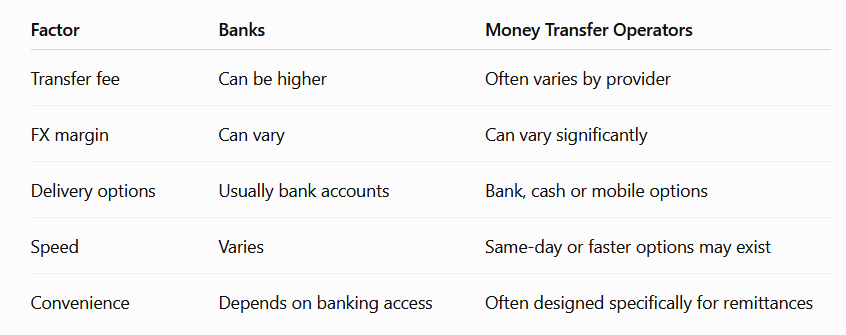
There is no universally cheapest option. The best service depends on the amount, delivery method and exchange rate.
How to Compare South Africa-to-Kenya Money Transfer Services
Before sending money, compare at least four things:
1. Transfer fee How much does the provider charge for sending the transaction?
2. Exchange rate What ZAR/KES rate will actually be applied?
3. Amount received How many Kenyan shillings will the recipient receive?
4. Delivery time When will the recipient actually have access to the money?
The World Bank's remittance database combines the fee and exchange-rate margin into a total cost percentage, making it easier to compare providers on a like-for-like basis.
Why a Cheap Transfer Fee Can Be Misleading
Imagine two services.
Provider A
- Fee: R25
- Better exchange rate
- Recipient receives more KES
Provider B
- Fee: R10
- Worse exchange rate
- Recipient receives less KES
Provider B appears cheaper at checkout. But Provider A could actually deliver more money to Kenya.
This is why the most important question is not: How much is the transfer fee? It is: How many Kenyan shillings will the recipient receive after all costs?
What Is the Cheapest Way to Send Money from South Africa to Kenya?
There is no single provider that is always cheapest. World Bank data demonstrates how dramatically costs can differ across providers and payment methods. In its latest South Africa–Kenya dataset, the total average cost for the surveyed corridor was 10.62% for the R1,370 transaction, although individual providers were considerably cheaper or more expensive than the average.
Digital providers can sometimes offer competitive pricing because they operate with lower physical distribution costs. However, customers should compare the final amount received, not simply the advertised fee.
Is It Better to Send Money Online or Through an Agent?
Both methods can work.
Online transfers
Online services can provide:
- Convenience
- Faster processing
- Digital tracking
- Transparent transaction records
Agent-based transfers
Agents can be useful for customers who:
- Prefer cash
- Need assistance
- Do not have access to suitable digital payment methods
- Want to send or receive money in person
The World Bank corridor data includes both internet and agent access points, showing that both models remain part of the South Africa–Kenya remittance market. World Bank — South Africa to Kenya corridor
Can You Send Large Amounts from South Africa to Kenya?
Yes, but larger transactions may be subject to additional verification and regulatory requirements. The provider follows strict AML requirements as per FICA.
The provider therefore may request:
- Proof of income
- Source-of-funds documentation
- Purpose of payment
- Identification
- Additional recipient information
Limits can also differ between providers. For large transfers, customers should check the provider's transaction limits and compliance requirements before initiating the payment.
What About Cryptocurrency and Stablecoins?
Cryptocurrency and stablecoins are emerging as alternative rails for moving value across borders.
Stablecoins can allow value denominated in assets such as the US dollar to move over blockchain networks before being converted into local currency. However, they introduce additional considerations, including:
- Regulatory requirements
- Wallet security
- Exchange liquidity
- Conversion costs
- Blockchain fees
- KYC/AML obligations
- Stablecoin risks
They should therefore not automatically be assumed to be cheaper or better than traditional remittance services.
The more important question is whether digital-asset infrastructure can eventually reduce the cost, settlement time and number of intermediaries involved in cross-border transfers. Finlazo's South Africa cross-border payments pillar examines the wider infrastructure behind these developments.
The Future of South Africa-to-Kenya Money Transfers
Digital payments are gradually changing how money moves between African countries.
Mobile wallets, fintech platforms, digital remittance services and blockchain-based settlement networks are creating more ways to move value without relying entirely on traditional correspondent banking structures.
But the winning payment rail will ultimately have to solve several problems simultaneously: - Low cost - Fast settlement - Reliable FX - Regulatory compliance - Consumer protection - Wide local distribution
The South Africa–Kenya corridor illustrates why those factors matter. The World Bank's data shows that consumers can face substantial differences in total transfer costs depending on the provider and delivery method.
The opportunity for the next generation of African payment infrastructure is therefore not simply to create another way to send money. It is to make cross-border money movement as simple as domestic digital payments have become.