Cross-Border Payments in South Africa: Infrastructure, Costs and the Road to Faster Settlement
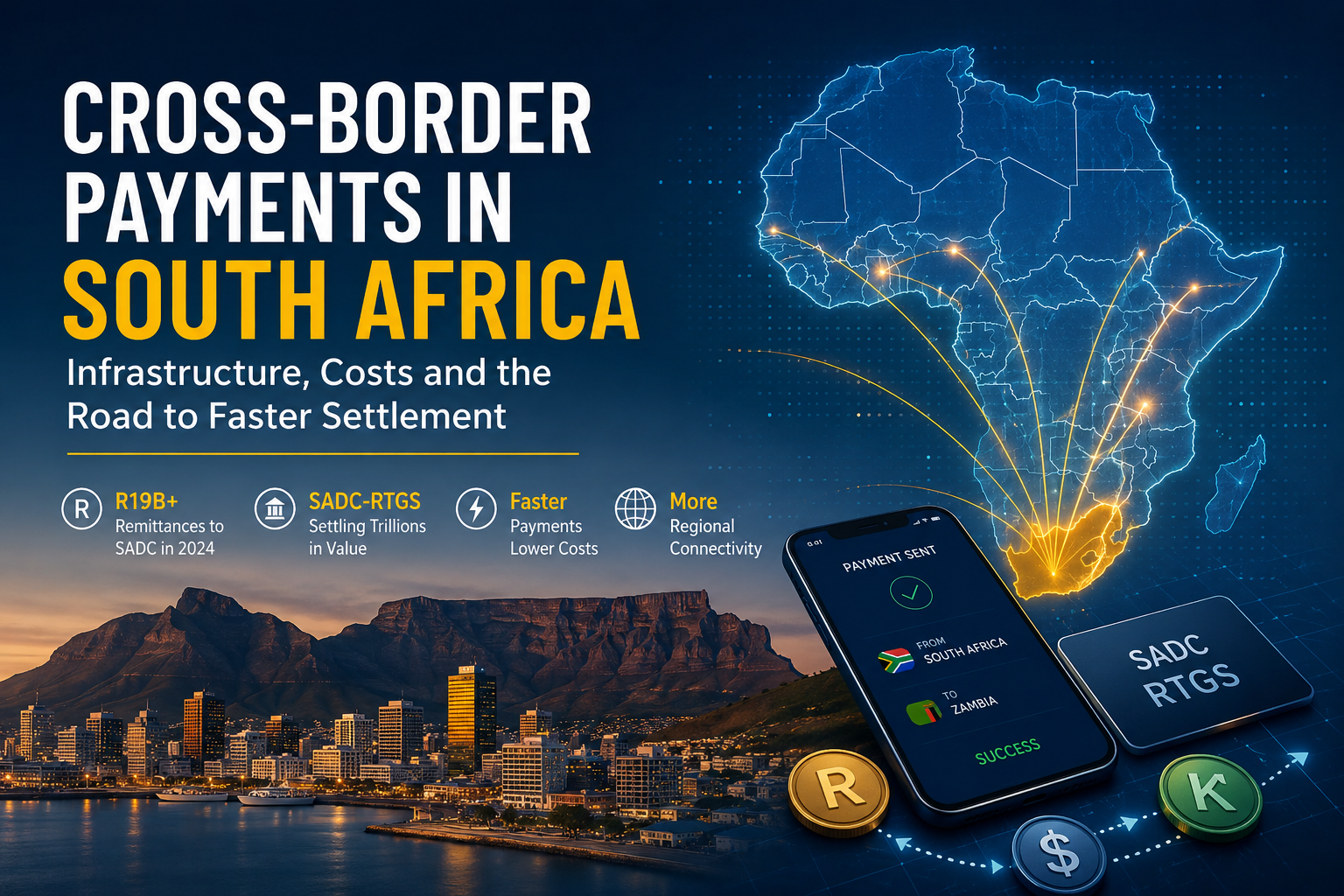
South Africa's cross-border payment market is growing, with formal remittance outflows to SADC countries exceeding R19 billion in 2024. This article examines the costs, regional payment infrastructure and emerging technologies shaping faster cross-border settlement.

On this page
In August 2024, I was on holiday in Dubai. I needed some money, and a friend sent me US$1,000 through Western Union. I remember the transfer fee being around US$15, although I no longer have the receipt and would not present that figure as an exact historical cost.
What stayed with me was that the visible fee was only part of the equation.
The exchange rate used by a money-transfer provider can create an additional cost. That is through the exchange-rate margin — the difference between the provider's rate and the market reference rate. The World Bank tracks this separately from the advertised transfer fee because both contribute to the actual cost of moving money across borders.
That experience was not an African-to-African transfer.
But it made me think about a broader question: Why does moving money across borders still require so much infrastructure, intermediation and foreign-exchange friction when domestic digital payments can be almost instantaneous?
South Africa provides an especially interesting case. It has one of the continent's most developed financial systems, yet cross-border payments within the Southern African region still involve multiple currencies, payment systems, regulatory requirements and settlement arrangements.
And the numbers show that this is not a small market.
South Africa Is a Major Regional Payment Hub
South Africa is the economic and financial hub of the Southern African Development Community (SADC), making it an important origin point for regional remittances.
A recent South African Reserve Bank study found that formal remittance outflows from South Africa to SADC countries exceeded R19 billion in 2024. That is more than three times the R6 billion recorded in 2016.
The same study found that Zimbabwe, Lesotho, Malawi and Mozambique accounted for nearly 90% of formal SADC remittances originating from South Africa.
That concentration tells us something important. South Africa's cross-border payment challenge isn't theoretical. There are millions of people and businesses regularly moving money between South Africa and neighbouring economies.
Why Cross-Border Payments Are Different
Sending money domestically is relatively straightforward. A customer can initiate a payment in rand and have the recipient receive rand through a domestic payment network.
Cross-border payments introduce additional layers. A South African sender may need to move: ZAR → Foreign exchange → Cross-border payment infrastructure → Correspondent or regional settlement system → Local currency → Recipient.
Each additional layer can introduce:
- Foreign-exchange costs
- Compliance checks
- Settlement delays
- Intermediary fees
- Liquidity requirements
- Different regulatory rules
- Different payment standards
The South African Reserve Bank has described cross-border payments in sub-Saharan Africa as fragmented, costly and slow compared with increasingly sophisticated domestic payment systems. That is the infrastructure problem.
South Africa Already Has Regional Payment Infrastructure
The answer isn't that South Africa lacks payment infrastructure. Quite the opposite. South Africa operates and participates in several important regional payment systems.
The SADC Real-Time Gross Settlement system (SADC-RTGS) settles large-value cross-border transfers within the SADC region, while the Transactions Cleared on an Immediate Basis (TCIB) scheme supports lower-value cross-border payments.
SADC-RTGS is already operating at substantial scale. In June 2026, it processed 156,530 transactions worth ZAR 250.7 billion. And as of July 2025, the system had settled more than 5.3 million transactions worth ZAR 17.34 trillion since inception.
So the question isn't: Does South Africa have cross-border payment infrastructure? It does.
The more interesting question is: How effectively can the different pieces of that infrastructure connect banks, fintechs, payment providers and end users?
TCIB Is Designed for Smaller Cross-Border Payments
Large-value settlement is only one part of the problem. Most ordinary consumers and small businesses aren't sending hundreds of millions of rand through a wholesale settlement system. They need to send smaller amounts. That's where TCIB becomes important.
The South African Reserve Bank describes TCIB as a retail payment platform designed for lower-value cross-border transactions. The system uses ISO 20022 messaging and is intended to support regional interoperability.
This is important because the future of African cross-border payments isn't simply about building another payment app. It is about making existing payment systems interoperable.
The Remittance Market Shows Where the Friction Remains
The South Africa–SADC remittance market provides a useful illustration. A recent SARB study examined 309 real transactions and binding quotes across the market, covering different transaction sizes and service providers.
The study found that most transactions in the largest formal remittance corridors clustered between R500 and R1,899. More than R4.5 billion was sent in the R1,100–R1,299 transaction range alone during 2024.
This matters because cross-border payment infrastructure isn't only a problem for multinational corporations. It affects ordinary people sending relatively small amounts. And small transactions can be particularly sensitive to fees and exchange-rate margins.
The Cost Is Not Always the Advertised Fee
This is where my Dubai experience comes back into the story. When someone sends US$1,000 internationally, they might first look at the transfer fee. But the real cost can include:
- Transfer fee
- Exchange-rate margin
- Potential receiving charges
- Other intermediary costs
The World Bank's Remittance Prices Worldwide methodology explicitly defines total remittance cost as the fee charged to the sender plus the exchange-rate margin.
That distinction matters. A provider advertising a low or zero transfer fee isn't necessarily offering the cheapest transfer. The exchange rate can make a substantial difference.
For example, the World Bank's South Africa-to-Tanzania corridor data from August 2025 showed one provider with a 6.63% exchange-rate margin, producing a 11.63% total cost for the quoted transaction.
That doesn't mean every South Africa-to-Tanzania transfer costs 11.63%. It demonstrates something more important: The exchange-rate component can materially change the true cost of a cross-border payment.
South Africa's Regional Remittance Market Is Still Expensive in Places
The South African Reserve Bank's research found significant variation in the cost of sending money from South Africa to neighbouring countries. The study notes that international policy targets aim to reduce remittance costs to below 3% of a US$200 transaction by 2030, while eliminating corridors where costs exceed 5%.
That benchmark provides a useful way of thinking about the infrastructure challenge. A payment doesn't necessarily become efficient merely because it is digital. The important questions are:
- How much does it cost?
- How quickly does it settle?
- How transparent is the exchange rate?
- How many intermediaries are involved?
- Can the recipient receive local currency?
Cash Still Plays a Major Role
One of the most interesting findings from the SARB study is that digital infrastructure has not completely displaced cash. Cash remains the dominant first-mile payment method in major South Africa-to-SADC corridors such as Zimbabwe and Malawi, accounting for approximately 80%–90% of transactions in those markets.
That creates an important lesson for fintech companies. Building a sophisticated digital payment network does not automatically mean customers will abandon existing channels. The infrastructure has to solve the user's actual problem: access → payment → conversion → settlement → cash-out or account credit.
If any part of that chain is difficult, users may continue relying on familiar cash-based systems.
South Africa Is Trying to Modernise the Middle Mile
Cross-border payments can be viewed as three layers:
- First mile - Getting money from the sender into the payment system.
- Middle mile - Moving and settling value across the border.
- Last mile - Getting money to the recipient.
The SARB's South Africa-to-SADC remittance study uses essentially this [three-stage framework](South Africa Is Trying to Modernise the Middle Mile). This distinction is useful because different problems occur at different stages.
A customer may have an excellent mobile app but still experience expensive foreign exchange. A payment provider may have excellent technology but limited access to settlement liquidity. A regional payment system may settle quickly while the recipient still depends on a cash-out network. Better cross-border payments require all three layers to work together.
PAPSS Adds Another Piece to the Puzzle
South Africa's regional payment story also exists within the wider African push toward local-currency settlement. The Pan-African Payment and Settlement System (PAPSS) is designed to enable cross-border payments between African countries in local currencies rather than requiring every transaction to pass through a major foreign currency.
PAPSS describes its model as enabling instant or near-instant payments between African countries, with the sender initiating a payment in local currency and the beneficiary receiving funds in their local currency. Its stated processing target for instant payments is within 120 seconds.
This is a fundamentally different approach from traditional correspondent banking. Instead of: Local currency → hard currency → foreign exchange → correspondent bank → local currency, the objective is increasingly: Local currency → regional settlement infrastructure → local currency.
But Interoperability Remains the Hard Part
Africa now has an expanding collection of payment systems. There are domestic instant-payment systems. There is SADC-RTGS. There is TCIB. There is PAPSS. There are mobile-money networks. There are commercial banks. There are fintechs. The challenge is making these systems work together.
The South African Reserve Bank noted in its 2025 G20 cross-border-payments discussions that 31 fast-payment systems were already live across Africa, but interoperability and adoption of common messaging standards remained limited.
That is a critical distinction. More payment systems do not automatically mean better cross-border payments. The value comes from connecting them.
South Africa Is Moving Toward More Interoperable Payments
South Africa's own National Payment System Vision 2030+ consultation paper recognises the importance of regional integration. The document notes South Africa's existing role in SADC payment infrastructure through SADC-RTGS and TCIB, while also identifying PAPSS and other regional initiatives as part of the future cross-border payments landscape.
The direction is clear: Domestic payment infrastructure needs to be designed with regional connectivity in mind. That is increasingly important as African trade becomes more digitally enabled.
A New Development: Crypto Is Entering the Cross-Border Conversation
South Africa's cross-border payment infrastructure is also beginning to intersect with crypto regulation. In August 2026, South Africa published draft rules addressing cross-border crypto-asset transfers.
The proposed framework would treat transfers from South African authorised crypto-asset service providers to offshore providers or non-custodial wallets as cross-border transactions subject to reporting to the Reserve Bank's Financial Surveillance Department. Public comments are due by 30 September 2026.
This development is significant because it shows regulators are increasingly considering crypto as part of the broader cross-border financial system rather than as an entirely separate ecosystem. It also demonstrates why crypto payment infrastructure cannot be designed independently of foreign-exchange, reporting and financial-surveillance requirements.
The Future Is Not Bank Versus Crypto
The more interesting future may be bank + fintech + payment network + digital asset infrastructure. Traditional banks provide:
- Accounts
- Liquidity
- Regulated access
- Settlement
Fintechs provide: - User experience - APIs - Automation - Local payment connectivity - Regional systems provide: - Interoperability - Settlement infrastructure
Digital assets and stablecoins can potentially provide:
- 24/7 transferability
- Programmable settlement
- Cross-border liquidity
- Digital representations of value
The challenge is connecting these pieces while maintaining compliance and protecting customers.
What Better Cross-Border Infrastructure Could Look Like
Imagine a South African business paying a supplier in Kenya. Today, the payment could involve: South African bank → Foreign exchange → Correspondent or regional infrastructure → Kenyan financial institution → KES settlement.
A modern infrastructure layer could potentially abstract much of that complexity from the customer. The customer sees: Pay R100,000 → recipient receives the agreed amount in Kenyan shillings. Behind the scenes, however, the infrastructure would need to manage:
- FX
- Liquidity
- Compliance
- Settlement
- Fraud monitoring
- Reporting
- Reconciliation
That is where payment infrastructure becomes much more interesting than simply building another consumer wallet.
The Real Opportunity Is the Middle Layer
South Africa doesn't need another payment system simply for the sake of having another payment system.
It already has sophisticated domestic and regional infrastructure. The opportunity is increasingly about connecting existing systems. That means building technology capable of communicating with: Banks → Payment processors → Mobile-money networks → Regional payment systems → FX and liquidity providers → Digital-asset settlement networks.
The customer should not need to understand how every layer works. The infrastructure should.
South Africa's Cross-Border Payment Future
South Africa has already built much of the foundation required for modern regional payments.
SADC-RTGS has processed trillions of rand in cross-border settlement. TCIB is designed for lower-value payments. PAPSS is expanding local-currency payment infrastructure across Africa. Domestic instant-payment systems are growing. And regulators are increasingly focused on interoperability, cost, transparency and speed.
The remaining challenge is connecting these systems effectively. For consumers, that means cheaper and more transparent transfers. For businesses, it means faster regional settlement. For fintechs, it means access to interoperable financial infrastructure. And for Africa's broader digital economy, it could mean making cross-border commerce feel much more like domestic commerce.
My experience in Dubai was a small personal example of the friction that can exist when moving money internationally. South Africa's much larger regional payment ecosystem shows why solving that friction requires more than a cheaper transfer fee.
It requires better infrastructure.