Digital Payment Infrastructure in Africa: The Systems Connecting a Digital Economy
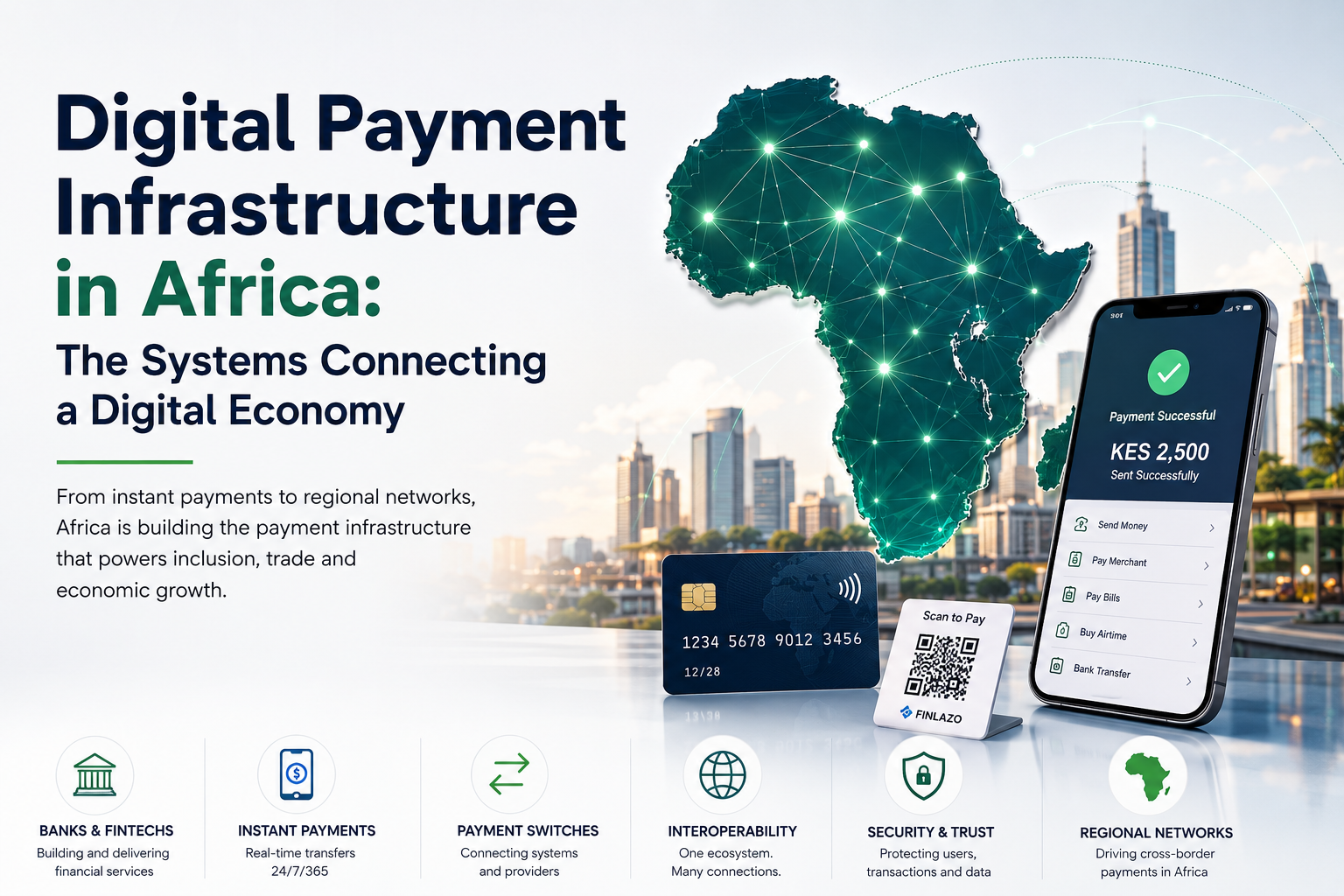
Africa's digital economy depends on the infrastructure behind every payment. Explore how banks, mobile money, fintechs, instant-payment systems and PAPSS are building a more connected payment ecosystem across the continent.

On this page
Africa's digital-payment revolution is entering a new phase.
The first phase was about access: putting financial services onto mobile phones and bringing millions of people into digital payments. The next phase is about infrastructure: making banks, fintechs, mobile-money providers, instant-payment systems and regional networks work together.
The scale of the transformation is already significant. The World Bank's 2026 research on African instant-payment systems finds that almost half of African countries now have a live instant-payment system. But the research makes an important point: building the payment rail is no longer enough. Usage, trust, sustainable economics, interoperability and fair competition are becoming the critical challenges.
Africa's payment infrastructure is therefore evolving from isolated national systems toward increasingly connected financial networks. And the numbers are getting serious.
As of June 2026, the Pan-African Payment and Settlement System (PAPSS) reported 22 African countries signed up and authorized, with more than 180 direct and indirect participating institutions. Its extended network adds another 170 institutions, giving PAPSS reach to more than 270 financial institutions across 15 African countries.
This is not simply a story about faster payments. It is a story about building the financial infrastructure required for a more integrated African economy.
Africa's Payment Infrastructure Is Becoming More Sophisticated
For years, African payment systems developed largely within national boundaries. Kenya built a sophisticated mobile-money ecosystem. Nigeria developed large-scale bank and fintech payment networks. South Africa developed advanced banking and payment infrastructure. Ghana, Rwanda, Tanzania, Uganda and other markets developed their own digital-payment ecosystems.
The result is impressive—but fragmented. A payment network that works extremely well inside one country does not automatically allow a customer to send money seamlessly to another country. That is where interoperability becomes important.
What Is Digital Payment Infrastructure?
Digital payment infrastructure is the underlying technology and institutional framework that allows money to move electronically.
It can include:
- Banks
- Mobile-money platforms
- Payment service providers
- Payment switches
- Automated clearing houses
- Real-time gross settlement systems
- Instant-payment systems
- Card networks
- Digital wallets
- Regional payment networks
- Settlement infrastructure
- Digital identity systems
The World Bank describes payment systems and financial market infrastructures as foundational to financial inclusion, economic development and financial stability. Its work covers everything from domestic retail payments and government payments to foreign-exchange settlement and cross-border payment systems.
In other words, the payment application a consumer sees is only the visible layer. Underneath it sits an increasingly sophisticated network of infrastructure.
Instant Payments Are Becoming National Infrastructure
Instant payments are one of the biggest developments in this transformation. A fast-payment system allows money to become available to the recipient almost immediately, generally operating 24 hours a day, 365 days a year.
The World Bank's 2026 research describes instant-payment systems as increasingly critical national infrastructure across Africa. And there is a reason. Instant payments can support:
- Person-to-person payments - Merchant payments - Government transfers - Remittances - Business payments - Financial services The payment rail therefore becomes a platform on which other financial products can be built.
Africa Already Has a Growing Network of Instant-Payment Systems
The scale has changed dramatically. The World Bank's earlier Africa-wide analysis identified 32 live instant-payment systems in Africa, including 29 domestic systems and three regional cross-border systems, facilitating nearly 32 billion transactions worth approximately $1.2 trillion in 2022.
Since then, the landscape has continued developing. The World Bank's 2026 research now describes almost half of African countries as having live instant-payment systems. That progression matters. Africa isn't waiting for digital payments to arrive. It is building the rails underneath them.
PAPSS Is Building a Regional Layer
One of the most important developments is the Pan-African Payment and Settlement System. PAPSS is designed to facilitate cross-border payments between participating African markets while reducing some of the friction associated with conventional international payment routes.
Its network has grown substantially. As of June 2026: 22 African countries were signed up and authorized. 180+ institutions were participating directly or indirectly. 170+ additional institutions were reachable through extended-network partners. Combined, the network reached 270+ financial institutions across 15 African countries.
And importantly, PAPSS isn't only connecting traditional banks. Its network includes banks and fintechs. That is significant because Africa's payment ecosystem is no longer bank-only.
PesaLink and PAPSS Show Where Interoperability Is Going
In February 2026, PesaLink and PAPSS announced a connection involving more than 80 PesaLink participants and more than 160 PAPSS participating banks, enabling instant, 24/7 cross-border payments into Kenya using local currencies.
This is precisely what interoperability looks like in practice. Instead of forcing users to abandon their existing domestic payment infrastructure, regional connectivity can allow those systems to interact. The long-term model could look increasingly like: Local payment system → regional payment network → local payment system, rather than requiring every country to build a completely new payment infrastructure.
The Payment Switch: The Invisible Connector
One of the least visible but most important pieces of payment infrastructure is the payment switch. A payment switch helps route transactions between different payment systems, providers, banks and networks.
The World Bank describes switches as intermediaries that allow payment providers, banks, non-bank financial institutions and merchants to communicate and complete electronic transactions.
For consumers, the switch is usually invisible. They simply see: Pay → confirmation → money received. But underneath that simple experience may be several interconnected systems. This is why payment infrastructure is becoming increasingly important as Africa's digital economy expands.
Read more: Digital Payments and Financial Inclusion in Africa: What the Data Shows
Banks Are No Longer the Only Infrastructure Participants
The old payment model was heavily bank-centric. The modern model is increasingly multi-layered. Today, payment ecosystems can include: Banks → Fintechs → Mobile-money providers → Payment service providers → Payment switches → Instant-payment operators → Regional payment networks.
The World Bank's 2026 research emphasizes that allowing regulated non-bank providers to participate in instant-payment systems can be critical for competition, innovation and reach.
That is particularly relevant in Africa, where fintech and mobile-money providers often reach consumers that traditional banking infrastructure does not.
Interoperability Is More Important Than Building Another Wallet
This is where Africa's payment infrastructure story gets interesting. There is no shortage of payment applications. Consumers can already choose between:
- Bank apps - Mobile-money wallets - Fintech apps - Cards - Merchant QR systems - Digital wallets The bigger question is: Can these systems communicate with one another?
The World Bank has long highlighted the problem of closed-loop payment systems, where customers can transact easily within one network but face friction when interacting with another. Interoperability allows users to transact across different providers and networks.
That means the next competitive advantage may not simply be: “We have another wallet.” It may be: “Our infrastructure connects everything else.”
The Challenge Is No Longer Just Technology
Africa's payment infrastructure has reached a point where simply building the technology is not enough. The World Bank's 2026 research identifies several constraints:
- Governance
- Pricing
- Fraud
- Dispute resolution
- Trust
- Sustainable economics
- Competition
- Non-bank participation
The report makes a particularly important observation: “Free payments” are not actually free. If policymakers force end-user prices toward zero without creating a sustainable funding model, payment operators may underinvest in reliability, innovation and service quality. That means infrastructure has to be economically sustainable, not merely technically impressive.
Fraud Becomes More Important as Payment Volumes Grow
The success of instant payments creates another problem. Speed helps legitimate users—but it can also help fraudsters. Once money moves instantly, there may be very little time to reverse a fraudulent transaction.
The World Bank identifies fraud, scams and weak dispute-resolution mechanisms as major threats to the adoption of instant payments, particularly among first-time and lower-income users. This makes several technologies increasingly important:
- Digital identity
- Fraud monitoring
- Transaction screening
- Risk scoring
- Authentication
- Dispute management
Payment infrastructure is therefore increasingly becoming a trust infrastructure problem.
Digital Identity and Payments Are Becoming Connected
A fast payment system needs to know:
- Who is paying?
- Who is receiving?
- Is the transaction legitimate?
- Can the transaction be safely authorized?
The World Bank's 2026 work on digital identity and fast payments highlights the growing relationship between trusted digital identity and secure payment infrastructure. Digital identity can support onboarding, fraud prevention and transaction authorization. This means Africa's next-generation payment infrastructure may not consist of payment rails alone. It may combine: Identity + payments + data + security, into a broader digital public infrastructure.
Cross-Border Payments Are the Next Major Test
Domestic interoperability is one challenge. Cross-border interoperability is much harder. Different countries have:
- Different currencies - Different regulators - Different payment systems - Different compliance requirements - Different settlement arrangements - Different consumer-protection frameworks That is why regional systems such as PAPSS matter.
But it also creates an opportunity for payment infrastructure companies that can connect multiple rails while handling the complexity underneath. The customer should not have to understand: which switch, which clearing system, which settlement mechanism or which network processed the transaction. They should simply be able to send and receive money.
Africa's Payment Infrastructure Could Become a Competitive Advantage
Africa's payment transformation is sometimes described purely as a financial-inclusion story. It is bigger than that. Modern payment infrastructure can support:
- E-commerce
- Digital businesses
- Regional trade
- Remittances
- Government services
- SMEs
- Financial services
- Cross-border commerce
The World Bank notes that interoperable digital infrastructure can create network effects, reduce fragmentation and support the development of integrated digital markets across Africa. That makes payment infrastructure part of the continent's broader economic infrastructure.
The Next Payment Revolution Is About Connection
Africa has already built impressive domestic payment systems. Mobile money proved that financial services could leapfrog traditional banking infrastructure. Fintechs proved that new financial products could be built rapidly on top of digital rails.
Instant-payment systems are now making real-time transactions increasingly normal. Regional networks such as PAPSS are beginning to connect national systems. The next challenge is therefore not simply to build another payment product. It is to connect the infrastructure that already exists.
The World Bank's 2026 research makes the direction clear: as instant-payment systems mature, the biggest questions increasingly involve interoperability, governance, trust, fraud, competition and sustainable economics rather than simply whether the technology works.
Africa's digital-payment revolution is therefore moving into a new stage. From access → to infrastructure → to interoperability. And the companies capable of connecting those layers could become some of the most important pieces of Africa's digital economy.