How to Buy USDT (Tether) in South Africa with Rand (2026 Complete Guide)
Learn how to buy USDT (Tether) in South Africa with rand, including EFT and card funding, fees, taxes, regulation, wallet networks and safe buying practices.

On this page
Buying USDT with South African rand is a straightforward way to move from ZAR into a dollar-pegged crypto asset on a supported platform.
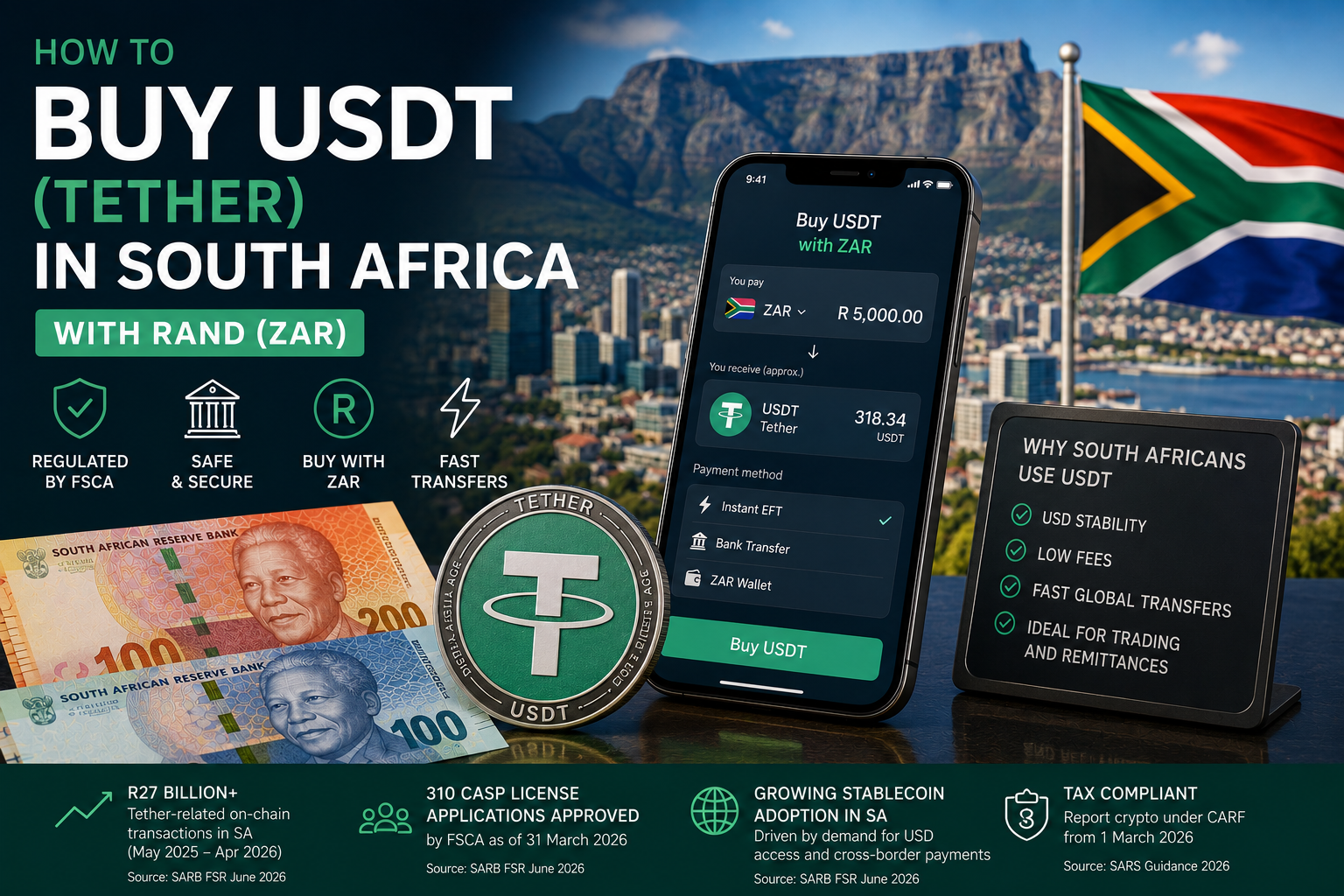
The market around stablecoins has become much more visible to South African regulators. By 31 March 2026, the Financial Sector Conduct Authority had approved 310 crypto-asset service provider licence applications out of 533 received since licensing began. FSCA licensing and supervision update
Tether is also the most prominent stablecoin in South Africa's monitored market activity. The South African Reserve Bank reported almost R27 billion in Tether-related on-chain transactions across Luno, VALR and AltCoinTrader during the year to 30 April 2026. SARB Financial Stability Review, June 2026
USDT should not be confused with rand or with Bitcoin.
Tether is designed to maintain a value linked to the US dollar, while Bitcoin has a floating market price.
This article explains how to buy USDT with ZAR, how bank and card funding work, what fees matter, how South African regulation and tax treatment apply, and what to check before moving USDT off an exchange.
For the country-wide buying guide, see how to buy crypto in South Africa with rand.
For Bitcoin, see how to buy Bitcoin in South Africa.
Buying USDT in South Africa at a Glance
- 310 approved CASP applications — FSCA position as at 31 March 2026.
- 533 CASP applications received — FSCA position as at 31 March 2026.
- Almost R27 billion in Tether-related on-chain transactions — selected South African platforms in the year to 30 April 2026.
- 2 March 2026 — CARF effective date stated in SARS' 2026 FAQ.
- 18% maximum effective CGT rate for individuals — current maximum effective rate stated by SARS.
- R50,000 annual CGT exclusion — current annual capital-gains exclusion for individuals and special trusts.
- 3.9% ZAR card-deposit fee — VALR's current published card funding fee.
- 0% ZAR EFT deposit fee — VALR's current published EFT funding fee.
- 10,000 ZAR rolling 24-hour card limit — VALR's current stated card-funding limit in its USDT buying guide.
- 3 November 2026 — end date for Luno's current discounted ZARU/USDT and ZARU/USDC promotion.
Provider pricing, funding rules and limits can change.
Always check the live quote before confirming a purchase.
What Is USDT?
USDT is the ticker used for Tether.
Tether is a stablecoin designed to track the US dollar.
Luno describes USDT as a US-dollar-pegged cryptocurrency and notes that it is used widely across crypto markets. Luno — What is Tether (USDT)?
USDT is therefore different from Bitcoin.
Bitcoin's market price can rise or fall sharply.
USDT is designed to keep its value close to the US dollar, although a stablecoin can still have risks and can trade away from its target.
Is USDT Legal in South Africa?
USDT can be bought and held through supported services in South Africa.
But it is not legal tender.
The South African Reserve Bank states that crypto assets are not legal tender and are not backed or guaranteed by the central bank. SARB — Crypto Asset FAQ
That applies to crypto assets generally.
It does not turn USDT into South African currency.
Why Do People Buy USDT With Rand?
USDT can be useful for people who want digital dollar exposure inside the crypto ecosystem.
It is also widely used as a trading and settlement asset between crypto markets.
A South African user may buy USDT to:
Hold a dollar-linked crypto asset.
Move value between exchanges.
Trade against other crypto assets.
Transfer value on a supported blockchain.
Use a crypto service that prices a market in USDT.
The correct use case depends on the buyer.
Is USDT the Same as Holding US Dollars?
No.
USDT is a crypto asset.
A US dollar bank deposit is a bank liability denominated in dollars.
The legal, operational and counterparty structures are different.
SARB also warns that crypto assets are not backed or guaranteed by the central bank. SARB — Crypto Asset FAQ
A person seeking conventional USD banking should not assume a USDT balance is equivalent to a bank deposit.
Where Can You Buy USDT With ZAR?
A South African buyer can use a supported crypto-asset service provider that offers ZAR funding and USDT.
VALR currently publishes a South Africa-specific guide for buying Tether with ZAR.
It says users can deposit rand by EFT or card and then buy USDT through its Simple Buy/Sell service or the USDT/ZAR market. VALR — How to Buy Tether (USDT) in South Africa
Luno also lists USDT for South African customers. Luno — Tether
How to Buy USDT With Rand
The process is simple.
Open an account.
Complete verification.
Deposit ZAR.
Choose USDT.
Review the price and fees.
Confirm the purchase.
Then decide whether to keep the USDT on the platform or transfer it to another wallet.
Step 1: Choose a Provider
Start with regulation.
The FSCA licensing framework now covers qualifying crypto-asset service providers.
The regulator had approved 310 CASP applications from 533 received by 31 March 2026. FSCA — CASP licensing update
Check the provider's current regulatory status before depositing money.
For the broader country framework, see crypto regulation in South Africa.
Step 2: Open and Verify the Account
The provider will normally require KYC.
This can include an identity document, passport, proof of address and other information.
Use your own account.
Do not deposit through an unknown third party.
Step 3: Deposit Rand
Once verified, deposit ZAR.
VALR currently lists ZAR EFT deposits as free and ZAR card deposits at 3.9%. VALR — current charges
Its current USDT guide says card funding requires a 3D Secure-enabled card and has a rolling 24-hour card limit of 10,000 ZAR. VALR — buying USDT with ZAR
The exact funding options can differ across providers.
Step 4: Select USDT
Choose USDT or Tether.
On a simple buy interface, you can enter the amount of rand to spend.
On an exchange interface, you can select the USDT/ZAR market.
VALR currently offers both the Simple Buy/Sell route and the USDT/ZAR trading pair. VALR — buying Tether with ZAR
Step 5: Review the Quote
Before confirming, check:
ZAR amount.
USDT amount.
Effective USDT price.
Trading fee.
Funding fee.
Spread.
Any withdrawal charge.
Do not compare only the headline trading fee.
Step 6: Confirm the Purchase
Once the quote looks acceptable, confirm the trade.
The resulting USDT balance should appear in the relevant wallet.
Keep the transaction record.
Step 7: Decide Where to Hold USDT
You can leave USDT on the exchange.
You can also withdraw it to a self-custody wallet if the provider and network support the transfer.
The choice is about custody and risk.
Exchange custody is convenient.
Self-custody puts more responsibility on the user.
Can You Buy USDT Using EFT?
Yes.
VALR currently supports ZAR EFT deposits.
Its current fee schedule lists the ZAR EFT deposit fee as 0%. VALR — current charges
The funds can then be used to buy USDT.
The time required for the bank transfer depends on the bank and provider.
VALR's current USDT guide says EFT deposits take around 2 business days in its documented flow. VALR — buying Tether with ZAR
Can You Buy USDT With a Debit or Credit Card?
Yes, where the provider supports card funding.
VALR currently accepts supported South African Visa and Mastercard cards through its card-buy process and requires 3D Secure. VALR — card deposits and USDT
The current card-funding limit in that guide is 10,000 ZAR on a rolling 24-hour basis. VALR — card limit for USDT purchases
VALR's current fee schedule charges 3.9% for ZAR card deposits. VALR — current charges
Card funding can be convenient.
It can also be more expensive than EFT.
Is EFT Cheaper Than Card for USDT?
It can be.
On VALR, the currently published ZAR EFT deposit fee is 0%.
The current ZAR card-deposit fee is 3.9%. VALR — current charges
That difference makes the funding method worth checking before a purchase.
Another provider can have a different fee structure.
Can You Buy USDT Instantly?
Card-funded purchases can be fast.
VALR says its South African card deposits are credited instantly after successful payment, while its USDT buying guide says EFT deposits can take around 2 business days. VALR — buying USDT with ZAR
The crypto purchase can only happen after the provider receives or makes available the ZAR funding.
Does the USDT Price Stay Exactly at One Dollar?
The design goal is a dollar peg.
That does not mean the market price is guaranteed to be exactly one dollar at every moment.
USDT can trade at a premium or discount to its reference value.
A buyer should therefore check the actual quoted price on the platform.
Why Can USDT Trade Above or Below Its Target?
Crypto-market demand can change.
Liquidity can differ between exchanges.
Trading pairs can move quickly.
Transfers between venues can also affect local pricing.
The peg is a target mechanism, not a promise that every market print will equal exactly one US dollar.
How Is USDT Different From USDC?
Both are dollar-linked stablecoins.
Their issuers, reserve structures, ecosystems and distribution can differ.
South African buyers should compare the asset itself, the provider, the supported networks and the withdrawal costs.
For the South Africa-specific USDC page, see how to buy USDC in South Africa.
USDT vs Bitcoin in South Africa
Bitcoin is a volatile crypto asset.
USDT is designed as a dollar-linked stablecoin.
Chainalysis found Bitcoin represented 74% of crypto purchases made with fiat in South Africa in its centralized-exchange analysis for the 12 months ending June 2025. Chainalysis — South Africa crypto adoption
That statistic describes Bitcoin's share of the analysed fiat-purchase activity.
It does not mean USDT has no demand.
SARB's own data show substantial Tether-related on-chain activity in South Africa. SARB — Financial Stability Review, June 2026
For the Bitcoin purchase process, see how to buy Bitcoin in South Africa.
USDT vs Ethereum in South Africa
Ethereum's native asset is Ether.
ETH is used within the Ethereum network and also trades as a volatile crypto asset.
USDT is designed to maintain dollar-linked value.
For the Ethereum-specific buying process, see how to buy Ethereum in South Africa.
USDT vs Solana in South Africa
SOL is the native asset of the Solana network.
USDT is a stablecoin that can exist across supported blockchain networks.
The two assets therefore serve different purposes.
See how to buy Solana in South Africa.
Why Tether Matters in South Africa
The SARB's June 2026 Financial Stability Review says Tether remained the preferred stablecoin domestically for transactions.
It reported almost R27 billion of Tether-related on-chain transactions across Luno, VALR and AltCoinTrader in the year to 30 April 2026. SARB — Financial Stability Review, June 2026
SARB said crypto-asset activity did not currently pose a systemic risk to the domestic financial system, while noting that it continues to monitor the sector because global stablecoin activity and cross-border linkages are growing. SARB — Financial Stability Review, June 2026
The figure is a market-activity measure.
It is not the amount of USDT held by South Africans.
Is USDT Regulated in South Africa?
The asset itself is not a bank deposit or legal tender.
Qualifying services involving crypto assets are regulated through the applicable financial-services framework.
The FSCA had approved 310 CASP licence applications by 31 March 2026. FSCA — CASP licensing update
A regulated provider can still expose a user to market, counterparty, custody and technology risk.
Regulation does not eliminate those risks.
What Does the South African Reserve Bank Say About Stablecoins?
SARB says crypto assets and stablecoins are being monitored because of the pace of global stablecoin growth and cross-border linkages. SARB — Financial Stability Review, June 2026
In its work on crypto assets for domestic payment purposes, SARB has highlighted concerns around foreign-currency stablecoins and currency substitution.
It has also explored rand-denominated stablecoin use cases in controlled environments. SARB — Crypto assets for domestic payment purposes
That makes the distinction between USDT and a rand-denominated digital asset important.
Can USDT Be Used as Money in South Africa?
USDT is not legal tender.
A merchant can refuse crypto as payment.
SARB's position is that crypto assets are not legal tender and are not backed or guaranteed by the central bank. SARB — Crypto Asset FAQ
A business can voluntarily use crypto in an arrangement that complies with applicable laws, but that does not make USDT South African currency.
Can You Send USDT to Another Wallet?
Yes, where the provider supports external USDT withdrawals.
The critical step is choosing the correct blockchain network.
USDT exists on multiple supported networks.
Sending over an unsupported or incompatible network can result in loss of funds.
Always use the network shown by both the sending platform and the receiving wallet.
What Is the Cheapest Network for USDT?
There is no permanent cheapest network.
Fees and liquidity can change.
The receiving wallet must support the exact network used by the sender.
A cheap network is useless if the destination does not support it.
Check the current withdrawal screen before sending.
Why Does the Network Matter So Much?
USDT is a token representation that can operate on different blockchains.
The same USDT label does not mean that every wallet address is interchangeable.
For example, an exchange may offer USDT withdrawal on one network while your receiving wallet expects another.
Always match the network before confirming.
Can You Buy USDT and Withdraw It Immediately?
Some platforms allow immediate withdrawal.
Others may delay withdrawals after a new deposit or purchase for security reasons.
The current provider policy controls.
A fast purchase does not guarantee immediate external withdrawal.
What USDT Fees Should You Watch?
The main costs are:
ZAR funding fee.
Trading fee.
Spread.
USDT withdrawal fee.
Network fee, where passed through.
A provider can display some of these separately and others inside a quote.
Compare the complete transaction.
What Are VALR's Current USDT-Related Fees?
VALR's current fee schedule lists ZAR EFT deposits at 0%.
It lists ZAR card deposits at 3.9%. VALR — current charges
Its lowest spot stable-to-stable tier is 0.05% taker and 0% maker, but the actual tier depends on the user's rolling 30-day trading volume and the selected market. VALR — current trading-fee tiers
These are VALR-specific figures.
They are not universal USDT fees.
What About Luno and USDT in South Africa?
Luno currently lists Tether among the crypto assets available to South African customers. Luno — Tether
Luno also recently introduced ZARU/USDT trading.
The new market was opened to traders in South Africa and the promotional discounted taker fee is 0.05% until 3 November 2026. Luno — ZARU/USDT launch
This is a different trading route from buying USDT directly with ZAR.
It can be useful for users already holding ZARU.
What Is ZARU?
ZARU is a rand-backed stablecoin designed to maintain a one-to-one relationship with the rand.
Luno says ZARU is backed one-to-one by rand reserves held onshore and is available on its institutional-grade market infrastructure. Luno — ZARU explained
It is not USDT.
USDT is dollar-linked.
ZARU is rand-linked.
That difference matters when comparing digital-dollar and digital-rand exposure.
Can You Buy USDT With Cash?
Direct cash-to-USDT purchases can exist through various channels, but they introduce additional counterparty and fraud risks.
A verified South African provider funded through normal banking or card rails is generally easier to document.
Be cautious with private cash deals.
Never send rand to an unknown person because they promise a better USDT rate.
Can You Buy USDT P2P?
P2P crypto markets exist.
But P2P introduces additional counterparty risk.
Use a reputable platform's escrow and dispute mechanisms where available.
Confirm that the rand payment actually cleared before releasing anything.
Do not rely on screenshots.
Does SARS Tax USDT?
Yes, crypto-asset transactions can have tax consequences.
SARS says normal income-tax rules apply to crypto assets and that taxpayers must declare crypto-asset gains or losses. SARS — Crypto Assets & Tax
The tax treatment depends on the nature of the activity.
Trading can produce ordinary income.
Investment gains can be treated under the capital-gains framework.
Buying USDT does not create a special tax-free category simply because it is a stablecoin.
Is Selling USDT Taxable?
Potentially.
A disposal can create a taxable gain or loss depending on the taxpayer's circumstances and the nature of the transaction.
SARS lists exchange and disposal of crypto assets among transactions that can fall within the normal tax rules. SARS — Crypto Assets & Tax
A swap from USDT into another crypto asset can also have tax consequences.
Do not assume that only cashing out into rand matters.
What Is the Maximum Effective CGT Rate?
SARS currently states a maximum effective Capital Gains Tax rate of 18% for individuals. SARS — Budget 2026 FAQ
That is the maximum effective rate on the taxable capital gain.
It is not an 18% tax on the entire USDT sale proceeds.
What Is the Annual Capital-Gains Exclusion?
SARS currently lists an annual exclusion of R50,000 for individuals and special trusts. SARS — CGT rates and exclusions
The exclusion applies within the capital-gains calculation.
It is not a blanket exemption for every USDT transaction.
Does CARF Apply to USDT Transactions?
Yes, where the transaction falls within the reporting framework and involves a reporting crypto-asset service provider.
South Africa's CARF framework took effect on 1 March 2026.
SARS requires reporting crypto-asset service providers to collect and report specified crypto-asset transaction information. SARS — CARF
The first CARF reporting period runs from 1 March 2026 to 28 February 2027, and the first CARF return is due by 31 May 2027. SARS — CARF dates
Individuals do not submit CARF reports directly.
They must continue declaring taxable crypto activity through normal tax processes.
Does CARF Make USDT Taxable?
No.
CARF is a reporting framework.
SARS explicitly says CARF does not change how crypto assets are taxed. SARS — Budget 2026 FAQ
Taxability still depends on the underlying transaction and the taxpayer's circumstances.
Can You Buy USDT From an Overseas Exchange?
Potentially, but the transaction can involve South African exchange-control considerations.
SARB's current framework allows eligible individuals to purchase crypto assets from abroad using applicable foreign-exchange allowances, subject to the exchange-control rules and authorised-dealer process. SARB — Crypto Asset FAQ
The 2026 individual single discretionary allowance is R2 million per calendar year. SARB — Exchange Control Circular No. 3 of 2026
The individual foreign capital allowance remains R10 million per calendar year with the applicable tax-compliance process. SARS/SARB — 2026 tax chronology
These are exchange-control allowances.
They are not USDT purchase limits.
Is Buying USDT Locally Simpler?
For a South African buyer paying in rand, a local ZAR-enabled platform can be simpler.
The funding rail is local.
The price is displayed in relation to ZAR.
The buyer does not need to add an unnecessary foreign exchange step.
An overseas platform can still offer different liquidity or features.
The total cost and legal setup should be compared.
Can USDT Be Used for Cross-Border Transfers?
Yes, USDT can be transferred across supported blockchain networks.
That is one of the reasons stablecoins matter for cross-border crypto activity.
But sending USDT internationally does not automatically remove South African tax or exchange-control obligations.
The legal and reporting treatment depends on the transaction.
For the broader payments context, see cross-border payments in Africa.
What Are the Risks of Buying USDT?
USDT is designed to be less volatile than assets such as Bitcoin.
That does not make it risk-free.
Risks can include:
Issuer and reserve risk.
Exchange and counterparty risk.
Wallet-security risk.
Blockchain-network risk.
Depegging risk.
Regulatory risk.
A stablecoin can be useful without being equivalent to cash in a bank.
What Is the Safest Way to Buy USDT in South Africa?
Use a provider with clear regulatory status.
Create your own verified account.
Fund through a normal payment method.
Check the exchange rate.
Check the complete fee.
Use two-factor authentication.
Verify withdrawal networks.
Keep transaction records.
Never share your recovery phrase or exchange password.
What Should You Do Before Withdrawing USDT?
Check the destination address.
Check the network.
Check the withdrawal fee.
Check the minimum withdrawal.
Confirm that the receiving wallet supports that exact USDT network.
Then make a small test transfer when the amount is significant.
A wrong network can cause a loss that the exchange cannot reverse.
USDT, USDC and the South Africa Crypto Silo
USDT is the first stablecoin spoke in the Finlazo South Africa crypto cluster.
The next stablecoin page is how to buy USDC in South Africa.
The country hub is how to buy crypto in South Africa with rand.
The major volatile-asset spokes are Bitcoin, Ethereum and Solana.
This structure lets the country page explain the broad buying journey while each spoke answers a much more specific asset search.
Which Is Better: USDT or USDC?
Neither is universally better.
Compare issuer structure.
Compare liquidity.
Compare supported networks.
Compare provider availability.
Compare trading pairs.
Compare withdrawal costs.
Compare the reason you need a stablecoin.
For the second dollar-linked asset, see how to buy USDC in South Africa.
Why USDT Can Be Useful for Traders
USDT is widely used as a quote and settlement asset across crypto markets.
A trader can use it to move between crypto positions without first returning to a bank account.
The South African market's substantial Tether-related on-chain activity supports the view that USDT has a meaningful local role. SARB — Financial Stability Review, June 2026
That does not remove the risks.
Can USDT Be Converted Back to Rand?
Yes, where the provider supports USDT/ZAR selling or another route into ZAR.
VALR currently documents USDT/ZAR trading.
The user can sell USDT and withdraw the resulting rand through the provider's supported ZAR withdrawal methods. VALR — How to Buy Tether (USDT) in South Africa
The withdrawal fee depends on the provider.
What Should You Compare When Buying USDT?
Compare the ZAR deposit fee.
Compare the USDT price.
Compare the spread.
Compare the trading fee.
Compare the withdrawal fee.
Compare network availability.
Compare provider regulation.
Compare the custody model.
The final amount of USDT received for the same ZAR amount is the most useful overall comparison.
South Africa USDT Buying: Key Statistics
- 310 — CASP applications approved by the FSCA as at 31 March 2026.
- 533 — CASP applications received by the FSCA as at 31 March 2026.
- Almost R27 billion — Tether-related on-chain transactions across Luno, VALR and AltCoinTrader in the year to 30 April 2026.
- 74% — Bitcoin share of fiat crypto purchases in South Africa in Chainalysis' centralized-exchange analysis for the 12 months ending June 2025.
- 2 March 2026 — CARF effective date stated by SARS.
- 18% — maximum effective individual CGT rate.
- R50,000 — annual individual CGT exclusion.
- 3.9% — VALR ZAR card-deposit fee.
- 0% — VALR ZAR EFT deposit fee.
- 10,000 ZAR — VALR rolling 24-hour card-funding limit in its current USDT guide.
- 3 November 2026 — end date for Luno's current discounted ZARU/USDT promotion.
- R2 million — current individual single discretionary allowance per calendar year.
- R10 million — current individual foreign capital allowance per calendar year.
- 31 May 2027 — first CARF return deadline.
Frequently Asked Questions
Can I buy USDT with South African rand?
Yes. South African platforms such as VALR support ZAR funding for USDT purchases, and Luno currently lists Tether for South African customers.
What is the easiest way to buy USDT?
Use a verified provider that supports ZAR, deposit rand, select USDT and compare the complete quote before confirming.
Can I buy USDT with EFT?
Yes. VALR currently supports ZAR EFT deposits and lists the EFT deposit fee as 0%.
Can I buy USDT with a debit or credit card?
Yes, where the provider supports cards. VALR currently supports eligible South African cards for its USDT buying flow.
Is EFT cheaper than card?
It can be. VALR currently lists 0% for ZAR EFT deposits and 3.9% for ZAR card deposits.
What is USDT?
USDT is Tether, a dollar-pegged stablecoin designed to track the value of the US dollar.
Is USDT legal tender in South Africa?
No. SARB says crypto assets are not legal tender and are not backed or guaranteed by the central bank.
Is USDT the same as holding US dollars?
No. USDT is a crypto asset with different legal, operational and counterparty structures from a conventional dollar bank deposit.
Does USDT have the same volatility as Bitcoin?
No. USDT is designed to be much less price-volatile because it targets a dollar value. It can still face depegging and other risks.
How much USDT can I buy?
There is no single South African limit. Your provider, funding method and account verification can determine the practical limit.
What does VALR charge?
VALR currently lists 0% for ZAR EFT deposits and 3.9% for ZAR card deposits. Trading and withdrawal charges are separate.
Can I withdraw USDT to my own wallet?
Yes, where the provider supports external USDT withdrawals. Check the exact blockchain network before sending.
What happens if I choose the wrong network?
The transfer can be lost or become very difficult to recover. Confirm that the receiving wallet supports the exact network selected.
Can I convert USDT back to rand?
Yes, where the provider supports USDT/ZAR or another route back into ZAR.
Does SARS tax USDT?
Crypto-asset transactions can create tax consequences. SARS says normal tax rules apply to crypto assets.
Is selling USDT taxable?
Potentially. A disposal can create a taxable gain or loss depending on the transaction and taxpayer's circumstances.
What is the maximum effective CGT rate?
SARS currently states an 18% maximum effective rate for individuals.
What is the annual CGT exclusion?
SARS currently lists R50,000 for individuals and special trusts.
Does CARF apply to USDT?
Yes, where the transaction is reportable and involves a reporting crypto-asset service provider.
When did CARF start?
SARS says CARF took effect on 1 March 2026.
Can I buy USDT on an overseas exchange?
Potentially, but South African exchange-control rules can apply to the funding of foreign crypto purchases.
What are the current offshore allowances?
The current individual single discretionary allowance is R2 million per calendar year, while the individual foreign capital allowance remains R10 million per calendar year with the applicable tax-compliance process.
Is USDT better than USDC?
Not universally. Compare the issuer, liquidity, networks, provider support, fees and your intended use.
Is USDT better than Bitcoin?
They serve different purposes. USDT is a dollar-linked stablecoin. Bitcoin is a volatile crypto asset.
Is USDT better than Ethereum?
They have different functions. USDT focuses on dollar-linked value, while ETH is the native asset of the Ethereum network.
Is USDT better than Solana?
They are different assets with different roles. SOL is the native asset of the Solana network.
The Bottom Line
Buying USDT in South Africa with rand is straightforward when the buyer uses a supported provider and understands the full cost.
The market has become more formal.
The FSCA had approved 310 CASP applications from 533 received by 31 March 2026.
SARB reported almost R27 billion in Tether-related on-chain transactions across Luno, VALR and AltCoinTrader in the year to 30 April 2026.
For the buyer, the process is simple.
Choose a provider.
Complete KYC.
Deposit ZAR.
Select USDT.
Check the price and fees.
Confirm the purchase.
Then decide where the USDT should remain.
The funding method matters.
VALR currently lists 0% ZAR EFT deposits and 3.9% ZAR card deposits.
Its current USDT guide lists a 10,000 ZAR rolling 24-hour card limit.
Luno currently lists USDT for South African customers and has also introduced ZARU/USDT trading, with the current promotional discount ending 3 November 2026.
Tax matters.
SARS currently states a maximum effective individual CGT rate of 18% and an annual CGT exclusion of R50,000.
CARF took effect on 1 March 2026.
SARS says reportable crypto-asset service providers must collect and report specified transaction information under the framework.
USDT is not legal tender.
SARB says crypto assets are not legal tender and are not backed or guaranteed by the central bank.
The most important practical rule is to compare the complete transaction.
Check the ZAR funding fee.
Check the USDT price.
Check the spread.
Check the trading fee.
Check the withdrawal cost.
Check the network.
Check the provider's regulatory status.
For the country hub, return to how to buy crypto in South Africa with rand.
For Bitcoin, see how to buy Bitcoin in South Africa.
For Ethereum, see how to buy Ethereum in South Africa.
For USDC, see how to buy USDC in South Africa.
For Solana, see how to buy Solana in South Africa.
For the regulatory pillar, see crypto regulation in South Africa.
For AML requirements, see South Africa CASP AML requirements.
For the wider African market, see cryptocurrency in Africa.
USDT can be useful.
It is not risk-free.
Understand the asset.
Understand the provider.
Understand the network.
Then make the purchase.