How to Buy Crypto in South Africa With Rand (2026 Complete Guide)
Learn how to buy crypto in South Africa with rand, including ZAR funding, provider selection, fees, regulation, tax, custody and the main crypto assets.

On this page
Nearly 7.8 million customer accounts were registered across Luno, VALR and Ovex by July 2025, according to the South African Reserve Bank. But the number alone does not make buying crypto a single, standard transaction.
A South African buying Bitcoin is making a different purchase from someone buying Ethereum to use on-chain applications.
Stablecoins such as USDT and USDC add another consideration: the blockchain network on which the assets will be sent or received.
The process starts with choosing the asset. From there, you need to decide where to buy it, how to fund the purchase with rand, what you will actually pay and whether you plan to leave the crypto with the provider or move it to another wallet.
Here is how each part works.
Start With the Question Most People Skip: What Are You Actually Buying?
"Crypto" covers thousands of different assets.
That makes choosing the asset one of the first decisions.
Bitcoin: For Exposure to Bitcoin Itself
Bitcoin is the largest crypto asset by market recognition and is commonly bought as an investment or long-term holding. It can also be sent directly between Bitcoin wallets.
As seen in Finlazo's guide on how to buy Bitcoin in South Africa, You do not need to buy a whole Bitcoin. BTC can be bought in fractions.
Ethereum: For ETH and the Ethereum Network
ETH is the native asset of Ethereum. People may buy it for investment, but ETH also has a practical role on the Ethereum network.
It can be needed to pay network fees when interacting with applications and transactions on Ethereum.For a closer look at buying ETH specifically, see how to buy Ethereum in South Africa.
USDT and USDC: For a Dollar-Based Crypto Balance
USDT and USDC are stablecoins designed to maintain a value close to the US dollar.
That makes them different from assets such as Bitcoin or Ethereum, whose prices can move sharply. They are also available on multiple blockchain networks, so the network you choose can matter when sending or receiving them.
Read more about buying USDT in South Africa or buying USDC in South Africa.
Solana: For the Solana Network
SOL is the native asset of the Solana blockchain.
It can be bought as an investment, but SOL also plays a practical role in transactions and other activity across the Solana network. For a closer look at the buying process, see how to buy Solana in South Africa.
The important point is simple: buying crypto is not one decision. Choosing the crypto asset comes first.
Where Does Your Rand Go?
Once you know what you want to buy, the next question is where to make the purchase.
South Africans can use crypto exchanges and other providers that support rand deposits or purchases.
The buying experience can be very different.
Some platforms give you a simple screen where you choose an asset, enter a rand amount and receive a quote.
Others give you access to trading markets such as BTC/ZAR or ETH/ZAR. These platforms may let you place different types of orders and choose the price you are willing to pay.
Neither approach is automatically better.
A simple purchase flow may suit someone who wants to buy and hold. A market-based exchange can give more control to someone who wants to trade or place a specific order.
The Price on the Screen Is Not Always Your Final Cost
This is one of the most important things to understand before buying crypto.
A platform can show you the current market price of an asset. That does not automatically tell you how much crypto you will receive for your rand.
The final transaction can include:
- A trading or conversion fee
- A spread included in the quoted price
- A deposit or funding cost
- A withdrawal fee if you move the crypto later
That is why comparing one advertised fee is not enough.
Before confirming a purchase, check the full transaction.
How much rand are you spending?
How much crypto will you receive?
What fees are shown separately?
What will it cost if you later withdraw the asset?
Those questions give you a better comparison than the headline price alone.
How to Buy Crypto in South Africa
The exact screens differ between providers, but the basic process is similar.
Step 1: Choose the Crypto You Want to Buy
Decide what you are buying before choosing a platform.
If you want Bitcoin, look for a provider that supports BTC and the buying or withdrawal options you need.
If you want a stablecoin, check which stablecoin you want and which network you may eventually use.
Do not choose an asset simply because its price is moving quickly.
Understand what the asset is and why you are buying it.
Step 2: Choose a Platform
Choose a provider that serves South African customers and supports the crypto asset you want.
Compare:
- ZAR deposit options
- Purchase and trading costs
- The quoted price you receive
- Available crypto assets
- Withdrawal options
- Security and account features
The best platform for buying Bitcoin may not necessarily be your best option for buying or using another crypto asset.
Step 3: Create and Verify Your Account
Create an account with your chosen provider.
You will usually need to complete identity verification before accessing all services.
The exact requirements can differ between providers.
Complete the verification process before depositing a significant amount of money.
Step 4: Add South African Rand
Fund your account using one of the methods supported by the provider.
This may include a bank transfer, card payment or another available payment method.
Check the processing time and cost before sending money.
A convenient payment method is not always the cheapest one.
Step 5: Find the Crypto Asset
Search for the asset you want to buy.
You may see its name and ticker symbol.
For example:
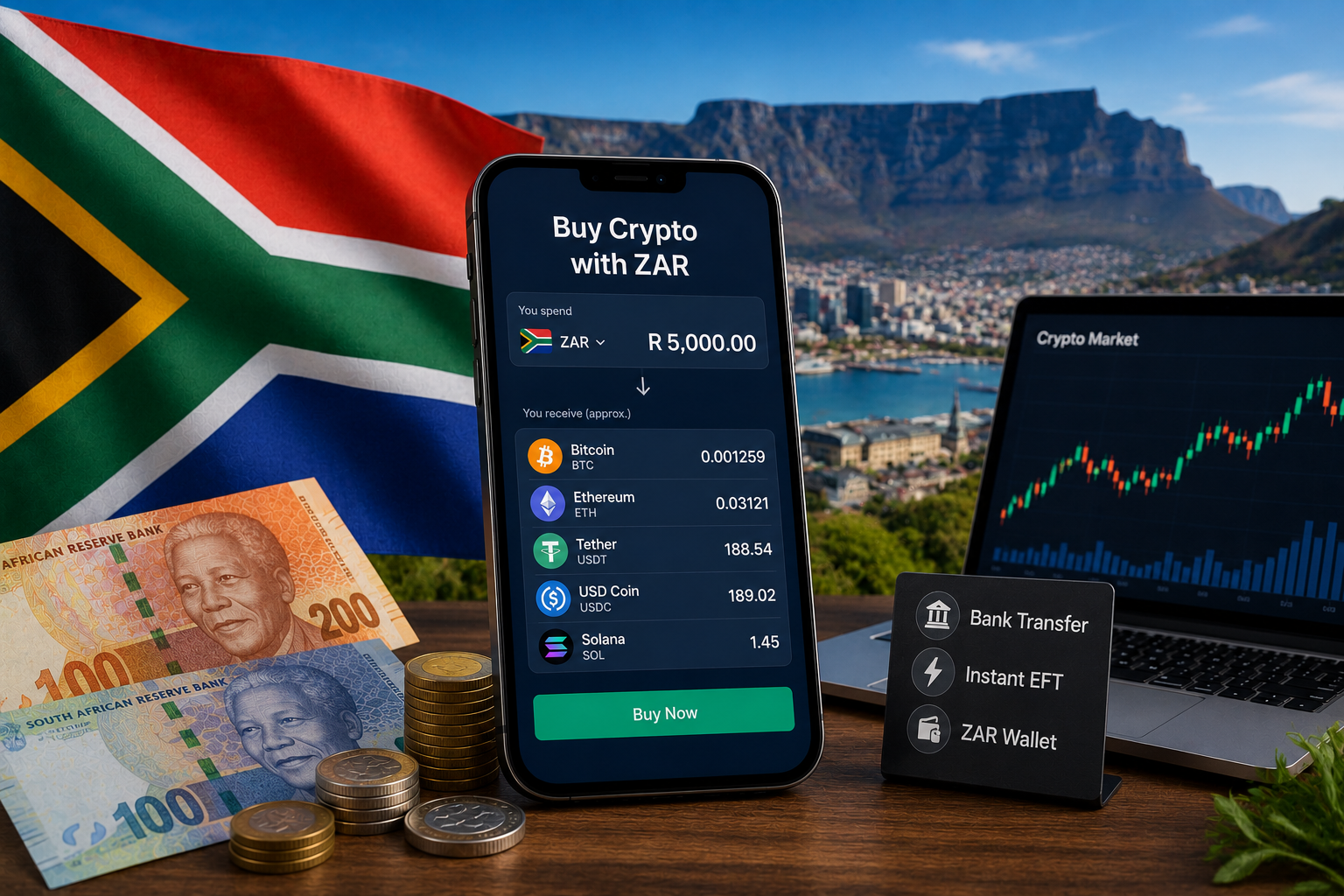
- Bitcoin — BTC
- Ethereum — ETH
- Tether — USDT
- USD Coin — USDC
- Solana — SOL
On some platforms, you will simply enter the amount of rand you want to spend.
On others, you may buy through a market such as BTC/ZAR.
Step 6: Enter the Amount
Enter either the amount of rand you want to spend or the amount of crypto you want to buy.
You do not need to buy one whole unit of Bitcoin, Ethereum or most other crypto assets.
You can usually buy a fraction.
Your decision should be based on how much money you are prepared to allocate, not whether you can afford one complete coin.
Step 7: Check What You Will Receive
Before confirming, check:
- The amount of rand you are spending
- The price being quoted
- Any fees
- The exact amount of crypto you will receive
This final amount matters.
Two platforms can display similar market prices while giving you different amounts of crypto for the same amount of rand.
Step 8: Confirm the Purchase
Once you are satisfied with the transaction details, confirm the purchase.
The crypto will appear in your account balance.
You can then decide whether to keep it with the provider or move it to another wallet.
Buying Is One Step. Using Crypto Is Another
After buying, your next decision depends on the asset.
If you bought Bitcoin as an investment, you may simply hold it.
If you bought ETH to use an Ethereum application, you may eventually need to move it to a wallet you control.
If you bought USDT or USDC, you need to know which network you are using before sending it.
This is where crypto differs from simply buying a share or opening a bank account.
The purchase can be easy. Using or moving the asset can require more care.
The Network Can Matter More Than You Expect
Not every crypto asset works on only one blockchain network.
Bitcoin uses the Bitcoin network.
ETH is used on Ethereum and can also exist in different forms across other supported networks.
Stablecoins such as USDT and USDC are available on multiple networks.
Before withdrawing or receiving crypto, check the network carefully.
The sending and receiving sides need to support the network being used.
Do not assume that two wallets support the same asset in the same way.
For example, receiving USDT on one network is not necessarily the same as receiving USDT on another.
Before You Send Crypto, Stop and Check
Blockchain transactions are not like ordinary bank transfers.
Once a transaction has been processed, recovering crypto sent to the wrong address or through an unsupported network can be difficult or impossible.
Before sending:
- 1Confirm the destination supports the asset
- 2Check which network is required
- 3Copy the receiving address directly
- 4Confirm the address after pasting it
- 5Check the amount being sent
- 6Review the network and withdrawal fees
- 7Read the receiving platform's deposit instructions
For a significant transfer, consider sending a small test amount first where practical.
Where Should You Keep Your Crypto?
You generally have two broad options.
You can leave the crypto with the platform where you bought it.
Or you can move it to a personal wallet.
Keeping it with a provider can be convenient. You may find it easier to trade or sell the asset without moving it again.
A personal wallet can give you more direct control, but it also creates more responsibility.
Depending on the wallet, you may be responsible for protecting private keys or a recovery phrase.
If you lose important recovery information, you may lose access to your crypto.
Never share a recovery phrase with anyone.
Security Starts Before You Buy
A good buying decision can still be ruined by poor account security.
Use a strong and unique password for your crypto account.
Enable available security features, including two-factor authentication where offered.
Be careful with links sent through email, social media or messaging apps.
A platform may have a genuine website and a genuine-looking fake copy somewhere else.
Always check where you are logging in and avoid sharing passwords, verification codes or recovery phrases.
Is Crypto Legal in South Africa?
Crypto assets can be owned and traded in South Africa, but they are not legal tender.
That does not mean every crypto business operates outside regulation.
The FSCA requires crypto asset service providers to obtain the appropriate licence to conduct relevant financial services involving crypto assets.
For wider legal and regulatory position, see crypto regulation in South Africa.
Crypto and Tax: Keep Your Records
SARS says normal tax rules apply to crypto assets.
The tax treatment of a transaction depends on the relevant facts and circumstances.
Keep records showing:
- When you bought crypto
- How much rand you spent
- What asset you received
- How much you received
- Fees paid
- Later sales, exchanges or other disposals
In an October 2024 compliance warning, SARS said that more than 5.8 million South Africans hold a crypto asset. The revenue service also said it was engaging the FSCA and receiving information directly from local exchanges to improve crypto-asset tax compliance.
CARF Changed How Crypto Transactions Are Reported
South Africa implemented the Crypto-Asset Reporting Framework (CARF) on 1 March 2026.
CARF requires relevant crypto-asset service providers to report certain transaction information to SARS. Individual taxpayers do not report directly under CARF, but must continue to declare crypto-asset transactions in their income tax returns under existing tax legislation.
SARS says the first reporting period runs from 1 March 2026 to 28 February 2027, with the first CARF return due by 31 May 2027.
CARF does not create a separate tax on crypto. It changes the reporting framework around relevant crypto transactions.
Before You Buy: A Quick Checklist
Before buying crypto, ask yourself:
- What crypto asset am I buying?
- Why am I buying it?
- Which platform suits the way I want to buy?
- How will I deposit rand?
- What is the total cost of the purchase?
- How much crypto will I actually receive?
- Do I plan to keep it with the provider or move it?
- If I move it, which network will I use?
The answers are often more important than simply finding the platform with the lowest advertised fee.
The Bottom Line
Buying crypto in South Africa starts with a simple question: what are you actually buying?
Once you know that, choose a platform that supports the asset and the way you want to buy it. Compare the full cost of the transaction, check how much crypto you will receive and understand what happens if you later move it elsewhere.
Bitcoin, Ethereum, stablecoins and Solana may all be available on the same platform. That does not make them the same purchase.
The better you understand the asset before buying it, the easier it is to make the right decisions afterwards.