How to Buy Ethereum in South Africa with Rand (2026 Complete Guide)
Learn how to buy Ethereum in South Africa with rand, including ZAR funding, ETH fees, gas, ERC-20 tokens, Layer 2 networks, staking, taxes and safe storage.

On this page
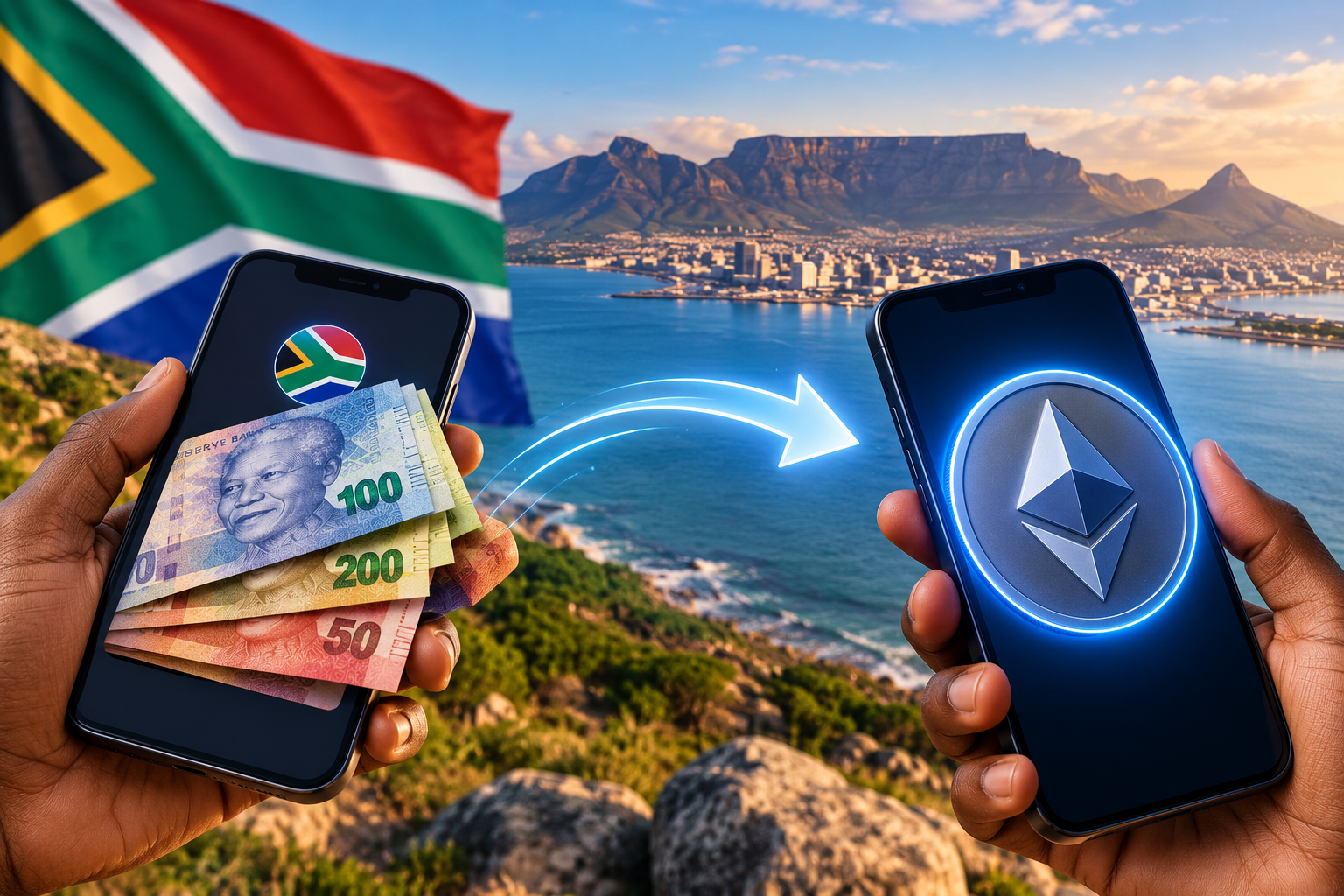
Buying Ethereum in South Africa means using South African rand to acquire Ether, the native crypto asset of the Ethereum network.
Ethereum is different from Bitcoin because ETH is not only an investable crypto asset. It is also the asset used to pay transaction fees on Ethereum and a key part of the network's proof-of-stake security model. What is Ether? — Ethereum.org
Ether (ETH) is the native cryptocurrency of the Ethereum network. It is used to pay transaction fees and is also part of Ethereum's proof-of-stake security system.
For South African users, that creates an important practical distinction. Buying ETH is one decision.
Deciding what you will do with that ETH after buying it is another.
You may simply hold it, use it to pay gas fees, move it to a personal wallet, use Ethereum applications, or stake it through an appropriate service.
For South African users looking to buy a dollar-linked stablecoin instead, see how to buy USDC in South Africa
Why South Africans Use ETH
Some people buy ETH purely as an investment. They want exposure to the price of Ether and may simply hold it on an exchange or move it to a personal wallet.
Others buy ETH because they want to use the Ethereum network.
Ethereum transactions require computational resources, measured in gas, and the resulting gas fees are paid in ETH. Ethereum.org explains how gas works and how fees are calculated.
That matters when sending ETH from one wallet to another, but it also applies to more complex activity.
For example, interacting with a smart contract requires a transaction, and more complex contract interactions generally use more gas than a simple transfer. Ethereum transactions can include regular transfers or interactions with deployed smart contracts.
ETH is also needed for many on-chain activities involving ERC-20 tokens.
If you hold USDT or USDC on Ethereum and want to send the tokens, the transaction still requires gas. Ethereum's fee documentation lists an ERC-20 transfer as a transaction that consumes gas.
This means a wallet can hold USDT or USDC but still be unable to move those tokens if it does not have enough ETH to pay the network fee.
Others buy ETH to participate in staking.
Ethereum uses proof of stake, where validators stake ETH as part of the network's consensus and security mechanism. Ethereum.org explains that staking helps secure the network and allows participants to earn rewards.
The first question - Where Can You Buy ETH With Rand?
VALR
They provide a direct route from South African rand into crypto.
Users can fund a ZAR balance and use that balance to buy supported assets, including ETH. Its platform also offers different ways to trade, which can suit users who want more control over how their order is placed.
For example, a buyer may use a simpler purchase flow or trade through a supported market, depending on the interface and service available to them.
Luno
The platform also serves South African customers and supports Ethereum purchases. Its approach may be more suitable for users who want a simpler route into crypto without immediately dealing with an exchange-style trading interface.
South African users can fund their account in rand using the payment methods supported by Luno before purchasing ETH.
What Matters Beyond the ETH Price
The better choice depends on more than the ETH price shown on the screen. Before choosing a platform, compare:
- 1How you can deposit rand
- 2The cost of funding the account
- 3Trading or conversion fees
- 4Any spread included in the quoted price
- 5The cost of withdrawing ETH if you plan to move it elsewhere
This last point matters more with Ethereum than some buyers initially realise.
If you intend to keep ETH on the platform as an investment, your main concerns may be the purchase cost and custody arrangements.
If you plan to withdraw ETH to a personal wallet, use decentralised applications or interact with tokens on the Ethereum network, check the withdrawal process and make sure you understand the network you will be using before buying.
How to Buy Ethereum With South African Rand
You need a crypto-asset service provider that supports South African customers, ZAR funding and ETH. VALR currently supports ZAR deposits and crypto trading; Luno also serves South African customers and lists Ethereum as an available asset.
Step 1: Choose a Provider
Start with regulation, not price. Check the actual provider rather than assuming every crypto website is regulated — a crypto brand may offer a service in South Africa without being a licensed South African CASP.
Step 2: Complete KYC
A regulated provider normally verifies your identity. You may need an identity document or passport, and proof of address. Additional checks can apply to larger transfers or unusual activity.
Step 3: Deposit ZAR
VALR currently lists ZAR EFT deposits at 0% and ZAR card deposits at 3.9%. VALR current charges Luno's South African card-buy guidance currently lists a matching 3.9% service charge. Luno — Buy crypto with card in South Africa EFT can take longer to clear; card funding can land in seconds but costs more — compare the total cost, not just the speed.
Step 4: Select ETH
Search for Ethereum or ETH. The platform may label it ETH/ZAR, "Buy ETH," or simply "Ethereum" — the objective is the same regardless of the label.
Step 5: Check the Price
Review the ZAR spent against the ETH received, and check the trading fee, spread, funding fee and withdrawal fee separately. A platform can have a low trading fee but a less competitive effective ETH price.
Step 6: Confirm the Purchase
After checking the quote, confirm the order and keep the transaction record — it's useful for tax reconciliation later.
Step 7: Decide What You Will Do With ETH
Leave it on the platform, transfer it to a personal wallet, use it in Ethereum applications, or stake it through an appropriate service. The right choice depends on why you bought it in the first place.
What Is Ethereum Gas?
Gas is the unit Ethereum uses to measure computational work.
Ethereum.org describes gas as the fuel that allows Ethereum transactions and applications to operate, and every transaction requires some amount of it, paid in ETH. Ethereum gas and fees
The total gas fee depends on gas used and the price per unit of gas.
The network fee splits into a base fee (set by the protocol) and a priority fee (a tip to validators), so the formula is roughly: gas used × (base fee + priority fee). Gas prices are usually quoted in gwei — one gwei equals one-billionth of an ETH (0.000000001 ETH). Ethereum gas and fees
Ethereum.org's current examples: a basic ETH transfer uses about 21,000 gas units, an ERC-20 token transfer uses about 65,000, and a token swap runs 100,000–150,000. Ethereum network fees
These are examples, not fixed prices — actual rand cost depends on current gas price and the ETH/ZAR rate.
Why You Need ETH to Send an ERC-20 Token
This is one of the most important things for a new Ethereum user to understand.
An ERC-20 token — the standard interface for fungible tokens on Ethereum, covering things like stablecoins, governance tokens and other fungible assets — is executed by Ethereum smart contracts, and the network charges gas in ETH regardless of which token you're moving. ERC-20 Token Standard
So a wallet holding USDT or USDC on Ethereum but no ETH can become unable to move those tokens — plenty of tokens, not enough ETH to pay the network fee.
ETH itself is native to Ethereum; ERC-20 tokens are created by smart contracts deployed on top of it, which is why an exchange can offer "USDT on Ethereum" alongside "USDT on another network," while ETH itself only exists on Ethereum.
USDT and USDC both operate as ERC-20 tokens on Ethereum as well as on other supported networks — see how to buy USDT in South Africa and how to buy USDC in South Africa for the asset-specific routes.
What Is a Smart Contract?
A smart contract is code deployed on a blockchain that executes according to its programmed rules.
An ERC-20 token can be implemented through one; so can a decentralized exchange. More computation requires more gas, which is why swapping a token typically costs more than a basic ETH transfer.
Ethereum Layer 2s
A Layer 2 is a network built to scale Ethereum while inheriting its security. Ethereum.org says networks such as Optimism and Arbitrum can offer fees 10–100x cheaper than Ethereum mainnet. What is Ether? — Ethereum.org
That saving depends on the transaction and network conditions, and — critically — both the sending and receiving platform need to support the exact same Layer 2.
Buying ETH on a centralized exchange is one decision; moving it to a Layer 2 is another. Never select a network merely because it shows the lowest displayed fee — confirm the destination supports it first.
Staking ETH
Staking is part of Ethereum's proof-of-stake security mechanism.
Validators lock ETH to participate in consensus, and Ethereum.org says validators who stake ETH can participate in transaction processing and earn ETH rewards. What is Ether? — Ethereum.org
Buying ETH does not automatically mean you're staking it. South Africans can potentially stake through available providers or protocols, but the tax and regulatory implications depend on the structure used — understand the provider's terms first.
A staking reward comes from blockchain economics, not a bank's balance sheet: a staking service can introduce smart-contract, platform, liquidity and slashing-related risks that a savings account simply doesn't have. Don't treat staking as risk-free yield.
Wallets and Security
A wallet is software or hardware that lets you control blockchain addresses and sign transactions — it doesn't literally store ETH as a file, since the blockchain records the balance and the wallet just manages the keys.
Exchange custody is convenient; the platform controls the underlying private keys. Self-custody gives you direct control but makes you responsible for securing the recovery phrase — there's no bank branch that can reset it if it's lost, and a hardware wallet only helps if the recovery phrase itself stays protected.
Always verify the exact address and network before sending — confirmed blockchain transactions are generally irreversible, and different assets can share the same address format without being interchangeable.
Never share a wallet recovery phrase, and never enter one into a website claiming to be customer support.
On token approvals: many DeFi interactions require an ERC-20 approval, letting a third party spend a specified amount of a token from your wallet under the contract's rules. EIP-20 — ERC-20 Token Standard Read what you're authorizing — an unlimited approval to a malicious contract can expose your full balance, not just the amount you intended to spend. Many approvals can be revoked later through compatible wallet tools if you're unsure what you've approved.
Ethereum Withdrawal Fees
The platform charges its own withdrawal fee on top of the underlying network's gas cost — some exchanges subsidize part of that, others pass it straight through.
Compare the actual amount of ETH that arrives, not just the platform's displayed fee. And because gas is denominated in ETH, the rand cost of the same gas amount can shift as ETH's price moves, even if the network's gas price hasn't changed at all.
ETH and Taxes in South Africa
SARS says normal tax rules apply to crypto assets.
Long-term investment gains can fall under the capital-gains framework, with a maximum effective individual CGT rate of 18%, and an annual exclusion of R50,000 for individuals and special trusts. SARS — Budget 2026 FAQ SARS — Capital Gains Tax
Frequent or business-like trading can instead produce ordinary income-tax consequences — the nature of the activity determines the treatment, not just the fact that a gain occurred.
South Africa implemented CARF, the Crypto-Asset Reporting Framework, on 1 March 2026.
Reporting crypto-asset service providers must collect and report specified transaction information — CARF is a reporting framework, and it doesn't itself change the underlying tax treatment. SARS — CARF
Keep records regardless: ZAR deposits, ETH purchase and sale confirmations, crypto-to-crypto swaps (potentially a taxable disposal), wallet addresses, transaction hashes, and fees.
Moving ETH between your own wallets is generally different from disposing of it, but record it anyway — good records are what establish that distinction if SARS ever asks.
How Ethereum Compares
Vs Bitcoin
Bitcoin is primarily a decentralized monetary asset; Ethereum is a smart-contract platform, with ETH required to pay gas. See how to buy Bitcoin in South Africa.
Vs USDT/USDC
Both are dollar-linked stablecoins that can exist on Ethereum as ERC-20 tokens, while ETH is native to the network and floats in price. See How to buy USDT and How to buy USDC.
Vs Solana
Different architectures entirely — SOL is Solana's native asset the way ETH is Ethereum's, but the networks don't share technical design or application ecosystems. See how to buy Solana in South Africa.
Risks of Buying ETH
Market volatility, exchange risk, wallet-security risk, smart-contract risk, network-selection mistakes, scams, regulatory change, tax obligations, and staking-specific risk where applicable.
SARB warns that users bear crypto-asset price risk and that crypto assets carry no central-bank backing.
A sophisticated blockchain doesn't make every application built on it safe — the network's security says nothing about the legitimacy of a given smart contract or website.
Confirmed transactions are generally irreversible, and common causes of loss include wrong addresses, wrong networks, phishing, compromised seed phrases and malicious approvals.
Ethereum Buying Checklist
Before buying: verify the provider, complete KYC, fund with ZAR, check the price and fee, check the spread, confirm the ETH amount you'll receive, and decide where you'll store it.
If you plan to use Ethereum on-chain, keep enough ETH for gas.
If you plan to hold ERC-20 tokens, remember they still need ETH to move. If you plan to use a Layer 2, confirm the receiving platform supports that exact network before you withdraw.
Ethereum in South Africa at a Glance
- 21,000 gas units — example gas requirement for a basic ETH transfer.
- 65,000 gas units — example gas requirement for an ERC-20 token transfer.
- 10–100x cheaper — Ethereum.org's stated potential fee advantage of Layer 2 networks such as Optimism and Arbitrum over Ethereum mainnet.
The Bottom Line
Buying Ethereum with South African rand is simple at the entry point.
The deeper story starts after the purchase: ETH pays network gas, supports proof-of-stake security, and is what most wallets need on hand before they can move an ERC-20 token at all.
Start with a provider that supports ZAR, compare the effective ETH price (not just the headline fee), and understand gas before you transact on-chain.
If mainnet fees don't suit your use case, Layer 2 networks can help — provided both ends of the transaction support the same one.
Tax matters too: a maximum effective individual CGT rate of 18%, a R50,000 annual exclusion, and CARF reporting in effect since 1 March 2026.
For a broader look at buying digital assets with rand, including provider selection, ZAR funding and the factors to consider before choosing an asset, see how to buy crypto in South Africa with rand.
South Africa's wider regulatory framework is covered in crypto regulation in South Africa.