How to Buy Solana in South Africa with Rand (2026 Complete Guide)
Learn how to buy Solana (SOL) with South African rand, choose a suitable platform, withdraw SOL safely, understand Solana fees and SPL tokens, and evaluate staking and tax considerations.

On this page
Solana is one of the most widely used smart-contract networks outside Ethereum, but buying SOL is only the first step.
South African buyers also need to understand Solana wallets, network addresses, transaction fees, SPL tokens, staking, and the difference between buying SOL on an exchange and using SOL onchain.
The South African market is also becoming more regulated.
The Financial Sector Conduct Authority (FSCA) said it had received 533 crypto asset service provider licence applications and approved 310 by 31 March 2026. FSCA licensing update
That makes provider selection part of the buying decision, not a detail to check later.
South African users should also keep tax records. SARS says CARF took effect on 1 March 2026 and requires reporting solana and other crypto-asset transaction information from reporting crypto-asset service providers. SARS CARF guidance
For a broader overview of buying digital assets with rand, see how to buy crypto in South Africa with rand.
Why SOL works differently from simply buying a coin
SOL is the native asset of the Solana network. It is used to pay transaction fees and to support activity across applications running on Solana.
A user can hold SOL as an investment, send it to another wallet, use it inside decentralised applications, or stake it with validators.
Solana uses a different account model from Ethereum. The network stores state in accounts, while programs contain the logic that processes instructions. Transactions package one or more instructions together. Solana core concepts
That distinction matters when you move assets around.
A Solana wallet address is not the same thing as an SPL token account. Tokens such as USDC on Solana are issued through token programs and are held in token accounts associated with a wallet. Solana SPL Token basics
This is why sending SOL and sending an SPL token can look similar in a wallet but work differently underneath.
Before buying SOL with rand
Start with the route you plan to use after the purchase.
If you only want to hold SOL, a regulated South African exchange may be enough. If you expect to use Solana applications, swap SPL tokens, or stake, you will also need a compatible wallet.
Check four things before depositing rand: the provider's regulatory status, the ZAR funding method, the spread or trading cost, and its SOL withdrawal policy. A cheap purchase price can become expensive if the platform adds a wide spread or makes withdrawals difficult.
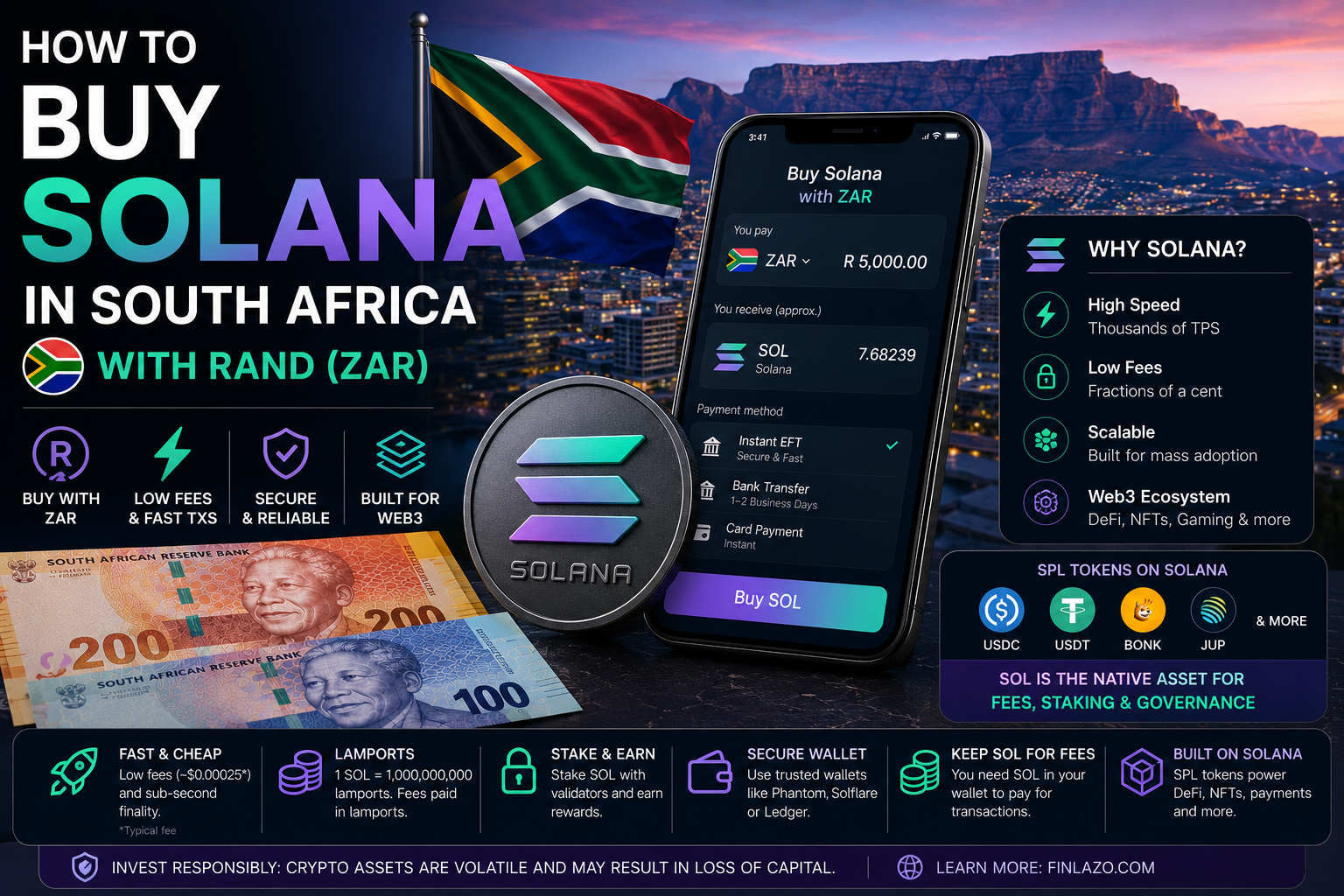
VALR publishes a South Africa-specific SOL buying flow that supports ZAR funding by EFT and by card, with the purchase made after the ZAR balance is credited. VALR's Solana buying instructions
For a wider look at the local crypto market and regulation, see crypto regulation in South Africa.
How to buy SOL in South Africa in 6 steps
1. Choose a South African crypto platform
Prioritise a provider with a clear South African regulatory position and a transparent funding process. The FSCA's licensing regime covers qualifying crypto-asset services under the FAIS framework. Its March 2026 update shows how large the local licensed market has become. FSCA licensing update
Look for SOL/ZAR or another direct SOL market rather than buying an unrelated asset first. Also confirm that the provider allows SOL withdrawals if self-custody matters to you.
2. Deposit ZAR
EFT is usually the straightforward route for larger bank transfers because the money moves from your South African bank account to the exchange. Card funding can be more convenient, but card fees and limits can be higher.
VALR says its SOL purchase flow supports ZAR deposits by EFT and credit or debit card. It states that EFT deposits can take about two business days, while card deposits can be credited instantly, subject to the provider's controls and limits. VALR
Do not judge the cost from the quoted SOL price alone. Check the deposit fee, trading spread, trading fee, and eventual withdrawal charge.
3. Buy SOL instead of chasing the lowest headline price
On a simple buy screen, enter the amount of rand you want to spend and review the SOL amount you will receive. On a professional order book, you can place a market or limit order.
A market order prioritises execution. A limit order lets you specify the maximum price you are prepared to pay. The better choice depends on liquidity, urgency, and how closely you want to control the execution price.
SOL trades continuously, so the ZAR value can move quickly. Buying smaller amounts does not remove price risk. It simply reduces the size of the position. ### 4. Understand the Solana fee before withdrawing
Every Solana transaction requires a fee paid in SOL. The current protocol fee structure has a base fee of 5,000 lamports per signature, plus an optional prioritisation fee. Solana fee documentation
One SOL equals 1,000,000,000 lamports. Solana developer documentation
The fee is separate from the exchange's own withdrawal charge. Your exchange may charge a fixed withdrawal amount even when the underlying Solana network fee is small. Compare those two costs separately.
Priority fees can increase transaction scheduling priority during periods of demand. That does not mean every ordinary wallet transfer needs an expensive priority setting.
5. Withdraw to the right Solana address
This is where Solana differs sharply from a simple bank transfer.
A Solana wallet address should be checked carefully before you approve a withdrawal. Do not assume that an address designed for another network can receive SOL.
For SPL tokens, the network uses token accounts associated with the owner's wallet. Solana's documentation notes that token transfers rely on token accounts and that the expected mint should be checked when handling a token transfer. Solana payment address verification
For a normal SOL withdrawal, confirm that the recipient address is a Solana address and that the destination wallet supports Solana. Send a small test amount first when the wallet or recipient is unfamiliar.
Never paste a recovery phrase into an exchange chat, website popup, or support conversation. A real support representative does not need your seed phrase.
6. Keep enough SOL for future activity
A common mistake is to withdraw every last fraction of SOL and leave a wallet with no SOL to pay future network fees. If you later receive or move SPL tokens, you may still need SOL for transaction fees.
Solana also uses account structures for token balances and application state. Creating some token-related accounts can require lamports to fund account storage. Solana's developer documentation describes the minimum balance used when creating token accounts and mint accounts. Solana account funding example
The practical lesson is simple: do not treat SOL as only an investment asset. On Solana, it is also the network fuel.
SOL, SPL tokens and why USDC can live on Solana
Solana supports fungible tokens through the Solana Program Library, commonly called SPL tokens. Token accounts hold balances for a particular mint. The token program validates that transfers use compatible token accounts for the same mint. SPL Token basics
That is important for South African users because a wallet may display SOL, USDC, USDT and other assets together even though SOL itself is the native network asset and the others are tokenized assets.
The network used for the withdrawal must match the asset's supported network. Sending an exchange's Solana-based USDC to an Ethereum-only destination, for example, is not the same as sending money between ordinary bank accounts. Always confirm the receiving platform supports the exact network.
This also creates a natural connection with how to buy USDT in South Africa and how to buy Ethereum in South Africa. The assets can appear in the same portfolio, but their networks and transaction mechanics are different.
Staking SOL is a separate decision
Holding SOL and staking SOL are not the same thing. Staking involves delegating SOL to validators that participate in securing the network. Solana says staking rewards depend on factors including the network's current inflation rate, the amount of SOL staked, validator uptime and validator commission. Solana staking
Solana's published staking model starts with an 8% annual inflation rate, decreases the inflation rate by 15% year over year, and targets a long-term inflation rate of 1.5%. The inflation rate is not the same as the yield earned by an individual staker. Solana staking economics
That means a headline staking percentage should not be treated as guaranteed income. Validator performance and commission matter.
Delegators should also understand unstaking mechanics, wallet support and liquidity needs before locking up funds.
Solana wallet security matters more than the purchase screen
The exchange is only one part of the security model. Once SOL leaves the exchange, control depends on the wallet's private keys or recovery system.
For meaningful holdings, separate the amount you keep for active transactions from longer-term holdings. A hardware wallet can reduce exposure to malware and browser-based attacks, but only when the user follows the device's security procedures.
Be particularly careful with Solana applications. Signing a transaction can give a program permission to perform actions you did not expect. Read wallet prompts rather than approving every transaction automatically.
Do not connect a valuable wallet to random token claim sites, copy trading dashboards, or unsolicited airdrop links. A familiar-looking Solana interface is not proof that a program is legitimate.
Taxes: buying SOL is not the same as having no tax consequences
SARS treats crypto activity within the South African tax framework. The 2026 Budget Tax Guide lists a maximum effective Capital Gains Tax rate of 18% for individuals and an annual R50,000 capital-gain exclusion. SARS 2026 Tax Guide
The nature of the activity matters. SARS's 2026 FAQ explains that frequent or business-like trading can result in gains being taxed as ordinary income, while long-term investment gains can fall within the Capital Gains Tax regime. SARS Budget 2026 FAQ
Keep records of your ZAR purchase amount, SOL quantity, fees, transfers, disposals and the rand value used when a taxable event occurs. Moving SOL between wallets you control is not the same economic event as selling SOL for rand, but detailed records make the tax position easier to establish.
CARF adds another layer of reporting transparency. SARS says the framework began on 1 March 2026 and that reporting crypto-asset service providers must collect and report certain transaction information. SARS CARF
SOL compared with BTC, ETH, USDT and USDC
SOL is best understood as a network asset first. Bitcoin is primarily designed as a decentralised monetary network. Ethereum is a broad smart-contract platform with ETH as its native asset. USDT and USDC are stablecoins designed to maintain a value linked to the US dollar, although their network representation differs.
The practical choice depends on the job you are trying to perform. Someone sending value between exchanges may care about transfer speed, network support and fees. Someone using decentralised applications may care more about wallet compatibility, program support and liquidity.
For the full South African crypto silo, start with how to buy crypto in South Africa with rand, then compare Bitcoin, Ethereum, USDT.
Common mistakes when buying Solana in South Africa
Buying SOL on an unregulated or poorly understood platform because its quoted price looks slightly better is one avoidable mistake.
Another is withdrawing SOL to the wrong network or sending an SPL token to an address that does not support that asset.
A third is holding no SOL for future fees. A wallet full of SPL tokens can still need SOL to transact.
New users also sometimes confuse an exchange withdrawal fee with Solana's network fee. They are separate costs.
Finally, do not let the technical design create false confidence. Fast or inexpensive transactions do not make price volatility disappear. SOL remains a volatile crypto asset.
How much SOL should a South African beginner buy?
There is no universally correct rand amount. A sensible starting position is one that would not materially change your finances if the market moved sharply against you.
For a first transaction, the useful objective is not to maximise the amount purchased. It is to understand the full cycle: deposit ZAR, buy SOL, view the balance, withdraw a small amount, verify the transaction, and then decide whether self-custody or staking makes sense.
That approach gives you practical experience with the Solana network before the amounts become large.
Final checklist before your first SOL purchase
Confirm the provider and its South African regulatory position.
Check the ZAR deposit method and all trading or funding costs.
Make sure the platform supports SOL withdrawals on Solana.
Verify the receiving wallet address and network before approving a withdrawal.
Keep some SOL available for future Solana fees.
Record your purchase price, fees, transfers and sales for tax purposes.
Treat staking and decentralised applications as separate decisions from simply buying SOL.