Botswana Cryptocurrency: Adoption, Bitcoin, Stablecoins and the Digital-Asset Market
Botswana has a growing digital-asset market shaped by Bitcoin, stablecoins, P2P trading and regulated VASPs. Explore adoption, market activity, crypto infrastructure and the trends shaping the country's ecosystem.

On this page
Botswana has a small but increasingly visible cryptocurrency market.
The latest NBFIRA national risk assessment, issued in 2026, recorded more than BWP169 million in virtual-asset transaction volume by December 2024.
The same assessment found that six VASPs had been licensed by NBFIRA as of 2024.
Only two had started operations.
Yellow Card accounted for more than 85% of the market in the assessment.
A separate Triple-A estimate puts the number of cryptocurrency owners in Botswana at more than 27,000 people, or about 1% of the population.
These numbers should not be treated as one market-size calculation.
The NBFIRA data measure activity among the VASP sector.
The Triple-A figure is an ownership estimate.
Together, they show a market that is still relatively small but clearly established.
Botswana Cryptocurrency at a Glance
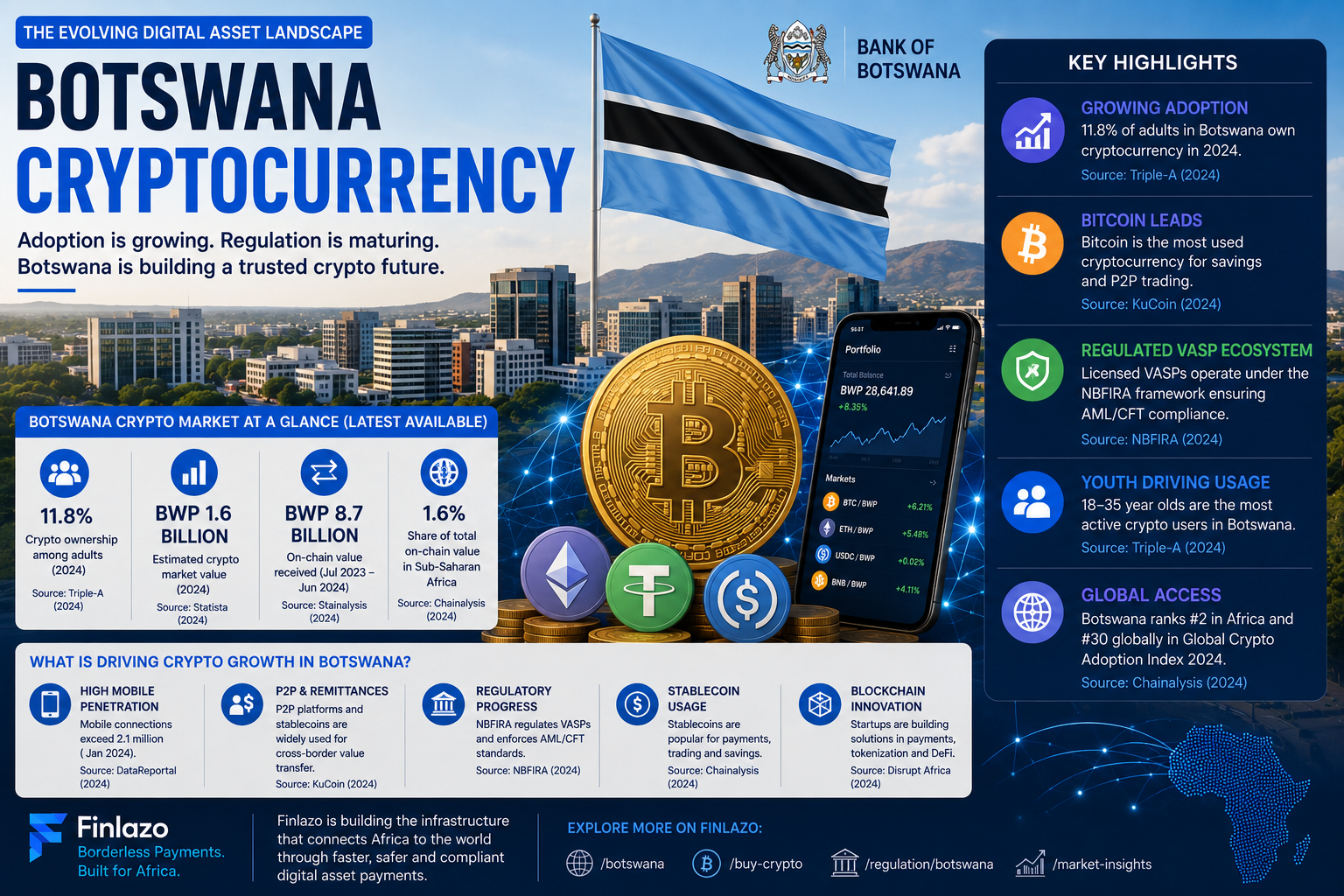
- More than BWP169 million — virtual-asset transaction volume recorded by December 2024.
- 6 licensed VASPs — number licensed by NBFIRA as of 2024 in the national risk assessment.
- 2 operating VASPs — licensed providers that had commenced operations as of 2024.
- More than 85% — Yellow Card's market share in the 2024 market snapshot.
- More than 27,000 — estimated cryptocurrency owners in Botswana in the latest Triple-A country data.
- About 1% — estimated share of the population represented by those crypto owners.
- 151st — Botswana's position in the 2024 Chainalysis Global Crypto Adoption Index.
- 144th — Botswana's 2024 centralized-service ranking.
- 147th — Botswana's 2024 retail centralized-service ranking.
- Pula-backed stablecoin — Temtum's token was identified in the national risk assessment as a Botswana-related virtual-asset product.
- BWP169 million+ — sector transaction volume should not be confused with the value of all cryptocurrency traded by Botswana residents.
These figures come from different datasets.
They should not be added together.
They also cover different years.
That distinction matters when describing Botswana's crypto market.
How Big Is Cryptocurrency in Botswana?
Botswana does not publish a single official figure for the number of people who own cryptocurrency.
The latest Triple-A country estimate says more than 27,000 people currently own cryptocurrency in Botswana, representing approximately 1% of the population.
That estimate is useful as an indication of ownership.
It is not an NBFIRA registry.
It is also not a household survey conducted by Botswana's government.
The regulatory data tell a different part of the story.
The NBFIRA 2025 national risk assessment recorded more than BWP169 million in VASP transaction volume by December 2024.
The figures indicate that Botswana has a real crypto market.
They do not suggest that cryptocurrency has become a mainstream payment method.
Botswana's 2024 Crypto Adoption Ranking
The latest full country ranking publicly available from Chainalysis places Botswana at 151st in its 2024 Global Crypto Adoption Index.
Botswana ranked 144th for centralized-service value received.
Its retail centralized-service ranking was 147th.
Those rankings put Botswana toward the lower end of the global index.
That is not necessarily a sign that the market is inactive.
It reflects the size of Botswana's population and the amount of crypto activity measured relative to other countries.
More recent Chainalysis research continues to use a 151-country index, but Botswana does not appear in the published 2025 top-20 table. The 2024 country ranking remains the latest directly published Botswana position available in the source set used here.
What Is Cryptocurrency Used For in Botswana?
Botswana's national risk assessment says the main target customers for virtual assets are individual retail clients.
Users buy.
Users sell.
Users send cryptocurrency.
Users receive cryptocurrency.
The NBFIRA assessment identifies Bitcoin, USDT, Ethereum and Solana among the assets available in the Botswana market.
It also identifies exchange services, custodial wallets, cryptocurrency ATMs and initial token offerings.
The market is therefore broader than a simple buy-and-hold Bitcoin story.
Bitcoin in Botswana
Bitcoin is one of the main assets available through Botswana's regulated and informal crypto ecosystem.
The Bank of Botswana's 2024 Annual Report said digital assets such as Bitcoin and Ethereum were steadily gaining traction within the local financial ecosystem.
The Bank also named Yellow Card, Binance and Paxful among platforms facilitating cryptocurrency trading and exchange.
That does not mean all of those platforms were locally licensed VASPs.
It shows that Botswana residents had access to international and regional crypto marketplaces.
Stablecoins in Botswana
Stablecoins are particularly interesting because they can serve trading, savings and payment functions.
The NBFIRA risk assessment identifies USD Tether, or USDT, among the cryptocurrencies used in Botswana.
It also notes Express Minds' focus on cryptocurrency ATMs and purchases of stablecoins such as USDT.
Stablecoins are not the same as bank deposits.
Their value, redemption and operational risks depend on the issuer, reserves, custody arrangements and market infrastructure.
Botswana's Pula-Backed Stablecoin Experiment
Botswana's crypto market has also produced a local example of token innovation.
The NBFIRA national risk assessment identifies a Pula-backed stablecoin associated with Temtum among the virtual-asset products considered in the country's assessment.
That is significant because it moves the discussion beyond imported cryptocurrencies.
A local-currency-linked token raises questions about reserves.
It raises questions about redemption.
It also raises questions about payments and monetary policy.
The Bank of Botswana's fintech framework treats stablecoins and global stablecoins as an emerging area with potential implications for payments, consumer protection, financial stability and monetary policy.
P2P Crypto Trading in Botswana
Peer-to-peer trading is part of Botswana's crypto ecosystem.
The NBFIRA risk assessment identifies P2P transfers as one of the ways virtual assets can move between users.
P2P can make market access easier.
A buyer does not necessarily need a large domestic exchange.
The buyer can find a seller.
They can agree on a payment method.
The digital asset can then move between wallets.
That convenience comes with risks.
A fraudulent counterparty can disappear.
A payment can be disputed.
A user can send funds to the wrong wallet.
The platform itself can also be compromised.
Why P2P Matters in Smaller Markets
A smaller market does not need a large local exchange to have active crypto users.
International platforms can provide liquidity.
P2P networks can connect buyers and sellers.
Self-custody wallets can reduce dependence on one local intermediary.
The result can be a crypto ecosystem that is more visible in user behaviour than in domestic company registrations.
Botswana is a useful example.
The Bank of Botswana has acknowledged access to platforms including Binance and Paxful.
At the same time, the NBFIRA assessment says much of the sector remains highly concentrated and relatively small.
Botswana's Crypto Market Is Highly Concentrated
The national risk assessment provides one of the clearest statistics about market structure.
Six VASPs had been licensed by NBFIRA as of 2024.
Only two had commenced operations.
Yellow Card accounted for more than 85% of the market.
The sector had recorded more than BWP169 million in transaction volume by December 2024.
This concentration matters.
A market dominated by one major operator can have limited competitive depth.
It can also create operational dependency.
A disruption affecting the largest provider may have an outsized effect on users.
The Two Operating VASPs
The national assessment identifies Yellow Card and Express Minds as the two operating VASPs in its 2024 snapshot.
Yellow Card is described as a regional exchange offering buying, selling, transfers and safekeeping.
Express Minds is described as a smaller domestic operator with a focus on cryptocurrency ATMs, stablecoin purchases and selected over-the-counter transactions.
The assessment says their combined active customer base exceeded 1,200 users.
That is a historical assessment figure.
It should not be presented as the current total number of crypto users in Botswana.
What Does the 1,200-User Figure Tell Us?
The combined active customer base of more than 1,200 users recorded for Yellow Card and Express Minds is small compared with the Triple-A estimate of more than 27,000 crypto owners.
That is not necessarily a contradiction.
The numbers measure different things.
The NBFIRA figure covers customers of two operational VASPs in the assessment.
The Triple-A figure estimates crypto ownership across the country.
Some users can also use international platforms.
Others can hold assets in self-custody wallets.
The two figures therefore answer different questions.
Botswana's Financial Sector Is Engaging With Crypto
Cryptocurrency does not exist separately from Botswana's financial system.
The Bank of Botswana has discussed virtual assets, stablecoins and CBDCs within its fintech work.
The Bank's 2024 Annual Report says there was no official cryptocurrency or stablecoin issued or sanctioned by the Bank of Botswana at the time of publication.
The same report said Bitcoin and Ethereum were gaining traction in the local financial ecosystem.
This is an important distinction.
Market use can grow even while the central bank does not issue or endorse a digital asset.
Botswana and Stablecoin Regulation
The Bank of Botswana's 2025 Fintech Analytical Assessment Framework gives stablecoins special attention.
The framework says stablecoins can potentially become alternative payment instruments or stores of value.
It also points to possible growth in online platforms, P2P transactions, micropayments and cross-border payments.
That creates a regulatory overlap.
NBFIRA regulates VASPs.
The Bank of Botswana has responsibilities around payment systems, banks and monetary stability.
A stablecoin product can potentially touch both areas.
Botswana and CBDC Research
The Bank of Botswana is also exploring central-bank digital currency.
Its 2024 Annual Report says a multidisciplinary CBDC working group was established to assess feasibility, infrastructure, legal issues and potential effects before the Bank decides whether a CBDC should be adopted.
A CBDC is not a cryptocurrency.
It would represent central-bank money.
Still, the research shows that Botswana is examining different forms of digital money at the same time.
Private crypto assets are being regulated.
Stablecoins are being analysed.
CBDC technology is being studied.
Crypto and Botswana's Digital Economy
Botswana's broader digital economy provides a useful backdrop for crypto.
The country has been expanding digital financial services.
The Bank of Botswana's fintech framework considers payment innovation, virtual assets, stablecoins, open banking, data protection and cybersecurity together.
That approach reflects an important reality.
A crypto application can touch several financial systems at once.
A wallet can involve payments.
A stablecoin can involve money-like functions.
A token can involve securities.
A crypto exchange can involve custody and foreign exchange.
The regulatory question depends on what the product actually does.
Consumer Risks in Botswana's Crypto Market
The NBFIRA risk assessment identifies several vulnerabilities.
Virtual assets can move quickly.
They can cross borders.
They can be held in self-hosted wallets.
They can be exchanged through online platforms without face-to-face interaction.
The assessment identifies fraud, scams, cyber risks, market manipulation and other financial-crime vulnerabilities.
These risks do not mean cryptocurrency is inherently fraudulent.
They mean users need to understand what they are buying and who they are dealing with.
Crypto Scams and Due Diligence
A user should verify the provider.
A website address is not enough.
A social-media account is not enough.
A trading platform's logo is not proof of authorisation.
Botswana's regulator maintains a public list of regulated VASPs.
Users should check the official register before assuming a provider is licensed.
The same principle applies to investment offers.
Promises of unusually high returns should receive particular scrutiny.
What About Foreign Crypto Platforms?
International platforms can provide liquidity to Botswana users.
But foreign incorporation does not automatically mean local authorisation.
Botswana's regulatory framework applies to VASP activities carried on into or from Botswana, subject to the scope of the law.
This matters for global exchanges.
A business can be incorporated elsewhere while actively targeting Botswana customers.
The regulatory question is then whether its activities fall within Botswana's VASP and financial-services rules.
Botswana's Crypto Regulation Is Now More Mature
The regulatory framework has changed since Botswana first began discussing virtual assets.
The original Virtual Assets Act was enacted in 2022.
The framework was revised through the Virtual Assets Act, 2025.
The revised legislation strengthened NBFIRA's role and updated the regulatory perimeter.
For the full legal analysis, see Botswana cryptocurrency regulation.
The important point for the crypto market is that regulation is no longer merely theoretical.
There is a licensing system.
There are AML/CFT duties.
There is active supervision.
Enforcement Has Become Visible
Regulation matters most when it is enforced.
NBFIRA cancelled PAA Capital's VASP licence in February 2026.
The regulator's public notice said the company could no longer conduct regulated virtual-asset activities under its licence.
The action demonstrates that Botswana's framework has supervisory consequences.
For users, that is important.
A regulated market is not defined only by the existence of a law.
It also requires a regulator willing to intervene when rules are breached.
Botswana and the Wider African Crypto Market
Botswana is part of a wider African digital-asset market.
The Chainalysis 2025 Sub-Saharan Africa analysis estimated that the region received more than US$205 billion in on-chain cryptocurrency value between July 2024 and June 2025.
The same Chainalysis analysis reported approximately 52% year-over-year growth in regional on-chain value.
Botswana is much smaller than the largest African crypto markets.
Its importance lies more in financial infrastructure, regulation and regional market access.
For a broader look at Africa, see cryptocurrency in Africa.
Botswana Compared With Mauritius and Seychelles
Mauritius has a detailed VASP framework with five licence categories.
See Mauritius cryptocurrency regulation.
Seychelles also operates a dedicated VASP regime.
See Seychelles cryptocurrency regulation.
Botswana has its own structure.
NBFIRA licenses VASPs.
The Bank of Botswana has overlapping responsibilities around payments and banking.
The market is smaller than Mauritius' international financial-services ecosystem.
But the regulatory architecture is becoming increasingly formal.
What Could Drive Botswana's Crypto Market?
Several factors could shape the next stage.
Stablecoins
Stablecoins could become more relevant for payments, savings and cross-border transfers.
The Bank of Botswana is already analysing the risks and opportunities.
P2P Markets
P2P platforms can continue to provide flexible market access.
Their growth will depend on regulation, liquidity and consumer trust.
Institutional Adoption
Financial institutions may become more interested in custody, tokenisation and digital-asset infrastructure.
That will depend on regulatory clarity and risk controls.
CBDC Research
The Bank's CBDC work could influence how digital money develops alongside private crypto assets.
Regional Connectivity
Botswana's position in Southern Africa gives it links to regional payment and financial markets.
The combination of fintech and virtual-asset regulation could become increasingly important.
Botswana Cryptocurrency Statistics
- More than 27,000 — estimated cryptocurrency owners in Botswana.
- About 1% — estimated population share represented by those owners.
- More than BWP169 million — VASP transaction volume by December 2024.
- 6 — VASPs licensed as of 2024.
- 2 — VASPs that had commenced operations as of 2024.
- More than 85% — Yellow Card's market share in the 2024 assessment.
- More than 1,200 — combined active customer base reported for Yellow Card and Express Minds.
- 151st — Botswana's 2024 Chainalysis overall adoption ranking.
- 144th — Botswana's 2024 centralized-service ranking.
- 147th — Botswana's 2024 retail centralized-service ranking.
- US$205 billion+ — Sub-Saharan Africa's on-chain crypto value received between July 2024 and June 2025.
- 52% — year-over-year growth in Sub-Saharan Africa's on-chain crypto value during that period.
Frequently Asked Questions
Is cryptocurrency popular in Botswana?
Botswana has a relatively small but established cryptocurrency market. Triple-A estimates more than 27,000 cryptocurrency owners, while NBFIRA recorded more than BWP169 million in VASP transaction volume by December 2024.
How many people own cryptocurrency in Botswana?
Triple-A estimates that more than 27,000 people, or about 1% of the population, own cryptocurrency in Botswana. This is an independent estimate rather than an official government count.
What cryptocurrencies are used in Botswana?
The NBFIRA national risk assessment identifies Bitcoin, USDT, Ethereum and Solana among the virtual assets used in Botswana. It also identifies cryptocurrency ATMs, custodial wallets, exchanges and token offerings.
Can people buy Bitcoin in Botswana?
Botswana residents have access to cryptocurrency platforms, including services identified by the Bank of Botswana in its 2024 Annual Report. Users should verify whether a provider is appropriately authorised before trading.
Is peer-to-peer crypto trading available in Botswana?
Yes. P2P transfers form part of the virtual-asset ecosystem described by NBFIRA. Users should be aware of counterparty, fraud and payment risks.
Are stablecoins used in Botswana?
Yes. USDT is identified in NBFIRA's national risk assessment, and Express Minds is described as offering purchases of stablecoins. Botswana has also been examining the wider financial and regulatory implications of stablecoins.
Does Botswana regulate cryptocurrency?
Yes. Botswana has a VASP licensing and supervisory framework administered by NBFIRA. The framework is built around the Virtual Assets Act and related AML/CFT requirements.
Who regulates crypto businesses in Botswana?
NBFIRA is the primary VASP regulator. The Bank of Botswana can also be relevant where crypto activities involve payment services, banks, monetary issues or other functions within its mandate.
The Bottom Line
Botswana's cryptocurrency market is not one of Africa's largest.
It is, however, real.
Triple-A estimates more than 27,000 cryptocurrency owners in Botswana.
The NBFIRA assessment recorded more than BWP169 million in VASP transaction volume by December 2024.
The same assessment found six licensed VASPs at that time.
Only two had commenced operations.
Yellow Card controlled more than 85% of the measured market.
The market is therefore still small and concentrated.
But the regulatory environment is becoming more sophisticated.
Botswana has moved from the early 2022 virtual-asset framework to the revised Virtual Assets Act, 2025.
NBFIRA now operates an established supervisory framework.
The Bank of Botswana is studying stablecoins and CBDCs.
P2P trading remains part of the market.
Bitcoin and stablecoins remain important assets.
The next stage will depend on whether regulation can support innovation without weakening consumer and financial-system protections.
Botswana is not trying to become the biggest crypto market in Africa.
Its more interesting opportunity may be building a credible digital-asset market inside a disciplined financial system.