Best Crypto Exchanges in Kenya (2026): Custody, M-Pesa and Withdrawal Costs
Kenya crypto exchange comparison: Binance, VALR, Luno, Bybit, OKX, KuCoin, Bitget, MEXC and Gate for KES or M-Pesa, with costs, custody and withdrawal charts.

On this page
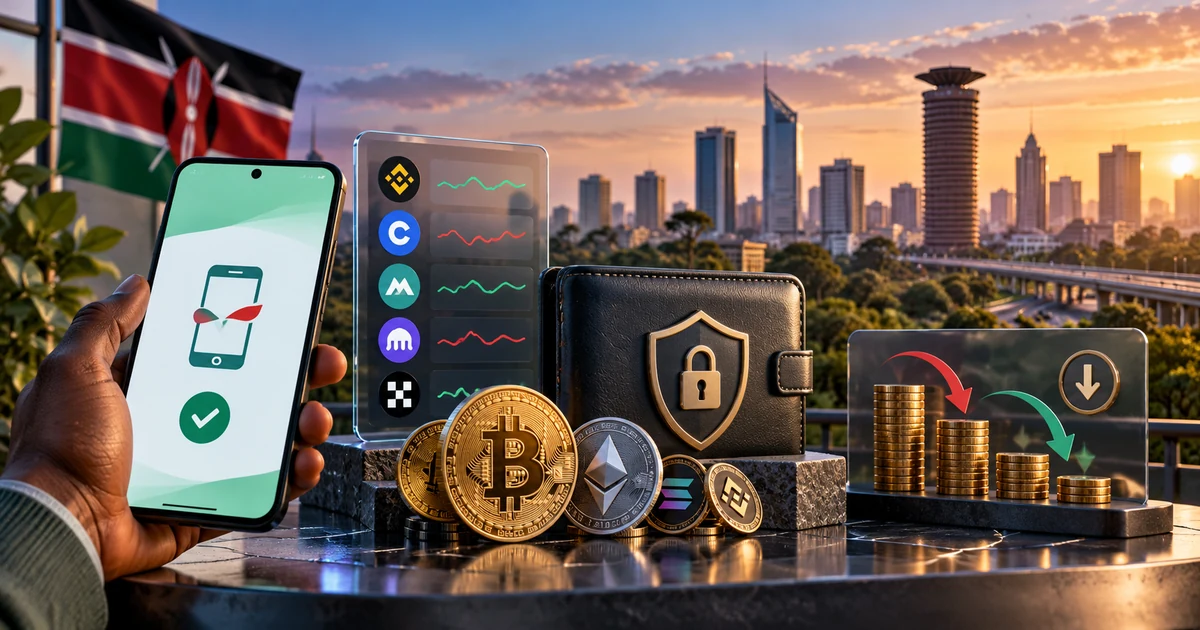
The best crypto exchange in Kenya depends on what the customer intends to do with the money afterward. Binance documents direct KES purchases with M-Pesa, while VALR supports mobile-money transactions through Onafriq. Luno supports existing Kenyan customers, but new sign-ups remain paused.
An advertised trading fee is only part of the cost. Buyers also need to evaluate the exchange rate, mobile-money processing, custody and the fee for moving coins to an external wallet. This investigation compares documented routes instead of presenting a universal ranking.
For a country-wide reference, consult Finlazo's Crypto Exchanges in Kenya directory. It separates documented product availability from local regulatory authorisation and includes source links and record verification dates.
Kenya's exchange market is part of a wider ecosystem of digital payments, stablecoins and crypto investing. Our Crypto in Kenya market overview explains that broader picture, while the guide to buying cryptocurrency in Kenya covers the practical payment and account setup choices.
Crypto exchanges accepting KES: documented choices by transaction type
The entries below have first-party documentation of a KES purchase route, KES P2P market or an existing-customer service in Kenya. They are not all direct M-Pesa deposits, and operator announcements do not guarantee every feature is available to every account today. The Finlazo Kenya exchange directory should make these access distinctions explicit.
| Platform | What the operator documents | KES or M-Pesa model | Important access distinction |
|---|---|---|---|
| Binance | KES purchases and sales through M-Pesa for eligible users | Direct platform-facilitated checkout | The 0.5% promotion ends 25 October 2026 |
| VALR | KES mobile-money funding and cryptocurrency purchases | Onafriq mobile-money integration | Mobile-money processing and conversion charges may both apply |
| Luno | Existing Kenyan accounts and M-Pesa withdrawal support | Existing-customer KES account | New Kenyan sign-ups paused |
| Bybit P2P | KES peer-to-peer advertisements | Payment to an individual advertiser | Price, limits and M-Pesa eligibility depend on the offer |
| OKX P2P | A dedicated guide to buying USDT with M-Pesa in Kenya | KES P2P, with platform escrow | Official instructions say the seller, not OKX, receives the KES payment |
| KuCoin P2P | KES/USDT offers naming M-Pesa Paybill and Safaricom | KES P2P marketplace | Merchant quotes can change at any time |
| Bitget P2P | An operator guide to KES P2P with M-Pesa, Airtel Money and bank transfers | KES P2P, not a direct exchange M-Pesa deposit | Official supported-currency list includes Kenya/KES |
| MEXC P2P | Operator announced KES peer-to-peer transactions for BTC, USDT, ETH and USDC | KES P2P marketplace | 2025 announcement; check current order access |
| Gate P2P | Operator announced KES trading using Safaricom M-Pesa, Paybill and banks | KES P2P marketplace | 2023 introduction and 2025 KES campaign are historical evidence; current offer availability requires a fresh check |
Direct payment versus P2P: Binance and VALR have documented platform-facilitated mobile-money routes. The OKX, KuCoin, Bitget, MEXC, Gate and Bybit evidence concerns peer-to-peer marketplaces where individual counterparties supply KES quotes and receive payment. Our M-Pesa versus P2P comparison explains escrow, release timing and payment-name controls.
A separate institutional category is worth including in the directory rather than mixing it into the retail table. Busha's business API lists KES as supporting deposits, withdrawals and on-ramp purchases, with M-Pesa funding and payouts documented for Kenya. That establishes an API capability, not automatic eligibility for an individual retail exchange account.
Similarly, Yellow Card documents KES business mobile-money collection and payouts, but its October 2026 retail app closure notice says individual retail services are ending as it focuses on businesses. A B2B payment rail should not be presented as an open retail crypto exchange.
For this article's quantitative fee charts, we retain Binance, VALR and Luno as examples because their published fee schedules provide specific comparable calculations. That focus does not imply that they are the only exchanges or marketplaces supporting Kenyan shillings.
Why international card on-ramps are secondary in Kenya
Kenya's payment habits explain why this comparison focuses on M-Pesa, KES trades and P2P. The 2024 FinAccess Household Survey found that 82.3% of Kenyan adults used mobile money. That figure measures financial-service usage, not the popularity of any crypto provider.
Mercuryo lists cards and several international digital payment methods. Banxa documents card payments and region-specific transfers. Changelly routes fiat purchases through third-party providers such as Banxa and MoonPay. These documents do not establish a comparable direct Kenyan M-Pesa checkout for those three services.
Paybis is an important exception. Its official M-Pesa buying instructions specifically describe payments in Kenya, and its payment-method list includes M-Pesa. It should not be described as card-only. Buyers still need to verify current availability, the final KES quote, charges and wallet withdrawal options.
International card on-ramps can suit customers whose banks permit crypto purchases. But published card availability alone does not make a service the best choice for an M-Pesa user. Our M-Pesa versus P2P guide explains the payment and counterparty differences.
Binance versus VALR: two M-Pesa routes, different cost structures
Binance announced its M-Pesa Mobile Money option for eligible Kenyan accounts on 13 October 2026. The company reduced the applicable trading fee from 1% to 0.5% for 12–25 October 2026. That promotion is temporary, and users must verify the exact order quote.
VALR's Onafriq instructions describe KES deposits that can be credited in USDC, USDT or EURC. The platform also supports direct crypto purchases using mobile money, potentially routing through USDC before delivering the requested asset. It lists a maximum transaction size of $300 per mobile-money transaction.
The VALR guide says a mobile-money processing fee and a standard conversion fee may both apply. Its fee schedule updated 23 October 2026 lists 1.6% for Simple Buy/Sell/Swap. This means the quoted purchase result matters more than any isolated percentage.
Chart: published fee components on a KSh 10,000 example
This is an illustrative calculation, not a ranking of total buying costs. The charges apply to different stages: Binance direct-buy trading, Luno funding and VALR conversion. They omit exchange-rate spread, additional M-Pesa or card costs and later withdrawals.
| Category | Value (KSh) |
|---|---|
| Binance promotional direct M-Pesa fee, 0.5% | 50 |
| Binance stated standard direct M-Pesa fee, 1% | 100 |
| Luno KES deposit fee, 1% | 100 |
| VALR Simple Buy conversion fee, 1.6% | 160 |
Each bar is one published fee component, not an all-in transaction quote. The Binance promotion ends 25 October 2026. Values are arithmetic examples, not measured fills.
Source: Binance fee promotion; Luno Kenya fee schedule; VALR fee schedule
For a hypothetical KSh 10,000 base, a 0.5% fee equals KSh 50, while a 1.6% fee equals KSh 160. Those calculations are not equivalent completed transactions. VALR may add mobile-money processing, and Luno's funding charge occurs before a trade.
Luno publishes 0% on Portfolio-screen instant buys and sells, but that does not establish zero exchange-rate spread. Its published first-tier exchange taker fee is 0.10%, which applies to a separate trading interface. Compare the actual BTC delivered to your account after the entire quote.
Withdrawal costs: M-Pesa cash-out and blockchain transfer are not the same
A fiat withdrawal sends KES back to a payment account. An on-chain withdrawal sends cryptocurrency to a blockchain address. Their fees and minimums cannot be combined into a single exchange-wide “withdrawal charge.”
Luno publishes a KSh 50 fee for an M-Pesa withdrawal by eligible existing Kenyan customers. Its guide states a KSh 500 minimum, KSh 250,000 per-transaction limit and KSh 500,000 daily limit, with funds generally expected within 24 hours.
By contrast, Binance explains that its crypto withdrawal fees vary by blockchain and network conditions. VALR quotes variable external crypto withdrawal fees, while Luno uses dynamic cryptocurrency send fees. A flat BTC-withdrawal number copied from another date would mislead readers.
| Provider | Documented KES or M-Pesa cash-out | External cryptocurrency withdrawal | Important qualifier |
|---|---|---|---|
| Binance | Supported KES-to-M-Pesa sell route for eligible customers | Network-dependent | Check the live quote and supported network |
| VALR | KES mobile-money funding is documented; matching KES cash-out not established here | Variable, quoted before approval | Internal transfers to another VALR customer can be free |
| Luno | KSh 50 per eligible M-Pesa withdrawal | Dynamic crypto send fee | Existing customers only in Kenya |
| Bybit P2P | Cash payment determined by live peer advertisement | Depends on coin and withdrawal settings | The P2P quote is not a fixed exchange cash-out tariff |
VALR says transfers to another VALR account are free for supported coins. That can help an internal transfer but does not give the recipient private-key control, because the asset has not been sent to a self-custody wallet.
Chart: the true weight of Luno's flat KSh 50 withdrawal charge
A fixed fee can overwhelm a small cash-out even when it appears negligible for larger balances. The next chart divides Luno's KSh 50 M-Pesa withdrawal fee by four hypothetical withdrawal amounts, then expresses the result as a percentage.
| Category | Value (%) |
|---|---|
| KSh 500 withdrawal | 10 |
| KSh 1,000 withdrawal | 5 |
| KSh 10,000 withdrawal | 0.5 |
| KSh 50,000 withdrawal | 0.1 |
Assumes one eligible withdrawal and excludes the original crypto purchase, sale, price spread or other fees. Percentages are calculated examples, not observed user withdrawals.
Source: Luno official M-Pesa withdrawal charges; percentage calculations by Finlazo
| Hypothetical KES cash-out | Stated Luno fee | Fee as share of cash-out (calculated) |
|---|---|---|
| KSh 500 | KSh 50 | 10% |
| KSh 1,000 | KSh 50 | 5% |
| KSh 10,000 | KSh 50 | 0.5% |
| KSh 50,000 | KSh 50 | 0.1% |
That calculation is why a trader selling a small balance should compare net KSh received, not just the trading fee. Luno's help page also says the cash-out fee may be deducted either from the remaining wallet balance or, if insufficient, from the requested amount. The eventual M-Pesa credit therefore depends on the confirmed transaction.
Custody: does the user actually control the Bitcoin?
On a custodial exchange, the operator ordinarily holds the signing keys and records customers' balances internally. A self-custody wallet gives the user responsibility for the keys, recovery phrase and transaction security. Buying Bitcoin by M-Pesa does not automatically move it into a wallet the user controls.
| Custody arrangement | Who controls transaction signing? | Useful feature | Failure to consider |
|---|---|---|---|
| Custodial exchange account | Exchange operator | Integrated trading and account recovery | Withdrawal freezes, platform risk and account compromise |
| Self-custody wallet | Wallet owner | Direct blockchain withdrawal and transfer authority | Seed-phrase loss, phishing and irreversible mistakes |
| P2P order settled to exchange account | Exchange operator after trade release | Marketplace-facilitated purchase | Counterparty disputes plus continuing exchange custody |
Readers who need a detailed walkthrough can follow our where does Bitcoin go after M-Pesa guide. The key test is whether the account can withdraw the actual coin to a compatible outside address at an understandable fee. Binance warns that choosing the wrong network can result in asset loss.
A wallet that holds Bitcoin is not necessarily a service that accepts M-Pesa directly. Our Kenyan crypto wallets and M-Pesa guide explains the distinction, while the Bitcoin scams in Kenya checklist covers misleading payment confirmations and unsafe transfers.
A more useful test than advertised fees: the delivered-asset method
To compare two providers, ask both for an executable quote at nearly the same time. Use an identical KSh amount and record the units of BTC that would be credited after the purchase. Then review the external BTC withdrawal fee for the same compatible destination network.
| Measurement | What to record | Why it matters |
|---|---|---|
| Funding amount | Identical KSh amount | Controls for different trade sizes |
| BTC credited | Units after quoted purchase costs | Captures the combined buying rate |
| External withdrawal fee | BTC deducted on the correct network | Captures the cost of leaving custody |
| Net BTC to personal wallet | BTC credited minus withdrawal fee | Shows how much the buyer actually controls |
| KES return path | Net payout after sell and cash-out fees | Shows whether the platform works for the buyer's exit |
A platform with a nominally lower trading fee could deliver less BTC after pricing and withdrawal costs. This is especially relevant for smaller trades, because a flat fee does not scale down with the order size. The Finlazo analysis of the total cost of M-Pesa Bitcoin buying expands on this calculation.
Which exchange should a Kenyan user research first?
For an eligible first-time buyer who wants a direct M-Pesa checkout, start by comparing Binance's Kenyan offer with VALR's Onafriq route. Both document local funding options, but their fees and conversion sequences differ. Always compare the delivered BTC amount and potential withdrawal charge.
For someone who already holds a Luno account, Luno's Kenyan deposit, exchange and cash-out documentation is unusually specific. But new-user registration remains paused, so it is not an equivalent new-account recommendation.
Other P2P alternatives deserve the same scrutiny. OKX, KuCoin, Bitget, MEXC and Gate have each documented KES P2P options. The buyer still needs to check a live offer, applicable KYC, payment-recipient name, fees and whether their country and account remain supported.
A user comfortable with advertiser pricing can review Bybit's KES marketplace. Its P2P fee documentation says KES is not among the explicitly fee-bearing currencies in the published table, but that does not eliminate a seller spread or mobile-money payment charge. Compare live advertisements and follow the platform's dispute rules, not messages outside it.
KES trading support and local regulatory authorisation are separate questions. Our Kenya cryptocurrency regulation guide examines the VASP framework, while the guide to buying Bitcoin with M-Pesa legally in Kenya looks specifically at the mobile-money payment route.
Availability is not a Kenyan operating licence
A company serving Kenyan users might be incorporated elsewhere, authorised under another country's rules or subject to restrictions under Kenyan law. The CMA publishes the Virtual Asset Service Providers Regulations, 2026, while the official CBK/CMA commencement notice explains the designated regulators. These sources do not establish that every platform listed here is Kenyan-licensed.
Our Kenya cryptocurrency regulation guide follows the regulatory framework in greater detail. When evaluating a platform, look for the exact legal entity, licence number, authorised activities and official regulator source. A brand-level claim without a verifiable local legal entity is insufficient.
If an M-Pesa STK prompt fails, consult the Finlazo troubleshooting guide before retrying a payment. For a cross-rail comparison, our M-Pesa versus PesaLink guide explains what changes when buying from a bank account.
Methodology and conclusion
This comparison uses exchange-owned support pages, public fee schedules and Kenyan regulatory sources reviewed on 24 October 2026. The bar charts contain simple arithmetic from stated published fee components. They are not observations from tested accounts, independently verified executions or predictions of future fees.
The conclusion is conditional: the best exchange is the one that supports the person's country, offers the needed payment rail, discloses the complete executable cost, and permits the intended withdrawal or custody method. Recheck each live quote before paying. For a wider shortlist, visit Crypto Exchanges in Kenya; for examples of what happens when access disappears, see the closed cryptocurrency exchanges directory.
Source review: 24 October 2026. Finlazo's directory is research, not an endorsement or certification of any exchange.