Cryptocurrency Regulation in Nigeria: SEC Rules, VASPs and the 2026 Framework
Explore cryptocurrency regulation in Nigeria in 2026, including SEC rules, VASP registration, banking, ARIP, new capital requirements and what the framework means for crypto businesses.

On this page
Nigeria's cryptocurrency regulatory framework is entering a new phase.
The Securities and Exchange Commission has continued to bring digital-asset businesses into its regulatory system. In January 2026, the SEC raised minimum capital requirements for regulated digital-asset operators.
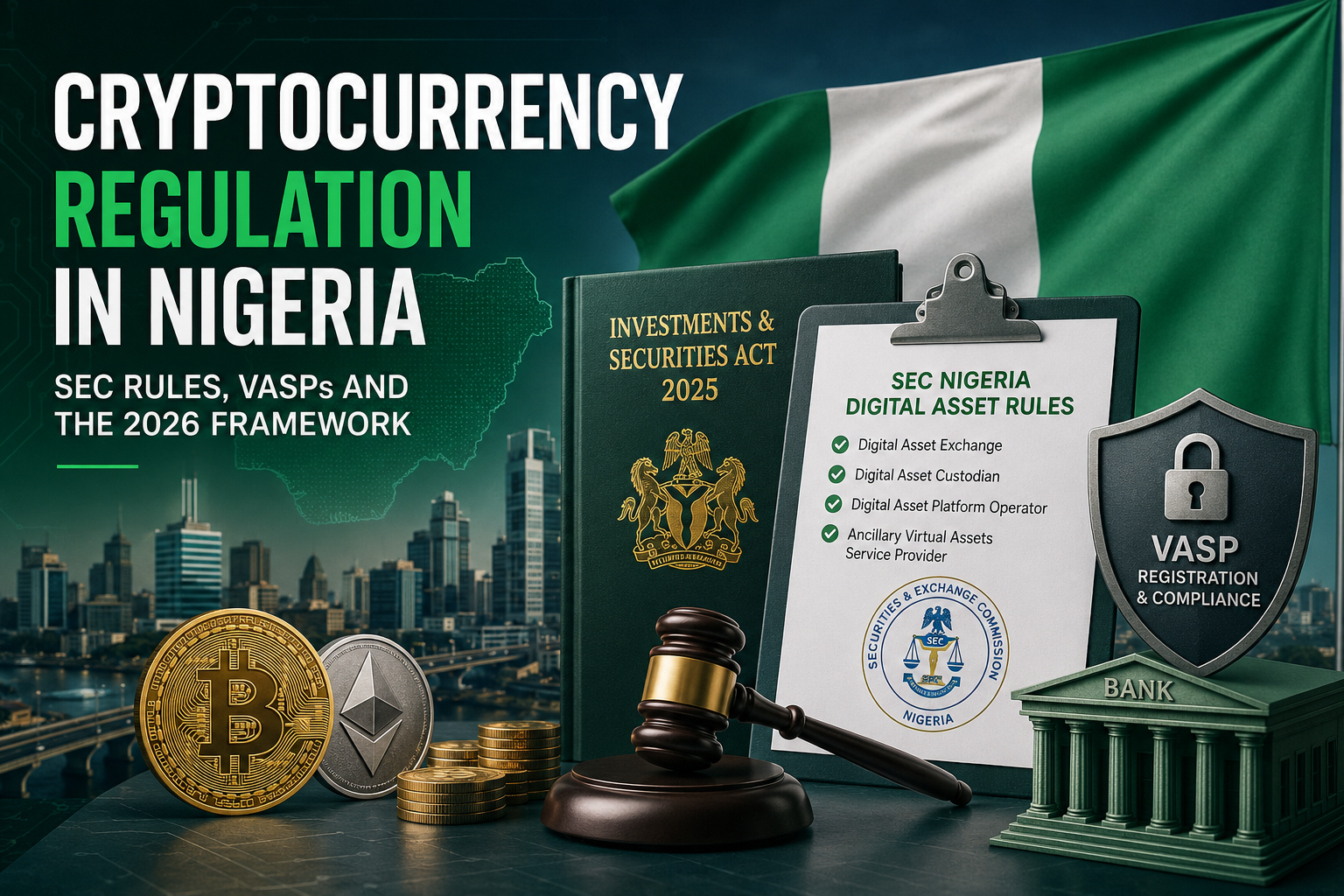
The new framework sets a minimum of ₦2 billion for a Digital Assets Exchange and ₦2 billion for a Digital Assets Custodian. A Digital Assets Platform Operator requires ₦500 million. An Ancillary Virtual Assets Service Provider requires ₦300 million.
The SEC gave affected entities until 30 June 2027 to meet the revised requirements.
Regulatory activity has also continued during 2026. In July, the SEC admitted two additional virtual-asset businesses into its Accelerated Regulatory Incubation Programme. In August, it cleared three more.
Nigeria is therefore no longer defined by the simple question of whether cryptocurrency is banned.
The more important question in 2026 is which activity is being carried out, which regulator has authority over it and what requirements apply.
Who Regulates Cryptocurrency in Nigeria?
Nigeria's crypto framework involves more than one institution.
The SEC regulates digital-asset activities that fall within its securities and capital-market mandate.
The Central Bank of Nigeria regulates banks and other financial institutions under its authority.
Other laws also matter. Nigeria's anti-money-laundering framework recognises Virtual Asset Service Providers within the relevant financial-sector framework.
This means a crypto company can face several layers of regulation.
The exact obligations depend on the service.
An exchange does not necessarily face the same requirements as a custodian.
A token issuer does not necessarily face the same rules as a payment provider.
The SEC Is the Main Capital-Market Regulator for Digital Assets
The Securities and Exchange Commission has been building Nigeria's digital-asset regulatory framework for several years.
Its Rules on Issuance, Offering Platforms and Custody of Digital Assets established a framework covering several forms of digital-asset activity.
The rules cover areas including issuance, offering platforms, exchanges and custody.
The SEC has also continued to update its approach.
In August 2026, it published proposed rules on Digital and Virtual Assets Operations, Custody and Markets.
The proposal is important because it is broad.
It covers issuance and offering, tokenisation, lifecycle management, trading, custody, transfer and settlement. It also covers investment, advisory and other financial services relating to digital and virtual assets.
The proposed scope can also reach businesses that operate in Nigeria, provide services to Nigerian residents or target the Nigerian market through digital channels.
Kenya's Crypto Regulation is also developing. Our researchers have given a detailed analysis about this developing structure on our blog.
Why the SEC's Role Matters
Nigeria is moving toward a more activity-based framework.
The regulator is looking at what a company actually does.
That is more important than simply calling a business a crypto company.
A platform offering exchange services may fall into one category.
A business safeguarding customer assets may fall into another.
A company issuing or tokenising an asset may face a different set of rules.
This approach can become increasingly important as stablecoins, tokenisation and other digital-asset products expand.
The Investments and Securities Act 2025 Changed the Legal Foundation
The Investments and Securities Act 2025 provides a new statutory foundation for Nigeria's capital-market framework.
The Act is relevant to the digital-asset sector because it expressly addresses virtual and digital assets within the broader regulatory system.
That matters for legal certainty.
SEC rules do not exist in isolation.
The Commission's authority is connected to legislation governing Nigeria's securities market.
The result is a stronger legal foundation for regulating activities that qualify as investments or securities business.
Not Every Crypto Activity Is Automatically the Same
The legal treatment of a digital asset can depend on its structure and function.
A token can be designed as an investment product.
Another can function as a utility within a network.
A stablecoin can raise different questions again.
That is why Nigeria's framework increasingly focuses on the activity, product and service involved.
Businesses should not assume that one licence or one regulatory category automatically covers every service they plan to offer.
What Is a VASP in Nigeria?
VASP stands for Virtual Asset Service Provider.
The term is used for businesses carrying out specified services involving virtual assets.
Nigeria's regulatory framework recognises that these businesses can create consumer, market-integrity and financial-crime risks.
The CBN's Guidelines on Operations of Bank Accounts for Virtual Assets Service Providers specifically addresses banking relationships with VASPs.
The guideline followed the CBN's recognition that global regulatory trends had moved toward regulating VASPs rather than leaving the sector outside the financial system.
The guideline also notes that Nigeria's Money Laundering (Prevention and Prohibition) Act 2022 recognises VASPs within the definition of a financial institution.
Can Crypto Companies Use Nigerian Banks?
Yes, but this needs to be understood carefully.
In December 2023, the CBN issued its Guidelines on Operations of Bank Accounts for Virtual Assets Service Providers.
The guidelines replaced the earlier blanket restrictions referenced by the CBN.
They provide a framework for banks and other financial institutions to maintain banking relationships with VASPs, subject to the requirements of the guidelines.
This was a major policy shift.
However, the rules did not mean banks were free to trade cryptocurrency for themselves.
The CBN states that banks and other financial institutions remain prohibited from holding, trading or transacting in virtual currencies on their own account.
What the Banking Change Actually Means
There is an important distinction between a bank providing an account to a compliant VASP and a bank becoming a crypto trader.
The first can be part of a regulated banking relationship.
The second remains outside what the CBN permits for banks under the guideline.
That distinction is important for founders and customers.
A crypto business may still need to satisfy SEC, AML and other applicable requirements before it can operate within the wider financial system.
Nigeria's Accelerated Regulatory Incubation Programme
The SEC uses the Accelerated Regulatory Incubation Programme to bring eligible virtual-asset businesses into a structured regulatory process.
ARIP is not the same as an unrestricted final operating licence.
The SEC can grant an Approval-in-Principle to an entity admitted into the programme.
That approval remains conditional.
The business must continue meeting applicable regulatory, operational and supervisory obligations.
The SEC's process includes an initial assessment and a formal application stage.
Applicants must meet eligibility requirements and submit supporting documents.
ARIP Activity Continued in 2026
The programme remained active in 2026.
On 3 July 2026, the SEC cleared GIGX Technologies and KuCoin Nigeria Limited for admission into ARIP.
On 13 August 2026, the SEC cleared three additional VASPs.
Those entities were Pisi Payments Solution Limited, BC Access (Nigeria) Limited and Yellow Card Financial Limited.
The July and August decisions show that the SEC is continuing to process digital-asset businesses through its regulatory system.
Nigeria's 2026 Minimum Capital Requirements
One of the biggest regulatory developments of 2026 came in January.
The SEC published its Revised Minimum Capital Requirements on 16 January 2026.
The circular applies to regulated entities including VASPs.
For digital-asset businesses, the revised figures are substantial.
Digital Asset Capital Requirements
The SEC's January 2026 framework sets the following minimum capital levels:
- ₦300 million — Ancillary Virtual Assets Service Provider.
- ₦500 million — Digital Assets Intermediary.
- ₦500 million — Digital Assets Platform Operator, including token issuers.
- ₦1 billion — Digital Assets Offering Platform.
- ₦1 billion — Real-World Assets Tokenization and Offering Platform.
- ₦2 billion — Digital Assets Exchange.
- ₦2 billion — Digital Assets Custodian.
These figures are minimum capital requirements.
They do not represent the full cost of launching or operating a regulated digital-asset business.
A company must also consider technology, cybersecurity, compliance, staffing, legal work and other operational requirements.
The Compliance Deadline Is 30 June 2027
The SEC gave affected entities until 30 June 2027 to comply with the revised framework.
The circular says non-compliance can result in regulatory sanctions.
Those can include suspension or withdrawal of registration.
The SEC also published further guidelines on the revised minimum capital framework in March 2026.
For startups, this is one of the most important developments in Nigeria's crypto market.
The capital thresholds could reshape which companies can independently operate certain regulated functions.
Some smaller businesses may focus on narrower activities.
Others may need partnerships, new investment or consolidation.
The Difference Between Old and New Capital Rules
Nigeria's digital-asset framework should not be read using old numbers alone.
The SEC's earlier digital-asset rules contained capital requirements for several categories.
For example, the original rules required a Digital Assets Exchange applicant to show ₦500 million in minimum paid-up capital.
The January 2026 framework raised the minimum capital requirement for a Digital Assets Exchange to ₦2 billion.
That is a fourfold increase.
The same January framework set ₦2 billion for a Digital Assets Custodian.
This is why articles quoting only the older ₦500 million exchange figure can become outdated.
The current capital framework needs to be read alongside the older rules because the 2026 circular revised the minimum capital levels.
Registration Is About More Than Capital
Meeting the capital threshold does not automatically guarantee registration.
The SEC framework also involves governance and operational requirements.
Depending on the activity, an applicant may need to demonstrate systems, controls and qualified personnel.
The ARIP process also requires supporting documentation.
The SEC's ARIP information lists requirements including evidence of capital and a Fidelity Bond.
The page states that the bond must cover at least 25% of the required shareholders' funds.
Applicants also face fees during the assessment and application process.
For example, the SEC lists a ₦200,000 non-refundable initial assessment fee and a ₦2 million non-refundable processing fee for the ARIP application process.
These are specific programme fees.
They should not be confused with the minimum capital a company must maintain for its regulated activity.
Anti-Money-Laundering Rules Matter
Crypto regulation is not only about market licences.
Financial-crime controls are also central.
The CBN's VASP banking guidelines refer to the risks of money laundering and terrorism financing.
The SEC's digital-asset framework also places compliance and investor protection at the centre of the regulatory approach.
For a VASP, compliance can involve customer identification, transaction monitoring, record keeping and reporting obligations.
The exact requirements depend on the applicable law, regulator and business activity.
This is particularly important for companies handling customer funds or moving value across borders.
What the Rules Mean for Exchanges
An exchange is one of the most heavily regulated digital-asset business models.
Under the SEC's revised 2026 framework, a Digital Assets Exchange faces a ₦2 billion minimum capital requirement.
The business must also fit within the SEC's broader registration and compliance framework.
The rules are therefore not designed around simply launching a website and allowing customers to trade.
A regulated exchange requires a substantial operational and compliance structure.
That can create higher barriers to entry.
It can also increase the importance of well-capitalised operators.
What the Rules Mean for Crypto Startups
Nigeria's framework does not mean every startup needs ₦2 billion.
The requirement depends on the regulated activity.
A business offering an ancillary service falls under a different capital category from a full Digital Assets Exchange.
This is why founders need to define the product before estimating regulatory cost.
What does the company actually do?
Does it custody customer assets?
Does it operate an exchange?
Does it issue or offer digital assets?
Does it provide intermediary services?
The answers can change the regulatory category.
Regulatory Design Can Become a Business Decision
For a startup, compliance architecture can shape the product itself.
A company may decide to partner with a licensed or regulated infrastructure provider rather than perform every regulated function directly.
Another may narrow its product scope.
A larger company may decide to raise capital and build the required internal systems.
The regulatory framework can therefore influence market structure.
It is not simply a legal issue handled after the product has been built.
What Is Still Changing?
Nigeria's framework is active, but it is not static.
The SEC's August 2026 proposed Digital and Virtual Assets Operations, Custody and Markets rules show that the regulatory architecture is still evolving.
Proposed rules should not be described as final law.
That distinction matters.
A consultation document can indicate the direction of regulation.
It does not automatically create a final obligation until the relevant legal or regulatory process is completed.
The safest approach is therefore to separate:
- Current law.
- Current SEC rules and circulars.
- Active regulatory programmes.
- Proposed future rules.
Mixing these categories can make a regulation article misleading.
Nigeria Crypto Regulation: Key Numbers and Dates
- 22 December 2023 — CBN issued guidelines on bank accounts for VASPs.
- 2025 — Investments and Securities Act 2025 created an updated statutory foundation for the capital market and expressly addresses digital and virtual assets.
- 16 January 2026 — SEC published revised minimum capital requirements.
- ₦300 million — minimum capital for an Ancillary Virtual Assets Service Provider.
- ₦500 million — minimum capital for a Digital Assets Intermediary.
- ₦500 million — minimum capital for a Digital Assets Platform Operator.
- ₦1 billion — minimum capital for a Digital Assets Offering Platform.
- ₦1 billion — minimum capital for a Real-World Assets Tokenization and Offering Platform.
- ₦2 billion — minimum capital for a Digital Assets Exchange.
- ₦2 billion — minimum capital for a Digital Assets Custodian.
- 30 June 2027 — SEC compliance deadline for the revised minimum capital requirements.
- 2 — additional VASPs cleared for ARIP admission in July 2026.
- 3 — additional VASPs cleared for ARIP admission in August 2026.
The Outlook
Nigeria has one of Africa's most developed and active crypto regulatory environments.
The framework is becoming more formal.
The SEC is defining categories.
It is processing businesses through ARIP.
It has raised capital requirements.
The CBN has created a framework for banking relationships with VASPs while maintaining restrictions on banks dealing in virtual currencies for their own account.
The result is a market moving away from regulatory uncertainty toward a more structured system.
But the work is not finished.
The SEC is still consulting on new rules.
The interaction between digital assets, banking, securities regulation and financial-crime controls will continue to evolve.
For users, the key issue is whether a platform operates within the applicable framework.
For founders, the key issue is classification.
The first question is no longer simply whether Nigeria regulates crypto.
It does.
The more important question is which rules apply to the specific digital-asset activity a business wants to carry out.