Cryptocurrency in Tanzania: Adoption, Bitcoin, Stablecoins and the Growing Crypto Market
Explore cryptocurrency in Tanzania, including Bitcoin, stablecoins, crypto adoption, mobile money, regulation, cross-border payments and the latest Tanzania crypto market statistics.

On this page
Tanzania is not one of Africa's largest crypto markets. But the country is becoming increasingly relevant to the digital-assets economy.
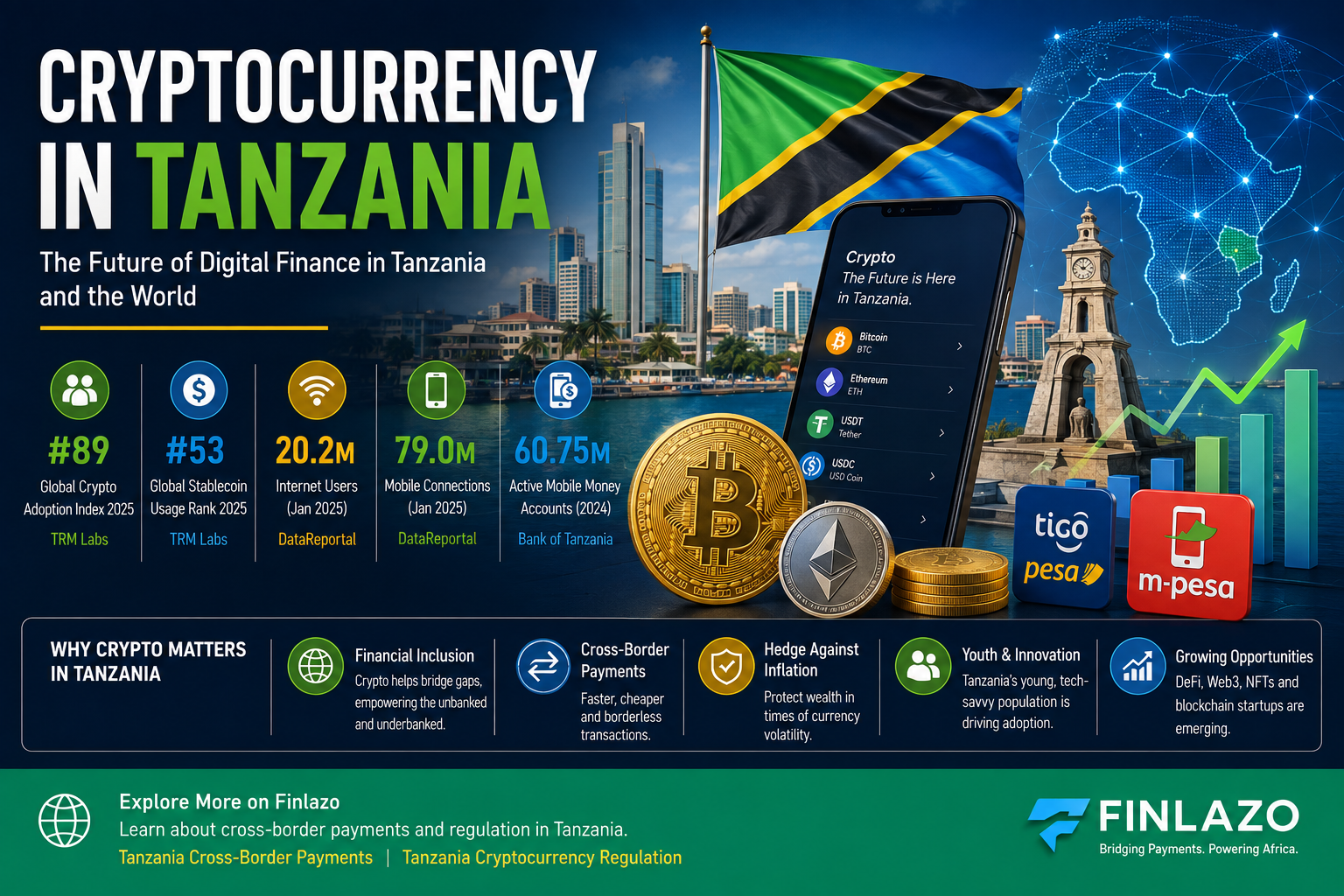
TRM Labs ranked Tanzania 89th overall in its 2025 Crypto Adoption and Stablecoin Usage Report. Tanzania ranked 53rd in TRM Labs' stablecoin usage ranking. At the regional level, Chainalysis reported that Sub-Saharan Africa received more than US$205 billion in on-chain value between July 2024 and June 2025. That was growth of roughly 52% from the previous year.
Tanzania also has the digital infrastructure needed for a larger online financial economy.
DataReportal recorded 20.2 million internet users in Tanzania at the start of 2025. It also recorded 79.0 million cellular mobile connections, equal to 114% of the population because many people use more than one connection. Tanzania's financial system is also deeply mobile. The Bank of Tanzania recorded 60.75 million active mobile money accounts at the end of 2024.
The crypto market is developing inside that wider digital-finance environment.
Public interest is growing.
The regulatory framework remains cautious.
The Bank of Tanzania has studied virtual assets. Its National Cryptocurrency Technical Committee conducted a pilot assessment in Dar es Salaam and Zanzibar. The assessment examined transaction volumes, market activity and regulatory concerns using data from exchanges, blockchain explorers and crypto wallets. The Bank's 2024 Financial Inclusion Report said the findings showed increasing public awareness and participation in cryptocurrency-related activities.
Tanzania is therefore a market to watch.
It is not yet a fully regulated crypto hub.
But digital access, mobile money, stablecoin activity and growing public participation are creating a foundation for future growth.
Is Cryptocurrency Popular in Tanzania?
Crypto adoption in Tanzania appears smaller than in some major African markets.
That does not mean the market is inactive.
TRM Labs ranked Tanzania 53rd for stablecoin usage.
The difference is interesting.
It suggests that Tanzania's position in stablecoin activity may be stronger than its overall crypto adoption ranking.
Stablecoins can serve different purposes from speculative crypto assets.
They may be used for dollar exposure.
They may be used for transfers.
They may also be used in cross-border transactions.
That does not prove how every Tanzanian user uses stablecoins.
Country-level rankings should not be confused with a census of individual crypto users.
But they provide a useful market signal.
Tanzania Is Part of a Fast-Growing African Crypto Region
The regional picture is much larger.
That was roughly 52% growth from the previous year.
Chainalysis described Sub-Saharan Africa as the world's third-fastest-growing crypto region during that period.
Retail activity is especially important.
The equivalent figure for the rest of the world was 6%.
That does not mean Tanzania alone follows the regional average.
It does show the environment in which Tanzania's crypto market is developing.
What Is Driving Cryptocurrency Interest in Tanzania?
Several factors can support crypto interest.
The most important are not always speculation.
Digital Connectivity
Crypto services are internet-based.
Access to smartphones and mobile networks matters.
DataReportal recorded 20.2 million internet users in Tanzania at the start of 2025.
Internet penetration stood at 29.1%.
The same report recorded 79.0 million cellular mobile connections.
It said 85.8% of those connections could be considered broadband connections.
Digital access creates a potential market for online financial services.
That includes exchanges.
Wallets.
Stablecoin applications.
Decentralized finance platforms.
And blockchain-based payment services.
Mobile Money Culture
Tanzania is already familiar with digital money.
The Bank of Tanzania recorded 60.75 million active mobile money accounts at the end of 2024.
That figure grew 17.5% during the year.
The number of mobile money agents reached 1.48 million, up 19%.
Crypto is different from mobile money.
The technologies are different.
The regulation is different.
The risks are also different.
But widespread familiarity with digital financial services can reduce the educational barrier for users exploring new forms of online money.
Cross-Border Payments
Cross-border payments are another important use case.
The report identified regular multi-million-dollar stablecoin transfers supporting sectors including energy and merchant payments.
Tanzania's own cross-border payment infrastructure is also expanding.
For more detail on the payment rails behind these flows, see Tanzania's cross-border payments market, including EAPS, SADC RTGS, TIPS and mobile cross-border payments.
Crypto and stablecoins could eventually become more relevant to some international payment use cases.
That depends on regulation.
It also depends on licensed infrastructure, liquidity and compliance.
Bitcoin in Tanzania
Bitcoin is the most recognized cryptocurrency globally.
It is also widely known in Tanzania's emerging crypto market.
However, Bitcoin is not legal tender in Tanzania.
The Tanzanian Shilling remains the country's legal tender.
That distinction is important.
Bitcoin can be accessed as a digital asset.
That does not make it official money.
It also does not mean that every Bitcoin service is licensed in Tanzania.
Why People Buy Bitcoin
Bitcoin can attract users for different reasons.
Some see it as a long-term investment.
Others see it as a speculative asset.
Some use it to gain exposure to the wider crypto market.
Others may use it as part of an international portfolio.
Bitcoin's supply is limited by its protocol.
But its price can still move sharply.
Price volatility is one of the major risks highlighted by regulators.
Users should understand that a limited supply does not guarantee a stable price.
Stablecoins in Tanzania
Stablecoins are an important part of the global crypto market.
They are designed to maintain a more stable value than assets such as Bitcoin or Ethereum.
Many major stablecoins are linked to the value of the US dollar.
The global market is dominated by dollar-pegged products.
TRM Labs reported that more than **90%** of fiat-backed stablecoins are pegged to the US dollar.
It also reported that USDT and USDC represented 93% of total stablecoin market capitalization.
Tanzania's 53rd-place stablecoin usage ranking in the TRM Labs 2025 report is therefore worth watching.
It may reflect growing interest in stablecoins even though Tanzania ranked 89th overall for crypto adoption.
Why Stablecoins Can Be Useful
Stablecoins can potentially support several use cases.
These include:
- Holding dollar-denominated digital value.
- International transfers.
- Crypto trading.
- Cross-border settlement.
- Access to blockchain-based financial services.
The potential use case is not the same as regulatory approval.
A stablecoin is still a virtual asset.
Its legal and regulatory treatment depends on the jurisdiction and activity.
Tanzania's current framework remains cautious.
For the full regulatory position, see cryptocurrency regulation in Tanzania.
Ethereum and Other Cryptocurrencies
Bitcoin is not the entire crypto market.
Ethereum supports smart contracts and decentralized applications.
Other digital assets serve different technical purposes.
Some are used for blockchain infrastructure.
Others support decentralized finance.
Some are designed for payments.
Some are highly speculative.
This creates a major challenge for users.
Not every token has the same risk profile.
A large and established network is different from a newly launched token.
A stablecoin is different from a governance token.
A blockchain utility token is different from a meme coin.
Users should evaluate the asset itself.
They should also evaluate the platform used to buy or store it.
How Do People Access Crypto in Tanzania?
Crypto users can access digital assets through different models.
The options can include:
- Centralized exchanges.
- Peer-to-peer markets.
- Self-custody wallets.
- Hosted wallets.
- Decentralized exchanges.
- International crypto platforms.
Availability does not equal local regulatory approval.
The report highlights risks including volatility, money laundering, terrorist financing, fraud, cyber risks and regulatory arbitrage.
Users should therefore check the exact service they are using.
They should also avoid assuming that an international platform is licensed by the Bank of Tanzania.
Buying Cryptocurrency With Tanzanian Shillings
Buying crypto usually requires an on-ramp.
An on-ramp connects fiat money with digital assets.
The process can involve a payment method, an exchange or broker and a wallet.
In Tanzania, users may encounter platforms that support different payment routes.
However, payment-system regulation matters.
The same report says the Bank restricts payment system providers from cryptocurrency operations involving issuance, distribution and settlement of virtual assets.
That means a company should not assume that an ordinary payment licence automatically allows crypto services.
The structure of the transaction matters.
The role of each provider matters.
Cryptocurrency Regulation in Tanzania
Tanzania's crypto market cannot be separated from regulation.
The Bank of Tanzania has taken a cautious position.
The regulatory picture is also evolving.
The Bank's 2024 Financial Inclusion Report said the National Cryptocurrency Technical Committee conducted a pilot assessment in Dar es Salaam and Zanzibar.
The study examined:
- Transaction volumes.
- Market activities.
- Regulatory concerns.
- Exchange data.
- Blockchain explorers.
- Crypto wallets.
The Bank said the findings indicated increasing public awareness and participation in cryptocurrency-related activities.
The same report said the Financial Intelligence Unit and other stakeholders were conducting a national risk assessment for virtual assets and virtual-asset service providers.
The assessment was aligned with FATF standards.
The Latest Regulatory Direction
The Bank of Tanzania's 2025 National Payment Systems Annual Report says virtual assets have gained global prominence and attracted growing public interest.
The report says the Bank remains cautious.
It also says distributed ledger technology may create opportunities for payment and financial innovation.
That balance is important.
The technology is not treated as having no value.
The risks are also not ignored.
For the detailed legal position, including legal tender, payment-provider restrictions, AML issues and the latest regulatory developments, read Tanzania cryptocurrency regulation.
Tanzania's Crypto Market and Mobile Money Are Different
Tanzania's mobile money ecosystem is huge.
Crypto is a separate market.
The distinction should remain clear.
At the end of 2024, the Bank of Tanzania recorded 60.75 million active mobile money accounts.
That does not mean Tanzania has 60.75 million crypto users.
It does not measure crypto ownership.
Mobile money is regulated within Tanzania's established payment framework.
Crypto remains a developing regulatory area.
Still, the digital-finance ecosystem matters.
Tanzania has millions of users already accustomed to digital transactions.
That creates an environment where new financial technologies can attract attention.
Tanzania's Crypto Market Compared With Kenya, Nigeria and Ghana
Africa's crypto markets are not identical.
Nigeria is one of the world's largest crypto adoption markets.
Chainalysis ranked Nigeria 6th globally in its 2025 Global Crypto Adoption Index.
Nigeria also received more than US$92.1 billion in crypto value during the 12 months examined by Chainalysis between July 2024 and June 2025.
Tanzania is smaller.
TRM Labs ranked Tanzania 89th overall in its 2025 adoption report.
But Tanzania's stablecoin usage ranking of 53rd suggests that the market deserves separate attention.
Kenya and Ghana have also developed distinct crypto ecosystems.
Different countries have different drivers.
Currency conditions matter.
Regulation matters.
Payment infrastructure matters.
Internet access matters.
For a broader look at another major African market, Nigeria's crypto market shows how adoption can scale when digital finance, currency demand and crypto infrastructure converge.
What Is the Biggest Opportunity for Crypto in Tanzania?
The strongest opportunity may not be speculation.
It may be financial infrastructure.
Cross-Border Settlement
Tanzania is connected to important East and Southern African trade corridors.
The country already uses regional payment infrastructure.
The Bank of Tanzania says EAPS supports cross-border payments within the East African Community.
Tanzania also participates in SADC RTGS.
The Bank says 6 Tanzanian banks participate in that system.
Stablecoins and blockchain settlement are being explored globally as additional financial infrastructure.
The future opportunity is not necessarily to replace every existing payment rail.
It may be to connect regulated rails more efficiently.
Digital Asset Infrastructure
Another opportunity is infrastructure.
That can include:
- Custody technology.
- Compliance systems.
- Blockchain analytics.
- Identity tools.
- Payment APIs.
- Wallet infrastructure.
- Tokenization platforms.
The Bank of Tanzania's 2025 report recognizes that distributed ledger technology presents opportunities for enhancing payment and financial innovation.
The future market may therefore extend beyond buying and selling coins.
What Are the Biggest Risks?
Crypto also has significant risks.
The Bank of Tanzania highlights several.
Price Volatility
Bitcoin and many other cryptocurrencies can rise or fall sharply.
A user can lose a substantial part of their investment.
Fraud
Scammers can exploit the complexity of crypto.
Promises of guaranteed returns are a major warning sign.
So are fake investment platforms.
Cybersecurity
A stolen private key can result in permanent loss.
Compromised exchange accounts can also create losses.
Users should use strong security practices.
Regulatory Change
Tanzania's framework is still developing.
Future rules could change the obligations of exchanges, payment companies and other crypto businesses.
Platform Risk
A crypto asset may continue to exist even when a particular platform fails.
But users can still lose access to funds held by a failing or fraudulent service.
The platform matters.
Custody matters.
Security matters.
Tanzania Crypto Statistics
Here are some of the most important figures shaping Tanzania's crypto and digital-finance environment:
- 89th — Tanzania's overall rank in the TRM Labs 2025 Crypto Adoption and Stablecoin Usage Report.
- 53rd — Tanzania's stablecoin usage ranking in the same TRM Labs report.
- More than US$205 billion — on-chain value received by Sub-Saharan Africa between July 2024 and June 2025.
- Roughly 52% — year-over-year growth in Sub-Saharan African on-chain value received during that period.
- More than 8% — share of regional value transferred in transactions below US$10,000, compared with 6% in the rest of the world.
- 20.2 million — internet users in Tanzania at the start of 2025.
- 29.1% — internet penetration at the start of 2025.
- 79.0 million — cellular mobile connections in Tanzania at the start of 2025.
- 60.75 million — active mobile money accounts at the end of 2024.
- 17.5% — growth in active mobile money accounts during 2024.
- 1.48 million — mobile money agents at the end of 2024.
- 19% — growth in mobile money agents during 2024.
- 5.73 million — incoming mobile cross-border payment transactions in Tanzania during 2025.
- TZS 698 billion — value of those incoming mobile cross-border payments.
- 6 — Tanzanian banks participating in SADC RTGS, according to the Bank of Tanzania.
These figures measure different markets.
They should not be combined into one crypto-market size.
Together, they show the digital environment in which Tanzania's crypto market is developing.
The Future of Cryptocurrency in Tanzania
Tanzania's crypto market is still emerging.
The latest evidence shows growing public participation.
It also shows active regulatory assessment.
The country has strong mobile-money infrastructure.
Digital connectivity is expanding.
Regional payment systems are becoming more important.
Stablecoins are gaining global relevance.
Tanzania's 53rd-place stablecoin usage ranking from TRM Labs is therefore a figure worth watching.
The biggest change may come from regulation.
Clear rules could define how exchanges, custodians, payment providers and other virtual-asset businesses can operate.
They could also establish stronger consumer protections.
AML and financial-integrity controls will remain central.
The market's future will depend on whether Tanzania can combine innovation with trust.
The Bottom Line
Cryptocurrency in Tanzania is a developing market.
TRM Labs ranked Tanzania 89th overall for crypto adoption and 53rd for stablecoin usage in 2025.
The country sits inside a fast-growing regional crypto environment.
Tanzania also has a large digital-finance ecosystem.
The Bank of Tanzania recorded 60.75 million active mobile money accounts at the end of 2024.
That does not make Tanzania a major crypto market yet.
But it gives the country a large base of digital-finance experience.
Bitcoin and other cryptocurrencies remain risky.
Stablecoins may create additional use cases.
Regulation remains cautious and is still developing.
The most important opportunity may be infrastructure.
Tanzania's future crypto market could involve more than trading.
It could eventually include cross-border settlement, digital-asset infrastructure and regulated financial innovation.