Cryptocurrency Regulation in Tanzania: Laws, Rules and the Current Legal Framework
Explore cryptocurrency regulation in Tanzania, including Bank of Tanzania rules, Bitcoin and stablecoin status, payment restrictions, AML requirements, proposed tax changes and the latest crypto regulatory developments.

On this page
Tanzania's cryptocurrency framework is changing.
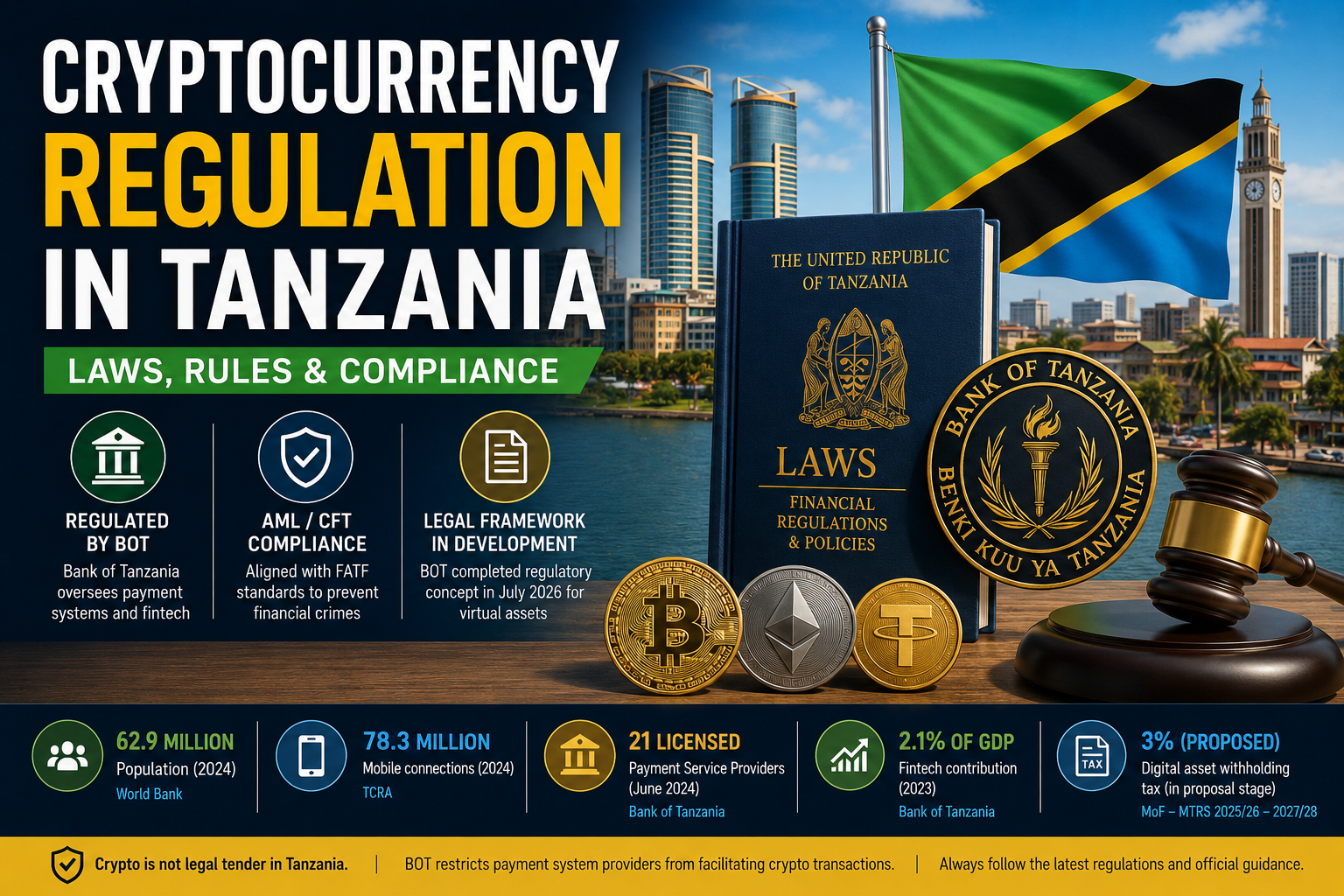
The latest official picture is still cautious. The Bank of Tanzania's 2024 National Payment System Annual Report says cryptocurrencies are not legally prohibited in Tanzania.
But the same report says the Bank restricts payment system providers from cryptocurrency operations, including the issuance, distribution and settlement of virtual assets.
The Bank's earlier November 2019 public notice on cryptocurrencies warned the public against trading, marketing and using virtual currencies. It said they were not legally authorised in Tanzania and that such activity was contrary to the foreign-exchange framework then in force.
Regulatory work has continued. The Bank of Tanzania's Annual Financial Inclusion Report 2024 says the National Cryptocurrency Technical Committee carried out a pilot assessment covering Dar es Salaam and Zanzibar.
It also says the Financial Intelligence Unit and other stakeholders were conducting a national virtual-asset and VASP risk assessment aligned with FATF standards.
The wider financial system is already deeply digital. By the end of 2024, Tanzania had 60.75 million active mobile money accounts, up 17.5%. The country also had 1.48 million mobile money agents, up 19%.
The next step may be formal crypto regulation. In July 2026, The Citizen reported that the Bank of Tanzania had completed a virtual-assets assessment and developed a regulatory concept. The newspaper reported that the concept had been submitted to the Ministry of Finance for further policy and legal development.
That is an important development.
It is not the same as a new crypto law.
As of August 2026, Tanzania should not be described as having a fully operational VASP licensing regime.
Is Cryptocurrency Legal in Tanzania?
The answer requires a distinction.
Cryptocurrencies are not legally prohibited in Tanzania, according to the Bank of Tanzania's 2024 National Payment System Annual Report.
That does not mean cryptocurrency is legal tender.
It does not mean every crypto business is licensed.
It also does not mean regulated payment providers can freely issue, distribute or settle virtual assets.
The same Bank of Tanzania report says the Bank restricts payment system providers from engaging in cryptocurrency operations.
This is one of the most important points in Tanzania's crypto framework.
Not Prohibited Is Not the Same as Regulated
A crypto asset can fall outside a blanket prohibition.
That still does not create a dedicated licensing regime.
A company may need to answer separate questions about:
- Financial services regulation.
- Payment systems regulation.
- Foreign exchange rules.
- Anti-money-laundering obligations.
- Consumer protection.
- Tax.
- Data protection.
- Marketing.
The legal position depends on the activity.
Are Cryptocurrencies Legal Tender in Tanzania?
No.
The Bank of Tanzania's November 2019 public notice said the Tanzanian Shilling is the only acceptable and used legal tender in the country.
The notice referred to Sections 26 and 27 of the Bank of Tanzania Act, 2006.
The Bank said it is the sole institution mandated to issue banknotes and coins and declare legal tender.
This matters for payments.
Bitcoin is not the official currency of Tanzania.
Neither is USDT.
Neither is any other private cryptocurrency.
A merchant and customer may still face separate contractual and legal questions when agreeing to a transaction involving a digital asset.
That does not convert the asset into Tanzanian legal tender.
What Did the Bank of Tanzania Say About Cryptocurrency?
The November 2019 public notice remains a central official reference.
The Bank said it had seen growing public participation in virtual-currency activities.
It also said some cryptocurrencies were being marketed and traded in a way that could make them appear to be legal tender.
The Bank advised the public against trading, marketing and using virtual currencies.
It cited the legal and operational risks involved.
The notice also said virtual currencies were not legally authorised in Tanzania.
The Position Developed Further in the 2024 Payment System Report
The 2024 National Payment System Annual Report adds an important clarification.
It says cryptocurrencies are not legally prohibited in Tanzania.
But it also says the existing Foreign Exchange Regulations 2022 do not provide for virtual currencies.
The report further says the Bank restricts payment system providers from cryptocurrency operations.
That includes:
- Issuance.
- Distribution.
- Settlement of virtual assets.
The report links those restrictions to Regulation 23(2)(d) and Regulation 31(2)(d) of the Payment Systems Licensing Approval Regulations 2015.
Does Tanzania Have a Crypto Licensing Regime?
As of August 2026, Tanzania should not be described as having a published, general VASP licensing framework comparable with dedicated crypto regimes in some other jurisdictions.
The Bank of Tanzania's own Fintech Regulatory Sandbox page says the Bank issued a public notice in 2019 cautioning the public about cryptocurrency operations because those operations were not regulated by the Bank.
The Bank's 2024 Annual Financial Inclusion Report also described ongoing work.
It said the National Cryptocurrency Technical Committee had conducted a pilot assessment.
The assessment covered Dar es Salaam and Zanzibar.
The report examined transaction volumes, market activity and regulatory concerns using exchange data, blockchain explorers and crypto wallets.
The same report said the FIU and other stakeholders were conducting a national risk assessment for virtual assets and VASPs.
The Latest 2026 Regulatory Development
The most significant recent development came from a July 2026 report by The Citizen.
The report said the Bank of Tanzania had completed an assessment of the virtual-assets sector.
It also said the Bank had developed a regulatory concept for virtual assets.
According to the report, the concept had been submitted to the Ministry of Finance for further policy and legal development.
The report attributed that information to the Bank's Governor.
This suggests Tanzania may be moving from assessment toward formal rulemaking.
But a concept is not a law.
A law must still pass through the required policy and legislative process.
Until a formal framework is published, companies should not claim that Tanzania has already opened a general crypto licensing regime.
Who Regulates Cryptocurrency in Tanzania?
The Bank of Tanzania is central to the current framework.
Its role includes monetary policy, financial stability and payment systems.
The Bank has also published the main official notices and reports addressing cryptocurrency.
Other authorities may become relevant depending on the activity.
These can include:
- The Financial Intelligence Unit.
- The Ministry of Finance.
- Tax authorities.
- Communications regulators.
- Other financial-sector authorities.
The exact regulatory analysis depends on the business model.
A crypto exchange raises different questions from a wallet.
A stablecoin issuer raises different questions from a blockchain analytics provider.
A company should identify its exact activities before deciding which approvals or obligations may apply.
What About Bitcoin and Other Cryptocurrencies?
Bitcoin is not legal tender in Tanzania.
The same principle applies to other private cryptocurrencies.
The Bank of Tanzania's published position focuses on the risks and regulatory status of virtual currencies.
The 2024 National Payment System Annual Report says virtual currencies are not legally prohibited.
But it also says the existing foreign-exchange rules do not provide for them.
That creates an important compliance distinction.
Availability is not the same as regulatory approval.
A user may be able to access an overseas crypto website.
That does not mean the platform is licensed by the Bank of Tanzania.
What About Stablecoins?
Stablecoins require the same caution.
A stablecoin is still a digital asset.
Its design may reduce price volatility.
That does not automatically determine its legal treatment.
A stablecoin business may raise questions about:
- Issuance.
- Payments.
- Settlement.
- Custody.
- Reserves.
- Foreign exchange.
- Consumer protection.
- AML/CFT controls.
The latest regulatory concept reported in July 2026 specifically covered virtual assets and could potentially address stablecoins as future policy develops.
But future rules should not be presented as current law.
Can Payment Providers Handle Cryptocurrency?
The Bank of Tanzania's 2024 National Payment System Annual Report draws a clear line.
The Bank restricts payment system providers from cryptocurrency operations.
The report specifically refers to issuance, distribution and settlement of virtual assets.
This is especially important for:
- Banks.
- Payment service providers.
- Mobile money operators.
- Licensed payment institutions.
- Fintech companies operating under the Bank's mandate.
A company should not assume that an existing payments licence automatically permits crypto activity.
The scope of the licence matters.
The exact service matters.
Regulatory approval may also matter.
Tanzania's AML Rules and Virtual Assets
Tanzania's crypto framework is not only about payment regulation.
Anti-money-laundering rules also matter.
The Anti-Money Laundering (Amendment) Act 2022 added provisions addressing risks linked to new and developing technologies.
The text specifically refers to risks connected with virtual currencies and virtual assets.
It also refers to decentralized convertible virtual-currency or asset networks.
The law requires reporting persons to assess risks associated with new or developing technologies.
It also requires attention to higher-risk points where value moves between virtual assets and fiat currencies.
That is important.
Tanzania can address virtual-asset risks through AML rules even before a dedicated VASP licensing regime is fully established.
Tanzania's National Virtual-Asset Risk Assessment
The Bank of Tanzania's 2024 Annual Financial Inclusion Report says the Financial Intelligence Unit and other stakeholders were conducting a national risk assessment for virtual assets and VASPs.
The work was aligned with FATF standards.
The report said completion was expected in 2025.
That assessment matters because FATF-based risk analysis can shape future regulation.
It can help authorities identify:
- Money-laundering risks.
- Terrorist-financing risks.
- High-risk services.
- Gaps in supervision.
- Gaps in customer due diligence.
- Risks linked to cross-border transfers.
What Do FATF Standards Mean for Tanzania?
The FATF's Tanzania mutual-evaluation page directs readers to the country's assessment under the FATF-style regional body process.
Tanzania has also remained in enhanced follow-up.
The FATF's 2024 follow-up publication says the country continued to report progress on technical-compliance deficiencies identified in its mutual evaluation.
Virtual assets are part of the wider FATF standards environment.
Recommendation 15 addresses risks from new technologies.
FATF standards also address virtual assets and virtual-asset service providers.
The standards do not force every country to use the same licensing model.
But they require countries to understand risks and respond appropriately.
Tanzania Is Building Digital Finance Without Treating Crypto Like Mobile Money
Tanzania is one of Africa's major digital-finance markets.
That does not mean crypto receives the same regulatory treatment as mobile money.
By the end of 2024, the Bank of Tanzania recorded 60.75 million active mobile money accounts.
The number of mobile money agents reached 1.48 million.
The Bank's 2024 financial-inclusion report said active mobile money accounts grew 17.5%.
Agents grew 19%.
These are regulated payment-system figures.
They are not crypto-adoption figures.
The distinction is essential.
Tanzania Instant Payment System
Tanzania has also built a national instant-payment infrastructure.
A Bank of Tanzania publication on TIPS reported more than 453.7 million interoperable retail transactions through TIPS in 2024.
The transactions were worth more than TZS 29.9 trillion.
The Bank's 2025 National Payment Systems Annual Report also shows continued growth in interoperable digital payments.
Digital-finance innovation is therefore not the issue.
The regulatory question is how virtual assets fit into Tanzania's financial system.
What About Tanzania's Fintech Regulatory Sandbox?
Tanzania's Fintech Regulatory Sandbox provides a controlled environment for financial innovations that are not fully covered by existing regulations under the Bank's mandate.
Eligible applicants include financial service providers and fintech companies.
The sandbox does not automatically create a general crypto licence.
A sandbox is a test environment.
It is not the same as a permanent market authorisation.
The Bank's sandbox page also repeats its cautious position on cryptocurrency.
It says the Bank promotes financial innovation while protecting consumers and financial stability.
Is Tanzania Taxing Cryptocurrency?
Tax policy is also developing.
The Ministry of Finance's Medium Term Revenue Strategy 2025/26–2027/28 includes a proposal to introduce a digital-asset withholding tax of 3% on cryptocurrency and NFT business transactions.
The strategy lists the measure as a proposed policy action.
A policy proposal is not automatically a tax already in force.
That distinction matters.
Businesses should check the current tax legislation and guidance before calculating any tax obligation.
Future Tax Rules Could Follow Future Regulation
Tax and licensing policy often develop together.
A formal virtual-assets framework could eventually create clearer rules for:
- Exchanges.
- Brokers.
- Custodians.
- Mining.
- Token issuers.
- NFT businesses.
- Stablecoin services.
But no future rule should be treated as current law until it is formally enacted or issued.
Can Crypto Companies Advertise in Tanzania?
Marketing creates its own risks.
The Bank's 2019 public notice specifically referred to cryptocurrency trading and marketing.
The Bank warned against activities that could create the perception that virtual currencies were legal tender.
Companies should therefore avoid misleading claims.
That includes claims such as:
- "Official Tanzanian crypto."
- "Approved by the Bank of Tanzania."
- "Legal tender in Tanzania."
- "Guaranteed crypto returns."
A company should only claim regulatory approval when it can verify that approval.
The Bank of Tanzania's Financial Consumer Alert system also warns consumers about entities that may be incorrectly perceived or portrayed as licensed by the Bank.
That principle matters for crypto marketing.
What Does the Current Framework Mean for Crypto Exchanges?
An exchange may be accessible online.
That does not establish local authorisation.
As of August 2026, companies should not assume that Tanzania has a broad published VASP licensing system for crypto exchanges.
The regulatory position should be assessed activity by activity.
Key questions include:
- Is the company handling fiat payments?
- Is it offering custody?
- Is it marketing directly to Tanzanian users?
- Is it operating through a Tanzanian entity?
- Is it connected to a licensed payment provider?
- Does it create AML reporting obligations?
- Does it trigger tax obligations?
A foreign licence may be relevant.
It does not automatically establish Tanzanian authorisation.
What Could Tanzania's Future Crypto Framework Look Like?
The July 2026 report on the Bank of Tanzania's regulatory concept suggests formal policy work is advancing.
The final model remains unknown.
Several approaches are possible.
A VASP Licensing Regime
Tanzania could create licences for:
- Exchanges.
- Brokers.
- Custodians.
- Wallet providers.
- Other virtual-asset service providers.
The framework could include governance, capital and AML requirements.
Stablecoin Rules
A future framework could distinguish stablecoins from other crypto assets.
It could address reserves, redemption and issuer obligations.
Limited Institutional Access
Authorities could initially permit selected institutions or use cases.
Retail services could face different conditions.
Sandbox-Based Testing
The existing fintech sandbox could help regulators test some innovations before wider rules are introduced.
These are possible models.
They are not current Tanzanian law.
Key Tanzania Crypto Regulation Numbers
- 60.75 million — active mobile money accounts at the end of 2024.
- 17.5% — annual growth in active mobile money accounts during 2024.
- 1.48 million — mobile money agents at the end of 2024.
- 19% — annual growth in mobile money agents during 2024.
- More than 453.7 million — interoperable retail transactions processed through TIPS during 2024.
- More than TZS 29.9 trillion — value of those TIPS transactions.
- 3% — proposed digital-asset withholding tax on cryptocurrency and NFT business transactions in the Medium Term Revenue Strategy.
- 2019 — year of the Bank of Tanzania's major public cryptocurrency notice.
- 2024 — the Bank's payment-system report stating that cryptocurrencies are not legally prohibited, while payment system providers remain restricted from specified crypto operations.
- July 2026 — reported completion of a Bank of Tanzania virtual-assets regulatory concept, according to The Citizen's report.
These figures measure different parts of Tanzania's financial and regulatory system.
They should not be combined into one crypto-market figure.
Together, they show a clear picture.
Tanzania has a large and rapidly growing digital-finance ecosystem.
Its virtual-assets framework remains cautious.
Formal regulation may be moving closer.
But a dedicated licensing regime has not yet been established through a published general framework.
The Bottom Line
Tanzania's cryptocurrency position requires nuance.
Cryptocurrencies are not legally prohibited, according to the Bank of Tanzania's 2024 National Payment System Annual Report.
They are not legal tender.
The Tanzanian Shilling remains the country's legal tender.
The Bank also restricts payment system providers from cryptocurrency operations involving issuance, distribution and settlement of virtual assets.
Tanzania has been studying the sector.
A National Cryptocurrency Technical Committee has carried out a pilot assessment.
The Financial Intelligence Unit and other stakeholders have worked on virtual-asset risk assessment.
The latest reported development is significant.
In July 2026, The Citizen reported that the Bank of Tanzania had completed a regulatory concept for virtual assets and submitted it to the Ministry of Finance for further development.
That could mark the next stage of Tanzania's crypto policy.
But a regulatory concept is not a licence.
It is not a new law.
Until formal rules are published, crypto businesses should avoid claiming Bank of Tanzania approval without clear evidence.