Tanzania Cross-Border Payments: Remittances, Trade and the Future of Regional Money Movement
Explore Tanzania's cross-border payments market, including remittances, mobile money, EAPS, SADC RTGS, TIPS, Tanzania-Kenya payments, foreign exchange and the latest payment statistics.

On this page
Tanzania's cross-border payments market is growing quickly.
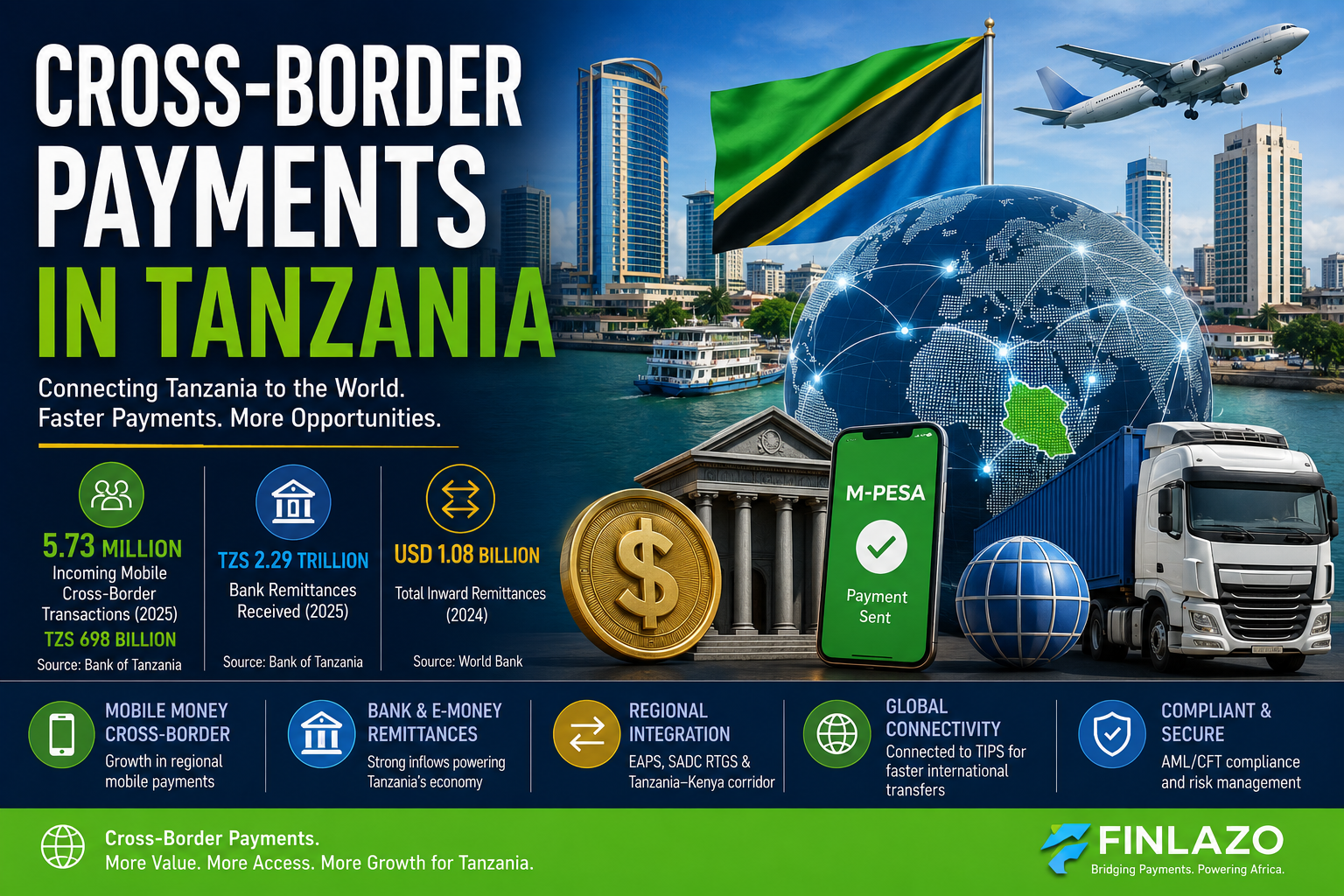
The Bank of Tanzania's National Payment Systems Annual Report 2025 recorded 5.73 million incoming cross-border mobile-payment transactions worth TZS 698 billion during 2025.
Incoming volume increased 32.76%. Incoming value increased 33.45%. Outgoing mobile cross-border payments reached 2.52 million transactions. Tanzania's electronic money ecosystem is becoming an increasingly important part of regional money movement.
Bank-based remittances also grew.
Incoming remittances processed by banks reached 1.45 million transactions worth TZS 2.29 trillion in 2025. The value increased 21.01% from 2024. Outgoing bank remittances reached TZS 1.78 trillion. Their value increased 53.17%. The Bank of Tanzania's 2025 report also recorded strong growth in electronic-money remittance channels.
Tanzania sits between major regional payment corridors.
It trades heavily with East African neighbours. It also participates in Southern African payment infrastructure. Its payment system connects domestic banks, mobile money providers and international remittance channels.
The infrastructure is evolving.
The East Africa Payment System supports cross-border interbank payments between participating East African markets. The SADC RTGS supports regional payments within Southern Africa. Tanzania has also upgraded its instant-payment infrastructure to support inbound international transfers.
The result is a market with a clear opportunity.
Cross-border payments are becoming faster and more digital.
But cost, foreign-exchange conversion, fragmentation and compliance still matter.
Tanzania's Cross-Border Payments Market at a Glance
Tanzania's latest official payment data shows strong momentum.
The Bank of Tanzania's National Payment Systems Annual Report 2025 recorded:
- 5.73 million incoming mobile cross-border payment transactions in 2025.
- TZS 698 billion in incoming mobile cross-border payment value.
- 32.76% growth in incoming mobile cross-border payment volume.
- 33.45% growth in incoming mobile cross-border payment value.
- 2.52 million outgoing mobile cross-border payment transactions.
- TZS 275.19 billion in outgoing mobile cross-border payment value.
- 1.45 million incoming bank remittance transactions.
- TZS 2.29 trillion in incoming bank remittance value.
- TZS 1.78 trillion in outgoing bank remittance value.
These figures cover different payment channels.
They should not be added together as one market-size figure.
Some represent bank remittances.
Others represent mobile cross-border payments.
Together, they show the importance of cross-border money movement to Tanzania's financial system.
Why Cross-Border Payments Matter in Tanzania
Tanzania is part of several important economic corridors.
Kenya is a major regional trading partner.
Uganda, Rwanda, Burundi and the Democratic Republic of Congo are also important to regional commerce.
Tanzania also connects East Africa with Southern Africa.
Its ports and transport networks give cross-border trade additional importance.
Payments are therefore part of a larger commercial system.
Businesses need to pay suppliers.
Importers need foreign currency.
Exporters need to receive funds.
Families receive remittances.
Workers send money across borders.
Small businesses increasingly use mobile and digital channels.
The payment infrastructure has to support all of those needs.
Trade Creates Payment Demand
Trade is one driver.
The World Bank's WITS profile for Tanzania reports total merchandise exports and imports in its latest country profile data.
The figures show the scale of Tanzania's international commercial relationships.
Every trade relationship creates payment requirements.
Those payments can move through correspondent banks.
They can use regional settlement systems.
They can also use money transfer operators, mobile money and other regulated payment channels.
The faster and more efficient those rails become, the easier it can be for businesses to manage working capital.
Remittances Create Another Major Flow
Cross-border payments are not only about trade.
Remittances are another major category.
The World Bank's Tanzania data shows that personal remittances received represented 1.4% of GDP in 2024.
The Bank of Tanzania's 2024 National Payment System Annual Report said Tanzania received approximately USD 747 million in formal remittances in 2023.
The Bank's diagnostic work identified opportunities to improve remittance infrastructure and reduce costs.
That matters for households.
It also matters for the wider payments market.
How Tanzania's Cross-Border Payment System Works
Tanzania does not rely on one payment rail.
The system is made up of several channels.
These include:
- Commercial banks.
- Money transfer operators.
- Mobile money operators.
- Electronic money issuers.
- Regional payment systems.
- International correspondent banking networks.
Different channels serve different use cases.
A large corporate payment may move differently from a family remittance.
A Kenya-Tanzania bank transfer may use different infrastructure from a transfer to Europe.
A mobile wallet transaction may also follow a different route.
Bank-Based Cross-Border Payments
Banks remain important for higher-value payments and international business transactions.
The Bank of Tanzania's 2025 National Payment Systems Annual Report recorded 1.45 million incoming remittance transactions through banks during 2025.
Their value reached TZS 2.29 trillion.
That was a 21.01% increase in value from 2024.
Outgoing bank remittances totalled 151,340 transactions.
Their value reached TZS 1.78 trillion.
That represented a 53.17% increase in value from 2024.
Bank payments remain essential.
But they are not the only growth story.
Mobile and electronic-money channels are becoming increasingly important.
Mobile Money Is Changing Tanzania's Cross-Border Payment Market
Tanzania has one of Africa's strongest mobile-money ecosystems.
That domestic infrastructure is increasingly supporting cross-border activity.
The Bank of Tanzania's 2025 payment systems report says mobile money operators facilitated cross-border payments to the East African Community, the SADC region and the rest of the world.
Incoming mobile cross-border payments reached 5.73 million transactions during 2025.
The value reached TZS 698 billion.
The volume increased 32.76%.
The value increased 33.45%.
Outgoing transactions reached 2.52 million.
That was a 13.77% increase in volume from 2024.
The value of outgoing payments was TZS 275.19 billion.
Why Mobile Money Matters
Mobile money can extend payment access beyond traditional bank branches.
It can connect consumers with agent networks.
It can also support smaller payment values.
For cross-border payments, the challenge is interoperability.
A payment needs to move between systems.
The sender's provider needs a connection to the receiving side.
Compliance checks must also work.
Foreign-exchange conversion may be required.
Settlement has to be reliable.
Partnerships between mobile money operators, money transfer operators and international remittance hubs can help solve some of those problems.
The Bank of Tanzania's 2025 report specifically linked strong electronic-money remittance growth to strengthened partnerships and expanded cross-border interoperability.
Electronic Money Remittances Are Growing
The latest Bank of Tanzania data also highlights electronic-money remittance channels.
The 2025 National Payment Systems Annual Report says incoming remittances facilitated by electronic money issuers grew in both volume and value.
The volume reached 8.74 million transactions in 2025.
The report recorded total value of TZS 1,753.97 billion.
The Bank said the growth was driven largely by stronger partnerships between mobile money operators, money transfer operators and international remittance hubs.
This is important for Tanzania's future.
Cross-border payments do not need to remain exclusively bank-based.
Digital wallets and electronic-money channels can handle an increasing share of smaller transfers when regulation and interoperability support the service.
East Africa Payment System: Tanzania's Regional Bank Rail
The Bank of Tanzania facilitates cross-border payments for East African Community member countries through the East Africa Payment System, or EAPS.
EAPS went live on November 25, 2013.
The system was designed to facilitate cross-border payments in real time.
The Bank says it supports payments and settlement within the East African region.
It also enables the use of local currencies.
The current operational network links payment infrastructure in Kenya, Tanzania, Uganda and Rwanda.
Why Local-Currency Settlement Matters
A regional payment may traditionally require multiple currency conversions.
For example, one local currency may first be converted into a major international currency.
The payment may then be converted into the beneficiary's local currency.
Every additional step can add cost and complexity.
Local-currency settlement can reduce some of that friction.
The Bank of Tanzania's EAPS description says the system architecture enables the use of local currencies for settlement in the region.
That is especially relevant for East African trade.
Tanzania-Kenya Cross-Border Payments
Kenya is one of Tanzania's most important regional payment corridors.
The Bank of Tanzania's 2024/25 Annual Report said EAPS transactions were dominated by the Tanzanian Shilling and Kenyan Shilling.
The Bank linked that pattern to trade volumes between Tanzania and Kenya.
For the 2024/25 financial year, the Bank reported 5,134 KES-denominated EAC cross-border transactions through the system.
The reported value was KES 64,816 million.
The Tanzanian Shilling side of the same regional system also processed 5,554 transactions valued at TZS 521,565 million.
These figures are not a complete measure of all Tanzania-Kenya payments.
They cover reported EAPS activity.
Other payments can move through correspondent banks, money transfer operators and mobile-money channels.
Still, the data shows the importance of the corridor.
For more regional context, Finlazo's Nigeria cross-border payments coverage examines another major African market where payment infrastructure and regional trade are shaping the future of money movement.
Tanzania and SADC Cross-Border Payments
Tanzania also participates in the SADC RTGS system.
The Bank of Tanzania describes SADC RTGS as a real-time gross settlement system for cross-border payments within SADC member states.
The settlement currency is the South African Rand.
Commercial banks can use the system for eligible regional payments.
The Bank says 6 Tanzanian banks currently participate.
The Bank of Tanzania's 2024/25 Annual Report reported that the SADC RTGS processed 1.6 million transactions worth ZAR 2,777.9 billion across the system during the year.
The report said Tanzanian banks collectively processed 3,483 transactions valued at ZAR 1,118 million.
Regional systems can improve settlement options.
But each system has its own participants, rules and currencies.
Tanzania Instant Payment System and International Transfers
Tanzania's domestic instant-payment infrastructure is also becoming more relevant to cross-border money movement.
The World Bank's FASTT profile for Tanzania identifies the Tanzania Instant Payment System, or TIPS, as the country's fast-payment infrastructure.
TIPS supports several payment types.
These include:
- Person-to-person payments.
- Person-to-business payments.
- Business-to-person payments.
- Business-to-business payments.
The system supports multiple channels.
These include mobile applications, USSD, QR codes, internet banking and agent channels.
The Bank of Tanzania's 2024/25 Annual Report said TIPS was upgraded to support incoming cross-border remittances and fund transfers.
The report also said Tanzania's National Switch was enhanced with a use case for inbound international money transfers through TIPS.
This is a major infrastructure development.
It can connect international inflows more directly with domestic payment rails.
From International Transfer to Domestic Wallet
A traditional remittance can involve several institutions.
The sender pays a provider.
The payment moves through international infrastructure.
A local partner receives the funds.
The beneficiary then collects the money or receives a credit.
TIPS and interoperable domestic systems can simplify the final stage.
The payment can potentially reach a bank account or electronic wallet through a connected domestic network.
The exact customer experience depends on the provider and corridor.
But the infrastructure direction is clear.
International and domestic payment rails are becoming more connected.
The Cost Problem in Cross-Border Payments
Speed is only one part of the problem.
Cost also matters.
A cross-border payment can include:
- Transfer fees.
- Foreign-exchange spreads.
- Correspondent banking charges.
- Intermediary charges.
- Cash-out fees.
- Recipient fees.
The sender may see only part of the total cost.
The exchange rate can also affect the final amount received.
That is why payment transparency matters.
Businesses need to know their full cost.
Consumers also need to understand how much the recipient will receive.
Why Foreign Exchange Matters
Many cross-border payments involve a currency conversion.
That creates foreign-exchange exposure.
A Tanzanian importer may need to buy foreign currency.
An exporter may receive foreign currency.
A remittance provider may need liquidity in multiple currencies.
The Bank of Tanzania continues to oversee the foreign-exchange framework.
Its January 2026 Directives on Foreign Exchange Operations show that foreign-exchange operations remain an active regulatory area.
For payment companies, cross-border product design cannot be separated from foreign-exchange compliance.
Correspondent Banking Still Matters
Regional payment infrastructure is expanding.
Correspondent banking still remains important for many international payments.
A Tanzanian bank may rely on relationships with banks in other jurisdictions.
Those relationships help move funds across currencies and markets.
The correspondent model can be effective.
But it can also create multiple intermediaries.
That can increase complexity.
It can also affect settlement times and costs.
Regional systems such as EAPS can reduce friction for some regional corridors.
Other systems serve different markets.
There is no single global rail for every Tanzania cross-border payment.
What Is PAPSS and Why Does It Matter?
The Pan-African Payment and Settlement System, or PAPSS, is designed to facilitate cross-border payments across Africa.
PAPSS works with central banks and eligible financial institutions.
It aims to support payments in local currencies.
According to PAPSS, its instant-payment process can handle payments within a maximum of 120 seconds.
The system also performs required validation and compliance checks within its payment flow.
PAPSS is important to the wider African payments story.
It aims to reduce reliance on multiple foreign-currency conversions for African trade.
PAPSS Is Not the Same as EAPS
The systems serve different purposes.
EAPS is an East African regional payment arrangement.
PAPSS has a broader pan-African ambition.
A business should not assume that every African bank or payment provider is automatically connected to PAPSS.
Participation depends on network eligibility and onboarding.
The PAPSS connection framework sets out participation requirements.
For Tanzania, future regional connectivity will depend on actual institutional participation and available payment corridors.
Cross-Border Payments and the African Continental Free Trade Area
Trade and payments are closely linked.
The African Continental Free Trade Area is increasing attention on the infrastructure needed to support intra-African commerce.
A payment can become a barrier even when a trade opportunity exists.
A business may find a supplier in another African country.
But it still needs an efficient way to pay.
The same applies to exporters.
Fast, predictable settlement can improve cash-flow management.
Local-currency options can also reduce some dependence on hard-currency conversion.
The PAPSS model is one example of infrastructure designed around that problem.
Tanzania's existing EAPS and SADC participation show that regional payment integration is already part of the country's financial infrastructure.
Compliance Is Central to Cross-Border Payments
Cross-border payments cannot focus only on speed.
Compliance is essential.
Payment providers may need to manage:
- Customer identification.
- Customer due diligence.
- Sanctions screening.
- Transaction monitoring.
- Suspicious-activity reporting.
- Fraud prevention.
- Foreign-exchange rules.
- Data protection.
- Licensing requirements.
The exact obligations depend on the institution and transaction.
Cross-border payments can involve multiple jurisdictions.
A provider may therefore need to comply with rules in both the sending and receiving markets.
Faster Payments Do Not Remove Compliance
Instant payments require strong controls.
The payment has less time to be stopped once it is executed.
That makes risk management important.
The PAPSS payment model says validation, legal and compliance checks are built into its payment process.
Other systems use their own controls.
The technology can change.
The compliance obligation remains.
The Role of Mobile Money Operators
Mobile money operators are becoming increasingly important in cross-border payment corridors.
The latest official Tanzanian data supports that trend.
The Bank of Tanzania reported 5.73 million incoming mobile cross-border payment transactions in 2025.
It also recorded 2.52 million outgoing transactions.
This growth can make mobile wallets more useful for regional users.
But interoperability remains essential.
The sender's network and the recipient's network need an approved way to exchange payment information and settle funds.
Partnerships with banks, money transfer operators and international hubs can help create those links.
What Are the Biggest Challenges?
Tanzania's cross-border payment infrastructure is improving.
Several challenges remain.
Foreign-Exchange Complexity
Many payments still need currency conversion.
Exchange rates can change.
Liquidity can also vary.
Fragmented Networks
Not every bank connects to every regional system.
Not every wallet connects to every international provider.
A payment corridor may work well in one direction and poorly in another.
Compliance Costs
AML, sanctions and fraud controls require investment.
Smaller providers may face higher relative costs.
Interoperability
Technical connections are only part of the challenge.
Commercial agreements and regulatory approval also matter.
Consumer Trust
Users need clear information.
They need to understand fees.
They need to know the exchange rate.
They also need protection against fraud.
Opportunities for Tanzanian Businesses
The payment transformation creates several opportunities.
Faster Supplier Payments
Businesses can potentially reduce payment delays when efficient regional rails are available.
That can improve supplier relationships.
It can also improve inventory planning.
Better Working Capital
Faster settlement can reduce the time money remains in transit.
That can be especially useful for SMEs.
Regional E-Commerce
Digital merchants need payment options that work across borders.
Mobile money and instant-payment infrastructure can help support those use cases.
Diaspora and Family Payments
Remittance infrastructure can improve the speed and convenience of international transfers.
The Bank of Tanzania's diagnostic work has specifically examined opportunities to improve the country's remittance ecosystem.
Fintech Innovation
Payment companies can build services on top of existing infrastructure.
But they need the right licences, partnerships and compliance systems.
What Cross-Border Payment Companies Should Consider
Tanzania is not a market where a company should simply launch a website and assume that payments can flow.
The operating model matters.
A company should assess:
- Which countries it will serve.
- Which currencies it will support.
- Whether it will hold customer funds.
- Whether it will perform currency conversion.
- Whether it needs a local licence.
- Which regulated partners it will use.
- How it will perform AML and sanctions checks.
- How it will handle refunds and disputes.
- How it will protect customer data.
- Which payment rail will handle settlement.
The strongest model may combine several systems.
For example, a company may use a licensed local partner for domestic collection and payout.
It may use a regional payment network for settlement.
It may also use a regulated foreign-exchange partner.
The structure depends on the service.
Tanzania Cross-Border Payment Statistics
Here are some of the most important recent figures:
- 5.73 million — incoming mobile cross-border payment transactions in 2025. Bank of Tanzania
- TZS 698 billion — value of incoming mobile cross-border payments in 2025. Bank of Tanzania
- 32.76% — growth in incoming mobile cross-border payment volume in 2025. Bank of Tanzania
- 33.45% — growth in incoming mobile cross-border payment value in 2025. Bank of Tanzania
- 2.52 million — outgoing mobile cross-border payment transactions in 2025. Bank of Tanzania
- 1.45 million — incoming bank remittance transactions in 2025. Bank of Tanzania
- TZS 2.29 trillion — incoming bank remittance value in 2025. Bank of Tanzania
- TZS 1.78 trillion — outgoing bank remittance value in 2025. Bank of Tanzania
- 8.74 million — incoming remittance transactions facilitated by electronic money issuers in 2025. Bank of Tanzania
- TZS 1,753.97 billion — value of those electronic-money incoming remittances. Bank of Tanzania
- 5,134 — KES-denominated EAPS cross-border transactions reported for 2024/25. Bank of Tanzania
- KES 64,816 million — value of those KES-denominated EAPS transactions. Bank of Tanzania
- 6 Tanzanian banks — current participants in SADC RTGS, according to the Bank of Tanzania. Bank of Tanzania
- 453.7 million — interoperable retail transactions through TIPS in 2024, according to a Bank of Tanzania publication. Bank of Tanzania
- TZS 29.9 trillion — value of those TIPS transactions in 2024. Bank of Tanzania
- 1.4% of GDP — personal remittances received by Tanzania in 2024. World Bank
- USD 747 million — approximate formal remittances received by Tanzania in 2023, according to the Bank of Tanzania's remittance diagnostic. Bank of Tanzania
The Future of Tanzania Cross-Border Payments
The direction is clear.
Cross-border payments are becoming more digital.
Mobile money is handling a larger share of international flows.
Electronic money issuers are expanding their role.
Regional systems support local and regional settlement.
TIPS is being developed beyond domestic use.
The Bank of Tanzania has already upgraded infrastructure to support inbound international money transfers through TIPS.
Future growth will depend on several factors.
These include:
- More regional interoperability.
- Better foreign-exchange infrastructure.
- More efficient compliance.
- Stronger bank and fintech partnerships.
- Greater mobile-wallet connectivity.
- Clear consumer protection.
- Better integration with African payment networks.
The market will not be transformed by one technology alone.
The strongest future systems will connect multiple rails.
The Bottom Line
Tanzania is becoming an important cross-border payments market.
The latest Bank of Tanzania data shows rapid growth in digital international money movement.
Incoming mobile cross-border payments reached 5.73 million transactions worth TZS 698 billion in 2025.
Incoming bank remittances reached TZS 2.29 trillion.
Electronic-money remittance channels handled 8.74 million incoming transactions.
Tanzania also has established regional infrastructure.
EAPS supports East African cross-border payments.
SADC RTGS connects Tanzania to Southern African payment infrastructure.
TIPS is being upgraded to support international inflows into Tanzania's domestic instant-payment ecosystem.
The opportunity is clear.
But cross-border payments remain complex.
Foreign exchange matters.
Compliance matters.
Interoperability matters.
The next phase will be about connecting Tanzania's strong digital-finance ecosystem with faster and more efficient regional and global payment rails.