Cryptocurrency in Nigeria: Market Size, Adoption, Bitcoin, Stablecoins and the Crypto Economy
Explore cryptocurrency in Nigeria, including market size, adoption, Bitcoin, stablecoins, DeFi, trading, cross-border payments and the latest crypto market data.

On this page
Nigeria remains one of the world's biggest cryptocurrency markets.
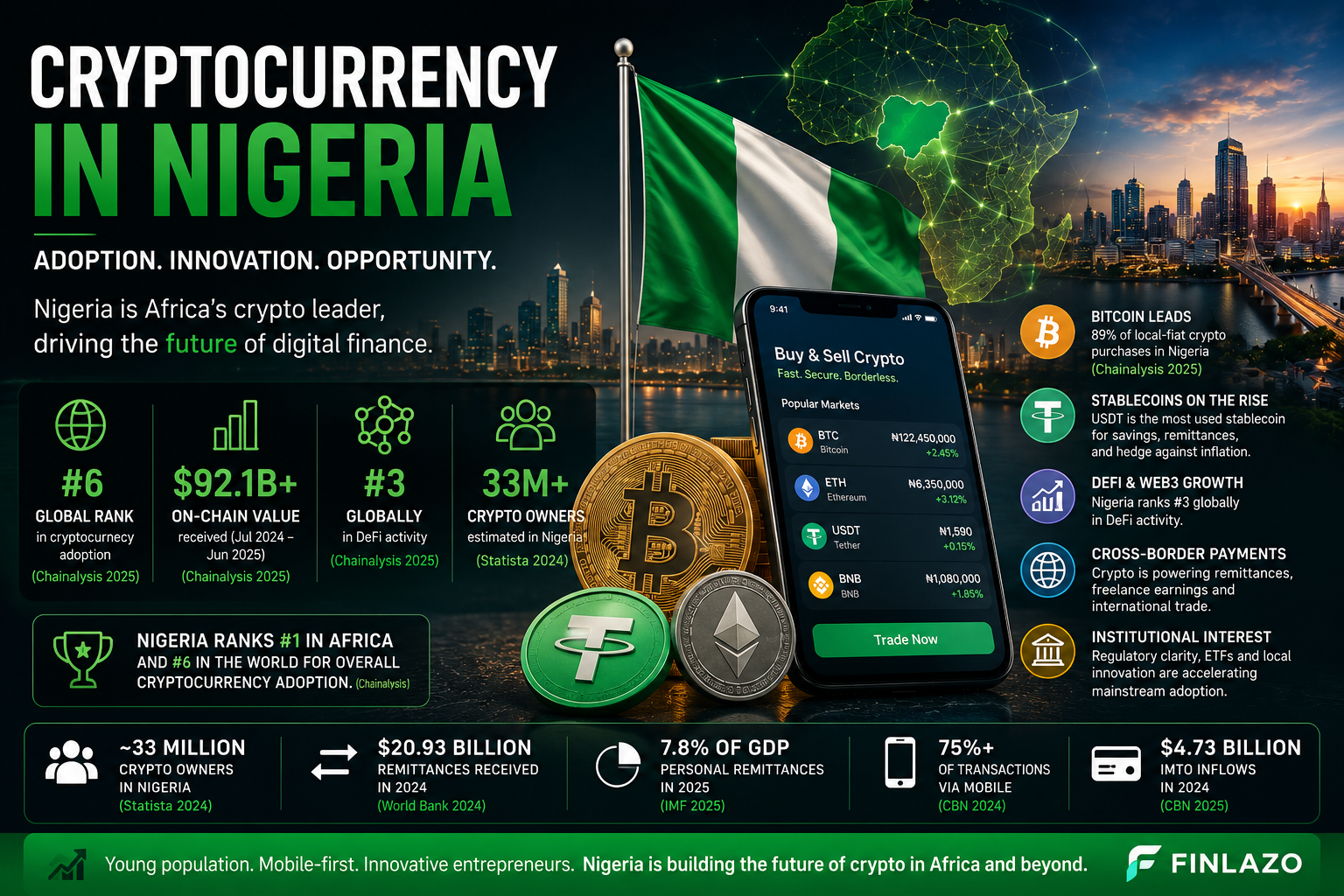
The latest 2025 Chainalysis Global Crypto Adoption Index ranked Nigeria sixth globally. Nigeria ranked third for decentralised-finance value received, seventh for retail centralised-service activity and eighth for total centralised-service value received.
The latest regional data is even more striking. Nigeria received more than US$92.1 billion in on-chain value between July 2024 and June 2025. That was nearly three times the value received by the next-largest crypto market in Sub-Saharan Africa.
The numbers show scale.
They also show something else.
Cryptocurrency in Nigeria is no longer only an investment story.
Bitcoin remains important. Stablecoins are increasingly used as a digital dollar alternative. DeFi has a significant footprint. Large transfers are supporting trade and cross-border activity.
At the same time, Nigeria's regulatory environment is becoming more formal.
The Securities and Exchange Commission continues to bring digital-asset businesses into its regulatory framework. The Central Bank of Nigeria has opened a controlled regulatory sandbox track for virtual-asset and stablecoin financial services.
Nigeria's crypto market is therefore entering a different phase.
The question is no longer whether Nigerians use cryptocurrency.
The question is how a market of this size develops as regulation, payments infrastructure and institutional participation catch up with adoption.
Nigeria Is One of the World's Largest Crypto Markets
Nigeria's sixth-place ranking in the 2025 Chainalysis Global Crypto Adoption Index places it among the world's leading countries for grassroots cryptocurrency use.
The ranking is important because Chainalysis does not measure adoption using one simple transaction-volume number.
Its index combines several forms of activity.
For Nigeria, the 2025 rankings were:
- 6th globally for overall cryptocurrency adoption.
- 7th for retail centralised-service value received.
- 8th for centralised-service value received.
- 3rd for DeFi value received.
- 8th for institutional centralised-service value received.
That DeFi ranking stands out.
Nigeria was not only a major centralised-exchange market.
It also ranked among the world's strongest markets for decentralised finance.
US$92.1 Billion in On-Chain Value
The strongest recent Nigeria-specific market figure comes from Chainalysis' 2025 Sub-Saharan Africa analysis.
Nigeria received more than US$92.1 billion in on-chain value between July 2024 and June 2025.
That figure measures value received through blockchain activity estimated by Chainalysis for the country.
It should not be described as Nigeria's crypto market capitalisation.
It is also not a forecast for 2026.
It is a measurement of on-chain value received during a specific 12-month period.
The same report found that Nigeria led Sub-Saharan Africa by a wide margin.
Nigeria received nearly three times as much value as South Africa, the next-largest market in the region during the period covered.
To compare this with East Africa's values, Finlazo has prepared analyses for both Cryptocurrency in Uganda and Crypto in Kenya.
Nigeria Helped Drive Regional Growth
Sub-Saharan Africa received more than US$205 billion in on-chain value between July 2024 and June 2025, according to Chainalysis.
That represented roughly 52% year-on-year growth.
Nigeria was one of the main drivers.
In March 2025, regional monthly on-chain volume reached nearly US$25 billion. Chainalysis linked much of that spike to centralised-exchange activity in Nigeria following a sharp currency devaluation.
That illustrates an important feature of Nigeria's crypto market.
Economic conditions can directly affect crypto demand.
Why Nigerians Use Cryptocurrency
There is no single reason.
Nigeria's crypto market developed through several overlapping use cases.
Savings and Currency Diversification
Bitcoin and stablecoins can give users exposure beyond the naira.
The International Monetary Fund's 2025 analysis of Nigeria's crypto market examined Nigeria as one of the world's leading crypto-adoption markets and discussed how macroeconomic conditions and foreign-exchange access can influence demand.
Crypto is not risk-free.
Bitcoin remains highly volatile.
Stablecoins also carry issuer, reserve, custody and regulatory risks.
But demand for alternatives can increase when users are concerned about local-currency purchasing power or access to foreign exchange.
Trading and Investment
Trading remains a major part of the ecosystem.
Nigeria has a large digitally connected population and a strong fintech culture.
Crypto exchanges and trading platforms gave many users access to Bitcoin and other digital assets without needing a traditional international brokerage account.
The market, however, is changing.
Higher regulatory requirements are increasing the importance of capital, compliance and licensed infrastructure.
Cross-Border Transfers
Cross-border payments are another important use case.
A blockchain transaction can move digital value internationally without following the same technical route as a traditional correspondent-banking payment.
That does not eliminate regulation.
Converting naira into crypto and converting crypto into local currency can involve regulated providers.
But digital assets can provide an additional settlement rail.
Chainalysis found that stablecoins are increasingly used in high-value transactions connected to trade flows between Africa, the Middle East and Asia, including regular multi-million-dollar transfers supporting sectors such as energy and merchant payments.
Bitcoin Remains the Dominant Entry Point
Stablecoins matter.
But Bitcoin remains the dominant crypto purchase in Nigeria.
According to Chainalysis' 2025 regional analysis, Bitcoin accounted for 89% of crypto purchases made with local fiat in Nigeria in the dataset examined.
That was far above the 51% Bitcoin share in the USD purchase cohort used in the report's comparison.
Chainalysis said the pattern suggests that Bitcoin is used not only as a speculative asset but also as a recognised entry point for crypto exposure in markets facing currency volatility and limited access to alternative investment products.
The figure applies to the report's centralised-exchange analysis.
It does not measure every crypto transaction in Nigeria.
Stablecoins Are Becoming Financial Infrastructure
Stablecoins are becoming increasingly important in Nigeria's crypto economy.
In Chainalysis' analysis, USDT represented 7% of crypto purchases made with local fiat in Nigeria, compared with 5% in the USD purchase cohort used for comparison.
That points to a specific use case.
For some users, a dollar-linked stablecoin can provide digital access to dollar-denominated value.
Stablecoins can also support:
- Cross-border settlement.
- Treasury management.
- Merchant payments.
- Digital dollar access.
- Crypto trading.
- International trade.
Nigeria's regulators are now paying closer attention to this part of the market.
The CBN Regulatory Sandbox includes a dedicated VASP track for virtual-asset and stablecoin financial services.
The eligible areas listed include fiat-backed stablecoin payments, stablecoin issuance models, virtual-asset payments, digital wallet infrastructure, custody, token-based products, fiat on- and off-ramps and stablecoin exchanges.
That is a significant development.
It shows that the discussion inside Nigeria's financial system has moved beyond simply asking whether crypto should exist.
The regulatory question increasingly concerns how specific products should be tested, supervised and integrated safely.
Nigeria Has Its Own Stablecoin Story
Nigeria's crypto market has also produced a local stablecoin project.
The SEC's public registered fintech operators information has listed cNGN as a Digital Asset (Stablecoin) Offering under the VASP framework.
The IMF's 2025 Nigeria report also discussed the launch of cNGN as Nigeria's first locally issued stablecoin within the regulatory framework.
Its long-term importance will depend on adoption, liquidity, use cases, reserves, governance and regulation.
But its existence shows that Nigeria's digital-asset market is moving beyond foreign-issued cryptocurrencies alone.
DeFi Is a Major Part of Nigeria's Crypto Market
Nigeria ranked third globally for DeFi value received in the 2025 Chainalysis Global Crypto Adoption Index.
That is one of the most important statistics in the Nigerian crypto market.
DeFi, or decentralised finance, refers broadly to financial applications built on blockchain networks that can allow activities such as swapping, lending, borrowing and liquidity provision through smart contracts.
The technology can reduce reliance on traditional intermediaries for some functions.
But it creates other risks.
Smart-contract vulnerabilities can lead to losses.
Users can lose private keys.
Fraudulent tokens and protocols exist.
Nigeria's high DeFi ranking therefore represents both opportunity and regulatory complexity.
Retail Activity Is Still Important
Sub-Saharan Africa has become a particularly strong retail crypto market.
The equivalent share for the rest of the world was 6%.
Nigeria's seventh-place global ranking for retail centralised-service value received supports that picture.
For many users, crypto is accessible through a smartphone.
The transaction can be small.
The barrier to entry can be lower than for some traditional international investment products.
That does not remove risk.
Retail investors can still lose money through volatility, scams, hacks and poor custody practices.
Institutional Activity Is Growing Too
Nigeria's crypto market is not only retail.
Chainalysis ranked Nigeria eighth globally for institutional centralised-service value received in 2025.
The Sub-Saharan Africa report also found substantial institutional activity in Nigeria and South Africa.
Chainalysis linked some of this activity to a growing B2B sector facilitating cross-border payments.
That points to a second stage of market development.
Early crypto adoption can be dominated by retail trading.
A more mature market begins to develop infrastructure for businesses.
That can include institutional custody, treasury services, stablecoin settlement, merchant infrastructure, fiat on- and off-ramps and compliance technology.
The Earlier US$59 Billion Figure
Earlier data should not be presented as if it were current 2026 activity.
However, it is useful for showing the market's scale.
The IMF reported that Nigeria recorded approximately US$59 billion in crypto transaction volume between July 2023 and June 2024, based on Chainalysis data.
The IMF noted that the figure covered transactions where both the buyer and seller were registered in Nigeria or where either side was registered in Nigeria.
That methodology is different from simply counting value received.
The US$59 billion figure and the later US$92.1 billion value-received figure should therefore not be treated as directly comparable measures.
They come from different reporting contexts and definitions.
The important point is that both datasets place Nigeria among the largest cryptocurrency markets globally.
Regulation Is Catching Up With Adoption
Nigeria's crypto market is becoming more regulated.
The SEC has developed a framework covering digital-asset issuance, offering platforms, exchanges and custody.
The regulator also continues to use its Accelerated Regulatory Incubation Programme for eligible virtual-asset businesses.
In 2026, the SEC raised minimum capital requirements for regulated digital-asset categories.
A Digital Assets Exchange now faces a ₦2 billion minimum capital requirement.
A Digital Assets Custodian also faces ₦2 billion.
A Digital Assets Platform Operator requires ₦500 million.
An Ancillary Virtual Assets Service Provider requires ₦300 million.
The SEC gave affected entities until 30 June 2027 to comply with the revised requirements under its 2026 minimum capital framework.
Those figures belong to the regulatory side of the market.
They do not measure crypto adoption.
But they show that Nigeria is increasing the barriers to entry for businesses that want to operate key regulated digital-asset functions.
The Risks Are Still Real
A large crypto market does not automatically mean a safe market.
Nigeria has experienced major concerns around scams and fraudulent investment schemes.
The SEC's Director General, speaking in a 2025 Chainalysis discussion on Nigeria's crypto ecosystem, said more than 33% of Nigeria's population of over 220 million was engaged in the digital-asset space.
The same discussion highlighted major losses linked to crypto-related Ponzi schemes.
The exact scale of fraud is difficult to measure because estimates can depend on definitions and reporting.
But the underlying risk is clear.
Users should understand that:
- Crypto prices can fall sharply.
- Stablecoins can lose their peg.
- Exchanges can fail.
- Wallet credentials can be stolen.
- Private-key loss can be permanent.
- Fake investment platforms exist.
- High returns are not guaranteed.
Adoption statistics should never be confused with a recommendation to invest.
What Nigeria's Crypto Market Could Look Like Next
Nigeria's next phase will likely be shaped by infrastructure.
The first phase was largely about access.
Could users buy Bitcoin?
Could they trade?
Could they send value across borders?
The next phase is broader.
Can regulated businesses provide reliable custody?
Can stablecoins connect to local payment rails?
Can institutions use blockchain settlement safely?
Can startups build compliant on- and off-ramps?
Can consumers get better protection?
Nigeria has the adoption base.
It ranked sixth globally in the latest Chainalysis index.
It received more than US$92.1 billion in on-chain value during the latest 12-month period measured.
It ranked third globally for DeFi value received.
Bitcoin accounted for 89% of the centralised-exchange crypto purchases analysed by Chainalysis.
Stablecoins are becoming more important as digital-dollar infrastructure.
The market now has to solve the harder problems.
Regulation.
Consumer protection.
Liquidity.
Interoperability.
Compliance.
Trust.
Key Nigeria Crypto Market Numbers
- 6th globally — Nigeria's overall ranking in the 2025 Chainalysis Global Crypto Adoption Index.
- 3rd globally — Nigeria's ranking for DeFi value received.
- 7th globally — ranking for retail centralised-service value received.
- 8th globally — ranking for total centralised-service value received.
- 8th globally — ranking for institutional centralised-service value received.
- More than US$92.1 billion — on-chain value received by Nigeria between July 2024 and June 2025.
- Nearly 3 times — Nigeria's value received compared with the next-largest Sub-Saharan African market during that period.
- More than US$205 billion — on-chain value received across Sub-Saharan Africa between July 2024 and June 2025.
- 52% — approximate year-on-year growth in Sub-Saharan African on-chain value received.
- Nearly US$25 billion — regional monthly on-chain volume reached in March 2025.
- 89% — share of Nigeria's crypto purchases made with local fiat that went into Bitcoin in the Chainalysis centralised-exchange analysis.
- 7% — share of Nigeria's local-fiat crypto purchases represented by USDT in that analysis.
- Approximately US$59 billion — crypto transaction volume recorded for Nigeria between July 2023 and June 2024 in the IMF's reporting of Chainalysis data.
- ₦2 billion — 2026 SEC minimum capital requirement for a Digital Assets Exchange.
- ₦2 billion — 2026 SEC minimum capital requirement for a Digital Assets Custodian.
- 30 June 2027 — deadline given by the SEC for affected entities to comply with the revised minimum capital requirements.
These figures measure different things.
Some measure adoption rankings.
Some measure on-chain value received.
Some measure transaction activity.
Others are regulatory capital requirements.
They should not be added together or treated as one market-size figure.