Seychelles Cryptocurrency: Crypto Adoption, Exchanges, P2P Trading and the Market
Seychelles has played an outsized role in the global crypto industry despite its small population. Explore its exchange ecosystem, P2P activity, crypto-CFD market, stablecoins and the forces shaping its digital-asset sector.

On this page
Seychelles has a much larger connection to the global cryptocurrency industry than its population might suggest.
In the first half of 2020, exchanges resident in Seychelles handled approximately 31% of global Bitcoin transfer volume, according to the country's national virtual-asset risk assessment as later cited by the IMF in 2026.
The historical figure is striking.
It does not mean 31% of Bitcoin users were in Seychelles. It reflects the location of exchanges processing the transfers.
Seychelles had become an important corporate base for major crypto platforms even though the domestic population remained small.
That history helps explain why Seychelles still appears regularly in discussions about African cryptocurrency markets.
The current market looks different.
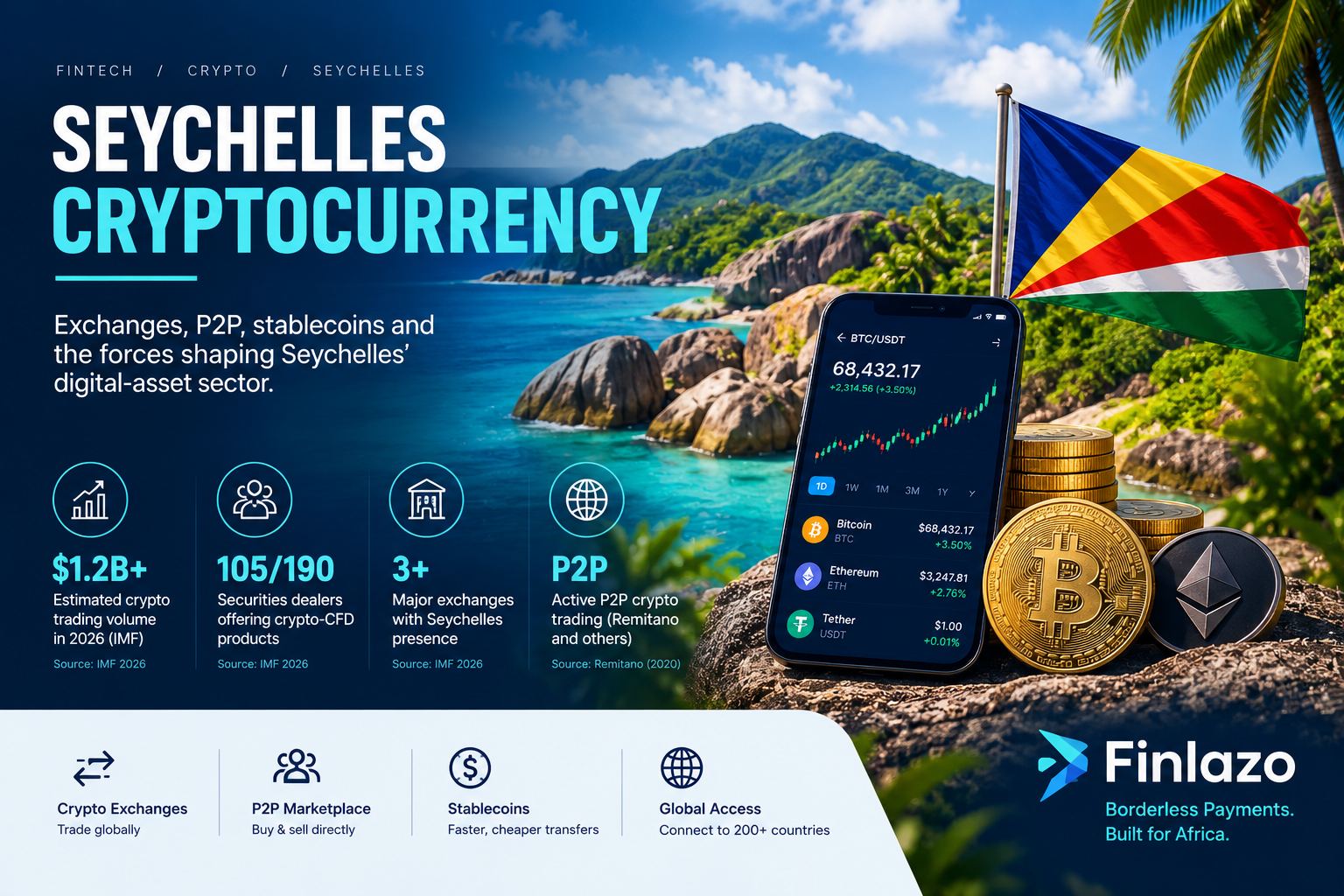
The IMF's 2026 Seychelles report said about 56% of licensed securities dealers, or 105 of 190 firms, offered crypto-CFD products.
At the same time, the new VASP licensing framework had not yet produced an issued VASP licence by the IMF's reporting date.
Crypto is therefore still commercially important in Seychelles.
But much of the visible activity sits around international platforms, securities dealers and a regulated transition rather than a large domestic retail market.
Seychelles Cryptocurrency at a Glance
- 31% of global Bitcoin transfer volume — approximate share handled by Seychelles-resident exchanges in the first half of 2020, according to the national virtual-asset risk assessment cited by the IMF.
- US$1.5 billion — approximate average daily crypto trading volume attributed to Seychelles in the IMF's 2026 discussion of the sector.
- 105 of 190 securities dealers — approximately 56% reported by the IMF to offer crypto-CFD products.
- 0 VASP licences — none had been issued as of end-January 2026.
- 8 VASP applications — complete applications were in the assessment stage at end-January 2026.
- 9 refused applications — VASP applications refused as reported by the IMF.
- 8 rejected applications — applications rejected, with the IMF noting a six-month reapplication restriction.
- US$100,000 — minimum paid-up capital for a new virtual asset exchange.
- US$75,000 — minimum paid-up capital for a new wallet provider.
- US$50,000 — minimum paid-up capital for a new broker.
- US$25,000 — minimum paid-up capital for a new virtual asset investment provider.
These figures describe different parts of Seychelles' crypto economy.
They should not be added together or treated as a measure of the number of local crypto users.
How Seychelles Became a Crypto Hub
Seychelles' role in cryptocurrency developed partly through its international financial-services industry.
The country's offshore corporate environment attracted digital-asset businesses looking for an international base.
That made Seychelles an important corporate jurisdiction for crypto exchanges and other platforms.
The scale was unusual for such a small country.
The IMF's 2026 report notes that the national risk assessment found Seychelles-resident exchanges handled approximately 31% of global Bitcoin transfer volume in the first half of 2020.
The same assessment identified hundreds of unlicensed VASPs operating from the jurisdiction.
That history helps explain why Seychelles' modern crypto framework is focused heavily on closing regulatory gaps.
A Personal Introduction to Seychelles' Crypto Market
I first came to know Seychelles as a cryptocurrency market around 2020.
I remember seeing a Remitano press release saying the company was registered in Seychelles.
That caught my attention.
I opened the Remitano website and looked at its peer-to-peer marketplace.
There were P2P offers involving several African markets, including Kenya, Nigeria, Seychelles and Malawi.
That was how I first realised that Seychelles had crypto users too.
It was a simple observation, but it changed how I viewed the country.
Until then, Seychelles had mainly been a holiday destination in my mind.
Seeing Seychelles alongside Kenya and Nigeria on a crypto P2P marketplace showed me that the country's connection to cryptocurrency was not limited to company registrations.
There were people using crypto there as well.
That experience was informal and personal.
It was not a measure of national adoption.
The later regulatory and market data provide the wider context.
What the Latest Data Tell Us About Seychelles Crypto Activity
The latest official and international data do not provide a clean national count of cryptocurrency users.
That is an important limitation.
There is no single government figure showing how many Seychelles residents own Bitcoin, USDT or other cryptocurrencies.
Instead, the available evidence measures different parts of the ecosystem.
The IMF reports major crypto-related activity among licensed securities dealers.
The FSA tracks VASP applications and enforcement.
The national risk assessment provides historical evidence about offshore crypto activity.
Together, these sources show an ecosystem with significant international connections but limited publicly available data on domestic household adoption.
Crypto-CFDs Are a Major Part of the Market
One of the clearest current statistics comes from Seychelles' securities industry.
The IMF reported in 2026 that 105 of 190 licensed securities dealers offered crypto-CFD products.
That is approximately 56% of licensed securities dealers.
Crypto-CFDs are derivatives.
They are not the same as buying and holding Bitcoin or another cryptocurrency directly.
That distinction matters.
A customer trading a Bitcoin CFD may never own Bitcoin.
The product instead tracks the price of the underlying asset.
Seychelles' crypto market therefore cannot be measured simply by looking at CFD activity.
It is still a useful indicator of the country's connection to global digital-asset markets.
Seychelles and Global Crypto Exchanges
International exchanges have been an important part of Seychelles' crypto story.
Companies connected to major trading platforms have historically used Seychelles structures.
That does not mean every platform associated with a Seychelles company was serving Seychelles residents.
A corporate domicile and a customer market are different things.
The distinction is especially important for research.
A Seychelles-registered crypto company can have customers across the world.
Its transaction activity may therefore say more about Seychelles' role as a business jurisdiction than about local consumer adoption.
Peer-to-Peer Cryptocurrency in Seychelles
P2P trading is one of the simplest ways to see how crypto can reach smaller markets.
A user does not necessarily need a large domestic exchange.
They can find a counterparty online.
They can agree on a payment method.
They can then exchange fiat and cryptocurrency.
My own experience on Remitano around 2020 showed that Seychelles appeared alongside larger African markets on a P2P marketplace.
It does not prove how many people were trading.
It does show that Seychelles was part of the P2P network.
P2P markets can also help users work around gaps in conventional payment access.
The trade-off is additional counterparty risk.
Users must consider fraud, payment reversals, account restrictions and platform rules.
Bitcoin in Seychelles
Bitcoin was historically central to Seychelles' crypto story.
The country's national risk assessment found that Seychelles-resident exchanges handled approximately 31% of global Bitcoin transfer volume in the first half of 2020.
That was an extraordinary level of exchange activity for such a small jurisdiction.
But it needs to be interpreted correctly.
The statistic refers to exchanges resident in Seychelles.
It does not mean Seychelles residents generated 31% of global Bitcoin transfers.
This is an example of why corporate location and user adoption should not be confused.
Stablecoins and Seychelles
Stablecoins have become increasingly important in the wider African crypto economy.
They offer a digital asset designed to maintain a relatively stable reference value, often against the U.S. dollar.
For Seychelles users and businesses, stablecoins may be relevant for trading, liquidity and international value transfer.
The wider African trend is discussed in crypto and stablecoins in Africa.
Stablecoins can also connect crypto markets with payment infrastructure.
That is one reason they matter beyond speculative trading.
The actual use case still depends on the availability of compliant exchanges, liquidity and local conversion routes.
Crypto and Seychelles' Financial Services Industry
Crypto has become part of a wider financial-services ecosystem in Seychelles.
The country already has an established securities-dealer industry.
The IMF's 2026 report shows how much crypto-CFD activity sits inside that sector.
In 2024, business tax collected from licensed securities dealers reached SCR 353.4 million.
From January to October 2025, collections reached SCR 586.5 million.
These are securities-dealer tax figures.
They should not be described as revenue generated by VASP licences.
No VASP licence had been issued as of the IMF's January 2026 reporting date.
Why Seychelles Does Not Have a Simple Crypto Adoption Number
A country can have a large crypto industry without having a large number of local users.
Seychelles is a good example.
International companies can be incorporated in the country.
Trading platforms can process global transactions.
Securities dealers can offer crypto-CFDs.
Local residents can use P2P marketplaces.
All four activities can exist at the same time.
They represent different parts of the market.
That is why a serious analysis should avoid unsupported claims such as "Seychelles has X crypto users" unless a credible dataset actually provides the number.
Regulation Is Changing the Market
The Seychelles crypto market is now moving from its older offshore model toward formal oversight.
The Financial Services Authority maintains a public VASP register and assessment list.
The latest IMF assessment reported eight complete applications in the assessment stage as of end-January 2026.
The FSA has also taken enforcement action against unlicensed businesses.
For the full legal framework, see Seychelles cryptocurrency regulation.
This matters to the market itself.
Regulation can change which companies remain in the jurisdiction.
It can also affect banking relationships, customer onboarding, custody and the cost of operating a crypto business.
Seychelles and Other African Crypto Markets
Seychelles is not the only African market where cryptocurrency is moving toward formal oversight.
Rwanda now has a dedicated virtual-asset framework. See Rwanda cryptocurrency regulation.
Zambia is also developing formal rules for virtual-asset businesses. See Zambia cryptocurrency regulation.
South Africa has a different model built around licensing crypto-asset service providers. See South Africa cryptocurrency.
These countries are not identical.
Their markets, financial systems and regulations differ.
But the direction is similar.
Crypto businesses are increasingly being drawn into formal financial regulation.
What Could Shape Seychelles' Crypto Market Next?
Several factors will matter.
VASP Licensing
The biggest immediate change is the transition from application and assessment to actual licensing.
That will show which business models can meet the new regulatory requirements.
International Crypto Businesses
Seychelles remains attractive to companies that want an international financial-services base.
The challenge will be balancing that role with stronger supervision.
Stablecoins
Stablecoins could become more important in trading, liquidity and payments.
Their growth will depend on regulation and reliable fiat conversion.
P2P Markets
P2P trading can remain useful for individuals who need flexible access to crypto.
It will also remain an area where consumer-protection and fraud risks require attention.
Banking Connectivity
Crypto businesses need banks and payment services.
Better links between digital assets and conventional finance could influence the next phase of the Seychelles market.
Seychelles Cryptocurrency Statistics
- 31% — approximate share of global Bitcoin transfer volume handled by Seychelles-resident exchanges in H1 2020, according to the national virtual-asset risk assessment cited by the IMF.
- US$1.5 billion — approximate average daily crypto trading volume attributed to Seychelles in the IMF's 2026 analysis.
- 105 of 190 — licensed securities dealers offering crypto-CFD products.
- 56% — approximate share of licensed securities dealers offering crypto-CFD products.
- SCR 353.4 million — business tax collected from licensed securities dealers in 2024.
- SCR 586.5 million — business tax collected from licensed securities dealers from January to October 2025.
- 0 — VASP licences issued as of end-January 2026.
- 8 — complete VASP applications in assessment at end-January 2026.
- 9 — VASP applications refused according to the IMF's 2026 report.
- 8 — applications rejected according to the IMF's 2026 report.
Frequently Asked Questions
Is cryptocurrency popular in Seychelles?
Seychelles has a significant connection to the global cryptocurrency industry, but there is no authoritative public figure showing the total number of local crypto users. Available data show substantial crypto-related business activity and international exchange activity.
How big is the Seychelles cryptocurrency market?
There is no single official measure of the total market size. The IMF has reported significant crypto trading activity connected to Seychelles and found that 105 of 190 licensed securities dealers offered crypto-CFD products.
Do people in Seychelles use Bitcoin?
Yes, Bitcoin has been used in Seychelles, although reliable official data on the number of individual Bitcoin users are limited. P2P marketplaces have also provided access to cryptocurrency for users in the country.
Is peer-to-peer crypto trading available in Seychelles?
P2P cryptocurrency trading has been available to users in Seychelles through international platforms. My own experience on Remitano around 2020 showed Seychelles appearing alongside Kenya, Nigeria and Malawi in P2P offers.
Why are crypto companies associated with Seychelles?
Seychelles became an important corporate jurisdiction for international crypto businesses. Its international financial-services environment attracted digital-asset firms, although the regulatory framework has since become substantially stricter.
Does Seychelles have a large number of crypto users?
There is no reliable official figure establishing the number of cryptocurrency users who are resident in Seychelles. Business registration and exchange activity should not be confused with local consumer adoption.
What role do stablecoins play in Seychelles?
Stablecoins can support trading, liquidity and transfers. Their importance in Seychelles will depend on access to regulated services, liquidity and the ability to convert between digital assets and fiat currencies.
Is cryptocurrency regulated in Seychelles?
Yes. Seychelles introduced a dedicated VASP framework and has been moving existing virtual-asset businesses through an application and assessment process. See Seychelles cryptocurrency regulation for the legal and licensing details.
The Bottom Line
Seychelles has an unusual place in Africa's cryptocurrency story.
The country is small.
Its connection to the global crypto industry is not.
The national risk assessment found that Seychelles-resident exchanges handled approximately 31% of global Bitcoin transfer volume in the first half of 2020.
That figure is historical.
It also needs to be interpreted carefully.
It measured exchange location, not local ownership.
The current market is different.
The IMF reported that 105 of 190 licensed securities dealers offered crypto-CFD products.
That is about 56%.
At the same time, Seychelles is moving toward a formal VASP market.
No VASP licence had been issued as of end-January 2026, while eight complete applications were still under assessment.
My own experience first noticing Seychelles on Remitano around 2020 gave me an early glimpse of another side of the market.
I saw P2P offers involving Seychelles alongside Kenya, Nigeria and Malawi.
It showed me that Seychelles was not only a place where crypto companies registered.
People there were using crypto too.
The next phase will be defined by regulation, banking connectivity, stablecoins, P2P markets and the ability of legitimate businesses to operate within the new framework.
Seychelles' crypto story is therefore not simply about adoption.
It is about the country's continuing role in the global digital-asset industry.