Zambia Cryptocurrency Regulation: VASP Registration, AML Rules and the Latest Crypto Framework
Explore Zambia cryptocurrency regulation, including the 2026 VASP registration rules, AML requirements, Travel Rule obligations, FIC guidance and the developing crypto framework.

On this page
Zambia's cryptocurrency framework changed significantly in March 2026.
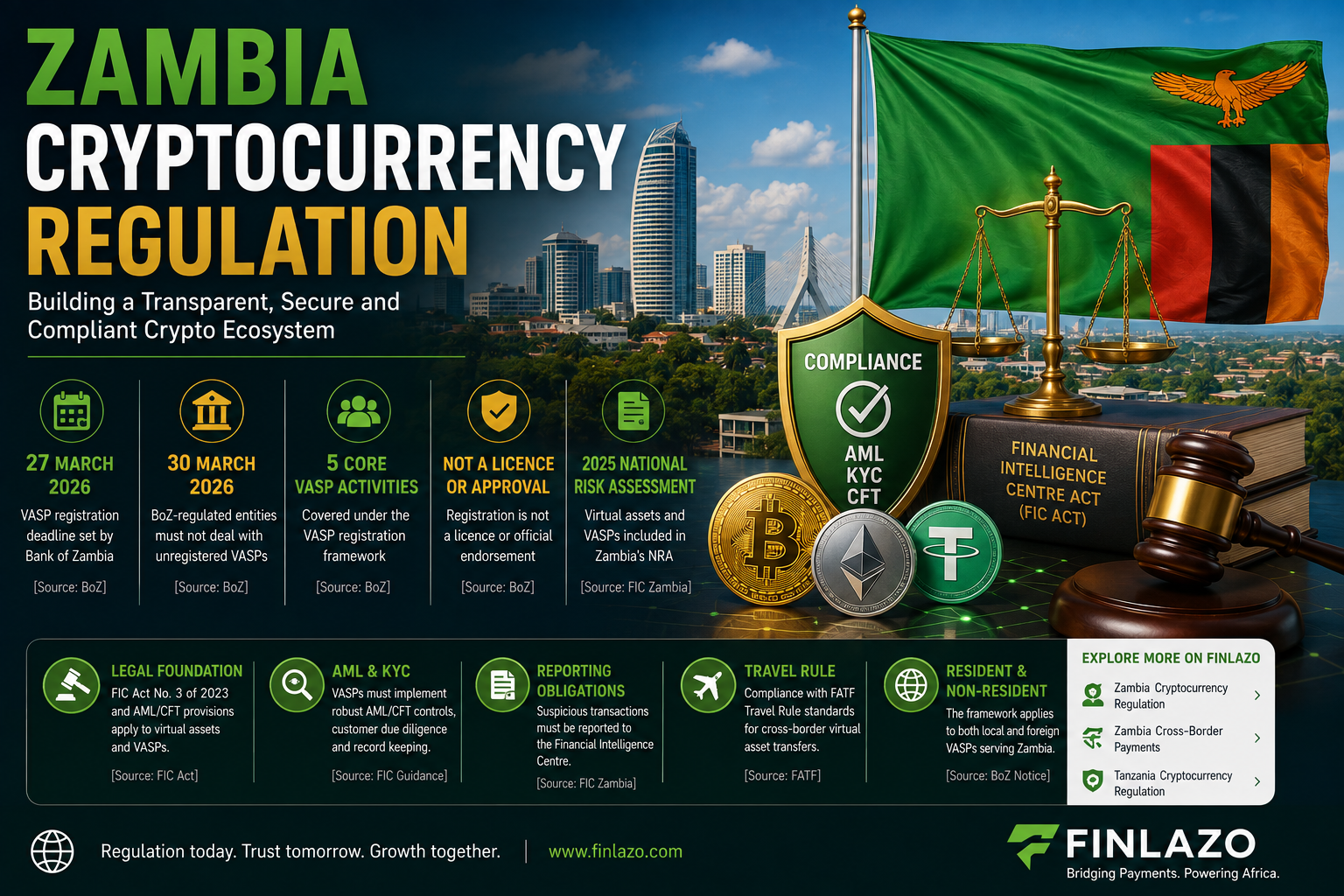
The Bank of Zambia required entities and individuals providing virtual or crypto asset services in Zambia to register by 27 March 2026. The registration notice covers 5 core VASP activities.
They include crypto-to-fiat exchange, crypto-to-crypto exchange, virtual asset transfers, custody and administration, and financial services linked to an issuer's offer or sale of a virtual asset.
The Bank later said the exercise was a preliminary step. It did not constitute a licence or official approval to operate.
The policy direction is now clearer. Zambia is developing a comprehensive framework for Virtual Asset Service Providers, or VASPs.
The Bank of Zambia's March 2026 public notice says the framework is intended to support innovation while addressing risks including price volatility, money laundering, terrorist financing and proliferation financing.
The Bank's March 2026 Zambanker publication also states that, effective 30 March 2026, entities regulated by the Bank were not allowed to facilitate transactions to or from VASPs that had not registered with the Bank.
Zambia therefore sits in an important transition period.
Cryptocurrency is no longer being discussed only through general warnings.
The country already has AML obligations for VASPs.
The Financial Intelligence Centre has issued VASP guidance.
The Bank of Zambia has now carried out a sector registration exercise.
Parliament has also acknowledged the need for a clearer framework.
In an April 2026 National Assembly debate, the Government said the FIC had been registering and supervising VASPs as a supervisor of last resort in the absence of a dedicated framework. It also said the Ministry of Finance and National Planning would commence amendments to the Financial Intelligence Centre Act to explicitly incorporate provisions on virtual assets.
The framework is evolving.
That distinction matters for consumers, exchanges, fintech companies and cross-border payment businesses.
Zambia Crypto Regulation at a Glance
The latest position can be summarized as follows:
- The Bank of Zambia required VASPs serving Zambia to register by 27 March 2026.
- The registration notice covered 5 categories of VASP activity.
- Registration was explicitly described as a preliminary step. It was not a licence or official approval.
- From 30 March 2026, Bank of Zambia-regulated entities were not allowed to facilitate transactions to or from VASPs that had not registered with the Bank.
- The Financial Intelligence Centre's VASP Guidelines state that VASPs are reporting entities under the Financial Intelligence Centre Act.
- Zambia's 2025 Second National Risk Assessment includes a dedicated assessment of virtual assets and VASPs.
- In April 2026, the Government acknowledged that Zambia lacked a dedicated legal framework to supervise and monitor virtual assets and virtual asset providers.
- The Government said the Ministry of Finance and National Planning would begin work to amend the Financial Intelligence Centre Act to explicitly incorporate provisions on virtual assets.
The most important point is simple.
Zambia's framework is active.
But the full dedicated VASP regulatory regime was still being developed at the time of the latest official statements cited here.
Is Cryptocurrency Legal in Zambia?
Zambia's regulatory position should not be reduced to a simple yes-or-no answer.
Buying, holding or dealing with a crypto asset is different from operating a regulated crypto business.
The Financial Intelligence Centre's discussion of virtual assets explains that the Bank of Zambia had not issued any cryptocurrency and did not regulate the cryptocurrency landscape at the time of the earlier statement.
That position has since evolved.
The Bank of Zambia's March 2026 registration notice directly addresses entities and individuals providing virtual or crypto asset services within Zambia.
The Bank is developing a comprehensive regulatory framework.
That means the current conversation is no longer only about whether crypto exists in Zambia.
It is increasingly about who provides crypto services.
It is also about AML controls, registration, supervision and financial-system risk.
Cryptocurrency Is Not the Same as Legal Tender
The Bank of Zambia issues Zambia's national currency.
A cryptocurrency is not the same thing as a kwacha banknote or coin.
The Bank of Zambia's March 2026 VASP notice discusses virtual asset technologies as a separate category.
The notice identifies potential benefits.
It also identifies financial-sector risks.
Users should not assume that access to a crypto platform means a crypto asset has become official legal tender.
The legal status of an asset and the regulatory status of a service provider are separate questions.
What Changed in March 2026?
March 2026 was a major regulatory milestone.
The Bank of Zambia public notice requested all entities and individuals providing virtual or crypto asset services within Zambia to register by 27 March 2026.
The notice applied to both:
- Resident entities and individuals.
- Non-resident entities and individuals.
Physical presence in Zambia was not the only test.
The notice said registration applied to providers offering virtual asset services to individuals and businesses within Zambia.
That is important for international platforms.
A company can serve a market without having a traditional office there.
The Bank's approach therefore looks at the service being offered into Zambia.
The Five Activities Covered by the Registration Notice
The notice identifies 5 activities.
A person or business conducting one or more of them for or on behalf of another person could fall within the registration exercise:
- 1Exchange between virtual assets and fiat currencies.
- 2Exchange between one or more forms of virtual assets.
- 3Transfer of virtual assets.
- 4Safekeeping or administration of virtual assets, or instruments enabling control over them.
- 5Participation in and provision of financial services related to an issuer's offer or sale of a virtual asset.
These categories closely reflect the international VASP framework used in AML standards.
They are broader than a simple crypto exchange definition.
Custody can be relevant.
Transfers can be relevant.
Services connected to token offerings can also be relevant.
Registration Is Not the Same as Licensing
This is one of the most important distinctions in Zambia's current framework.
The Bank of Zambia's March 2026 publication states that the registration exercise is preliminary.
It says registration does not constitute a licence.
It does not constitute official approval to operate as a VASP.
It also says registration should not be treated as an endorsement of a VASP or its business practices.
This matters for both businesses and customers.
A registered entity should not automatically describe itself as Bank of Zambia licensed unless it has actually received the relevant licence or authorization.
A customer should also avoid assuming that registration means the government guarantees a company's safety.
Why the Bank Asked VASPs to Register
The Bank said the exercise would help it:
- Create a central database of VASPs operating in Zambia.
- Assess the scale, scope and nature of virtual asset activity.
- Gather data for a comprehensive and risk-based framework.
- Improve the Bank's ability to monitor compliance with existing laws and international standards.
- Support consultations with registered VASPs during framework development.
The Bank's March 2026 notice links the registration exercise directly to the development of the wider framework.
This is a regulatory mapping exercise.
It is also a step toward more structured supervision.
What Happened After the Registration Deadline?
The Bank of Zambia's March 2026 publication says that, effective 30 March 2026, all entities regulated by the Bank would not be allowed to facilitate transactions to or from VASPs that had not registered with the Bank.
That statement is important.
It potentially affects the connection between crypto businesses and the traditional financial system.
Bank accounts matter.
Payment services matter.
Fiat on-ramps and off-ramps matter.
A crypto platform may have technology.
But it may still need access to regulated financial infrastructure.
The March 2026 measure therefore increases the importance of registration for providers seeking to interact with Bank of Zambia-regulated institutions.
Businesses should still verify the latest operational requirements with the Bank and other relevant regulators.
The full framework was still under development in the official notice.
Who Regulates Cryptocurrency in Zambia?
More than one institution can be relevant.
The exact regulator depends on the activity.
Bank of Zambia
The Bank of Zambia is central to the current VASP framework development.
Its March 2026 notice requested registration from VASPs operating in or serving Zambia.
The Bank said it was working with other regulators and stakeholders on a comprehensive framework.
Its stated objectives include:
- Financial-system stability.
- Innovation.
- Consumer protection.
- Management of financial-crime risks.
Financial Intelligence Centre
The Financial Intelligence Centre is central to Zambia's AML and financial-intelligence framework.
Its 2022 VASP Guidelines state that VASPs are reporting entities under the Financial Intelligence Centre Act.
The Guidelines explain legal obligations designed to prevent and detect:
- Money laundering.
- Terrorism financing.
- Proliferation financing.
The FIC has also published virtual-asset risk material and includes VASPs within its wider risk assessment work.
Ministry of Finance and National Planning
The Ministry is relevant to the legislative framework.
In an April 2026 National Assembly response, the Government said the Ministry would commence amendments to the Financial Intelligence Centre Act to explicitly incorporate provisions on virtual assets.
That statement should not be confused with a completed amendment.
It describes a legislative direction announced in Parliament.
A business should verify the status of any bill or enacted amendment before relying on it.
Other Regulators
The precise structure can also involve other authorities.
The activity matters.
A business dealing with securities, investments, payments or consumer products may trigger obligations outside the VASP framework.
A crypto token is not automatically regulated the same way in every use case.
Businesses should assess the actual product.
Zambia's AML Rules for VASPs
Zambia already has a significant AML foundation for virtual asset businesses.
The FIC VASP Guidelines say that VASPs are reporting entities under the Financial Intelligence Centre Act.
That creates legal and compliance obligations.
The Guidelines are not merely a discussion paper.
They are compliance guidance for the sector.
Customer Due Diligence
The FIC identifies non-face-to-face relationships as a major risk.
Crypto platforms can onboard customers remotely.
That can make identity verification more complex.
The FIC Guidelines therefore discuss customer due diligence and risk-based controls.
A VASP should understand who its customer is.
The required approach depends on the applicable legal framework and risk.
Transaction Monitoring
Crypto transactions can move across borders.
They can also move rapidly.
The FIC identifies the global reach of virtual assets as a risk factor.
That makes transaction monitoring important.
A provider may need to assess activity for unusual patterns.
It may also need to identify exposure to known illicit activity.
Suspicious Transaction Reporting
Reporting entities have obligations under the Financial Intelligence Centre framework.
The FIC's reporting portal lists VASP Sector Guidelines among the guidance available to reporting entities.
A business should establish clear internal escalation procedures.
The exact reporting requirements should be checked against the current law and FIC instructions.
Record Keeping
AML controls need evidence.
A compliance programme should maintain the records required by applicable law.
The precise retention period and record requirements should be verified against the current statutory framework.
The Travel Rule and Virtual Asset Transfers
Virtual asset transfers raise a specific compliance challenge.
Information about the originator and beneficiary may need to travel with the transaction.
Zambia's 2022 statutory instrument on financial-intelligence regulations includes requirements for intermediary VASPs.
The provisions require reasonable measures to identify virtual asset transfers that lack required originator or beneficiary information.
They also require risk-based policies and procedures for deciding when to execute, reject or suspend a transfer.
The rules also address incomplete information.
This is closely related to the global FATF Travel Rule framework.
Why the Travel Rule Matters
A blockchain transfer can technically move quickly.
Compliance information may be more difficult.
The Travel Rule is intended to reduce anonymity risks in regulated transfers.
For VASPs, this can require systems capable of:
- Identifying relevant counterparties.
- Collecting required information.
- Transmitting information securely.
- Screening transactions.
- Applying risk-based controls.
The FATF's July 2026 update said 83% of surveyed jurisdictions had passed legislation implementing the Travel Rule, up from 73% in 2025.
The report also said more work was needed on implementation, supervision and enforcement.
Zambia's own framework is developing inside that global regulatory environment.
Zambia's 2025 Virtual Asset Risk Assessment
The latest official risk-assessment landscape also matters.
The FIC's publications page lists the Second National Risk Assessment - 2025.
The report includes a dedicated chapter on virtual assets and VASPs.
The 2025 National Risk Assessment document confirms that Zambia assessed money laundering and terrorism financing risks associated with virtual assets and virtual asset service providers.
This matters because modern VASP regulation is expected to be risk-based.
A regulator needs to understand the market before designing controls.
That was also one purpose of the Bank of Zambia's March 2026 registration exercise.
Why Is Zambia Developing a Dedicated VASP Framework?
The Bank of Zambia identifies both benefits and risks.
The March 2026 public notice lists potential benefits of virtual asset technology.
These include:
- Reduced transaction costs.
- Faster transfers of value.
- Resilience associated with decentralized systems.
The Bank also identifies risks.
These include:
- Price volatility.
- Limited visibility of service providers and participants.
- Money laundering.
- Terrorist financing.
- Proliferation financing.
The policy objective is therefore not simply to encourage or ban technology.
The Bank says the framework is being developed to mitigate risks while promoting innovation and safeguarding consumers.
That is the central theme of Zambia's current approach.
Consumer Protection and Crypto Risks
A clearer regulatory framework can improve consumer protection.
But regulation does not remove investment risk.
Users should understand several risks.
Price Volatility
Bitcoin and other crypto assets can move sharply.
A regulatory framework cannot guarantee that a token will maintain its value.
Fraud and Scams
The FIC's virtual asset material warns that individuals and entities can falsely claim to be dealing or investing in virtual assets.
Consumers may be lured into schemes.
The money may then be diverted rather than invested as promised.
A crypto business should never be judged only by a website or social media presence.
Cybersecurity
Crypto platforms can face hacking and account takeover.
Self-custody also creates responsibility for private keys and recovery information.
A lost private key may mean permanent loss of access.
Regulatory Status
A platform can operate internationally.
That does not automatically mean it is authorized to provide every service in Zambia.
Customers should check the company's actual regulatory status.
Businesses should avoid misleading claims about registration, licensing or approval.
What the 2026 Registration Means for Foreign Crypto Companies
The Bank of Zambia notice applies beyond traditional local companies.
It expressly covers resident and non-resident entities and individuals offering virtual asset services to individuals and businesses within Zambia.
That is significant.
A company may be based abroad.
It may still be within the scope of the registration exercise if it offers covered services into Zambia.
This reflects a broader international regulatory trend.
Crypto services can be borderless.
Regulators are increasingly focusing on where customers are located.
A Website Can Still Create Regulatory Exposure
An online platform does not need a branch on every street.
It can reach users digitally.
That makes geographic targeting important.
A business should consider:
- Where it markets its services.
- Which customers it accepts.
- Which currencies it supports.
- Which payment methods it integrates.
- Whether it has local partners.
- Whether it holds customer assets.
- Whether it performs exchange or transfer activity.
The March 2026 Bank of Zambia notice specifically looked at service provision within Zambia.
Cross-Border Payments and Crypto Regulation
Cross-border payments are one area where virtual asset technology can attract attention.
The Bank of Zambia itself recognizes potential benefits such as reduced transaction costs and faster transfers of value.
But payment efficiency does not remove compliance obligations.
Cross-border transactions can increase exposure to:
- Money laundering.
- Terrorist financing.
- Sanctions risks.
- Fraud.
- Foreign-exchange issues.
- Counterparty risk.
For payment businesses, the technology layer is only one part of the model.
The legal structure matters.
The custody model matters.
The fiat conversion model matters.
The location of customers matters.
This creates a useful connection with Tanzania's cross-border payments market, where mobile money, regional payment systems and international remittances are also reshaping how value moves across borders.
Different countries have different regulatory frameworks.
But the infrastructure challenge is similar.
How can money move faster without weakening financial integrity?
Zambia and International FATF Standards
Zambia's VASP framework is also part of a wider global regulatory shift.
The FATF defines virtual assets as digital representations of value that can be digitally traded, transferred or used for payment or investment purposes.
FATF standards require countries to assess and mitigate risks.
They also require relevant jurisdictions to regulate and supervise VASPs.
The FATF's 2026 targeted update said many jurisdictions had made legislative progress.
It also warned that implementation gaps remain.
The FATF's 2025 Zambia follow-up page records Zambia's continued work to address technical compliance deficiencies identified through the mutual evaluation process.
The wider AML context helps explain why Zambia is building more structured VASP oversight.
Zambia Crypto Regulation Timeline
Before 2022
Zambian authorities had already warned about risks associated with cryptocurrencies.
The FIC also monitored virtual asset developments and highlighted potential money laundering, terrorism financing, fraud and consumer-protection risks.
2022
The FIC issued VASP Guidelines.
The Guidelines identify VASPs as reporting entities under the Financial Intelligence Centre Act.
The 2022 regulations also include provisions relevant to information accompanying virtual asset transfers.
2025
The FIC published its Second National Risk Assessment.
The assessment includes virtual assets and VASPs.
16 March 2026
The Bank of Zambia issued a public notice on VASP registration.
It requested registration by 27 March 2026.
The notice covered 5 core categories of virtual asset service activity.
27 March 2026
This was the registration deadline stated in the Bank's public notice.
The registration exercise was described as a preliminary step.
It was not a licence.
30 March 2026
The Bank's March 2026 publication says Bank of Zambia-regulated entities would no longer be allowed to facilitate transactions to or from VASPs that had not registered with the Bank.
April 2026
In an 8 April 2026 National Assembly debate, the Government acknowledged the absence of a dedicated framework to supervise and monitor virtual assets and virtual asset providers.
It said the FIC had been acting as supervisor of last resort.
It also announced an intention to commence amendments to the FIC Act to explicitly incorporate virtual asset provisions.
What Should a Crypto Business Do Before Serving Zambia?
A business should not rely on a generic global crypto policy.
The Zambia-specific structure matters.
Key questions include:
Is the Activity a Covered VASP Activity?
The Bank of Zambia's March 2026 notice identifies 5 categories.
A business should map its services against those categories.
Has the Business Completed Required Registration?
The March 2026 notice required registration from covered providers serving Zambia.
The status of any registration should be verified directly with the relevant authority.
Registration should not be represented as a licence unless the authority has actually issued a licence.
Which Other Laws Apply?
A VASP may also face obligations involving:
- AML and counter-financing controls.
- Consumer protection.
- Data protection.
- Payments.
- Foreign exchange.
- Tax.
- Corporate law.
The exact answer depends on the business model.
How Will Fiat Payments Be Handled?
A crypto service often needs a fiat on-ramp or off-ramp.
The business may need relationships with banks or payment providers.
The 30 March 2026 measure described by the Bank makes the VASP registration status particularly important where Bank of Zambia-regulated entities are involved.
Is the Compliance Programme Ready?
A serious VASP should be able to demonstrate:
- Customer due diligence.
- Risk assessment.
- Transaction monitoring.
- Suspicious transaction escalation.
- Record keeping.
- Sanctions controls.
- Travel Rule processes where applicable.
- Governance and internal controls.
Zambia Crypto Regulation Statistics
The most important current figures and dates include:
- 5 activities — covered in the Bank of Zambia's March 2026 VASP registration notice.
- 27 March 2026 — registration deadline stated in the notice.
- 30 March 2026 — date from which Bank-regulated entities were not to facilitate transactions to or from unregistered VASPs, according to the Bank's March publication.
- 2025 — year of Zambia's Second National Risk Assessment, which includes virtual assets and VASPs.
- 83% — share of surveyed jurisdictions that had passed legislation implementing the Travel Rule in FATF's July 2026 update.
- 73% — corresponding figure reported by FATF for 2025.
- 7th — Zambia's enhanced follow-up report in the ESAAMLG process, adopted in September 2025.
These figures measure regulation and compliance.
They should not be treated as crypto adoption or trading-volume statistics.
How Does Zambia Compare With Other African Markets?
African crypto regulation is highly fragmented.
Some countries have moved toward dedicated licensing regimes.
Others are still developing frameworks.
Zambia's 2026 VASP registration process places it in an active transition phase.
The country already has AML obligations for VASPs.
It is also building a more comprehensive regulatory structure.
This is different from assuming Zambia has a complete crypto licensing regime today.
The distinction matters.
For comparison, Tanzania's cryptocurrency regulation has also been evolving through central-bank assessment, virtual asset risk work and a cautious approach to payment-system participation.
The regulatory direction across Africa is not identical.
But AML, consumer protection and VASP oversight are increasingly central themes.
What Happens Next?
The next major development will be the comprehensive framework promised by the Bank of Zambia.
The Bank said the registration exercise would help inform that process.
The March 2026 Bank publication said registered VASPs would be required to comply with the future framework to continue operating in Zambia.
Parliamentary statements also point toward possible amendments to the Financial Intelligence Centre Act.
The timing and final wording of future laws or regulations cannot be assumed.
Businesses should monitor official publications.
Consumers should also watch for clear distinctions between:
- Registered providers.
- Licensed providers.
- Unregulated providers.
- Foreign platforms.
- Scams falsely claiming official approval.
The Bottom Line
Zambia's cryptocurrency regulation entered a new phase in 2026.
The Bank of Zambia required covered VASPs to register by 27 March 2026.
The notice covered 5 core virtual asset service activities.
The registration exercise did not create a licence.
It was a preliminary step toward a comprehensive framework.
The Bank also stated that, from 30 March 2026, its regulated entities would not facilitate transactions to or from VASPs that had not registered with the Bank.
At the same time, Zambia already has an AML foundation for VASPs.
The FIC's VASP Guidelines treat the sector as part of the reporting-entity framework.
The country's 2025 National Risk Assessment includes virtual assets and VASPs.
The Government has also acknowledged the need for a dedicated legal framework.
For Zambia, the biggest story is not simply whether crypto exists.
It is the transition from a lightly structured environment toward formal registration, risk assessment, AML supervision and a broader regulatory regime.
The framework is still developing.
That means businesses should verify current requirements directly with the Bank of Zambia, the Financial Intelligence Centre and other relevant authorities before launching or expanding a crypto service.