Seychelles Cross-Border Payments: Remittances, Banking, SWIFT, SADC-RTGS and the Future of Digital Transfers
Seychelles relies on international and regional payment networks to support tourism, trade and personal transfers. Explore the costs, infrastructure and new technologies shaping how money moves across its borders

On this page
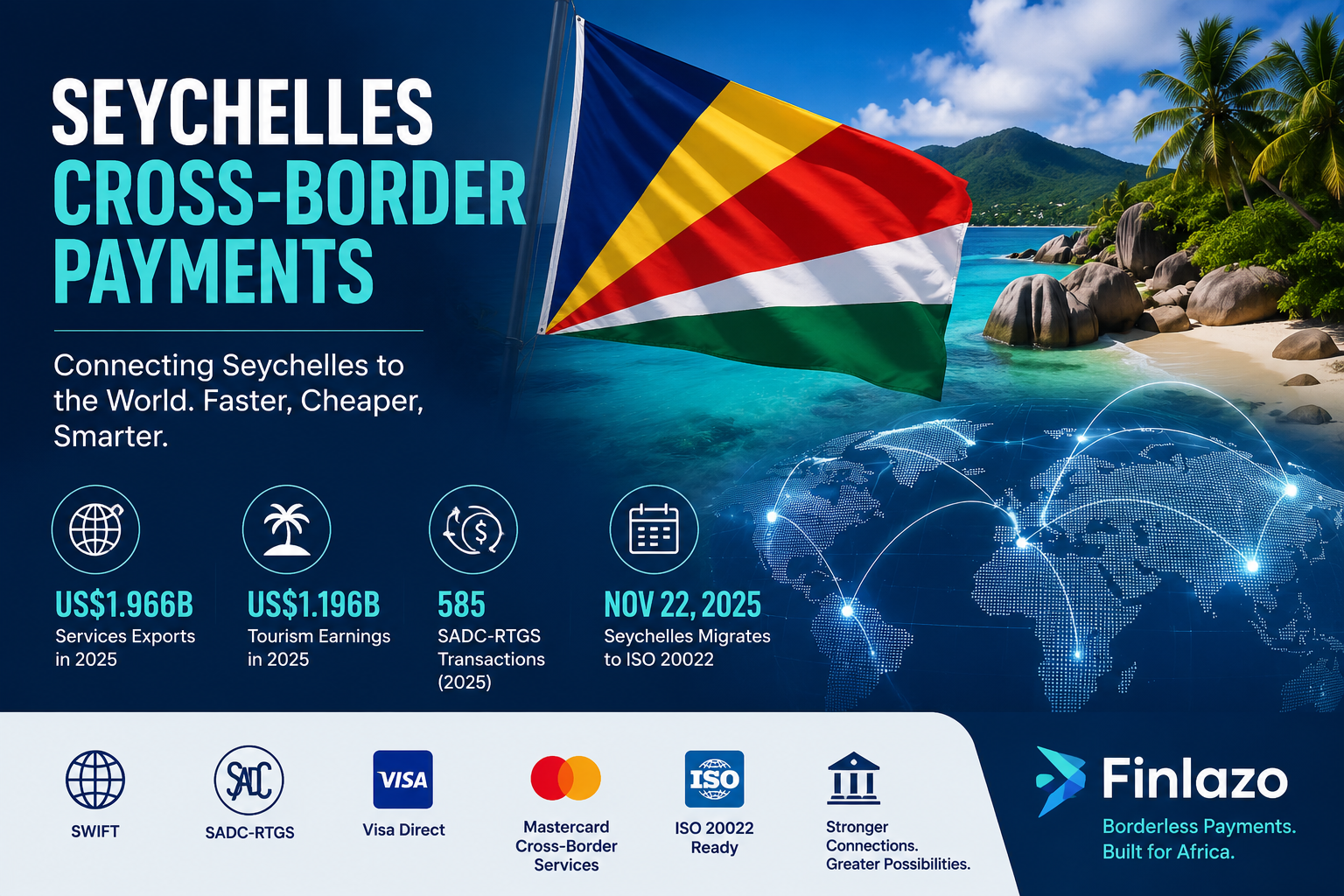
Seychelles is a small economy, but its cross-border financial flows are substantial relative to its size. The Central Bank of Seychelles reported US$1.966 billion in exports of services in 2025, up from US$1.714 billion in 2024.
Tourism generated an estimated US$1.196 billion in 2025. That was 29% higher than the US$925 million recorded in 2024.
Money therefore moves into Seychelles through tourism, trade, investment and other international activity. It also moves out to suppliers, workers, businesses and individuals overseas.
The payment infrastructure behind those flows is evolving. In 2025, Seychelles settled 585 SADC-RTGS transactions worth ZAR 21.193 million, compared with 529 transactions worth ZAR 18.677 million in 2024.
Seychelles also completed its transition to ISO 20022 for electronic payments processed through SWIFT, including international payments, on November 22, 2025.
The country is therefore entering a new phase.
Traditional banking rails remain important, but digital payment infrastructure is becoming more sophisticated.
Seychelles Cross-Border Payments at a Glance
- US$1.966 billion — exports of services in 2025.
- US$1.196 billion — estimated tourism earnings in 2025.
- 398,841 — visitor arrivals in 2025.
- 13% — growth in visitor arrivals in 2025.
- 585 — SADC-RTGS transactions settled by Seychelles in 2025.
- ZAR 21.193 million — value of those SADC-RTGS transactions.
- 11% — increase in SADC-RTGS transaction volume in 2025.
- 14% — increase in SADC-RTGS transaction value in 2025.
- November 22, 2025 — date by which electronic payments processed through SWIFT in Seychelles had moved to ISO 20022.
- 4.4 months — gross international-reserve import cover at the end of 2025.
Why Cross-Border Payments Matter to Seychelles
Seychelles depends heavily on the rest of the world.
It imports goods. It receives international visitors. Local businesses pay overseas suppliers. Individuals receive or send money across borders.
The structure of the economy makes payment connectivity important.
The Central Bank of Seychelles 2025 Annual Report estimated total services exports at US$1.966 billion in 2025.
That is a large international flow for a country with a population of roughly 127,000 people.
Tourism accounts for much of it. But tourism is only one part of the cross-border payment picture.
Businesses also need to pay for machinery, fuel, food, technology and professional services sourced outside the country.
That creates two-way payment demand.
Seychelles' International Trade Creates Payment Demand
Seychelles imports a large share of what its economy consumes.
The 2025 Annual Report shows that machinery and transport equipment represented 28.9% of imports by product group.
Food, live animals and vegetable oils accounted for another 22.2%.
Mineral fuels represented 20.8%.
These figures help explain why cross-border payments are not a niche banking service in Seychelles.
Importers need to settle invoices.
Banks need correspondent relationships.
Businesses need foreign currencies.
Payment providers need reliable settlement routes.
The payment system is therefore closely connected to the country's trade model.
A Personal Experience That Made the Problem Real
In 2023, I was in Tatu City, Kenya.
I visited Courtyard Bistro, a coffee shop within the Unity Homes environment.
There, I met a friend from Seychelles named Martin. We shared a meal and talked about personal matters.
When he returned to Seychelles, he needed to pay for his apartment in Tatu City.
He sent me the money through PayPal.
I expected the money to move naturally into my Kenyan bank account or M-Pesa.
It did not.
The money landed in my PayPal balance instead.
The apartment management did not accept PayPal.
I then had to find another way to move the money from PayPal into my bank account before I could pay the management.
The experience stayed with me.
The problem was not that the money could not move.
The problem was that it could not move directly into the payment rail I needed.
That made me think about a simpler model.
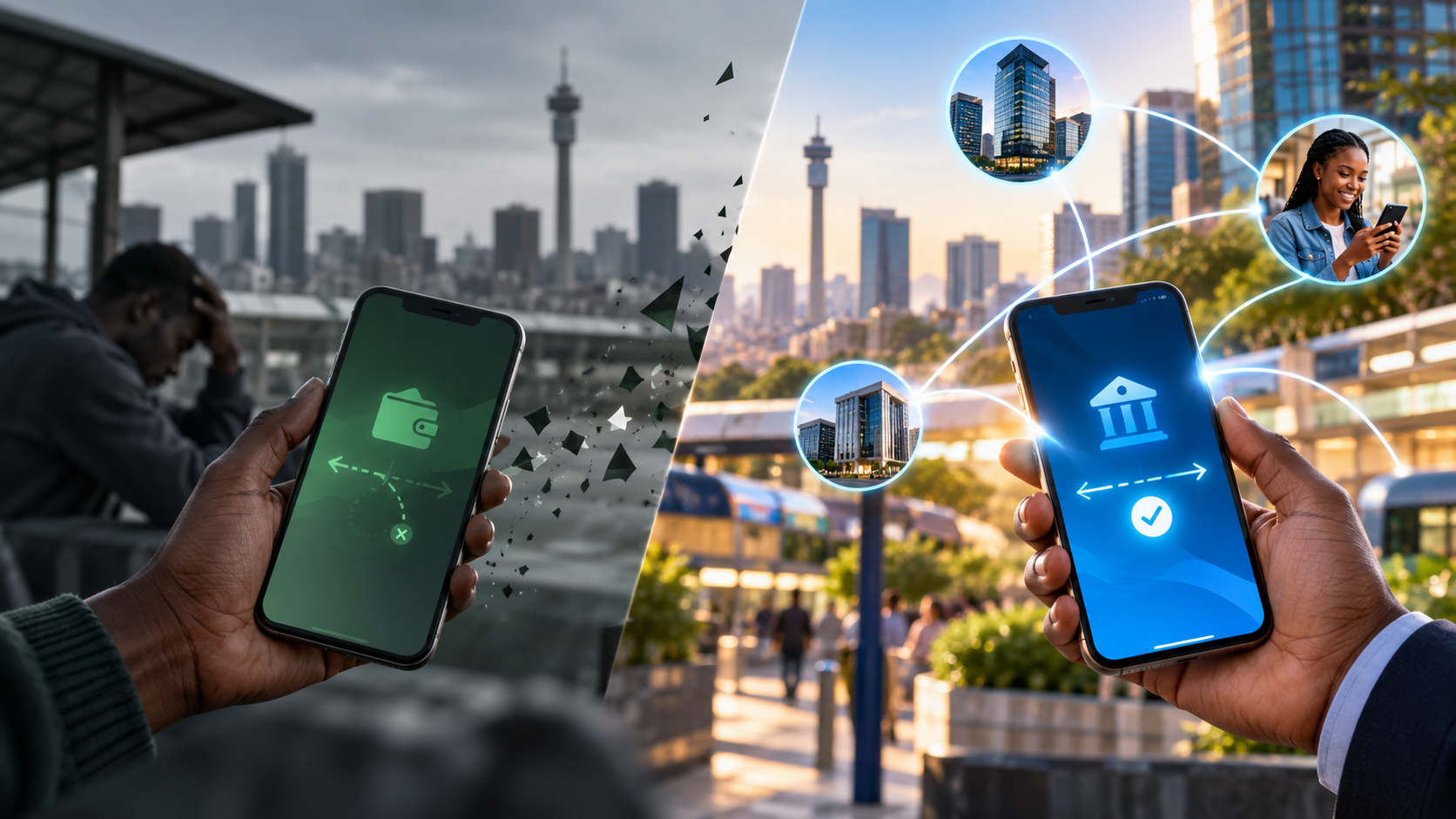
Why not allow someone in Seychelles to send money directly into a recipient's M-Pesa wallet or bank account in Kenya?
The customer should not have to understand what happens between the two countries.
They should simply choose the destination, confirm the amount and know what the recipient will receive.
How Cross-Border Money Moves Through Seychelles
A conventional international transfer can involve several institutions.
A customer may start with a Seychelles bank.
The bank may route the payment through a correspondent bank.
Foreign exchange can then be applied.
The receiving bank in another country may receive the payment and credit the beneficiary.
Each additional layer can create costs or delay.
The exact path depends on the currency, destination, banks involved and payment method.
Seychelles therefore relies on established international infrastructure as well as regional payment systems.
SWIFT remains important for international bank payments.
SADC-RTGS provides another route for eligible regional transactions.
Digital payment systems are developing alongside them.
SWIFT and the ISO 20022 Transition
Seychelles moved to the ISO 20022 messaging standard for electronic payments processed through SWIFT on November 22, 2025.
The Central Bank of Seychelles says the change applies to both domestic and international payments.
ISO 20022 does not replace SWIFT.
It improves the structure and detail of the payment messages carried through the system.
That matters for cross-border payments because richer data can improve tracking, reconciliation and compliance.
The CBS also says the new standard can reduce payment delays caused by missing or unclear information.
That is not as visible to consumers as a new wallet or payment app.
But it matters to the financial institutions processing international transfers.
SADC-RTGS and Regional Settlement
Seychelles also participates in the SADC-RTGS system.
The system supports regional settlement between participating financial institutions.
The 2025 CBS Annual Report recorded 585 SADC-RTGS transactions settled during 2025.
The total value was ZAR 21.193 million.
Transaction volume increased 11% from 529 in 2024.
Transaction value increased 14% from ZAR 18.677 million.
These numbers cover the SADC-RTGS transactions settled through the CBS.
They should not be presented as the total value of all cross-border payments involving Seychelles.
That distinction is important.
The SADC-RTGS figures show one part of the country's regional payment activity.
Why Local-Currency Settlement Matters
Cross-border payments can become expensive when transactions require multiple currency conversions.
A payment may start in Seychelles rupees.
It may then be converted into another currency for settlement.
The beneficiary may finally receive a different currency.
Every conversion can introduce an exchange-rate spread.
Regional payment infrastructure can reduce some of those unnecessary steps.
PAPSS is designed around a similar principle on the continental level. See PAPSS and African local-currency payments for a broader explanation of how regional payment networks are being built.
The long-term goal is straightforward.
Move value between African markets without making every transaction depend on a hard currency as an intermediate settlement currency.
How Expensive Are International Transfers From Seychelles?
The cost depends heavily on the bank, currency, destination and payment method.
The Central Bank of Seychelles' Comparative Bank Charges provides the most useful current reference point because the figures are updated quarterly from fees supplied by local commercial banks and the Seychelles Credit Union.
The current schedule applies from July 1 to September 30, 2026.
That schedule matters because international transfers are not priced in one uniform way.
A transfer can include a bank's own charge.
It can also involve correspondent-bank fees.
The recipient may face additional charges depending on the destination institution.
Exchange-rate margins can add another layer.
The CBS itself advises customers to contact their financial institution before relying on the published comparison because additional charges may apply.
Why Comparing the Headline Fee Is Not Enough
A customer can be told that an international transfer costs a fixed amount.
That does not always represent the total economic cost.
The exchange rate may be less favourable than a market reference rate.
A correspondent bank may deduct another charge.
The recipient's bank may also apply a fee.
The useful comparison is therefore:
- Amount sent.
- Transfer fee.
- Exchange rate.
- Correspondent charges.
- Receiving-bank charges.
- Amount actually received.
- Expected settlement time.
This is particularly important for recurring family support and small-business payments.
A difference that looks small on one transaction can become meaningful when payments are made every month.
Digital Payments Are Changing What Customers Expect
People increasingly expect payments to work instantly.
A customer using a domestic banking or wallet application can often see balances and make transfers without visiting a branch.
Cross-border payments have not always offered the same experience.
They may require additional information.
They may depend on bank cut-off times.
They may pass through correspondent institutions.
They may also involve manual compliance reviews.
That creates a gap between domestic digital convenience and international payment experience.
Seychelles' move to ISO 20022 is one attempt to modernise the underlying infrastructure.
The next challenge is connecting that infrastructure to more convenient customer-facing payment services.
The Role of Mobile Money in Cross-Border Payments
Mobile money can simplify the final step of an international payment.
A recipient does not necessarily need to visit a bank branch.
They can receive money in a wallet and use it immediately for local transactions.
That is particularly relevant in African corridors.
Kenya provides a strong example. For the wider Kenyan payment environment, see Kenya cross-border payments.
The lesson for Seychelles is not that mobile money should replace banks.
The opportunity is to connect the two.
A bank transfer from Seychelles could potentially settle into a Kenyan bank account or mobile wallet through the appropriate regulated payment infrastructure.
That would remove a payment step for the customer.
My PayPal Experience Shows the Missing Connection
The Tatu City payment was small.
The infrastructure problem was not.
I had money available.
The person sending it had already completed her part.
The apartment had a legitimate payment destination.
Yet the money stopped at an intermediate platform because the receiving merchant did not accept that platform.
The next step became manual.
That is exactly the type of friction that better payment connectivity can remove.
The customer experience should not depend on whether two unrelated platforms happen to accept each other.
Could Stablecoins Improve Seychelles Cross-Border Payments?
Stablecoins could become another settlement option.
A stablecoin can move between blockchain addresses without using the same correspondent-banking path as a conventional international transfer.
But the blockchain transfer is only one part of the transaction.
The sender still needs to convert local currency into the digital asset.
The recipient may then need to convert it back into local currency.
Compliance, custody, liquidity and consumer protection still matter.
That is why the potential use case is not simply "replace banks with crypto."
It could instead be a settlement layer connecting existing payment systems.
Finlazo's broader analysis in why stablecoins could transform cross-border payments in Africa looks at this model across the continent.
For Seychelles, the opportunity would depend on the regulatory framework, reliable liquidity and access to local payout infrastructure.
Seychelles' Cross-Border Payment Infrastructure Is Becoming More Modern
Several developments point in the same direction.
Seychelles has strengthened its SWIFT infrastructure.
It has moved to ISO 20022.
It continues to participate in SADC-RTGS.
The country's international reserves also strengthened in 2025. The CBS reported gross reserves of US$878.1 million at the end of 2025, covering 4.4 months of imports.
The reserve position is not a measure of payment-system efficiency.
It is, however, an important part of the country's ability to manage external payments and foreign-currency needs.
The Challenge of Cross-Border Payments for Businesses
For businesses, international payments are part of normal operations.
A Seychelles company may purchase equipment overseas.
A hotel may pay an international supplier.
A technology company may pay contractors abroad.
A local business may receive revenue from customers outside Seychelles.
The payment system needs to support both directions.
Businesses also need predictable settlement.
A payment that arrives late can affect inventory, payroll or supplier relationships.
A payment whose final value is unclear can create reconciliation problems.
That is why faster payments are useful only when they are also transparent and reliable.
What a Better Seychelles Cross-Border Payment Model Could Look Like
The customer experience could be much simpler.
A sender in Seychelles could enter the amount.
They could select Kenya as the destination.
They could choose a bank account or M-Pesa wallet.
The infrastructure would then handle the complexity underneath.
That could include:
- Foreign exchange.
- Compliance checks.
- Liquidity.
- Settlement.
- Fraud monitoring.
- Reconciliation.
- Local payout.
The customer would not need to know whether the payment travelled through a correspondent bank, regional settlement system or another regulated infrastructure layer.
They would simply know when the recipient receives the money.
Seychelles Cross-Border Payments Statistics
- US$1.966 billion — exports of services in 2025.
- US$1.196 billion — estimated tourism earnings in 2025.
- 398,841 — visitors to Seychelles in 2025.
- 13% — annual growth in visitor arrivals.
- 585 — SADC-RTGS transactions settled in 2025.
- ZAR 21.193 million — SADC-RTGS settlement value in 2025.
- 11% — increase in SADC-RTGS transaction volume.
- 14% — increase in SADC-RTGS transaction value.
- 4.4 months — import cover provided by gross international reserves at the end of 2025.
- November 22, 2025 — ISO 20022 implementation date for SWIFT-processed electronic payments.
Frequently Asked Questions
What are cross-border payments in Seychelles?
Cross-border payments are transactions in which money moves between Seychelles and another country. They include remittances, trade payments, international business transfers, salaries, tuition, investment flows and other payments.
How are international bank transfers made from Seychelles?
International bank transfers can use correspondent-banking networks and SWIFT. Seychelles also participates in regional infrastructure such as SADC-RTGS for eligible transactions.
What is SADC-RTGS?
SADC-RTGS is a regional real-time gross settlement system used by participating financial institutions in the Southern African Development Community. Seychelles settled 585 SADC-RTGS transactions worth ZAR 21.193 million in 2025.
Has Seychelles adopted ISO 20022?
Yes. The Central Bank of Seychelles states that all electronic payments processed through SWIFT, including domestic and international payments, use ISO 20022 as of November 22, 2025.
How much does an international transfer from Seychelles cost?
There is no single price. The cost depends on the bank, destination, currency and payment method. The Central Bank of Seychelles publishes quarterly comparative bank charges that can be used to compare available fees.
Can someone send money from Seychelles directly to a Kenyan bank account?
The available payment route depends on the banks and regulated payment providers involved. A customer should confirm whether the chosen provider supports direct settlement to the intended Kenyan bank account.
Can someone send money from Seychelles to M-Pesa in Kenya?
This depends on the regulated provider and corridor. Direct wallet delivery is possible in some international payment networks, but customers should verify the current availability and fees for the specific Seychelles-Kenya route.
Why can international payments take longer than domestic payments?
International payments can involve correspondent banks, foreign-exchange conversion, compliance checks and different operating hours. These additional steps can make cross-border transfers more complex than domestic payments.
Could stablecoins be used for Seychelles cross-border payments?
Stablecoins could potentially be used as a settlement layer between regulated financial or payment services. The practical model would still require appropriate compliance, liquidity, conversion and local payout infrastructure.
The Bottom Line
Seychelles is deeply connected to the international economy.
Tourism alone generated an estimated US$1.196 billion in 2025. Service exports reached US$1.966 billion.
Behind those flows is a payment system that has to connect a small island economy with banks, suppliers, businesses and people around the world.
The infrastructure is becoming more modern.
Seychelles settled more SADC-RTGS transactions in 2025 than in 2024. It also completed its transition to ISO 20022 for SWIFT-processed electronic payments.
But modern infrastructure does not automatically create a simple customer experience.
My own experience with the PayPal payment for an apartment in Tatu City showed me how a payment can become unnecessarily complicated when the sender, intermediary and recipient are not connected directly.
That is where the next opportunity lies.
The future of Seychelles cross-border payments may not be about replacing banks.
It may be about connecting banks, payment providers, mobile wallets and new settlement technologies so that money can move more directly.
For the customer, the ideal experience is simple.
Send the money.
Know the cost.
Know the exchange rate.
Know when it will arrive.
And let the infrastructure handle everything in between.