Kenya Cross-Border Payments: Remittances, Regional Transfers and Business Payments 2026
Explore Kenya’s cross-border payments market, from remittances and regional trade to EAPS, PAPSS, mobile money, transfer costs and the payment infrastructure connecting Kenya to Africa.

On this page
Kenya is becoming a more important hub for cross-border payments in East Africa.
Money moves into the country through diaspora remittances, regional trade, business payments and digital financial networks. It also moves out to suppliers, students, workers and businesses across the region and beyond.
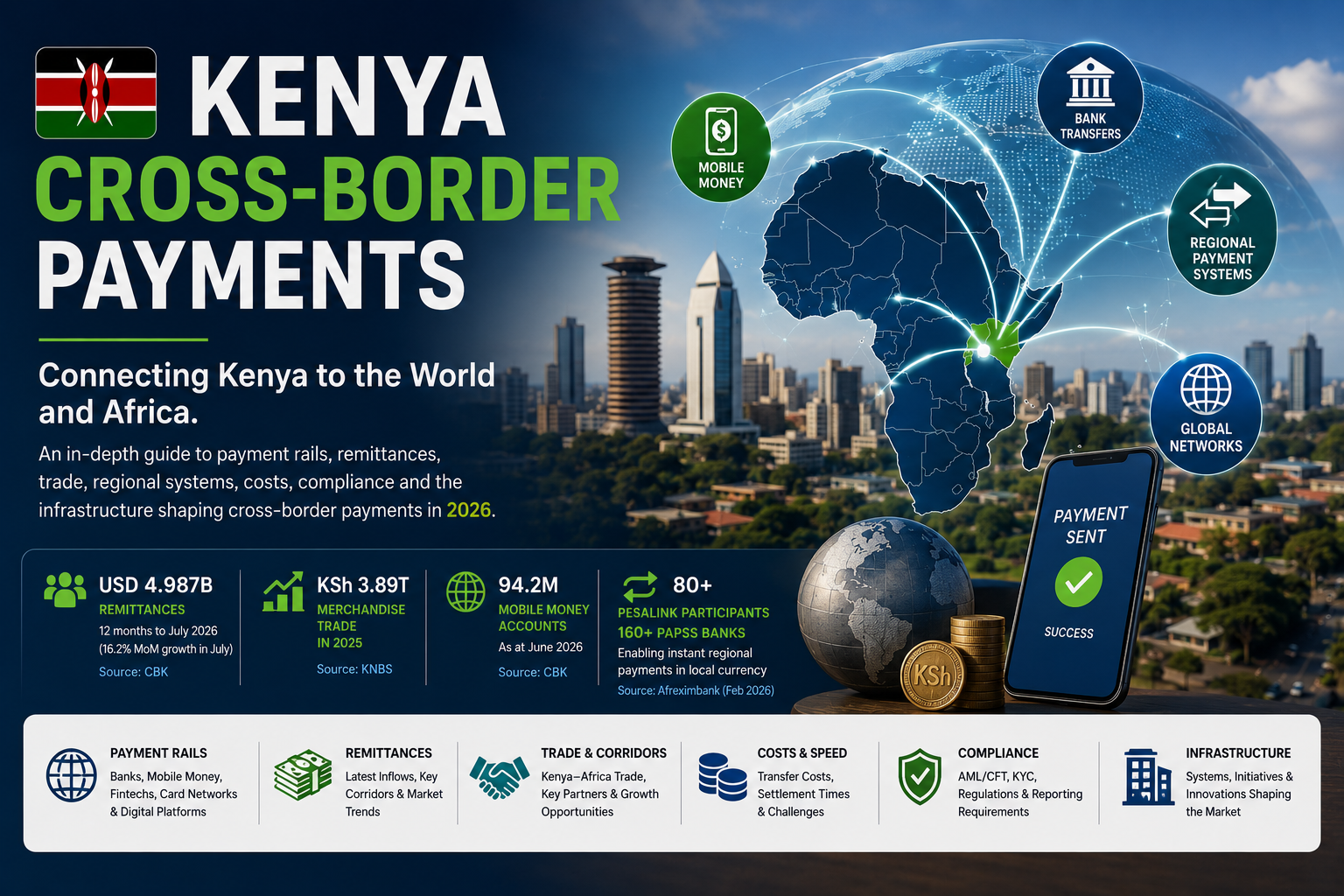
The latest figures show the scale. Kenya received USD436.6 million in diaspora remittances in July 2026. The 12-month total to July stood at about USD4.99 billion.
Trade creates another major payment flow. Kenya’s total merchandise trade reached KSh3.89 trillion in 2025. Trade with Africa reached KSh736.2 billion, while the East African Community accounted for 77.6 percent of Kenya’s exports to Africa.
Let's look at how cross-border payments work in Kenya. We will cover the main payment rails, remittance and trade figures, regional systems, costs and compliance.
Why Cross-Border Payments Matter to Kenya
Cross-border payments are not limited to sending money home. They support imports, exports, salaries, school fees, family support, travel, professional services and regional business transactions.
For Kenya, the connection between payments and trade is especially important. A business can sell goods in Uganda, Tanzania or Rwanda but still needs an efficient way to collect money. An importer faces the reverse problem when paying a supplier outside Kenya.
Remittances are equally important. They provide foreign currency to households and support Kenya’s balance of payments. The CBK describes remittances as a key source of foreign-exchange earnings.
Kenya Received Nearly USD5 Billion in Remittances in the Latest 12 Months
CBK data show that diaspora remittances rebounded sharply in July 2026. Inflows reached USD436.6 million, up 16.2 percent from USD375.6 million in June. The 12-month cumulative total to July was about USD4.987 billion.
That was 1.8 percent below the roughly USD5.080 billion recorded in the corresponding period a year earlier. Latest remittance indicators: (According to Central Bank of Kenya)
- 1USD436.6 million — July 2026 monthly inflows
- 216.2 percent — increase from June 2026
- 3USD4.987 billion — 12-month inflows to July 2026
- 41.8 percent — decline in the 12-month total
- 5USD375.6 million — June 2026 monthly inflows
The monthly rebound and the softer annual trend show why cross-border payment data should be viewed over several periods. One strong month does not necessarily mean annual flows are accelerating.
A New Household Survey Shows the Broader Remittance Market
A major dataset released in June 2026 provides a broader view. The 2025 Remittances Household Survey, conducted by KNBS, CBK, FSD Kenya and IFAD, estimated that Kenyan households received KSh931.8 billion in remittance inflows between June 2024 and May 2025.
The survey found that 91 percent of inflows were cash transfers. Banks and mobile-money platforms accounted for more than 92 percent of inflows. The United States was the largest source, contributing 43.5 percent of total remittances.
The survey also found that 42.3 percent of households described remittances as a supplementary source of income. Another 22.3 percent said remittances were their main source of livelihood.
The household survey should not be added to CBK’s monthly series. The two datasets use different methodologies and reference periods. The survey gives a broader household view, while CBK’s monthly series is useful for tracking formal remittance inflows and recent movements.
Fintech expansion across East Africa requires tracking distinct legislative speeds. To see how neighboring jurisdictions handle virtual asset risks, read our current framework analysis on Uganda's cryptocurrency regulations and AML rules.
Kenya Is Also a Major Regional Trade Payment Market
Cross-border payments follow trade. The 2026 Economic Survey reported total merchandise trade of KSh3.89 trillion in 2025. Domestic exports reached KSh967.9 billion, while total imports reached KSh2.77 trillion.
Kenya’s merchandise trade deficit widened to KSh1.65 trillion in 2025. That means Kenyan businesses made very large payment flows to suppliers outside the country while exporters generated foreign-currency receipts.
Africa is particularly important. Kenya’s trade with African countries expanded by 5.7 percent to KSh736.2 billion in 2025. The EAC accounted for 77.6 percent of Kenya’s exports to Africa.
Important regional trade figures: (As per KNBS Eonomic Survey 2026)
- 1KSh736.2 billion — Kenya’s trade with Africa
- 277.6 percent — share of African exports going to EAC markets
- 3KSh162.3 billion — Kenya’s exports to Uganda
- 4KSh63.6 billion — Kenya’s exports to Tanzania
- 5KSh339.3 billion — Kenya’s exports to COMESA markets
Uganda remained Kenya’s largest African export market in 2025. Export earnings from Uganda rose 28.8 percent to KSh162.3 billion. Exports to Tanzania fell 5.3 percent to KSh63.6 billion.
The East African Community Is Building Regional Payment Infrastructure
Kenya participates in several regional payment systems. The East African Payment System, or EAPS, supports bank-to-bank transfers between Kenya, Rwanda, Tanzania and Uganda. Transactions are carried out in local EAC currencies.
Kenya also participates in the COMESA Regional Payment and Settlement System, or REPSS. It supports cross-border payments between participating COMESA countries through local RTGS systems, using US dollars and euros for settlement.
PAPSS Is Expanding Local-Currency Payments
A major 2026 development is the connection between PesaLink and the Pan-African Payment and Settlement System, PAPSS. In February 2026, the two networks announced a partnership. This enabled instant 24/7 cross-border payments into banks and mobile-money operators within the PesaLink network, with settlement in local currencies.
Afreximbank said the partnership links more than 80 PesaLink network participants with more than 160 PAPSS participating banks. The model is designed to reduce correspondent-banking complexity and reliance on foreign reserve currencies.
For Kenyan businesses, the significance is practical. A regional payment may no longer need to travel through several correspondent banks before reaching the recipient. Local-currency settlement can reduce intermediaries. And this improves speed and transparency.
Kenya’s Mobile-Money Network Provides a Strong Domestic Foundation
Cross-border payments eventually need a domestic receiving and settlement network. Kenya’s mobile-money infrastructure provides that foundation.
By June 2026, Kenya had 94.2 million registered mobile-money accounts and 572,104 active agents. Monthly agent cash-in and cash-out transactions totalled 212.45 million, with a value of KSh682.46 billion.
These figures do not represent cross-border transactions by themselves. They show the scale of the domestic rails that international and regional payment providers can connect to.
The Cost of Sending Money Across Borders Remains a Key Issue
Speed is only one part of cross-border payments. The total cost can include a transfer fee, a foreign-exchange margin and additional charges along the payment chain.
For the South Africa-to-Kenya corridor, World Bank data collected in August 2025 showed a third-quarter average total cost of 6.37 percent in its sampled market.
For Kenya-to-Uganda, the World Bank’s third-quarter 2025 sample showed a total average cost of 12.75 percent. Costs varied sharply by provider and payment method.
The World Bank defines total cost as the transfer fee plus the foreign-exchange margin. A transfer advertised as low-fee can therefore still be expensive if the exchange rate is significantly worse than the market reference rate.
Digital Networks Are Changing the Traditional Cross-Border Model
Traditional international transfers can involve: - banks - money-transfer operators - correspondent institutions - foreign-exchange providers - local payout networks. Each step can add cost, delay or reconciliation work.
Digital payment networks are changing that structure. Mobile wallets, instant payment systems, APIs and local-currency settlement can reduce the number of intermediaries involved in some transactions.
Kenya’s payment infrastructure is moving in this direction. EAPS and REPSS provide established regional rails. PesaLink-PAPSS adds another route for local-currency payments.
Businesses Need More Than a Simple Money-Transfer Product
A business making cross-border payments has different needs from a consumer sending money to family.
Companies may need invoices, beneficiary management, transaction references reconciliation, foreign-exchange conversion and payment confirmation.
SMEs face an additional challenge. They may sell across the region but lack direct access to efficient correspondent-banking relationships. A digital cross-border platform can simplify that process by connecting local collection and payout rails.
The opportunity is significant because Kenya’s African trade reached KSh736.2 billion in 2025. Payment infrastructure is therefore part of the infrastructure that allows regional commerce to function. ## Informal Cross-Border Trade Shows Where Friction Remains
Formal trade statistics do not capture every regional transaction. KNBS also tracks informal cross-border trade. This includes commercial exchanges that are not formally recorded by customs authorities.
The latest KNBS survey found that informal cross-border trade between Kenya and neighbouring countries fell 16.7 percent between December 2024 and June 2025, from KSh299.0 million to KSh249.1 million. Informal exports fell 22.3 percent to KSh124 million, while informal imports fell 10.2 percent to KSh125 million.
The survey covered 13 border crossing points with Uganda, Tanzania, Ethiopia and Somalia. Such trade is often concentrated among smaller traders, making transaction cost, currency access and settlement convenience especially important.
Compliance Is Part of the Cross-Border Payment Infrastructure
Cross-border payments carry additional financial-crime and regulatory risks. Funds can move between jurisdictions quickly. Payment providers therefore need customer identification, transaction monitoring, sanctions screening, fraud controls and suspicious-transaction reporting.
CBK has also highlighted risks around the physical movement of cash across borders. In April 2025, the Bank conducted a survey of cross-border cash movement within the banking sector. This was part of efforts to strengthen Kenya’s AML/CFT/CPF framework.
For digital payment providers, compliance needs to be built into the payment flow. A fast transfer that cannot be properly monitored is not a sustainable cross-border payment product.
What the Future of Kenya Cross-Border Payments Looks Like
Kenya’s cross-border payments market is moving in several directions at once. Remittances remain large. Regional trade is substantial. Mobile money provides a deep domestic network. Regional payment systems are becoming more connected.
The next phase is likely to focus on interoperability. A Kenyan user should not need to understand the infrastructure behind a payment. The important question is whether money can move safely, quickly and at a reasonable total cost.
Local-currency settlement could become increasingly important. PAPSS, EAPS and other regional systems are designed to reduce friction between African currencies and financial systems.
For Kenya, the opportunity is larger than remittances. The same infrastructure can support regional commerce, supplier payments, payroll, education payments and other cross-border financial activity.
Key Numbers at a Glance
- USD436.6 million — July 2026 monthly diaspora remittance inflows
- USD4.987 billion — 12-month remittances to July 2026
- KSh931.8 billion — household remittance inflows recorded for June 2024–May 2025
- KSh3.89 trillion — Kenya’s total merchandise trade in 2025
- KSh736.2 billion — Kenya’s trade with Africa in 2025
- 77.6 percent — share of Kenya’s African exports going to EAC markets
- KSh162.3 billion — Kenya’s 2025 exports to Uganda
- KSh63.6 billion — Kenya’s 2025 exports to Tanzania
- 94.2 million — registered mobile-money accounts in June 2026
- 80+ — PesaLink network participants referenced in the PAPSS partnership
- 160+ — PAPSS participating banks referenced by Afreximbank