How to Send Money from South Africa to Nigeria (2026 Complete Guide)
Learn how to send money from South Africa to Nigeria, including transfer costs, exchange rates, delivery methods, bank deposits, cash pickup and provider limits.

On this page
Sending money to Nigeria from South Africa is possible through licensed international money-transfer operators, banks and other regulated payment channels.
The latest Central Bank of Nigeria list includes international operators such as WorldRemit, Western Union, MoneyGram, Mukuru, Remitly and Paysend among the providers licensed to operate in Nigeria.
The corridor is part of a much larger Nigerian remittance market.
The World Bank records US$21.293 billion in personal remittances received by Nigeria in 2024, the latest annual figure in its World Development Indicators dataset.
Nigeria's latest official balance-of-payments data show workers' remittances remained strong in 2025. The Central Bank of Nigeria recorded US$5.30 billion in workers' remittance inflows in Q2 2025, up 7.50% from the preceding quarter.
Cross-border payment infrastructure inside Nigeria is also substantial. The CBN reported 5.63 billion NIBSS Instant Payment transactions worth N476.89 trillion in the first half of 2024.
For someone sending money from South Africa, that means there are several layers behind a simple transfer.
The sender needs a funding method.
The provider needs foreign-exchange liquidity.
The transfer must pass applicable compliance checks.
The recipient needs a supported Nigerian payout channel.
The final question is how much naira the recipient receives.
South Africa to Nigeria at a Glance
- US$21.293 billion — Nigeria's personal remittance receipts in 2024.
- US$5.30 billion — workers' remittance inflows recorded by the CBN in Q2 2025.
- 7.50% — quarter-on-quarter increase in Nigerian workers' remittance inflows in Q2 2025.
- US$42.77 billion — Nigeria's external reserves at the end of September 2025.
- US$4.60 billion — Nigeria's overall balance-of-payments surplus in Q3 2025.
- US$5.24 billion — workers' remittance inflows recorded by the CBN in Q3 2025.
- 5.63 billion — NIBSS Instant Payment transactions in H1 2024.
- N476.89 trillion — value of NIBSS Instant Payment transactions in H1 2024.
- 14.65% — World Bank third-quarter 2025 average total remittance cost for South Africa-to-Nigeria in the corridor dataset.
- ZAR1,370 — first standard transaction amount used in the World Bank's corridor comparison.
- ZAR3,410 — second standard transaction amount used in the World Bank's corridor comparison.
- 3.20% — average exchange-rate margin in the World Bank's Q3 2025 South Africa-to-Nigeria corridor dataset.
- ZAR156.88 — average fee recorded in the World Bank's Q3 2025 South Africa-to-Nigeria corridor dataset.
The World Bank figures are corridor benchmarks collected in August 2025.
They are not live August 2026 quotes.
Can You Send Money from South Africa to Nigeria?
Yes.
You can use a regulated money-transfer provider or another authorised payment route that supports South Africa-to-Nigeria transfers.
The CBN maintains a list of licensed International Money Transfer Operators.
The list includes global and regional operators as well as Nigerian companies.
The exact options available to a South African sender depend on the provider's current corridor coverage.
What Are the Main Ways to Send Money?
There are several broad methods.
You can use an international money-transfer app.
You can use an online remittance service.
You can use a bank or bank-linked transfer service.
You may also be able to use an agent-based money-transfer operator.
The receiving side can be a Nigerian bank account or another supported payout channel.
We will cover the individual methods in separate Finlazo guides.
For the broader infrastructure behind African transfers, see cross-border payments in Africa.
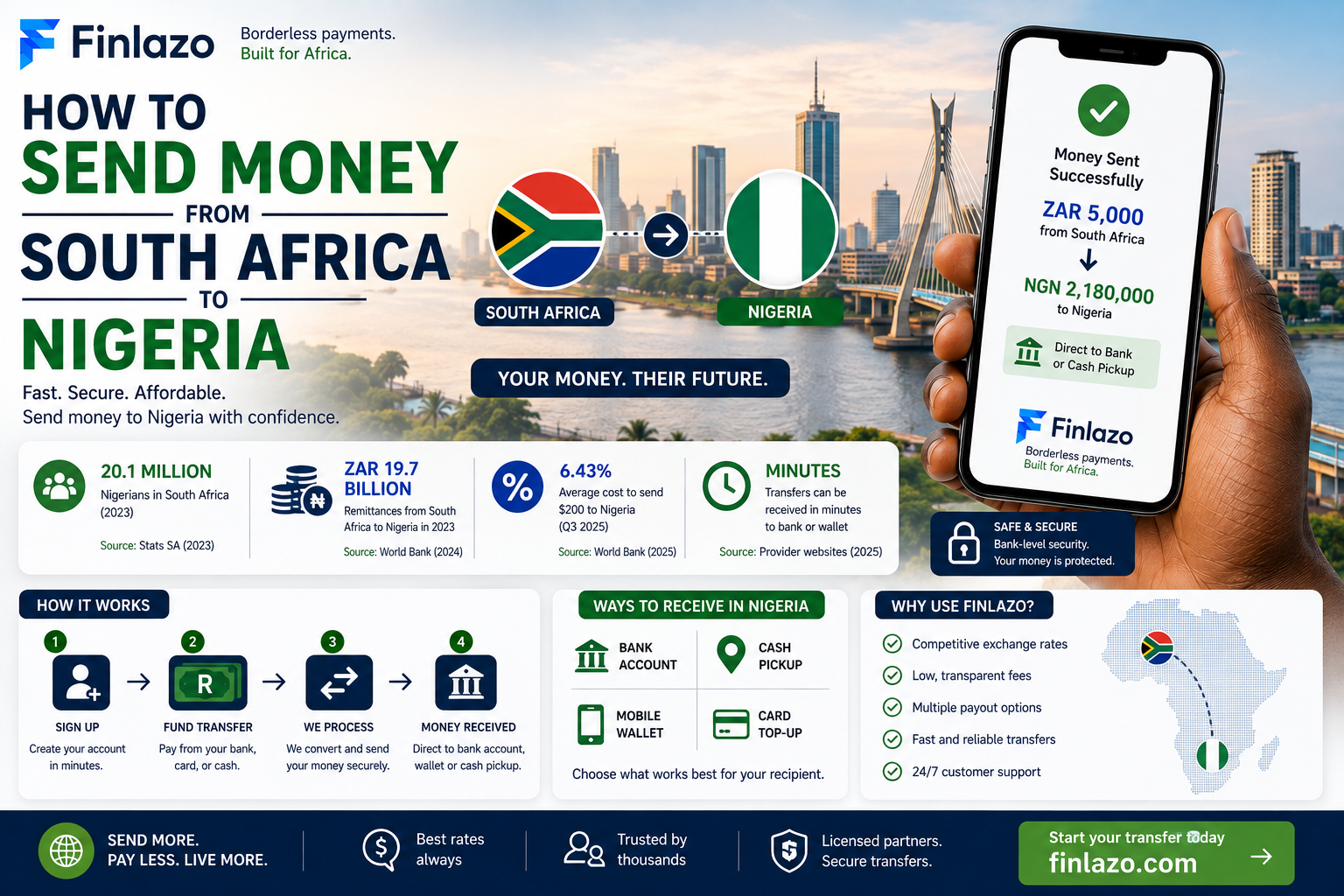
How the Basic Process Works
The exact interface depends on the provider.
The underlying process is similar.
Step 1: Choose the Sending Provider
Start by checking that the provider accepts South African senders.
Then confirm that Nigeria is supported.
Finally, check the available Nigerian receiving methods.
Do not assume that a provider supporting Nigeria offers every payout option.
Step 2: Create and Verify Your Account
Most regulated remittance services require identity verification.
The exact documents depend on the provider and your status in South Africa.
Verification may also depend on the amount, transaction history and regulatory requirements.
Step 3: Enter the Recipient's Details
For a bank-account transfer, you normally need the recipient's name, bank and account details.
For another payout method, the required information can be different.
Use the recipient's details exactly as supplied.
Step 4: Enter the Amount in Rand
Enter the amount you want to send in South African rand.
The provider should display the exchange rate.
It should also show the fee and the expected naira payout.
Step 5: Compare the Final Naira Amount
This is the most important step.
Do not compare providers using the advertised fee alone.
Compare how many naira the recipient will actually receive.
The World Bank's Remittance Prices Worldwide methodology includes both the sender fee and exchange-rate margin when calculating total remittance cost.
Step 6: Pay for the Transfer
The funding method depends on the provider.
Some services accept a bank transfer.
Some accept a debit or credit card.
Some offer cash or agent-based payment.
Step 7: Track the Transfer
Keep the transaction reference.
A reference makes it easier for the provider to trace a delayed or rejected payment.
How Much Does It Cost to Send Money from South Africa to Nigeria?
There is no single South Africa-to-Nigeria transfer fee.
The cost changes by provider, amount, payment instrument, receiving method and exchange rate.
The World Bank's Q3 2025 South Africa-to-Nigeria corridor data recorded an average total cost of 14.65%.
The same dataset recorded an average fee of ZAR156.88.
The average exchange-rate margin was 3.20%.
These three figures should be read together.
The fee is only one part of the total cost.
Why Exchange Rates Matter
A provider can advertise a low fee but offer a weaker rand-to-naira exchange rate.
That difference can reduce the recipient's payout.
The World Bank therefore includes the exchange-rate margin in its total remittance-cost calculation.
For South Africa-to-Nigeria, the World Bank's third-quarter 2025 dataset recorded a 3.20% average exchange-rate margin.
That is a corridor average.
A specific provider can be above or below it.
What Did the World Bank Observe on the Corridor?
The World Bank collected its latest South Africa-to-Nigeria corridor observations between August 16 and August 22, 2025.
The corridor dataset uses ZAR1,370 and ZAR3,410 as standard comparison amounts.
Different providers returned different costs.
For example, the dataset shows a Mama Money observation with a ZAR29 fee, a 1.34% exchange-rate margin and a 3.46% total cost for the relevant transaction configuration. World Bank — South Africa to Nigeria
The same corridor data show a WorldRemit observation with a zero displayed fee, a 4.99% exchange-rate margin and a 4.99% total cost for the relevant configuration. World Bank — South Africa to Nigeria
These are World Bank observations from 2025.
They are not live provider quotes.
Why Provider Quotes Can Be Different
A remittance provider may price a bank-funded transfer differently from an agent-funded transfer.
The receiving method can also change the price.
The exchange rate can change between transactions.
Promotions can change.
The amount can change the fee structure.
That is why a provider comparison should always be made using the same sending amount and the same receiving method.
How Much Money Does Nigeria Receive From Abroad?
Nigeria is one of the world's major remittance destinations.
The latest annual World Bank figure is US$21.293 billion for 2024.
The CBN's more recent balance-of-payments data show workers' remittances of US$5.24 billion in Q3 2025.
The CBN also recorded US$5.30 billion in Q2 2025.
The Q3 figure is the more recent quarterly observation.
The annual World Bank figure and the CBN quarterly figures are different datasets and should not be added together.
What Does This Mean for South Africa-to-Nigeria Transfers?
South Africa is one of many source markets.
The corridor is smaller than Nigeria's largest remittance corridors.
The CBK? No. The CBN's remittance and balance-of-payments statistics cover Nigeria's total inflows from all source markets, not the South Africa corridor alone.
For a corridor-specific view, the World Bank's South Africa-to-Nigeria remittance dataset is more useful.
It shows the actual pricing environment available to senders through sampled providers.
How Long Does a Transfer Take?
Delivery time depends on the provider and receiving method.
World Bank corridor observations include delivery categories such as less than one hour, same day, next day, two days and three to five days.
The South Africa-to-Nigeria corridor dataset contains examples across those speed categories.
Do not assume the fastest option is the cheapest.
Speed and price can move in opposite directions.
Can Money Be Sent Directly to a Nigerian Bank Account?
Yes.
Bank-account delivery is one of the receiving methods available on the corridor.
WorldRemit's Nigeria service supports bank transfers, while other CBN-licensed IMTOs can provide different combinations of bank, cash and other payout options.
The CBN's licensed IMTO list is the place to verify whether an operator is authorised in Nigeria.
What Nigerian Banks Can Receive International Transfers?
The receiving-bank options depend on the provider.
A sender should not assume that every Nigerian bank is supported by every remittance company.
The provider's Nigeria payout page normally gives the current list.
For a bank transfer, the recipient should supply the exact account information requested by the provider.
The name should match the bank account.
This reduces the risk of payment rejection or delay.
Can You Send Money to a Nigerian Mobile Wallet?
This depends on the provider and its current Nigerian payout network.
Some remittance services support digital-wallet or mobile-money delivery.
Others focus on bank accounts and cash pickup.
Because the available wallet options can change, this article intentionally does not treat one wallet as the universal Nigeria receiving method.
The specific wallet methods can be covered separately as those transactional pages are built.
Can You Send Cash to Nigeria?
Some international money-transfer providers support cash pickup in Nigeria.
The recipient collects the funds at an approved payout location.
This can be useful when the recipient does not want a bank deposit.
Cash pickup can also have different pricing and delivery times from bank deposits.
The provider should be checked before the sender starts the transaction.
Can You Send Money From a South African Bank Account?
Yes, where the selected provider accepts bank-account funding from South Africa.
For example, the World Bank's South Africa-to-Nigeria corridor includes internet and bank-branch access points in its provider observations.
The exact funding method should be checked with the provider before sending.
A bank-funded remittance is different from a direct SWIFT transfer from your bank.
The remittance provider handles the cross-border payout structure.
Direct Bank Transfer Versus Remittance Provider
A traditional international bank transfer can be appropriate for some larger or commercial payments.
A remittance provider can be easier for personal transfers because it usually shows the fee, exchange rate and expected payout before the transaction is confirmed.
The choice depends on the payment purpose.
For a family transfer, a remittance service may be more convenient.
For a business supplier payment, a bank or business-payment provider may be more appropriate.
Nigeria's Domestic Payment Infrastructure
The receiving side of a cross-border payment ultimately relies on Nigeria's domestic financial system.
The CBN reported 5.626 billion NIP transactions worth N476.89 trillion in H1 2024.
NIP is Nigeria's account-number-based, real-time electronic funds-transfer infrastructure.
NIBSS says the NIP service enables instant account-based transfers through internet banking, mobile apps, USSD, POS and other electronic channels.
The scale of domestic instant payments matters because an international transfer can ultimately end inside this ecosystem.
Nigeria's Payment System Is Increasingly Digital
The CBN says mobile phones and internet channels are increasingly used for financial services in Nigeria.
The CBN payment-system overview notes the growing use of mobile and internet banking.
Nigeria's NIP infrastructure is one part of that digital shift.
The international payment arrives from abroad.
The domestic system then makes the funds usable.
That separation is important.
The cross-border provider is not necessarily the same institution operating the Nigerian domestic payment rail.
CBN's 2026 Remittance Changes
Nigeria's remittance rules have continued to evolve.
In a March 24, 2026 circular, the CBN reminded IMTOs and authorised dealer banks of requirements under the Revised Guidelines for International Money Transfer Services approved on January 31, 2024.
The CBN said IMTOs must open designated naira settlement accounts with authorised dealer banks in Nigeria.
It also said remittance-related transactions, including beneficiary payments and settlements, must be processed through those designated accounts.
This is an important recent change for the infrastructure behind transfers into Nigeria.
As central bank restrictions modify traditional payout frameworks, a parallel financial infrastructure has emerged to absorb regional commercial volumes. Read our deep-dive analysis on Nigeria's stablecoin shadow currency ecosystem to see how local market participants handle hard-currency asset protection.
Why the 2026 Rule Matters
The rule strengthens the formal settlement structure around international remittances.
For customers, the visible experience may not change much.
You still enter the recipient's details.
You still pay in South African rand.
The recipient still receives the payout in Nigeria.
Underneath that transaction, however, the provider must comply with Nigeria's settlement and reporting requirements.
This is one reason using a licensed provider matters.
Nigeria's Foreign-Exchange Market Has Changed
Foreign exchange is central to the cost of sending money to Nigeria.
The CBN has introduced several reforms to improve price discovery and transparency.
The CBN's Macroeconomic Outlook says the Bank introduced the Electronic Foreign Exchange Matching System and the Nigeria Foreign Exchange Code as part of the reforms.
The same report says the gap between Nigerian Foreign Exchange Market and BDC rates had narrowed to 2.11% as of December 9, 2025, compared with 62.23% in May 2023.
That is a macroeconomic exchange-rate statistic.
It is not the margin charged by a remittance provider.
Why Naira Pricing Still Matters to the Sender
A South African sender normally thinks in rand.
The recipient thinks in naira.
The transfer therefore has two prices.
There is the fee.
Then there is the exchange rate.
A provider can reduce one while increasing the other.
That is why the recipient's final naira amount is the most useful comparison.
For more on how cross-border payment pricing works, see cross-border payments in South Africa.
What Identification Is Needed?
The provider will normally ask the sender to verify identity.
The exact requirements vary.
A South African citizen may use a South African identity document or passport where supported.
A foreign resident may need another approved identity document.
For larger transactions, the provider can ask for additional information.
This can include source-of-funds or purpose-of-payment information.
Why Can a Transfer Be Held for Review?
International transfers are subject to anti-money-laundering and financial-crime controls.
A transaction can trigger a compliance review because of the amount, unusual activity, incomplete information or other risk factors.
That does not necessarily mean the transfer has failed.
The provider may simply need additional documentation.
Responding quickly can reduce avoidable delays.
Is There a Maximum Amount You Can Send?
There is no single universal South Africa-to-Nigeria limit.
The maximum depends on the provider, the sending method, the recipient method and applicable regulatory rules.
A provider may impose its own limits.
The sender's bank may also impose limits.
The recipient channel can have its own restrictions.
For a large transfer, check the exact provider terms before paying.
Why You Should Avoid Comparing Only Fees
Imagine Provider A charges a lower fee.
Provider B gives a stronger exchange rate.
Provider B could still leave the recipient with more naira.
The World Bank's Remittance Prices Worldwide methodology explicitly recognises that both the transfer fee and exchange-rate margin affect the total cost.
That is why the best comparison is the same rand amount, the same receiving method and the final naira payout.
Is Sending Money From South Africa to Nigeria Safe?
Use licensed or appropriately authorised providers.
Verify the provider through the relevant regulator where possible.
Enter the recipient's details carefully.
Do not send money to unofficial intermediaries.
Keep the transaction reference.
Do not share your banking passwords or authentication codes.
For Nigerian operators, the CBN's licensed IMTO list provides an official reference point.
What If the Recipient Does Not Receive the Money?
First check the transaction status.
Then confirm that the recipient details were correct.
If the transaction is pending, the provider may be conducting verification.
If it is marked completed but the recipient cannot see the funds, contact the provider with the transaction reference.
Do not send a second transfer until the first transaction has been traced.
South Africa to Nigeria Cross-Border Payment Statistics
- US$21.293 billion — Nigeria's personal remittance receipts in 2024.
- US$5.30 billion — Nigerian workers' remittance inflows in Q2 2025.
- US$5.24 billion — Nigerian workers' remittance inflows in Q3 2025.
- 7.50% — quarter-on-quarter growth in workers' remittance inflows in Q2 2025.
- US$42.77 billion — Nigeria's external reserves at end-September 2025.
- 5.63 billion — NIP transactions in H1 2024.
- N476.89 trillion — NIP transaction value in H1 2024.
- 14.65% — Q3 2025 South Africa-to-Nigeria average total remittance cost.
- 3.20% — Q3 2025 average exchange-rate margin.
- ZAR156.88 — Q3 2025 average fee recorded in the corridor dataset.
- 2.11% — NFEM-to-BDC exchange-rate gap reported by the CBN as of December 9, 2025.
Frequently Asked Questions
Can I send money from South Africa to Nigeria?
Yes. South African senders can use supported international money-transfer operators, banks and other authorised payment channels to send money to Nigeria.
What is the cheapest way to send money from South Africa to Nigeria?
There is no permanent cheapest provider. Compare the same ZAR amount across providers and look at the final naira amount after the fee and exchange rate are applied.
How much does it cost to send money from South Africa to Nigeria?
The World Bank's Q3 2025 corridor dataset recorded an average total remittance cost of 14.65% for South Africa-to-Nigeria. Individual providers can be higher or lower.
How long does a South Africa-to-Nigeria transfer take?
Delivery time depends on the provider and receiving method. World Bank corridor observations include less-than-one-hour, same-day, next-day, two-day and three-to-five-day delivery categories.
Can I send money directly to a Nigerian bank account?
Yes. Bank-account delivery is supported by international money-transfer providers on the corridor. The available Nigerian banks depend on the provider.
Can I send money to Nigeria for cash pickup?
Yes, where the selected international money-transfer provider supports cash pickup in Nigeria. The recipient normally collects the money through the provider's approved payout network.
Can I send money from a South African bank account?
Yes, where the selected remittance provider accepts bank-account funding from South Africa. Some services also support card or agent-based funding.
How much money does Nigeria receive in remittances?
The latest annual World Bank figure is US$21.293 billion in personal remittances received in 2024. The CBN later recorded US$5.24 billion in workers' remittance inflows in Q3 2025.
Why is the exchange rate important?
The exchange rate determines how many naira the recipient receives. A lower transfer fee does not necessarily mean a cheaper transaction if the provider applies a weaker exchange rate.
Is there a universal limit on South Africa-to-Nigeria transfers?
No. Limits can be set by the provider, funding method, receiving method and applicable regulations. Large transfers may also trigger additional verification.
The Bottom Line
Sending money from South Africa to Nigeria is straightforward once the sender chooses an appropriate regulated route.
The Nigerian remittance market is large.
The World Bank records US$21.293 billion in personal remittance receipts for Nigeria in 2024.
The more recent CBN recorded US$5.24 billion in workers' remittance inflows in Q3 2025.
The payment infrastructure receiving those funds is also highly digital.
The CBN reported 5.63 billion NIP transactions worth N476.89 trillion in H1 2024.
The biggest lesson for senders is pricing.
The World Bank's South Africa-to-Nigeria corridor data recorded a 14.65% average total cost in Q3 2025.
That figure is a benchmark rather than a live quote.
The final amount received matters more than the headline fee.
Compare the exchange rate.
Compare the fee.
Compare the payout.
Then check the delivery time and provider limits.
Nigeria's regulatory framework is also becoming more structured.
The CBN introduced additional remittance requirements in March 2026, including designated naira settlement accounts for IMTOs.
For the sender, the process should remain simple.
Choose the provider.
Enter the recipient.
Review the naira payout.
Pay in rand.
Track the transfer.
For the wider regional picture, see cross-border payments in Africa.