Malawi Cryptocurrency: Adoption, P2P Trading, Stablecoins and the Digital-Asset Market
Malawi has a growing crypto ecosystem shaped by P2P trading, stablecoins, mobile money and increasing digital-asset activity. Explore adoption, market risks and the forces shaping the country's crypto sector.

On this page
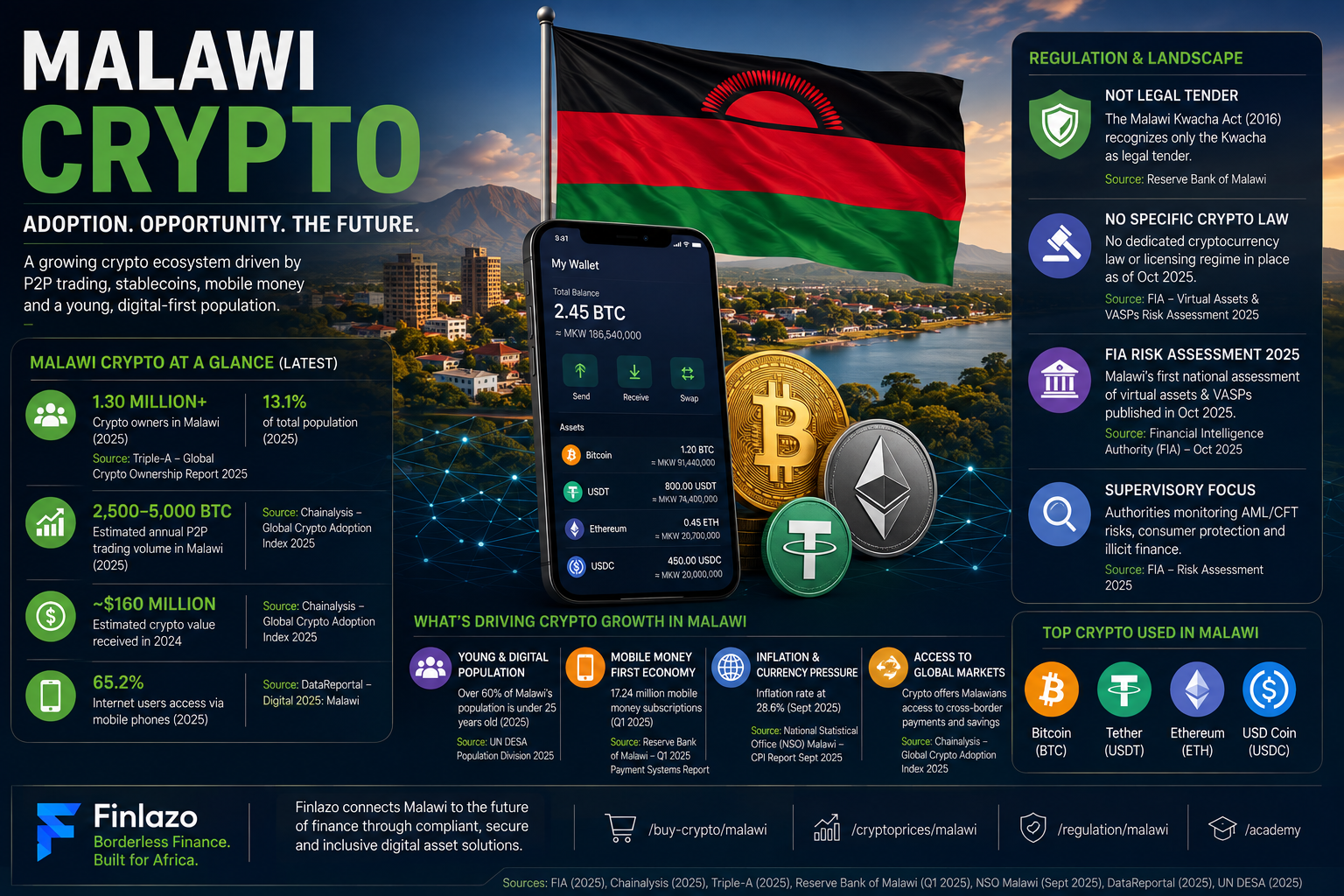
Malawi's cryptocurrency market is more active than the country's regulatory framework might suggest.
The latest Financial Intelligence Authority virtual-asset risk assessment, completed in 2025 and published by the FIA in October 2025, found that the virtual-asset sector already had a physical VASP, multiple online platforms and a measurable customer base.
The assessment identified one VASP with a physical presence in Malawi and 11 additional online platforms offering access to virtual-asset wallets, exchanges or investment services.
That physically present VASP had registered more than 84,000 customers and reported US$2.4 million in transaction volume for the year ending April 2025.
The same assessment rated Malawi's overall virtual-asset and VASP ML/TF/PF risk as high.
This creates an important contrast.
People are using cryptocurrency.
Businesses are providing crypto-related services.
Yet Malawi still does not have a comprehensive dedicated VASP licensing regime.
The latest FIA publications page lists the 2025 virtual-asset risk assessment among the country's current virtual-asset-specific publications, with no newer dedicated VASP risk assessment or comprehensive VASP law listed there as of August 2026.
Malawi Cryptocurrency at a Glance
- 84,000+ customers — customers registered by the physically present VASP for the year ending April 2025.
- US$2.4 million — transaction volume reported by that VASP for the year ending April 2025.
- 1 physical VASP — physically present VASP identified by the 2025 national assessment.
- 11 online platforms — additional online platforms identified for wallet, exchange and investment access.
- 262 responses — responses used in the national virtual-asset risk-assessment questionnaire.
- 59% — overall threat assessment for virtual-asset exchanges.
- 61% — overall threat assessment for virtual-asset wallet providers.
- 83% — vulnerability rating for investment-platform operators.
- 17% — government mitigation-measures score in the assessment.
- 33% — VASP mitigation-measures score.
- 50% — financial-institution and DNFBP mitigation-measures score.
- High — overall ML/TF/PF risk rating for Malawi's virtual-asset and VASP sector.
These figures come from the national assessment and describe the market captured by that exercise.
They are not a live count of all cryptocurrency users in Malawi.
How Many People Own Cryptocurrency in Malawi?
There is no official government census giving the current number of cryptocurrency owners in Malawi.
An independent Triple-A country estimate puts the number at more than 180,000 people, or approximately 1% of the country's population.
Triple-A's underlying country table gives a 2023 estimate of 187,835 cryptocurrency owners, representing 0.90% of the population in that dataset.
The two Triple-A presentations should be understood as the same underlying estimate rather than two separate populations.
The FIA's domestic assessment gives a different number.
It says the physically present VASP had more than 84,000 registered customers for the year ending April 2025.
That figure cannot be used as Malawi's total crypto-user count.
Some Malawians use foreign exchanges.
Some use P2P markets.
Some use self-custody wallets.
Some can have more than one exchange account.
The best description is therefore that Malawi has a visible cryptocurrency user base, but no authoritative current national user census.
What Does the Latest Adoption Data Tell Us?
Country-level crypto adoption rankings are useful, but Malawi needs to be treated carefully.
The Chainalysis 2025 Global Crypto Adoption Index ranks countries using estimated transaction activity across different crypto services.
It uses four sub-indices and adjusts the results for population and purchasing power.
Malawi does not appear in Chainalysis' published 2025 global top-20 table.
That does not mean the market is inactive.
It means Malawi is not among the countries that the published top-20 ranking identifies as leading global grassroots adoption under that methodology.
The domestic FIA assessment provides more useful country-specific evidence.
It documented actual VASP activity, customer registrations, online platforms and transaction flows.
Malawi's First Dedicated Crypto Risk Assessment
The 2025 assessment was an important milestone.
The FIA says the exercise was conducted between April and June 2025 and was led by officials from the Ministry of Finance and Economic Affairs, the Reserve Bank of Malawi and the Financial Intelligence Authority.
It was Malawi's first risk assessment focused specifically on virtual assets and VASPs.
The purpose was to understand the market.
It also examined money-laundering, terrorist-financing and proliferation-financing risks.
The assessment was carried out in line with FATF Recommendation 15 on new technologies.
That gives policymakers a stronger evidence base than earlier general warnings about cryptocurrency.
Malawi's Crypto Market Exists Despite Regulatory Gaps
The assessment found that Malawi did not have a legislative regime specifically regulating and supervising VASPs at the time of the exercise.
This does not mean there were no laws relevant to crypto.
AML/CFT legislation, payment rules, foreign-exchange rules, tax law and consumer-protection principles can still become relevant.
The problem is that those rules were not consolidated into a comprehensive virtual-asset framework.
The FIA assessment describes the sector as operating without dedicated market-entry, AML/CFT and consumer-financial-protection legislation specific to VASPs.
That is the central regulatory gap.
What Crypto Services Are Available in Malawi?
The assessment identified several types of crypto-related activity.
These include wallets.
Exchanges.
P2P transfers.
Fiat-to-virtual-asset conversion.
Virtual-asset-to-fiat conversion.
Virtual-asset-to-virtual-asset conversion.
Investment platforms also form part of the ecosystem.
The FIA assessment identifies these activities within its mapping of the country's virtual-asset ecosystem.
The market is therefore not limited to people holding Bitcoin.
It includes businesses and infrastructure that facilitate transactions.
Bitcoin in Malawi
Bitcoin is one of the major assets identified in Malawi's virtual-asset ecosystem.
The FIA's 2025 assessment lists Bitcoin alongside Ethereum, Solana, Ripple and stablecoins such as USDT as examples of virtual assets considered in the national assessment.
Bitcoin's importance goes beyond its price.
It provides a liquid and widely recognised crypto asset that can be bought, sold or transferred internationally.
For Malawian users, access can come through exchanges, P2P platforms or other crypto-service channels.
Stablecoins Are Especially Important
Stablecoins deserve special attention in Malawi.
The FIA assessment says stablecoins such as USDT and USDC have gained traction across Sub-Saharan Africa, particularly where local currencies are volatile and access to U.S. dollars is limited.
The assessment estimates that stablecoins represented approximately 43% of Sub-Saharan Africa's cryptocurrency transaction volume as of July 2024.
That is a regional figure.
It is not Malawi's stablecoin share.
The distinction matters.
Why Dollar-Linked Digital Assets Attract Interest
A stablecoin can provide a digital token designed to maintain a reference value, often against the U.S. dollar.
That can make it attractive for trading.
It can also be used to move value across borders.
But stablecoins are not equivalent to deposits in a regulated bank.
Their risks include issuer risk, custody risk, technology risk, liquidity risk and regulatory risk.
For Malawi, the policy challenge is deciding how these products should interact with the formal financial system.
P2P Trading Is a Significant Channel
Peer-to-peer crypto trading is important because it can connect users without requiring a large domestic exchange.
A buyer can find a seller.
The parties agree on a payment method.
The crypto moves after the agreed conditions are met.
The FIA's national assessment examined P2P and P2B transfers as part of Malawi's virtual-asset ecosystem.
The assessment rated P2P transfer activity as highly vulnerable.
The speed of P2P transfers was rated very high risk.
That reflects regulatory concerns.
It does not mean every P2P transaction is illicit.
Why P2P Can Become Important in Malawi
P2P markets can be useful where formal exchange infrastructure is limited.
They can also connect local payment methods to global crypto liquidity.
A customer may fund a trade through a bank account or mobile wallet.
The crypto can then be delivered to a digital wallet.
The FIA assessment found that electronic-money wallets were among the funding sources used by customers interacting with VASPs.
That links Malawi's mobile-money ecosystem to its cryptocurrency market.
Mobile Money Creates a Fiat On-Ramp
Malawi already has extensive mobile-money infrastructure.
The country's payment ecosystem included seven electronic money issuers in the FIA's 2025 assessment.
The same assessment identified two payment gateways.
The report says electronic-money wallets were a key funding source for customers dealing with VASPs.
This is one of the most important parts of Malawi's crypto story.
Crypto does not operate in isolation.
Users first need a fiat on-ramp.
Mobile money can provide part of that bridge.
Bank Accounts Also Connect to Crypto
The FIA assessment identified eight commercial banks within the financial-sector ecosystem covered by its analysis.
Some banks process transfers associated with VASPs.
Some provide accounts or cards.
But the relationship remains cautious.
The assessment says financial institutions have adopted a conservative approach because of the absence of clear crypto-specific regulation and the evolving nature of virtual assets.
That creates a practical barrier.
A customer may have a legal bank account.
The same customer can still find it difficult to access a compliant crypto service.
Crypto and Remittances
Remittances are another potential use case.
A person abroad can send money to Malawi through a conventional remittance provider.
Crypto creates an alternative digital path.
The FIA assessment says Malawians use virtual assets for remittances and online payments, alongside savings and investment.
The assessment also warns that the cross-border nature of virtual assets can increase ML/TF/PF risks.
That creates a policy trade-off.
Digital assets can improve speed and access.
The same characteristics can make transactions harder to supervise.
Malawi's Crypto Market Is Not Just About Speculation
It would be too simple to describe Malawi's market as people buying Bitcoin because they expect its price to rise.
The FIA assessment says individuals use virtual assets for savings, investments, remittances and online payments.
Those use cases matter.
A user may treat a stablecoin as a way to hold digital dollar-linked value.
Another may trade Bitcoin.
Another may receive an international payment.
A fourth may transfer funds through a P2P marketplace.
Each use case presents a different regulatory question.
Malawi's Crypto Market and Dollar Access
Access to foreign currency is part of the wider economic context.
The FIA's national risk assessment says stablecoins have gained traction in Sub-Saharan Africa where local currencies are volatile and access to U.S. dollars is limited.
This is a regional observation.
It should not be converted into a claim that every Malawian uses stablecoins to obtain dollars.
The more cautious conclusion is that dollar-linked digital assets provide a potential alternative channel for users who want digital exposure to foreign-currency value.
Investment Platforms Present a Higher Risk
The FIA's assessment identified investment platforms as particularly vulnerable.
The 83% vulnerability score was the highest among the VASP categories discussed in the assessment.
The report links this risk to anonymity, rapid settlement, cross-border transfers and limited domestic oversight.
That is especially important for retail consumers.
Investment products can be easier to market than to understand.
High promised returns can attract people quickly.
Losses can happen just as quickly.
Exchange Risk Is Also Significant
Virtual-asset exchanges received an overall threat assessment of 59%.
The assessment considered activities such as P2P transfers and conversion between fiat currency and virtual assets.
Exchange services can connect users to global liquidity.
They can also become channels through which illicit funds are moved.
The regulatory challenge is therefore balancing legitimate access with financial-crime controls.
Wallets Present Another Risk Layer
Wallet providers received an overall threat assessment of 61%.
A wallet can hold or transfer virtual assets.
Some wallets are custodial.
Others are controlled directly by users.
The regulatory implications are different.
A custodial provider may control customer assets.
A self-custody wallet may not have the same intermediary structure.
That distinction becomes increasingly important as Malawi develops its policy framework.
The Role of Unhosted Wallets
Unhosted or self-hosted wallets are not controlled by a regulated VASP.
They can still receive assets from exchanges.
They can send assets to other wallets.
That portability is one of the strengths of cryptocurrency.
It is also a regulatory challenge.
The FATF's 2026 update on virtual assets and VASPs highlights P2P transactions involving unhosted wallets as an important area of risk.
Malawi's assessment identified similar concerns around cross-border and less-intermediated activity.
Malawi's AML/CFT Framework Is the Main Protection Today
Malawi already has a broader financial-crime framework.
The FIA assessment nevertheless concluded that dedicated virtual-asset market-entry and AML/CFT legislation was missing.
The government mitigation score was 17%.
VASP mitigation measures scored 33%.
Financial institutions and DNFBPs scored 50%.
These are assessment scores.
They are not percentages of firms that are compliant or non-compliant.
What Does Malawi Need to Build?
The FIA assessment recommends a clear national policy position on virtual assets.
It also recommends an appropriate legislative environment.
The assessment calls for stronger supervisory capacity, better understanding of virtual-asset products and improved law-enforcement capability.
A mature framework would ideally clarify:
Who can provide crypto services.
Which authority licenses them.
What customer protections apply.
How custody works.
What AML/CFT controls are required.
How foreign platforms are treated.
How stablecoins are handled.
How P2P activity is supervised.
The Reserve Bank's Role Matters
The Reserve Bank of Malawi is central to the banking and payments side of the ecosystem.
The FIA says the RBM was one of the institutions leading the national virtual-asset assessment.
That matters because crypto products often touch regulated banking or payments infrastructure.
A customer may fund a crypto purchase through a bank or mobile wallet.
A crypto business may need a bank account.
A payment provider may need to process a transaction linked to a VASP.
Those interfaces create the need for regulatory coordination.
Crypto and Malawi's Foreign-Exchange Rules
Cross-border crypto activity can also intersect with foreign-exchange policy.
A Malawian user may move value from kwacha into a dollar-linked stablecoin.
A business may receive payment in crypto.
A trader may convert crypto back into local currency.
Each step can create a different legal question.
The FIA assessment specifically identifies foreign-exchange-related concerns around virtual assets.
The future framework will need to clarify how digital assets interact with Malawi's foreign-exchange controls.
Is Cryptocurrency Legal Tender in Malawi?
No.
The Reserve Bank of Malawi has historically stated that cryptocurrency is not legal tender and that the central bank does not issue or guarantee virtual assets.
The RBM's public information should be checked for the latest official position before treating any crypto asset as recognised money.
This distinction is fundamental.
A person can own a digital asset without it being official currency.
The Malawi kwacha remains the country's official monetary unit.
Does Malawi Have a Crypto Licence?
There was no comprehensive dedicated VASP licensing regime identified in the primary sources reviewed for this article.
The 2025 FIA risk assessment found that VASPs were operating without a dedicated sector-specific licensing and supervision framework.
The FIA publications page, checked in August 2026, does not list a newer dedicated VASP law or licensing framework after that assessment.
This does not mean a crypto company can ignore Malawian law.
Other regulated activities may still require approval.
Foreign Crypto Platforms and Malawi
International exchanges create another regulatory challenge.
A platform may serve Malawian customers from outside the country.
The FIA assessment identified foreign VASPs as a significant vulnerability because they can operate outside domestic oversight.
This creates a familiar problem.
The customer is local.
The company is foreign.
The blockchain is global.
Enforcement becomes complicated.
Consumer Protection Is a Major Issue
A dedicated VASP regime would also improve clarity for consumers.
Users need to know whether a provider is authorised.
They need information about custody.
They need clear terms.
They need procedures for complaints.
They need to understand what happens if a provider fails.
The FIA assessment identifies consumer-financial-protection gaps as part of the wider regulatory weakness.
That is especially relevant for retail users.
Crypto Scams Are a Real Risk
The national assessment documented crypto-related fraud and investment scams.
It also identified cases involving the misuse of virtual assets.
One case described in the assessment involved cryptocurrency worth US$108,000.
The figure refers to a specific case.
It is not an estimate of total crypto fraud losses in Malawi.
The distinction matters.
Case studies illustrate vulnerabilities.
They do not measure the entire market.
What Should Malawian Crypto Users Do?
Users should verify the identity of the service provider.
They should understand whether the provider has any local regulatory approval.
They should be careful with P2P counterparties.
They should protect their private keys and account credentials.
They should not assume that a cryptocurrency investment is protected like a bank deposit.
The FIA's 2025 assessment calls for greater public awareness and financial literacy around virtual assets.
That is particularly important while the dedicated regulatory framework remains incomplete.
Malawi and the Rest of Africa
Malawi's crypto market is part of a much bigger regional trend.
The Chainalysis 2025 Sub-Saharan Africa analysis says the region received more than US$205 billion in on-chain value between July 2024 and June 2025.
The same Chainalysis analysis says the region's on-chain value increased by about 52% year over year.
Malawi is not one of the largest markets in the region.
But the country shares many of the same drivers.
Remittances matter.
Mobile money matters.
Foreign-currency access matters.
P2P markets matter.
Stablecoins and Africa's Digital-Dollar Economy
The Malawi assessment's 43% regional stablecoin figure shows how important stablecoins have become across Sub-Saharan Africa.
Again, this is not a Malawi-specific percentage.
It is regional evidence.
Stablecoins can provide a common digital asset for users in countries with very different currencies.
That can make them useful for cross-border trade and payments.
It also creates regulatory questions around foreign exchange, consumer protection and financial stability.
Malawi Compared With More Regulated African Markets
Malawi is currently behind several African jurisdictions in building a dedicated VASP framework.
Mauritius has a structured VASP licensing regime. See Mauritius cryptocurrency regulation.
Seychelles has also established dedicated VASP rules. See Seychelles cryptocurrency regulation.
Botswana operates under a formal VASP licensing framework. See Botswana cryptocurrency regulation.
Zimbabwe introduced a formal VASP registration framework in 2026. See Zimbabwe cryptocurrency regulation.
Malawi has reached a different stage.
It has completed the risk assessment.
The next major step is legislation.
What Could a Malawi VASP Framework Look Like?
There is no final framework to describe yet.
But the risk assessment provides clues about the areas policymakers will need to address.
A future system could define licence categories.
It could establish capital requirements.
It could clarify custody.
It could require customer due diligence.
It could establish transaction-monitoring requirements.
It could establish rules for foreign VASPs.
It could also define how stablecoins and P2P platforms are treated.
Those are policy possibilities.
They should not be presented as existing Malawi rules.
What Should Crypto Businesses Watch?
Businesses considering Malawi should watch the regulatory direction closely.
Dedicated VASP Legislation
The first major development would be legislation creating a clear legal perimeter.
Licensing or Registration
A future framework could establish formal market-entry requirements.
AML/CFT Rules
The FIA's existing risk assessment makes AML/CFT one of the central issues.
Foreign-Exchange Treatment
Stablecoins and crypto-to-fiat conversion may require clearer foreign-exchange treatment.
Consumer Protection
Future rules may establish clearer requirements for custody, disclosure and complaints.
P2P Supervision
P2P activity is already visible in the market and was identified as a significant vulnerability.
Malawi Cryptocurrency Statistics
- 187,835 — Triple-A's 2023 estimate of cryptocurrency owners in Malawi.
- 0.90% — estimated population share represented by those owners.
- 180,000+ — current Triple-A estimate of cryptocurrency owners in Malawi.
- Approximately 1% — approximate population share in Triple-A's current country summary.
- 84,000+ — customers registered by the physically present VASP for the year ending April 2025.
- US$2.4 million — transaction volume reported by the physically present VASP for the year ending April 2025.
- 11 — online platforms identified in the assessment in addition to the physically present VASP.
- 59% — threat assessment for virtual-asset exchanges.
- 61% — threat assessment for virtual-asset wallet providers.
- 83% — vulnerability rating for investment-platform operators.
- 43% — estimated share of Sub-Saharan Africa's crypto transaction volume represented by stablecoins as of July 2024.
- US$205 billion+ — Sub-Saharan Africa on-chain crypto value received between July 2024 and June 2025.
- 52% — year-over-year growth in Sub-Saharan Africa's on-chain crypto value during that period.
Frequently Asked Questions
How many people own cryptocurrency in Malawi?
There is no official national count. Triple-A currently estimates more than 180,000 cryptocurrency owners in Malawi, while its underlying 2023 country dataset records 187,835 owners representing 0.90% of the population.
What cryptocurrencies are used in Malawi?
The FIA's 2025 national assessment identifies Bitcoin, Ethereum, Solana, Ripple and stablecoins such as USDT among the virtual assets considered in Malawi's ecosystem.
Is P2P crypto trading used in Malawi?
Yes. The national assessment identifies P2P and P2B transfers as part of the market and rates P2P activity as a significant vulnerability because of rapid settlement and cross-border portability.
Are stablecoins used in Malawi?
Stablecoins are part of the market identified by the FIA. The assessment specifically discusses USDT and USDC and says stablecoins have gained traction across Sub-Saharan Africa where local currencies are volatile and access to U.S. dollars is limited.
Is cryptocurrency legal tender in Malawi?
No. Cryptocurrency is not legal tender in Malawi. The Reserve Bank of Malawi has maintained that virtual assets are not official currency.
Does Malawi have a VASP licence?
Malawi does not currently have a comprehensive dedicated VASP licensing framework identified in the primary sources reviewed for this article. The 2025 FIA assessment found VASPs operating without a dedicated sector-specific licensing regime.
Who is responsible for cryptocurrency regulation in Malawi?
The Reserve Bank of Malawi is central to banking, payments and foreign-exchange matters. The Financial Intelligence Authority is responsible for financial-intelligence and AML/CFT functions. Both institutions participated in the national virtual-asset risk assessment.
How large is Malawi's crypto market?
There is no authoritative current market-value figure. The 2025 FIA assessment recorded more than 84,000 customers and US$2.4 million in transaction volume at one physically present VASP for the year ending April 2025.
Will Malawi regulate cryptocurrency?
The FIA's first national risk assessment recommends a clear policy position and an appropriate legislative environment for virtual assets and VASPs. A comprehensive dedicated framework had not been identified in the primary sources reviewed as of August 2026.
The Bottom Line
Malawi's cryptocurrency market is real.
It is also still developing.
The FIA's 2025 risk assessment identified one physically present VASP and 11 additional online platforms.
The same assessment recorded more than 84,000 customers and US$2.4 million in transaction volume for one physically present VASP for the year ending April 2025.
An independent Triple-A estimate puts Malawi's cryptocurrency ownership at more than 180,000 people.
These figures are not directly comparable.
One measures customers of a particular VASP.
The other estimates national ownership.
The regulatory gap is equally clear.
The FIA assessment found no dedicated comprehensive VASP legislative regime at the time of its assessment.
The overall ML/TF/PF risk was rated high.
Exchange services received a 59% threat assessment.
Wallet providers received a 61% assessment.
Investment platforms received an 83% vulnerability rating.
These findings explain why regulation is becoming an urgent policy question.
The opportunity is clear.
Crypto can support savings, investment, remittances and online payments.
Stablecoins can offer digital access to dollar-linked value.
P2P markets can connect local payment methods with global crypto liquidity.
Mobile money can provide an important fiat on-ramp.
But the risks are equally clear.
Fraud can occur.
Users can lose funds.
Foreign platforms can operate outside local oversight.
Cross-border transfers can complicate enforcement.
The next stage for Malawi is therefore not simply more cryptocurrency activity.
It is regulatory clarity.
The FIA has already supplied the evidence base.
The next question is what policymakers do with it.