How to Send Money from South Africa to a Bank Account in Kenya
Send money from South Africa to a Kenyan bank account with a supported provider. Compare fees, exchange rates, transfer limits, delivery times and recipient bank requirements.

On this page
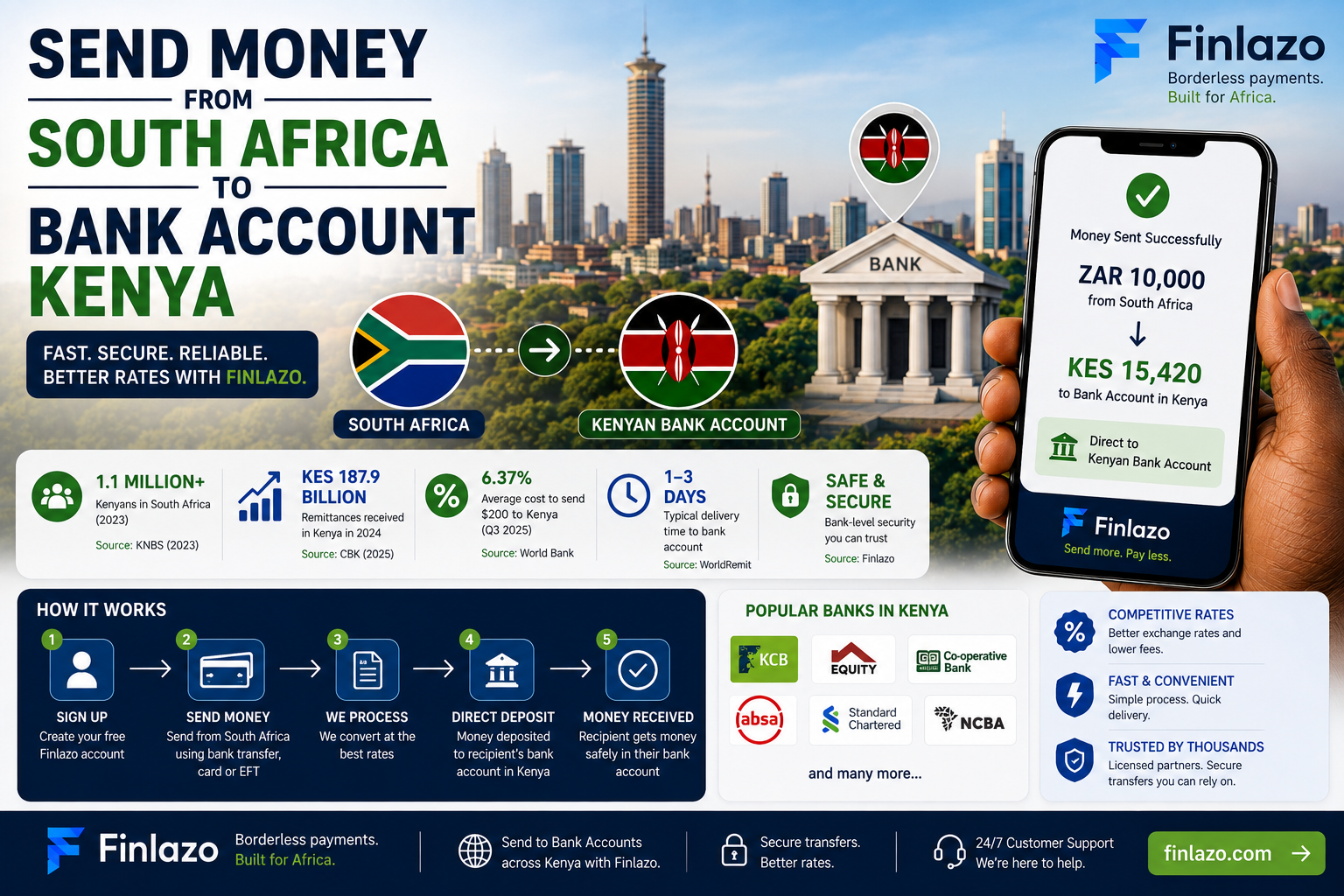
Sending money from South Africa to a bank account in Kenya is possible through international money-transfer providers that support direct bank deposits.
WorldRemit, for example, says its Kenya service can send money directly to Kenyan bank accounts. It lists major banks including Co-operative Bank of Kenya, KCB Bank, Equity Bank and Standard Chartered. WorldRemit — Bank Transfers to Kenya
The corridor is part of a much larger remittance market.
The Central Bank of Kenya recorded US$436.6 million in diaspora remittances in July 2026.
That figure covers Kenya's total formal diaspora remittance inflows from all source markets. It is not the value of South Africa-to-Kenya bank transfers alone. Central Bank of Kenya — Diaspora Remittances
The latest detailed CBK household survey recorded KSh4,417.1 million in total cash and in-kind remittance inflows from South Africa between June 2024 and May 2025.
The World Bank's latest published South Africa-to-Kenya corridor data were collected in August 2025. The corridor's third-quarter 2025 average total remittance cost was 6.37%.
For someone sending money from South Africa, the practical questions are simple.
Which provider can fund the transfer from South Africa?
Which Kenyan bank can receive it?
How much will the recipient actually get?
How long will the money take to arrive?
South Africa to Kenya Bank Transfer at a Glance
- US$436.6 million — Kenya's total diaspora remittance inflows in July 2026.
- KSh4,417.1 million — total cash and in-kind remittance inflows from South Africa in the CBK's June 2024 to May 2025 household survey.
- 0.5% — South Africa's share of total cash and in-kind remittance inflows in that survey.
- 6.37% — South Africa-to-Kenya average total remittance cost in the World Bank's Q3 2025 corridor data.
- R1,370 — first standard transfer amount used in the World Bank's South Africa-to-Kenya comparison.
- R3,410 — second standard transfer amount used in the World Bank's corridor comparison.
- US$19,000 — maximum WorldRemit transfer to most Kenyan bank accounts, subject to the sending-country and payment-method limits.
- US$9,999 — maximum stated WorldRemit transfer to Co-operative Bank accounts.
- US$5,000 — maximum stated WorldRemit transfer to Diamond Trust Bank accounts.
- R4,999 per transfer — WorldRemit's current South Africa funding limit per bank-account-funded transfer.
- R4,999 per day — WorldRemit's current daily bank-account-funding limit for senders in South Africa.
- R24,999 per month — WorldRemit's current monthly bank-account-funding limit for senders in South Africa.
These figures come from different systems.
A provider's South African funding limit can be lower than its Kenya-side payout limit.
Can You Send Money from South Africa to a Kenyan Bank Account?
Yes.
A supported international money-transfer service can take funds from South Africa and pay them into a Kenyan bank account.
WorldRemit explicitly supports bank transfers to Kenya. WorldRemit — Bank Transfers to Kenya
Its current Kenya bank-transfer page says customers can send to major Kenyan banks including Co-operative Bank of Kenya, KCB Bank, Equity Bank and Standard Chartered. WorldRemit — Bank Transfers to Kenya
The receiving account can be a personal account or a business account, subject to the provider's supported-bank and transaction rules.
How to Send Money from South Africa to a Kenyan Bank Account
The exact app screens differ by provider.
The core process is similar.
1. Choose a provider that supports bank deposits in Kenya
Check that the service accepts South African senders.
Also check that it supports bank-account delivery in Kenya.
The World Bank South Africa-to-Kenya corridor tracks services using different receiving methods, including bank accounts and mobile wallets.
2. Register and complete verification
International remittance providers normally require customer verification.
WorldRemit says South African senders can be asked for identity information depending on their residency and status. WorldRemit — Sending from South Africa
Additional checks can be triggered by the amount, the sender's profile or regulatory requirements.
3. Select Kenya
Choose Kenya as the destination country.
Then select bank transfer as the receiving method.
WorldRemit's Kenya service instructs customers to select Kenya and choose bank transfer as the payout method. WorldRemit — Bank Transfers to Kenya
4. Enter the recipient's bank details
You will need accurate beneficiary information.
WorldRemit asks for the recipient's full name, address, bank name, branch name and account number. WorldRemit — Bank Transfers to Kenya
Its Kenya page also asks for a mobile number and the reason for sending the money.
A correct name is important.
WorldRemit says the recipient's name should match the name shown on the bank statement to help avoid delays. WorldRemit — Bank Transfers to Kenya
5. Enter the amount in South African rand
Enter the ZAR amount you want to send.
The provider then calculates the Kenyan-shilling amount.
Do not assume that the exchange rate is the market rate.
The provider may include an exchange-rate margin.
6. Review the total cost
Look at the fee.
Look at the ZAR-to-KES exchange rate.
Look at the exact amount the recipient will receive.
Look at the delivery estimate.
The World Bank defines total remittance cost as the sender fee plus the exchange-rate margin. World Bank — Remittance Prices Worldwide
7. Pay for the transfer
For senders in South Africa, the payment method depends on the provider.
WorldRemit currently says it accepts bank-account transfers from South Africa as a way to fund a transfer. WorldRemit — Sending from South Africa
Mukuru also says customers can pay by EFT from their bank account when using its service. Mukuru — International Money Transfers
8. Track the transaction
Keep the transfer reference.
The provider should show the transaction status and notify you when the payment has been processed.
If the recipient does not see the money, the transaction reference makes it easier to trace.
Which Kenyan Banks Can Receive the Money?
The available banks depend on the provider.
WorldRemit currently lists Co-operative Bank of Kenya, KCB Bank, Equity Bank and Standard Chartered among the major Kenyan banks it supports. WorldRemit — Bank Transfers to Kenya
The same page says its service can send to checking/current accounts, savings accounts and business accounts, except Diamond Trust Bank under the general account-type rule stated on the page. WorldRemit — Bank Transfers to Kenya
Provider coverage should therefore be checked before the sender starts the transaction.
Can Money Be Sent to an Equity Bank Account in Kenya?
Yes, where the selected remittance provider supports Equity Bank.
WorldRemit lists Equity Bank among the Kenyan banks available for bank transfers. WorldRemit — Bank Transfers to Kenya
The sender needs the recipient's correct bank and account information.
The same provider says the recipient's name should match the bank statement.
Can Money Be Sent to a KCB Bank Account in Kenya?
Yes, where the selected provider supports KCB.
WorldRemit lists KCB Bank among the major Kenyan banks to which it can send bank transfers. WorldRemit — Bank Transfers to Kenya
The sender should enter the recipient's bank details exactly as provided by the bank.
Can Money Be Sent to a Co-operative Bank Account?
Yes.
WorldRemit supports Co-operative Bank of Kenya.
Its current Kenya bank-transfer page states a maximum of US$9,999 per transfer for Co-operative Bank accounts.
That is a WorldRemit-specific payout limit.
It should not be treated as a universal Kenyan banking limit.
Can Money Be Sent to a Business Bank Account?
Yes, where the provider supports business-account delivery.
WorldRemit says its Kenya bank-transfer service supports business accounts, in addition to checking/current and savings accounts, subject to the provider's account-type rules.
For a business payment, the sender should select the correct purpose and keep the transaction record.
How Much Does It Cost to Send Money from South Africa to Kenya?
There is no single fixed price.
The final cost depends on the provider, amount, funding method, receiving bank and exchange rate.
The World Bank's latest published South Africa-to-Kenya corridor data show a 6.37% average total cost for Q3 2025.
That is a corridor benchmark.
It is not a current quote from every provider.
Why the Exchange Rate Matters
A provider can advertise a low transfer fee and still deliver less money.
The difference can come from the exchange rate.
The World Bank calls this the exchange-rate margin.
Its methodology includes the exchange-rate margin when calculating total remittance cost. World Bank — Remittance Prices Worldwide Methodology
For the South Africa-to-Kenya corridor, the latest World Bank collection used standard transfer amounts of R1,370 and R3,410.
Those are comparison amounts used by the World Bank.
They are not minimum or maximum transaction values.
A World Bank Provider Example
The World Bank's South Africa-to-Kenya dataset provides provider-level observations.
For a R1,370 WorldRemit transfer, the database recorded a R41.10 fee and a 4.57% exchange-rate margin in an observation collected on 18 November 2024.
The total cost in that observation was 7.57%.
That is a historical provider-level observation.
It is not a live August 2026 quote.
The purpose of the example is to show how the exchange-rate margin can materially affect the total cost.
South Africa-to-Kenya Remittances Are Growing
The wider Kenyan remittance market remains substantial.
The CBK recorded US$436.6 million in formal diaspora remittance inflows in July 2026.
That was one month of total formal inflows from all source regions.
The South Africa-specific household survey provides a different lens.
The 2025 CBK Remittances Household Survey recorded KSh4,417.1 million in South Africa-origin cash and in-kind remittances during June 2024 to May 2025.
South Africa accounted for 0.5% of the survey's total cash and in-kind remittance inflows.
The two datasets should not be confused.
One is a monthly formal-flow series.
The other is a household survey covering cash and in-kind transfers.
How Long Does a Bank Transfer Take?
Transfer time depends on the provider, funding method, compliance checks and the recipient bank.
WorldRemit's current Kenya bank-transfer page says funds are usually credited within one working day.
WorldRemit also says it may request further information before processing a transfer to meet regulatory requirements. WorldRemit — Bank Transfers to Kenya
That means "one working day" should not be interpreted as a guaranteed delivery time for every transaction.
Could the Transfer Arrive Within Minutes?
Some providers advertise very fast delivery.
WorldRemit's broader Kenya page says 90% of money transfers reach its local partners within minutes, after which funds can be added to a bank or mobile-money account. WorldRemit — Send Money to Kenya
The specific bank-transfer page, however, states that bank-account funds are usually credited within one working day.
The provider's payment method and the receiving bank therefore matter.
For a bank transfer, use the estimate shown for the exact transaction you are creating.
What Can Delay a Bank Deposit?
Incorrect beneficiary information can cause a delay.
Additional identity checks can also delay a transaction.
WorldRemit says it may request further information to comply with regulatory requirements. WorldRemit — Bank Transfers to Kenya
A bank may also need to process the incoming payment before making the funds available.
The safest approach is to enter the recipient's bank details exactly as they appear on the bank record.
What Information Do You Need From the Recipient?
For a bank transfer to Kenya, expect to need:
- Full name.
- City or address.
- Bank name.
- Branch name.
- Account number.
- Mobile number.
- Reason for the payment.
WorldRemit lists these details for Kenyan bank transfers. WorldRemit — Bank Transfers to Kenya
The exact fields can differ by provider.
Is There a Limit on How Much You Can Send?
There is no single South Africa-to-Kenya bank-transfer limit that applies to every provider.
WorldRemit currently lists a R4,999 per-transfer bank-account funding limit for senders in South Africa.
Its current South Africa funding page also lists R4,999 per day and R24,999 per month.
On the Kenya payout side, WorldRemit says most supported Kenyan bank accounts can receive up to US$19,000 per transfer, subject to sending-country and payment-method limits.
The lower South African funding limit can therefore become the practical constraint for a sender using that specific payment method.
What If You Need to Send More?
A larger payment may require a different funding method or account verification.
WorldRemit says the maximum can depend on the country being sent from, the receiving method and how the transfer is funded. WorldRemit — Bank Transfers to Kenya
Mukuru has its own account-level limits and verification tiers.
Its current South Africa service says a customer registered with a South African ID can send up to R1 million under the stated account rules, while a foreign-ID customer may be able to send up to 12 times monthly income based on proof of income.
Those are Mukuru-specific limits.
They should not be treated as universal South African remittance limits.
Can I Fund the Transfer From a South African Bank Account?
Yes.
WorldRemit accepts bank-account transfer as a funding method for senders in South Africa. WorldRemit — Sending from South Africa
Mukuru also supports EFT payments from South African bank accounts. Mukuru — Send Money
The provider's instructions should be followed exactly because the payment normally needs a transaction or order reference for matching.
Can I Send From a South African Bank Directly to a Kenyan Bank?
A conventional international bank transfer may be possible, but many consumers use remittance providers because the provider handles the cross-border payment and local payout.
The advantage is convenience.
The provider can display the ZAR fee, exchange rate and expected KES payout before confirmation.
For many users, that is easier than arranging a traditional international bank payment themselves.
For more on the wider corridor, see South Africa to Kenya money transfers.
Bank Transfer Versus Mobile Money
A bank deposit is useful when the recipient already banks in Kenya.
It can also be better for business payments or larger balances that need to remain inside the formal banking system.
Mobile money can be more convenient for everyday spending.
Kenya supports both types of receiving methods through different international money-transfer providers.
For mobile-wallet delivery, see how to send money from South Africa to M-Pesa Kenya.
For Airtel Money, see how to send money from South Africa to Airtel Money Kenya.
Why Direct Bank Delivery Can Be Useful
A bank deposit can remove a cash-pickup step.
The recipient does not need to visit a remittance agent.
The funds arrive in the bank account.
That can be useful for rent, school fees, business expenses, savings and supplier payments.
It also creates a clear transaction record.
Paying Bills or Suppliers From South Africa
A South African sender may not be sending money for family support.
They may need to pay a Kenyan supplier.
They may be paying for accommodation.
They may be reimbursing a contractor.
They may be moving funds to their own Kenyan account.
The sending provider may ask for the reason for payment.
WorldRemit lists options such as family or friend support, purchase of services, property payment and sending funds to self. WorldRemit — Bank Transfers to Kenya
What About Business Payments?
Business payments require more care.
The sender should use the correct business details.
The recipient's account should be able to receive the payment.
The payment purpose should be accurate.
Records should be retained.
For recurring or larger commercial payments, a dedicated business-payment route may be more appropriate than a consumer remittance product.
See Kenya cross-border payments for the wider payment infrastructure.
Can I Send Money to My Own Kenyan Bank Account?
Yes, where the provider supports transfers to self.
WorldRemit's Kenya bank-transfer information explicitly lists sending funds to self as one of the possible sending reasons.
The sender should ensure that the account name and transaction details are correct.
Additional verification may be requested for certain transfers.
What Is the Cheapest Way to Send Money to a Kenyan Bank Account?
There is no permanent cheapest provider.
The right comparison changes with the transfer amount.
The provider's fee can change.
The exchange rate can change.
Promotions can change.
The most useful test is to enter the same ZAR amount into several services and compare the exact KES amount delivered.
The World Bank's 6.37% corridor average for Q3 2025 provides a market benchmark, not a current quote.
Why You Should Compare the Final KES Amount
Suppose one provider charges a lower fee but offers a weaker exchange rate.
Another provider charges more upfront but offers a stronger rate.
The second provider can still leave the recipient with more Kenyan shillings.
That is why the final payout matters.
The World Bank's methodology includes the exchange-rate margin in total cost for exactly this reason. World Bank — Remittance Prices Worldwide
Are There Extra Bank Charges?
Possible charges depend on the provider, the funding bank and the receiving bank.
A remittance provider may disclose its own fees upfront.
The recipient's bank may have separate rules for incoming payments.
The safest approach is to ask the receiving bank or provider whether any additional charges can apply to the selected transfer type.
Do not assume that a "zero-fee" transfer means every part of the transaction is free.
Is It Safe to Send Money From South Africa to a Kenyan Bank Account?
Use established and appropriately authorised payment providers.
Enter the beneficiary details carefully.
Do not send money to a personal intermediary who claims to be acting on behalf of a remittance company.
Keep your confirmation and transaction reference.
For online transfers, complete identity verification through the provider's official website or application.
Kenya's Formal Remittance Market Remains Large
The CBK recorded US$436.6 million in diaspora remittances in July 2026.
That is a national monthly figure.
The South Africa-specific CBK household survey recorded KSh4,417.1 million in cash and in-kind remittance inflows from South Africa during June 2024 to May 2025.
South Africa's share was 0.5% of total cash and in-kind remittance inflows in that survey.
The numbers show that the corridor is real, while also showing that South Africa is a relatively small source compared with Kenya's biggest remittance markets.
The Future of South Africa-to-Kenya Bank Transfers
The direction is toward more digital delivery.
Customers increasingly expect to enter an amount, see the total cost, select a bank account and track the transfer.
The payment system handles the rest.
That means exchange-rate transparency matters.
So does compliance.
So does local bank connectivity.
The strongest services will make all of those layers invisible to the customer.
For a broader look at African payment infrastructure, see digital payment infrastructure in Africa.
South Africa to Kenya Bank Transfer Statistics
- US$436.6 million — Kenya's total formal diaspora remittance inflows in July 2026.
- KSh4,417.1 million — South Africa-origin cash and in-kind remittance inflows in the June 2024 to May 2025 CBK household survey.
- 0.5% — South Africa's share of the survey's total cash and in-kind remittance inflows.
- 6.37% — South Africa-to-Kenya Q3 2025 average total remittance cost.
- R1,370 — standard comparison amount used in the World Bank corridor dataset.
- R3,410 — second standard comparison amount used in the World Bank corridor dataset.
- US$19,000 — WorldRemit stated maximum transfer to most supported Kenyan bank accounts.
- US$9,999 — WorldRemit stated maximum transfer to Co-operative Bank accounts.
- US$5,000 — WorldRemit stated maximum transfer to Diamond Trust Bank accounts.
- R4,999 — WorldRemit stated South Africa bank-account funding limit per transfer.
- R24,999 — WorldRemit stated monthly South Africa bank-account funding limit.
- R1 million — Mukuru's stated South African-ID account limit under its current service rules.
Frequently Asked Questions
Can I send money from South Africa directly to a Kenyan bank account?
Yes. Supported international money-transfer providers can send funds directly to Kenyan bank accounts. WorldRemit currently lists bank transfers to Kenya and major banks including KCB, Equity and Co-operative Bank.
Which Kenyan banks can receive money from South Africa?
The available banks depend on the provider. WorldRemit currently lists Co-operative Bank of Kenya, KCB Bank, Equity Bank and Standard Chartered among its major supported Kenyan banks.
How long does it take for money to reach a Kenyan bank account?
WorldRemit's current Kenya bank-transfer page says funds are usually credited within one working day. Actual timing can vary because of verification, payment processing and bank operating conditions.
How much does it cost to send money from South Africa to Kenya?
The latest published World Bank South Africa-to-Kenya corridor data show a 6.37% average total remittance cost in Q3 2025. Individual provider quotes can be higher or lower.
What bank details are needed?
Typically, the recipient's full name, address or city, bank name, branch name, account number and mobile number are required. The provider may also ask for the reason for the payment.
Can I send money to a Kenyan business bank account?
Yes, where the provider supports business accounts. WorldRemit's Kenya bank-transfer service lists business accounts as a supported account type.
Can I send money to my own Kenyan bank account?
Yes, where the provider supports transfers to self. WorldRemit lists "sending funds to self" among its possible payment reasons.
Is there a limit on how much I can send?
Limits vary by provider and funding method. For example, WorldRemit currently lists R4,999 per transfer, R4,999 per day and R24,999 per month for bank-account funding from South Africa.
Why is the recipient getting fewer Kenyan shillings than expected?
The exchange-rate margin can reduce the final payout even when the visible transfer fee is low. The World Bank includes this exchange-rate effect in its total-cost calculation.
The Bottom Line
Sending money from South Africa to a Kenyan bank account is straightforward when the chosen provider supports direct bank delivery.
The sender needs to select Kenya, choose bank transfer, enter the recipient's details and review the final KES amount before paying.
The market is large enough to matter.
The CBK recorded US$436.6 million in formal diaspora remittances in July 2026.
The latest detailed household survey recorded KSh4,417.1 million from South Africa during June 2024 to May 2025.
The World Bank's latest published South Africa-to-Kenya corridor data show a 6.37% average total remittance cost for Q3 2025.
The most important lesson is not to compare fees alone.
Compare the exchange rate.
Compare the final KES amount.
Compare the delivery estimate.
Check the provider's sending limit.
Check the recipient bank's requirements.
For the wider corridor, see send money from South Africa to Kenya.
For mobile-wallet delivery, see send money from South Africa to M-Pesa Kenya.
A good bank-transfer service should make the process simple.
You pay in rand.
The recipient receives Kenyan shillings.
The provider handles the international payment, conversion and local bank delivery underneath.