Mauritius Cryptocurrency: Adoption, Trading, Stablecoins and the Digital-Asset Market
https://finlazo.com/blog/mauritius-cryptocurrency

On this page
Mauritius has built a visible position in the global cryptocurrency industry despite having a population of only 1.24 million.
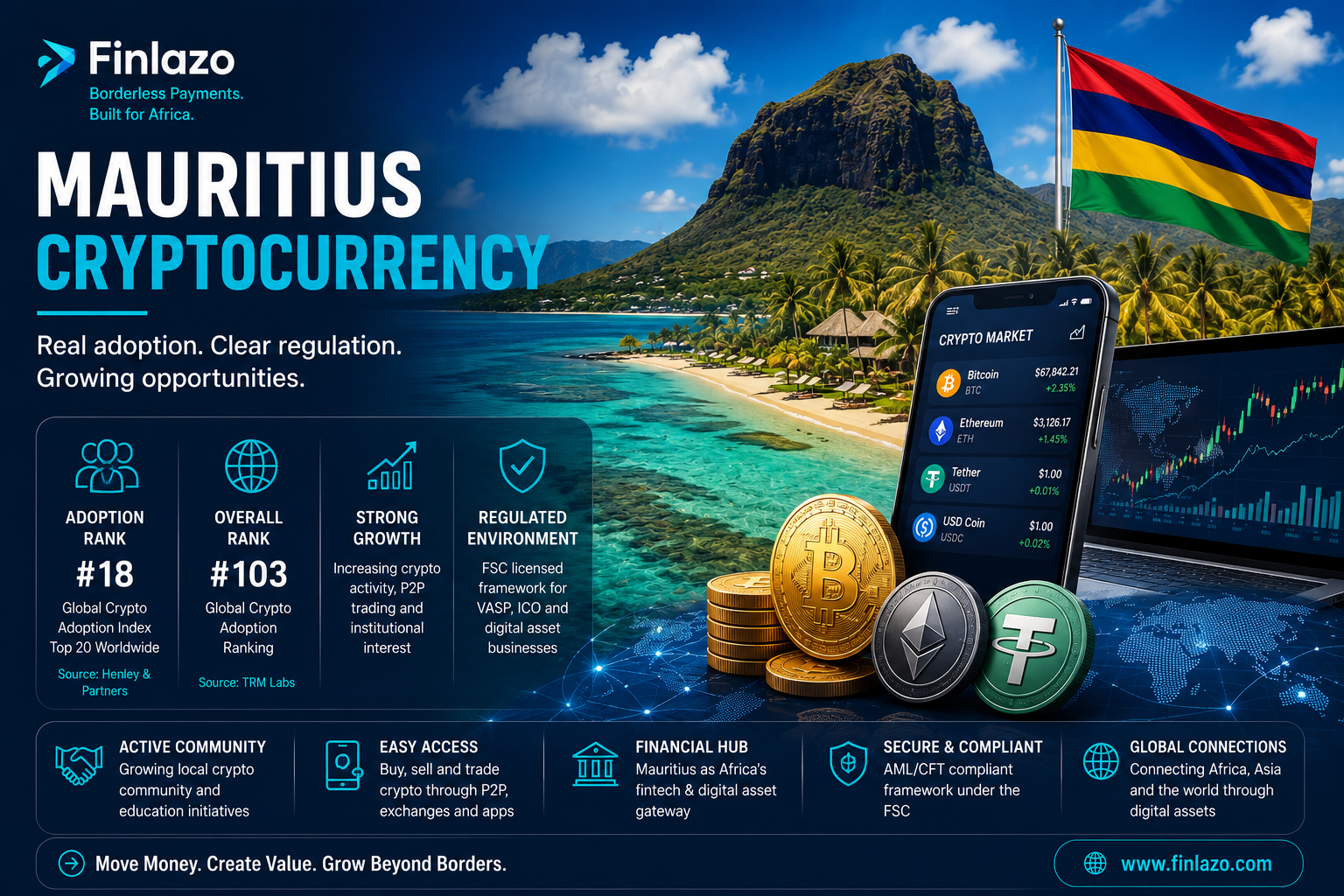
The latest Henley Crypto Adoption Index 2025 ranked Mauritius 18th in its 2025 index, with a score of 30.2 out of 60.
That is not a pure measure of cryptocurrency ownership.
Henley's index combines public adoption, infrastructure, innovation and technology, regulatory environment, economic factors and tax-friendliness. Mauritius scored 4.9 out of 10 for public adoption and 2.8 for infrastructure adoption.
A different dataset gives a more modest picture. TRM Labs' 2025 Country Crypto Adoption Index placed Mauritius at 103rd globally for January to July 2025.
The difference is useful.
It shows why Mauritius should be discussed as a crypto and financial-services hub, rather than automatically described as one of the world's largest retail crypto markets.
Mauritius Cryptocurrency at a Glance
- 18th — Mauritius' position in the Henley Crypto Adoption Index 2025.
- 30.2 out of 60 — Mauritius' total Henley Crypto Adoption Index score in 2025.
- 4.9 out of 10 — Mauritius' public-adoption score in the 2025 Henley index.
- 2.8 out of 10 — infrastructure-adoption score.
- 1.7 out of 10 — innovation and technology score.
- 4.7 out of 10 — regulatory-environment score.
- 9.1 out of 10 — tax-friendliness score.
- 103rd — Mauritius' position in TRM Labs' Country Crypto Adoption Index for January to July 2025.
- 126th — Mauritius' full-year 2024 TRM ranking under the report's updated methodology.
- 1,241,856 — estimated population of Mauritius at the end of 2025.
- 30% — share of global crypto transaction volume represented by stablecoins between January and July 2025, according to TRM Labs.
- 93% — share of stablecoin market capitalisation accounted for by USDT and USDC in TRM Labs' analysis.
These figures describe different aspects of the market.
They should not be combined into a single estimate of Mauritius' crypto-user base.
How Big Is Cryptocurrency in Mauritius?
There is no single official government figure for the number of people in Mauritius who own or use cryptocurrency.
That limitation matters.
Crypto activity can be measured through exchange traffic, on-chain transactions, licensed financial firms, surveys, investment products and business registrations. Each measure captures a different part of the market.
TRM's 2025 ranking provides one of the more current country-level indicators.
Mauritius ranked 103rd in the January-to-July 2025 index, up from 126th for full-year 2024 under the same report's revised methodology.
The ranking is based on attributed on-chain activity and web-traffic analysis, then adjusted for GDP per capita.
It is not a survey of Mauritian households.
Mauritius in the Global Crypto Adoption Rankings
The 2025 data paint an interesting picture.
Mauritius does not appear among the world's largest grassroots crypto markets in TRM's index.
Kenya ranked 28th.
Rwanda ranked 52nd.
Zambia ranked 55th.
South Africa ranked 23rd.
Those rankings come from the same TRM methodology and are useful for regional comparison. See Kenya cryptocurrency for a deeper look at one of East Africa's larger crypto markets.
Mauritius sits lower on pure adoption activity.
Its strength is different.
It combines financial infrastructure, international business services, regulation and a relatively developed fintech ecosystem.
What Does the Henley Index Say About Mauritius?
Henley's 2025 index tells a different story because it measures more than user activity.
Mauritius ranked 18th out of the countries and jurisdictions covered, with a total score of 30.2 out of 60.
The public-adoption score was 4.9.
Infrastructure adoption was lower at 2.8.
Tax-friendliness was much stronger at 9.1.
That combination helps explain Mauritius' reputation.
The country can be attractive to businesses and investors even when its domestic retail adoption is not among the world's highest.
Henley itself describes Mauritius as an African fintech and blockchain hub with regulation, innovation initiatives and a digital-rupee pilot.
A First-Hand Moment That Made Me Curious About Mauritius
It was during the 2018 period when my finance class lecture was on a holiday in Mauritius.
I was outside with my friend Elton when I saw an Instagram post from him showing his vacation time in Mauritius.
Mauritius looked beautiful.
Naturally, as traders, our conversation went somewhere else.
We asked ourselves a simple question.
How do people in Mauritius buy Bitcoin?
At the time, I had spent much of my time around crypto markets and P2P trading. Mauritius suddenly became more than a holiday destination.
I wanted to know whether there was a real crypto user base on the island.
Years later, there are better sources for answering that question.
The data show that Mauritius does have a crypto ecosystem, although it is not one of the world's biggest retail-adoption markets.
Mauritius and Cryptocurrency Businesses
Mauritius developed its digital-asset framework before many African jurisdictions.
The Financial Services Commission regulates virtual asset service providers in the non-bank financial sector.
The Virtual Asset and Initial Token Offering Services Act 2021 created five VASP categories and a separate registration framework for initial token offerings.
The five categories cover broker-dealers, wallet services, custody, advisory services and marketplaces.
For the full legal picture, see Mauritius cryptocurrency regulation.
That framework matters to the market because licensed infrastructure can make it easier for institutional and professional users to interact with digital assets.
Mauritius Was Regulating Crypto Before the Retail Market Was Large
Mauritius' regulatory development began before today's broader global crypto boom.
The FSC issued guidance on digital assets in 2018.
In 2019, it introduced rules for digital-asset custody.
The VAITOS Act followed in 2021 and came into force in February 2022.
This sequence is important.
Mauritius was not simply reacting to cryptocurrency after it became mainstream.
It was building a regulatory perimeter while the market was still developing.
What Cryptocurrencies Are Important in Mauritius?
There is no official national ranking of cryptocurrency ownership by asset.
The available evidence is broader.
Bitcoin remains the largest and most widely recognised crypto asset globally.
Stablecoins have become increasingly important for trading and settlement.
TRM's 2025 research found that stablecoins accounted for 30% of global crypto transaction volume between January and July 2025.
USDT and USDC together represented 93% of stablecoin market capitalisation in the same analysis.
Those are global figures, not Mauritius-specific adoption statistics.
They still matter to Mauritius because the country's financial sector is closely connected to international digital-asset markets.
Stablecoins and Mauritius
Stablecoins deserve particular attention in Mauritius.
They can be used for trading.
They can also support liquidity and digital settlement.
That makes them different from the purely speculative narrative often associated with cryptocurrency.
The global data show how large stablecoins have become.
TRM found more than US$4 trillion in stablecoin transaction volume during the first part of 2025.
Mauritius' regulated financial sector could provide an environment where stablecoin-related businesses connect with conventional financial services.
That opportunity depends on licensing, banking access and compliance.
For the wider African picture, see crypto and stablecoins in Africa.
Mauritius and Crypto-CFD Trading
One of the clearest measurable crypto-related activities in Mauritius is cryptocurrency derivatives.
The IMF's 2026 assessment reported that 105 of 190 licensed securities dealers, or approximately 56%, offered crypto-CFD products.
A crypto-CFD is not the same thing as owning cryptocurrency.
The customer trades a derivative that tracks the price of an underlying asset.
That distinction matters when discussing Mauritius' crypto market.
A large number of firms offering crypto-CFDs does not mean that the same number of firms operate crypto exchanges or hold customer Bitcoin.
It does show that digital assets have become commercially relevant within the country's financial-services industry.
Mauritius and International Crypto Platforms
Mauritius has also been associated with international crypto companies.
That does not automatically mean that those companies primarily serve Mauritian residents.
A company can operate from Mauritius while serving customers across Africa, Asia, Europe or other international markets.
The distinction between corporate domicile and customer location is therefore critical.
It is one reason country-level crypto statistics can be difficult to interpret.
A transaction attributed to a Mauritius-based platform may involve a customer somewhere else.
Cryptocurrency and Mauritius' Financial-Services Sector
Crypto sits inside a much larger international financial centre.
The Financial Services Commission continues to publish an annual statistical bulletin covering the non-bank financial sector.
The country also has a dedicated Bank of Mauritius framework for banks involved in virtual-asset-related activities.
The Guideline for Virtual Asset Related Activities took effect immediately when issued in November 2024, with banks expected to achieve full compliance by May 31, 2025.
That gives cryptocurrency businesses a second layer of institutional scrutiny.
The FSC regulates VASPs.
The Bank of Mauritius regulates banks.
The two frameworks meet where digital assets interact with the banking system.
Banking Access Matters to Crypto Businesses
A cryptocurrency company can have the right licence and still need a banking relationship.
That is one of the most important practical issues in the industry.
A VASP may need bank accounts for payroll, operating expenses, fiat settlements and customer-related transactions.
Banks must also assess liquidity, market, operational, cyber, legal, reputational and financial-crime risks associated with virtual-asset activity.
The Bank of Mauritius' guideline explicitly identifies these risks.
For a business, crypto regulation therefore cannot be separated entirely from banking infrastructure.
Mauritius and the Digital Rupee
Mauritius is also exploring central-bank digital money.
The Bank of Mauritius launched a Digital Rupee pilot in January 2024 with one commercial bank.
The pilot was completed in April 2024.
The Bank later said it was exploring broader ecosystem engagement and cross-border integration.
In November 2024, Mauritius joined the mBridge project as an observing member.
mBridge explores the use of central-bank digital currencies for cross-border payments and settlement.
A CBDC is not a cryptocurrency.
The Digital Rupee is central-bank money.
It is still relevant to Mauritius' digital-asset story because it shows how the country is exploring both regulated private digital assets and public digital-payment infrastructure.
Mauritius and Fintech Innovation
Crypto is part of a wider fintech strategy.
The Bank of Mauritius launched the Innov8 Innovation Hub in September 2024.
The hub provides a space for entrepreneurs, regulators, technology providers and other stakeholders to experiment with financial technology.
The Bank also operates a regulatory sandbox framework.
These initiatives matter to crypto businesses because blockchain products can sit across multiple regulatory categories.
A startup may involve virtual assets, payments, custody, securities or other financial services.
The correct regulatory pathway depends on what the product actually does.
Crypto Regulation Can Shape the Market
Mauritius' approach illustrates an important point.
Regulation does not only determine what is legal.
It can influence which business models are commercially viable.
A company may choose to become a regulated VASP.
Another may work with a licensed infrastructure provider.
A third may focus on blockchain technology without providing regulated virtual-asset services.
Those choices affect the shape of the market.
For comparison, see Seychelles cryptocurrency regulation, where a dedicated VASP regime has also developed around licensing, capital and supervisory requirements.
The Role of P2P Crypto in Mauritius
P2P trading can help connect users with the crypto market without requiring a large domestic exchange.
A buyer can find a seller.
They can agree on a payment method.
The crypto can then be released through the platform.
This model has been important across Africa.
Mauritius is different from some larger markets because its population is small and its financial sector is more internationally focused.
But P2P markets can still provide a route into crypto for individual users.
The key risks remain counterparty fraud, payment disputes and platform-related problems.
Crypto Education and Consumer Protection
The Bank of Mauritius and FSC issued a joint public notice in February 2026 warning the public about unregulated investment opportunities involving virtual assets.
The notice highlighted promises of unusually high returns, pressure to invest and unusual payment methods among warning signs.
That is important for consumers.
A regulated financial centre can still have unregulated crypto offers circulating through social media and informal channels.
Users need to verify the status of a provider before transferring money or digital assets.
Why Mauritius' Small Population Matters
Mauritius had an estimated population of 1,241,856 at the end of 2025.
That puts crypto adoption into perspective.
A country does not need millions of retail crypto users to become important to the industry.
It can host financial institutions, fintech companies, investment platforms and international businesses.
Mauritius' crypto story is therefore partly a story about financial infrastructure, not simply household ownership.
Mauritius Compared With Other African Crypto Markets
Mauritius occupies a different position from Kenya, Nigeria and South Africa.
TRM's 2025 index ranked South Africa 23rd, Kenya 28th, Rwanda 52nd, Zambia 55th and Mauritius 103rd.
The same dataset uses one methodology across all these countries.
Mauritius therefore has lower measured grassroots adoption than those larger African crypto markets.
Its institutional and regulatory advantages tell another story.
The country's appeal is closely linked to its position as an international financial centre.
That combination helps explain why crypto businesses continue to look at Mauritius even without massive domestic retail adoption.
What Could Drive Mauritius Cryptocurrency Adoption?
Several factors could shape the next phase.
Stablecoins
Stablecoins can connect crypto trading with dollar-denominated liquidity.
Their expanding global use creates potential opportunities for Mauritius-based financial businesses.
Better Banking Access
Crypto businesses need reliable banking relationships.
Stronger bank-VASP connectivity could make regulated digital-asset services easier to operate.
Digital-Rupee Development
Mauritius' CBDC work could create new infrastructure for digital payments and settlement.
That could increase the interaction between traditional finance and digital assets.
Regional Expansion
Mauritius already serves international financial markets.
Crypto businesses can use that position to serve customers beyond the domestic market.
Clearer Regulation
A defined framework can reduce uncertainty.
It can also increase compliance costs.
The market will depend on whether businesses see the benefits as outweighing those costs.
Mauritius Cryptocurrency Statistics
- 18th — Mauritius' Henley Crypto Adoption Index 2025 rank.
- 30.2/60 — total Henley score.
- 4.9/10 — public-adoption score.
- 2.8/10 — infrastructure-adoption score.
- 9.1/10 — tax-friendliness score.
- 103rd — TRM Country Crypto Adoption Index position for January to July 2025.
- 126th — full-year 2024 TRM ranking under the revised methodology.
- 105 of 190 — licensed securities dealers reported by the IMF to offer crypto-CFD products.
- 56% — approximate share of licensed securities dealers offering crypto-CFD products.
- 30% — share of global crypto transaction volume represented by stablecoins between January and July 2025.
- 93% — USDT and USDC share of stablecoin market capitalisation in TRM's 2025 analysis.
- 1,241,856 — Mauritius population at the end of 2025.
Frequently Asked Questions
Is cryptocurrency popular in Mauritius?
Mauritius has a developing cryptocurrency market and a strong connection to the international digital-asset industry. TRM Labs ranked Mauritius 103rd in its 2025 Country Crypto Adoption Index, while Henley ranked the country 18th in its broader 2025 crypto-adoption index.
Does Mauritius have a large number of crypto users?
There is no authoritative current figure for the total number of cryptocurrency users in Mauritius. Available rankings measure on-chain activity, web traffic, financial infrastructure and other indicators rather than producing a single household ownership figure.
What cryptocurrencies are used in Mauritius?
Bitcoin and stablecoins are important parts of the wider crypto market accessible from Mauritius. However, there is no official national dataset that provides a definitive ranking of cryptocurrency ownership by asset.
Can people buy Bitcoin in Mauritius?
Users in Mauritius can access cryptocurrency services and international platforms, subject to the platform's availability and applicable regulations. The FSC regulates qualifying VASP activity in or from Mauritius.
Is peer-to-peer crypto trading available in Mauritius?
P2P cryptocurrency trading has been available through international platforms. P2P can provide users with another route to buy and sell digital assets, but counterparty, fraud and payment risks remain.
Are stablecoins important in Mauritius?
Stablecoins are relevant to Mauritius because they are widely used across global crypto markets for trading, liquidity and digital settlement. TRM Labs found that stablecoins represented 30% of global crypto transaction volume between January and July 2025.
Is cryptocurrency legal in Mauritius?
Cryptocurrency is not legal tender in Mauritius. Virtual-asset activities can nevertheless be regulated and licensed under Mauritius' VAITOS framework. See Mauritius cryptocurrency regulation.
Does Mauritius regulate crypto exchanges?
Yes. Businesses conducting qualifying virtual-asset activities can require a VASP licence from the Financial Services Commission. The licence category depends on the services the business provides.
The Bottom Line
Mauritius is an unusual cryptocurrency market.
Its domestic population is only about 1.24 million.
Its connection to the global digital-asset industry is much larger.
The latest data show that clearly.
TRM Labs ranked Mauritius 103rd in its 2025 country adoption index.
Henley placed it 18th in a broader index that also measures infrastructure, regulation, economics, innovation and tax.
Neither figure should be treated as a count of Mauritian crypto users.
They measure different things.
The country's financial-services infrastructure is part of the story.
Its VASP framework provides a formal regulatory route.
Its banks now have dedicated guidance for virtual-asset-related activities.
The Digital Rupee and mBridge work add another layer to the country's digital-finance development.