Crypto Regulation in Ghana: VASP Act, Licensing, Sandbox and the New Regulatory Framework
Explore crypto regulation in Ghana, including the Virtual Asset Service Providers Act, 2025, VASP licensing, registration, the SEC sandbox, stablecoins, exchanges, AML requirements and the latest regulatory framework

On this page
Ghana's cryptocurrency industry has entered a new regulatory era.
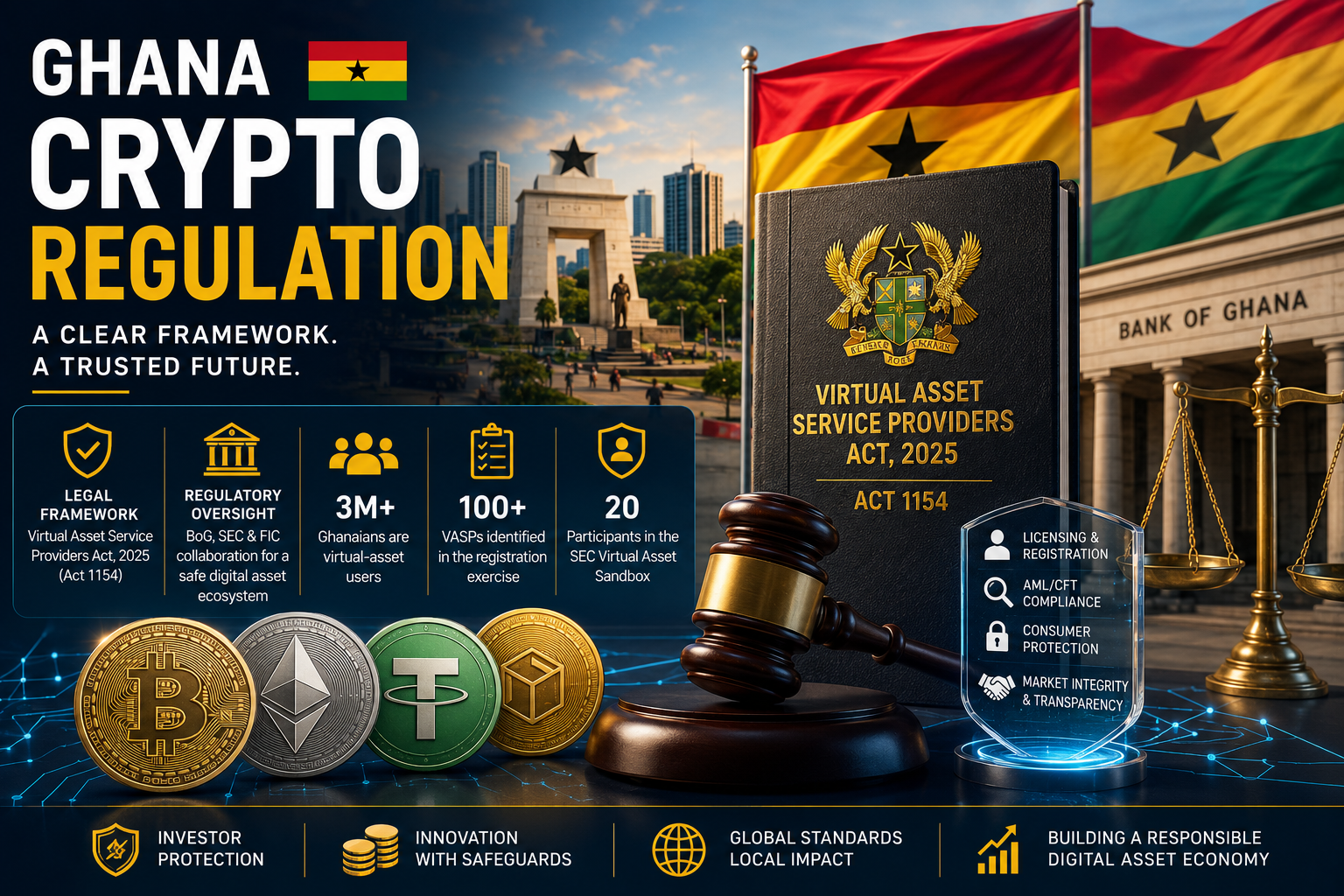
The country's official framework is now built around the Virtual Asset Service Providers Act, 2025 (Act 1154). The legislation establishes the legal foundation for the registration, licensing and supervision of Virtual Asset Service Providers, according to the Bank of Ghana's Virtual Assets framework.
The size of the market helps explain why the change is significant. Ghana's virtual-assets ecosystem now encompasses more than three million users, according to the joint policy position published by the Bank of Ghana, Securities and Exchange Commission and Financial Intelligence Centre.
The authorities also recorded over 100 Virtual Asset Service Providers during Ghana's mandatory registration exercise in July 2025.
The regulatory system is already moving into implementation. Ghana's Securities and Exchange Commission announced 20 participants in its Virtual Asset Sandbox in August 2026, covering activities ranging from crypto exchanges and trading platforms to tokenisation, brokerage and trade-finance products.
The sandbox itself runs for 12 months, with market-ready participants potentially able to transition to activity-based licensing or registration after the first six months, subject to compliance with regulatory requirements.
This means Ghana is no longer simply discussing whether cryptocurrency should be regulated.
The country is building the institutions, registration systems, licensing categories and supervisory tools needed to bring virtual-asset activity into a formal regulatory framework.
For crypto businesses, investors and consumers, the important question is now how the framework works.
Is Cryptocurrency Legal in Ghana?
The answer requires an important distinction.
Cryptocurrency can exist, be owned and be transferred as a virtual asset.
That does not mean every crypto activity is automatically licensed, approved or regulated in the same way as conventional banking.
The Bank of Ghana's policy position explains that the central bank previously warned the public that virtual assets are not legal tender in Ghana and were not regulated under the Payment Systems Act, 2019.
That earlier position reflected a period when Ghana did not yet have a dedicated legal framework for Virtual Asset Service Providers.
The regulatory position has now changed significantly.
The Virtual Asset Service Providers Act, 2025 (Act 1154) provides the legal foundation for the registration, licensing and supervision of Virtual Asset Service Providers.
The key distinction is therefore between:
- Owning or using a virtual asset.
- Operating a virtual-asset business.
- Offering regulated financial or investment services involving virtual assets.
- Issuing, managing or promoting specific virtual-asset products.
The legal and regulatory obligations depend on the activity.
A company cannot assume that simply calling itself a crypto platform, wallet, fintech or technology provider removes it from regulatory requirements.
The Virtual Asset Service Providers Act, 2025
Act 1154 Is the Foundation of Ghana's New Framework
The Bank of Ghana's official Virtual Assets portal identifies the Virtual Asset Service Providers Act, 2025 (Act 1154) as the legal foundation for Ghana's framework.
The law is designed to bring Virtual Asset Service Providers into a system of registration, licensing and supervision.
That is a major change from the earlier environment.
Before the dedicated framework was developed, the authorities identified a rapidly growing market operating with limited specific oversight.
The joint policy position of the Bank of Ghana, SEC and FIC said Ghana's 2024 national financial-crime risk assessment found that virtual assets had gained significant traction, while providers were offering services including exchange, wallet management, custody and transfer.
The authorities identified risks involving:
- Consumer protection.
- Market integrity.
- Money laundering.
- Terrorist financing.
- Financial crime.
- Financial stability.
- Cybersecurity.
The VASP Act is intended to create a framework for managing those risks while allowing responsible innovation to develop.
The Framework Is Activity-Based
One of the most important features of Ghana's approach is that regulation is not limited to crypto exchanges.
Different activities can fall under different regulatory responsibilities.
The Securities and Exchange Commission's December 2025 announcement listed services that the SEC is expected to license and regulate under the framework, including:
- Virtual Asset Exchanges.
- Virtual Asset Trading Platforms.
- Virtual Asset Issuance.
- Virtual Asset Tokenization.
- Virtual Asset Exchange Traded Funds.
- Virtual Asset Managers.
- Virtual Asset Investment Advisors.
- Virtual Asset Brokerage.
- Virtual Asset Advocacy on Securities.
- Virtual Asset Mining and Validation on Securities.
- Virtual Asset Sandbox activities on Securities.
The Bank of Ghana's official framework also identifies a broader virtual-asset ecosystem involving services such as wallet provision, custody, transfer and settlement, payments, stablecoins and other blockchain-based activities.
The practical implication is important.
A company's regulatory treatment depends on what it actually does.
A crypto exchange, a wallet provider, a stablecoin issuer and a tokenisation platform may not all face the same licensing path.
Who Regulates Cryptocurrency in Ghana?
Ghana's system is not designed around a single crypto regulator.
The three most important institutions are:
The Bank of Ghana
The Bank of Ghana is a central part of the virtual-assets regulatory architecture.
Its framework focuses on issues including financial stability, consumer protection, financial-crime compliance, responsible innovation and cybersecurity.
The Bank has also established a Virtual Assets Department, which is intended to regulate and supervise participants in Ghana's growing virtual-assets ecosystem in coordination with other authorities.
The Bank's responsibilities are particularly important where virtual assets intersect with payments, settlement, custody, stablecoins and the wider financial system.
The Securities and Exchange Commission
The SEC Ghana is the other major co-regulator under the VASP framework.
Its role is especially important for activities involving investment and securities-market functions.
The SEC has already moved beyond policy discussions into practical testing through its Virtual Asset Sandbox.
The Commission's framework covers activities including exchanges, trading platforms, tokenisation, issuance, virtual-asset investment management and brokerage.
The Financial Intelligence Centre
The Financial Intelligence Centre is a key part of the framework because Virtual Asset Service Providers must operate within Ghana's anti-money-laundering and counter-terrorist-financing architecture.
The joint policy position states that the three institutions — the Bank of Ghana, SEC and FIC — agree that virtual assets cannot remain outside Ghana's financial regulatory purview.
That coordinated approach matters.
Crypto businesses can involve payments, investments and financial-crime risks at the same time.
A modern framework therefore requires cooperation between financial, securities and AML authorities.
More Than Three Million Users Helped Drive Regulatory Change
The growth of Ghana's crypto market is one of the reasons regulation became unavoidable.
The Bank of Ghana's 2026 policy position states that Ghana's virtual-assets ecosystem now encompasses more than three million users.
That is no longer a tiny experimental market.
The same policy document explains that Ghana's 2024 National AML/CFT/CPF Risk Assessment included a dedicated assessment of virtual assets and Virtual Asset Service Providers.
The assessment found significant growth and identified the sector's potential exposure to financial-crime risks.
The authorities therefore moved from warning about an unregulated market toward building a structured regulatory regime.
The 2025 Mandatory VASP Registration Exercise
Ghana Required VASPs to Register
Before the full licensing system was operationalised, the Bank of Ghana conducted a mandatory registration exercise.
The July 2025 Bank of Ghana notice required Virtual Asset Service Providers operating within Ghana's jurisdiction to register with the Bank.
The registration exercise covered entities involved in activities including:
- Virtual-asset exchange services.
- Wallet provision or custody.
- Transfer or settlement involving virtual assets.
- Issuance or sale of virtual assets.
- Initial Coin Offerings.
- Stablecoin-related activities.
The deadline stated in the original notice was 15 August 2025.
Registration Was Not a Licence
This distinction is critical.
The Bank of Ghana explicitly stated that registration did not constitute a licence to operate and did not imply legal recognition or regulatory approval.
The purpose was to help the authorities identify and assess the market.
The results were significant.
According to the joint policy position, the July 2025 exercise recorded over 100 VASPs offering services including payments, exchanges, wallets, brokerage and investment advice.
That gave Ghana its first major regulatory baseline for the industry.
The country was no longer designing rules entirely from theory.
It had updated information about the businesses already operating in and from Ghana.
See how Cryptocurrency regulation in Nigeria is exercised.
Ghana's Regulatory Sandbox Is Already Operating
A 12-Month Controlled Testing Period
The SEC created a dedicated regulatory sandbox for Virtual Asset Service Providers.
According to the SEC's March 2026 announcement, the sandbox period lasts 12 months.
It is designed as a controlled environment where selected businesses can pilot products and services under regulatory oversight.
The purpose is not simply to allow companies to experiment without rules.
The SEC says the sandbox is intended to support responsible innovation while strengthening:
- Investor protection.
- Market integrity.
- Anti-money-laundering compliance.
- Counter-terrorist-financing compliance.
The lessons from the pilot are also intended to help the SEC finalise activity-based licensing guidelines.
Market-Ready Participants Can Transition After Six Months
The SEC's March 2026 framework contains another important detail.
After the first six months of the 12-month sandbox period, participants whose products and services are market-ready and compliant with regulatory requirements may be transitioned to the relevant activity-based licensing or registration process.
Participants that are not yet market-ready can potentially continue testing for the remaining six months.
This is a practical way to regulate an industry where products and technologies are still evolving.
The regulator can observe real operating models before applying permanent licensing requirements more broadly.
Ghana Had 20 Publicly Listed Sandbox Participants by August 2026
The SEC's public notice dated 19 August 2026 listed 20 Virtual Asset Service Providers and institutions participating in approved sandbox activities.
The list demonstrates how broad Ghana's virtual-assets market has become.
The approved activities included:
- Asset tokenisation of gold.
- Asset tokenisation of securities.
- Tokenisation of Treasury bills.
- Tokenisation of bonds.
- Tokenised trade finance.
- Virtual Asset Brokerage.
- Virtual Asset Exchanges.
- Virtual Asset Trading Platforms.
- A virtual-asset exchange for commodities.
- Real World Asset custody for gold.
The list included businesses and institutions testing very different models.
This matters because Ghana's framework is not being built only around Bitcoin buying and selling.
It is also being built around tokenised real-world assets, investment products, trade finance and digital market infrastructure.
That could make Ghana one of the more comprehensive virtual-asset regulatory experiments in Africa.
Which Crypto Businesses May Need Licensing or Registration?
The exact regulatory requirement depends on the activity and the applicable authority.
However, Ghana's framework covers a broad range of services.
Crypto Exchanges
A company operating a virtual-asset exchange or trading venue is within one of the specific categories identified by the SEC.
The SEC's VASP Act announcement makes clear that exchanges and trading platforms are part of the formal framework.
Wallet and Custody Providers
The Bank of Ghana's regulatory materials identify wallet provision and custody among important virtual-asset activities.
The treatment of a provider can depend on whether it controls customer assets or provides non-custodial technology.
Businesses should therefore assess the exact service model rather than relying on broad labels.
Stablecoin Businesses
Stablecoins are explicitly part of the regulatory conversation.
The original Bank of Ghana registration exercise included services related to the issuance or sale of virtual assets, including stablecoins.
The Bank's broader virtual-assets framework also identifies stablecoins as part of the ecosystem requiring regulatory attention.
A company issuing a stablecoin, providing stablecoin services or building payment infrastructure around stablecoins should therefore not assume it falls outside the VASP framework.
Tokenisation Platforms
Ghana's sandbox provides one of the clearest examples of the framework's wider ambition.
Participants have been admitted to test tokenisation involving:
- Gold.
- Securities.
- Treasury bills.
- Bonds.
- Trade finance.
Tokenisation is therefore not a theoretical future possibility in Ghana's regulatory framework.
It is already one of the activities being tested in the SEC sandbox.
Brokers and Investment Advisors
Virtual-asset brokerage and investment-advisory activities are also included within the SEC's regulatory categories.
This is important because a business can create regulatory obligations without operating a full exchange.
Providing advice, arranging transactions or managing virtual-asset investments can create a different regulatory profile.
What Does the Framework Mean for Foreign Crypto Companies?
Foreign companies serving Ghanaian users should not assume that operating through a website or mobile app removes them from Ghanaian regulatory requirements.
The Bank of Ghana's original mandatory registration exercise applied to VASPs offering services to people resident in Ghana, including through digital platforms.
That is an important principle for online businesses.
Physical presence is not necessarily the only factor.
A company targeting or serving users in a jurisdiction may still fall within that country's regulatory perimeter.
The precise requirement will depend on the activity, the company's operating model and the final applicable rules.
For a foreign crypto business entering Ghana, the sensible questions include:
- Which exact virtual-asset activity are we performing?
- Are we serving Ghana-resident customers?
- Which regulator has responsibility for our activity?
- Do we require registration, licensing or sandbox participation?
- Which AML/CFT obligations apply?
- How will customer assets and data be protected?
- What consumer disclosures are required?
A formal legal and compliance review is essential before launching services.
AML and Financial-Crime Compliance
Financial-crime risk is one of the biggest reasons Ghana developed a dedicated VASP framework.
The 2025–2029 National AML/CFT/CPF Policy specifically identified the absence of a robust framework, clear guidelines, mandatory registration and stringent AML/CFT/CPF compliance requirements for VASPs as a structural weakness highlighted by the country's risk assessments.
The new framework is intended to address that gap.
The policy position and regulatory materials repeatedly refer to risks involving:
- Money laundering.
- Terrorist financing.
- Proliferation financing.
- Fraud.
- Consumer harm.
- Financial-system integrity.
For businesses, compliance is therefore likely to be a central part of the licensing environment rather than a secondary requirement.
The exact obligations will depend on the activity-specific regulations and guidance.
But companies should expect the framework to involve areas such as customer due diligence, transaction monitoring, record keeping, suspicious-transaction reporting and other AML/CFT controls.
South Africa too has implemented their CASP AML requirements too!
Consumer Protection Is Becoming a Major Part of Ghana's Crypto Rules
Ghana's regulators are not regulating crypto only because of financial crime.
Consumer and investor protection are also central to the framework.
The Bank of Ghana's official Virtual Assets portal says the framework is intended to:
- Protect consumers and investors.
- Safeguard financial stability.
- Strengthen AML/CFT/CPF compliance.
- Foster responsible innovation.
- Address cybersecurity risks.
- Improve domestic and international regulatory coordination.
The SEC's sandbox framework similarly emphasises investor protection and market integrity.
This means crypto companies should expect greater scrutiny of how products are presented to customers.
A product may need clear disclosures about:
- Price volatility.
- Loss of capital.
- Custody arrangements.
- Fees.
- Conflicts of interest.
- Technology risks.
- The regulatory status of the provider.
Advertising Is Also Under Scrutiny
In August 2026, the Bank of Ghana and SEC issued a public notice on unauthorised advertising of virtual-asset and stablecoin products.
The authorities said they had noted increasing advertisements, including large billboards in Accra and other parts of the country, by certain VASPs.
That development is important.
The market is moving beyond quiet online crypto communities.
Virtual-asset businesses are increasingly visible to the general public.
Regulators are therefore paying closer attention not only to what a company does, but also how it markets products and services.
The SEC's 2026 Platform Directive
Ghana's wider approach to digital financial platforms also became clearer in June 2026.
The SEC directive on online investment and trading platforms stated that financial-technology providers and persons operating online investment or trading platforms performing SEC-licensed activities must obtain the appropriate registration or licence.
The directive set 31 August 2026 as the deadline for affected persons to complete the relevant licensing and registration process.
The directive is broader than cryptocurrency alone.
But it is relevant to Ghana's virtual-assets market because many crypto and tokenised-investment products are delivered through online platforms.
The larger regulatory message is clear.
Digital delivery does not place a financial product outside regulatory oversight.
What Ghana's Crypto Regulation Means for Consumers
For ordinary users, the new framework could eventually make the market easier to understand.
The most important change may be greater distinction between:
- Registered or licensed providers.
- Sandbox participants.
- Unauthorised businesses.
- Fraudulent platforms.
But consumers should be careful with terminology.
A company participating in a sandbox is not necessarily the same thing as a fully licensed provider for every activity.
Likewise, historical registration does not automatically mean a company has received a permanent operating licence.
Users should verify a provider's current status directly through official regulatory information.
Consumers should also remember that regulation does not eliminate investment risk.
Bitcoin and other cryptocurrencies can still be volatile.
A licensed company does not guarantee that an investment will make money.
What Ghana's Crypto Regulation Means for Businesses
For businesses, the opportunity is greater regulatory clarity.
The cost is greater compliance responsibility.
A serious operator may need to invest in:
- Licensing or registration processes.
- Legal and regulatory analysis.
- AML/CFT systems.
- Governance.
- Cybersecurity.
- Consumer disclosures.
- Transaction monitoring.
- Record keeping.
- Internal controls.
Smaller businesses may find this challenging.
But a formal framework can also make it easier for legitimate providers to differentiate themselves from anonymous or fraudulent operators.
Clearer rules can also create more confidence for banks, institutional investors and international partners.
Key Ghana Crypto Regulation Numbers
- More than 3 million — users in Ghana's virtual-assets ecosystem, according to the joint Bank of Ghana, SEC and FIC policy position.
- Over 100 VASPs — recorded during Ghana's July 2025 mandatory registration exercise.
- 15 August 2025 — original deadline for the Bank of Ghana's mandatory VASP registration exercise.
- Act 1154 — the Virtual Asset Service Providers Act, 2025.
- 20 participants — publicly listed in the SEC's Virtual Asset Sandbox in August 2026.
- 12 months — duration of the SEC's VASP sandbox period.
- 6 months — point after which market-ready and compliant sandbox participants may potentially transition toward activity-based licensing or registration.
- 31 August 2026 — deadline stated in the SEC's June 2026 directive for affected online investment and trading platforms to complete the relevant licensing and registration process.
These figures describe different parts of Ghana's regulatory transition.
They should not be interpreted as meaning that every registered entity, sandbox participant or platform is fully licensed for every virtual-asset activity.
How Ghana's Framework Differs From the Old Approach
Ghana's policy has changed substantially over a relatively short period.
The Earlier Approach
The authorities previously warned that virtual assets were not legal tender and were outside the conventional payment and securities regulatory framework.
The focus was largely on caution and risk.
The New Approach
The current framework accepts a different reality.
The virtual-assets industry exists.
Ghana has more than three million users.
More than 100 providers were identified during the registration exercise.
The question is therefore not whether the sector exists.
The question is how to regulate it.
The new approach combines:
- Registration.
- Licensing.
- Activity-based supervision.
- A regulatory sandbox.
- AML/CFT requirements.
- Consumer protection.
- Investor protection.
- Cybersecurity oversight.
- Coordination between regulators.
That is a much more mature regulatory model than simply issuing warnings to the public.
The Biggest Regulatory Questions Still Ahead
Although the framework has made major progress, implementation will continue to matter.
Activity-Specific Rules
The VASP Act creates the legal foundation.
Detailed requirements still need to be operationalised through regulations, guidelines and supervisory processes.
Different activities will need different standards.
A stablecoin issuer should not necessarily be regulated in exactly the same way as a tokenisation platform.
Licensing Pathways
The sandbox is helping regulators test and refine activity-based requirements.
As those guidelines become fully operational, businesses will have greater clarity about how to move from registration or pilot status into long-term authorisation.
Cross-Border Providers
Crypto is inherently international.
A platform can serve customers in several countries from one digital interface.
Ghana's regulators will therefore need continued coordination with foreign authorities and international standards.
Stablecoins and Payments
Stablecoins could become one of the most important future questions.
They can function differently from volatile cryptocurrencies when used for settlement and payments.
But they also raise questions involving reserves, redemption, liquidity, custody and financial stability.
The Bank of Ghana's framework already recognises stablecoin activities as requiring regulatory attention.
The Bottom Line
Crypto regulation in Ghana has moved decisively from warning and observation toward formal supervision.
The Virtual Asset Service Providers Act, 2025 (Act 1154) now provides the legal foundation for registration, licensing and supervision.
The market is large enough to justify the change.
Official policy material says Ghana's virtual-assets ecosystem has more than three million users.
The Bank of Ghana's 2025 registration exercise identified over 100 VASPs.
And by August 2026, the SEC had publicly listed 20 sandbox participants testing activities ranging from crypto exchanges to tokenised gold, securities, bonds and trade finance.
The framework is also unusually broad.
It is not limited to Bitcoin trading.
It covers the wider virtual-assets ecosystem, including exchanges, trading platforms, wallets, custody, brokerage, investment services, tokenisation and stablecoin-related activities.
The final outcome will depend on implementation.
Businesses still need to identify their exact regulatory category and follow current official guidance.
Consumers still need to verify a provider's status and understand that regulation does not remove investment risk.
But the direction is now clear.
Ghana is building one of the continent's more structured approaches to virtual-asset supervision, with the Bank of Ghana, SEC and Financial Intelligence Centre working together to bring crypto and blockchain businesses into a formal financial and regulatory system.