Cryptocurrency in Ghana: Adoption, Bitcoin, Stablecoins and the Future of Crypto
Explore cryptocurrency in Ghana, including crypto adoption, Bitcoin, stablecoins, DeFi, cross-border payments, Ghana’s growing digital asset market and the latest crypto developments.

On this page
Ghana's cryptocurrency market is no longer a small niche at the edge of the financial system.
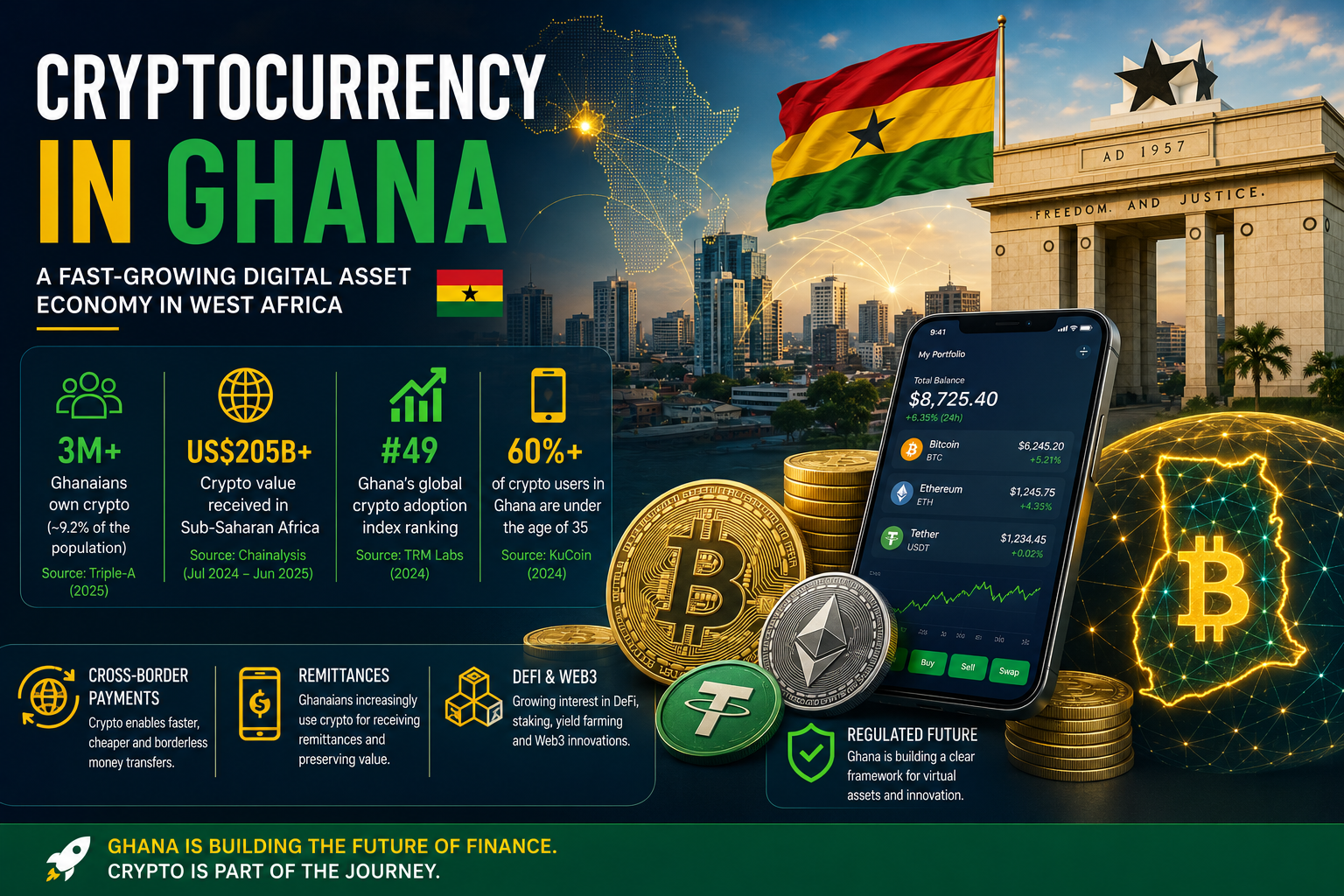
The Bank of Ghana's 2025 Financial Stability Review was published in August 2026, and reporting on the review said that more than three million Ghanaians were using cryptocurrencies. That is a significant number in a country with a population of just over 34 million.
Another major 2025 measurement places Ghana 49th globally on the TRM Labs Country Crypto Adoption Index, compared with 51st in the previous edition.
Ghana is also part of a much larger regional expansion. Chainalysis reported that Sub-Saharan Africa received more than US$205 billion in on-chain value between July 2024 and June 2025, a 52% year-on-year increase.
Within that regional market, Ghana was one of the five largest countries by estimated value received.
The numbers matter because they show that cryptocurrency in Ghana is not being driven by one single use case.
Some people buy Bitcoin as an investment.
Others hold stablecoins.
Some use digital assets to move value across borders.
Businesses and individuals can use crypto markets to access globally traded assets and alternative settlement rails.
At the same time, Ghana is moving from an environment with limited dedicated oversight toward a formal framework for virtual-asset businesses.
This article examines the Ghana crypto market itself: adoption, Bitcoin, stablecoins, DeFi, payments, cross-border use cases, risks and the infrastructure now forming around the industry.
How Big Is the Cryptocurrency Market in Ghana?
There is no single official number that measures the total value of Ghana's entire cryptocurrency market.
That distinction is important.
A user count measures something different from on-chain value.
An exchange's trading volume measures something different from long-term holdings.
A global adoption ranking is not the same thing as a market-size estimate.
The strongest recent picture therefore comes from combining several measurements.
More Than Three Million Crypto Users
The most significant recent Ghana-specific figure comes from the country's financial authorities.
Reporting on the 2025 Financial Stability Review said that more than three million Ghanaians were currently using cryptocurrencies.
That figure should not automatically be interpreted as three million active daily traders.
A person can use cryptocurrency occasionally, hold assets in a wallet, trade through a platform or use stablecoins for payments.
But the number still shows that digital assets have reached a meaningful share of the population.
It also helps explain why the Bank of Ghana, the Securities and Exchange Commission and other institutions have moved toward a dedicated framework for virtual assets.
Ghana Ranked 49th in TRM Labs' 2025 Adoption Index
TRM Labs ranked Ghana 49th globally in its 2025 Country Crypto Adoption Index, improving from 51st in the previous ranking.
TRM's index combines proprietary on-chain transaction data with web-traffic patterns and then adjusts for differences in economic conditions.
That means the ranking is not simply a list of countries with the largest dollar value of crypto transactions.
Larger economies can naturally generate more transaction volume.
The methodology attempts to measure adoption relative to economic conditions.
For Ghana, the movement from 51st to 49th suggests continued relevance in a global market that is becoming increasingly competitive.
Ghana Is One of Sub-Saharan Africa's Largest Crypto Markets
Chainalysis identified Nigeria, South Africa, Ethiopia, Kenya and Ghana as the region's five largest markets by value received during its July 2024 to June 2025 measurement period.
That places Ghana in an important group.
Nigeria dominates the region by a wide margin.
South Africa has a large and increasingly institutional crypto sector.
Kenya and Ethiopia have also become major markets.
Ghana's position among the top five shows that West Africa's crypto economy extends well beyond Nigeria.
Why Are Ghanaians Using Cryptocurrency?
Cryptocurrency adoption rarely has one simple explanation.
The reasons differ between users.
Investment and Long-Term Holdings
Bitcoin remains the best-known cryptocurrency in Ghana, as it is globally.
For some users, buying crypto is primarily an investment decision.
They may expect Bitcoin or other assets to rise over the long term.
Others use crypto as a high-risk speculative asset and trade shorter-term price movements.
These are different behaviours.
A person who buys Bitcoin and stores it for several years has very different needs from a person trading several times a day.
That is one reason a healthy crypto market eventually needs different types of infrastructure, including exchanges, wallets, custody, education and consumer protection.
Access to Dollar-Denominated Digital Assets
Stablecoins are another important part of the story.
A stablecoin is designed to maintain a relatively stable value by referencing another asset or currency.
Dollar-linked stablecoins are particularly important globally.
For users in emerging markets, they can provide access to digital dollar exposure without requiring a conventional US bank account.
That does not make them risk-free.
Users still face risks involving the issuer, reserves, platform, wallet security and regulation.
But stablecoins can be attractive where people want faster digital transfers or access to globally denominated value.
The importance of stablecoins is now recognised far beyond the crypto industry.
The International Monetary Fund has noted that stablecoins and other digital-payment innovations are increasingly relevant to financial systems in Sub-Saharan Africa.
Cross-Border Payments
Cross-border payments are one of the most interesting potential uses for cryptocurrency infrastructure in Ghana.
Ghana has a large diaspora and a significant remittance market.
It also trades internationally and increasingly participates in regional African commerce.
Traditional cross-border transfers can involve:
- Foreign-exchange conversion.
- Multiple intermediaries.
- Banking cut-off times.
- Compliance reviews.
- Settlement delays.
- Different fees at different stages.
Blockchain networks can move digital assets between wallets around the clock.
That does not mean every crypto transfer is automatically cheaper or legally suitable for every transaction.
The conversion between crypto and local currency still matters.
So do liquidity, regulation and compliance.
But stablecoins and other blockchain-based assets can create an additional settlement rail.
The IMF has specifically discussed the growing relevance of crypto assets and digital payment innovations across Sub-Saharan Africa, including Ghana.
Bitcoin in Ghana
Bitcoin is likely to remain the entry point through which many Ghanaians first encounter cryptocurrency.
It is the largest and most widely recognised crypto asset.
Why Bitcoin Attracts Users
Bitcoin has a fixed maximum supply built into its protocol.
That feature is often part of its appeal to people who view it as a scarce digital asset.
Users may buy it for:
- Long-term investment.
- Portfolio diversification.
- Speculation.
- Exposure to a globally traded asset.
- Participation in the wider crypto economy.
Bitcoin is volatile.
Its price can rise or fall sharply.
That means it should not be treated as equivalent to cash or a guaranteed savings product.
The difference between Bitcoin and stablecoins is particularly important.
Bitcoin is primarily a volatile crypto asset.
A dollar-linked stablecoin is designed to maintain a much more stable value against the dollar.
The two serve different purposes.
Stablecoins Could Become One of Ghana's Most Important Crypto Use Cases
If Bitcoin represents the investment side of crypto, stablecoins may become more important to the payments and settlement side.
Chainalysis' 2025 regional analysis found that stablecoins are frequently used in high-value transactions connected with trade flows between Africa, the Middle East and Asia.
The company observed regular multi-million-dollar stablecoin transfers supporting sectors including energy and merchant payments.
Ghana is not specifically identified as the source of every one of those flows.
The point is broader.
The infrastructure used by businesses across the region is evolving.
Stablecoins and International Settlement
A conventional international transfer can involve several banks.
A stablecoin transfer can potentially move between digital wallets directly on a blockchain network.
But the real-world transaction still has several layers.
The sender may need to convert fiat into a stablecoin.
The recipient may eventually want Ghanaian cedis.
A regulated provider may therefore be needed at one or both ends.
This is where crypto and fintech infrastructure increasingly overlap.
The blockchain can move the asset.
Payment providers, exchanges, banks and liquidity providers can connect that digital asset with the traditional financial system.
Stablecoins Are Not the Same as Bank Deposits
This distinction matters for users.
A stablecoin balance is not automatically the same as money held in a Ghanaian bank account.
The legal rights, consumer protections and risks can differ.
The Bank of Ghana's emerging virtual-asset framework explicitly includes stablecoin issuance among activities requiring regulatory attention.
That reflects how important stablecoins have become to the future structure of digital finance.
DeFi and Cryptocurrency in Ghana
Decentralised finance, usually called DeFi, is another part of the crypto ecosystem available to Ghanaian users.
DeFi applications can allow users to interact with blockchain-based financial services without using a conventional bank for every activity.
Examples include:
- Decentralised exchanges.
- Lending protocols.
- Borrowing protocols.
- Liquidity pools.
- Token swaps.
However, access to a protocol does not remove risk.
Smart contracts can contain vulnerabilities.
Users can lose access to private keys.
Prices can move rapidly.
Some DeFi products are complex and difficult for inexperienced users to understand.
The Chainalysis 2025 Global Crypto Adoption Index includes a DeFi component in its country-level methodology, showing that decentralised protocols remain part of the broader global adoption picture.
For Ghana, DeFi is likely to remain a more specialised segment than simple buying and holding of Bitcoin or stablecoins.
But it is part of the market that regulators and financial-service providers increasingly need to understand.
Ghana's Mobile-First Financial System Could Support Future Crypto Growth
Ghana already has significant digital-payment infrastructure.
That matters because cryptocurrency adoption does not happen in isolation.
A user needs a way to move money into and out of the crypto economy.
That connection between traditional finance and digital assets is called an on-ramp or off-ramp.
A Ghanaian customer may use:
- 1Ghanaian cedis.
- 2A bank account or digital payment channel.
- 3A regulated provider or exchange.
- 4A crypto wallet or trading account.
- 5Bitcoin, stablecoins or another digital asset.
The same process works in reverse when the customer sells crypto and returns to fiat currency.
The stronger a country's digital payments ecosystem becomes, the easier it can be for regulated providers to build customer experiences around these conversion points.
The Bank of Ghana's fintech publications now include its 2025 full-year sector report and a 2026 first-quarter report, illustrating how rapidly Ghana's wider fintech and payment ecosystem is developing.
Crypto infrastructure can eventually become another layer connected to that digital economy.
Cryptocurrency and Ghana's Remittance Market
Ghana receives billions of dollars in remittances from abroad.
That creates an obvious use case for faster digital settlement.
Traditional remittance providers remain extremely important.
Crypto has not replaced them.
But stablecoins and blockchain-based settlement networks are increasingly being explored as infrastructure that can operate behind the customer experience.
The customer does not necessarily need to see or hold a crypto asset.
A future payment service could potentially:
- Receive funds from a sender in another country.
- Convert value through a regulated liquidity network.
- Use a blockchain-based asset for settlement.
- Convert into Ghanaian cedis.
- Deliver the final amount through a bank or digital wallet.
That is very different from asking every remittance customer to become a crypto trader.
The technology can sit underneath the product.
This distinction is important for Ghana's future.
The largest crypto opportunity may not necessarily be millions of people speculating on tokens.
It could also involve blockchain technology becoming part of the infrastructure that moves money.
Ghana and Africa's Wider Crypto Growth
Ghana's market is developing inside a rapidly expanding African crypto environment.
Between July 2024 and June 2025, Chainalysis reported that Sub-Saharan Africa received more than US$205 billion in on-chain value, up approximately 52% year on year.
The region was the third-fastest-growing in the world by that measure.
Chainalysis also found that more than 8% of the value transferred in the region during the period came from transactions under US$10,000, compared with 6% for the rest of the world.
That suggests a meaningful role for retail users.
The regional market is not built entirely around large institutional transfers.
At the same time, large stablecoin transactions are also becoming more visible.
That creates two parallel trends.
One is grassroots adoption by individual users.
The other is growing interest in blockchain infrastructure for larger payments and business settlement.
Ghana can potentially participate in both.
Ghana's Emerging Crypto Infrastructure
The next phase of Ghana's market will depend heavily on infrastructure.
Exchanges and Trading Platforms
Exchanges provide one of the main gateways between Ghanaian cedis and crypto assets.
A reliable market needs access to liquidity.
It also needs secure custody arrangements, clear pricing and effective compliance controls.
The difference between holding crypto personally and holding it through a custodial provider is important.
With self-custody, the user controls the private keys.
With a custodial provider, the company generally controls the technical custody on the customer's behalf.
Each model has advantages and risks.
Wallets
A wallet is not necessarily a physical place where coins are stored.
In simple terms, crypto wallets manage the credentials used to control blockchain assets.
Wallets can be:
- Custodial.
- Non-custodial.
- Mobile-based.
- Hardware-based.
- Software-based.
The Bank of Ghana's virtual assets framework page specifically identifies both custodial and non-custodial virtual-asset wallet providers among entities expected to register or obtain licences under the framework.
That is a sign that Ghana's regulatory architecture is being designed around the full crypto ecosystem rather than exchanges alone.
Stablecoin Infrastructure
Stablecoins create a separate infrastructure challenge.
A user may be able to transfer a stablecoin globally within minutes, but the value is most useful locally if there is sufficient liquidity to convert it into the currency needed for everyday payments.
That requires:
- Liquidity providers.
- Trading venues.
- Payment partners.
- Banking relationships.
- Compliance systems.
- Reliable fiat on-ramps and off-ramps.
This is one area where fintech companies could play a major role.
Ghana Is Moving Toward a Formal Virtual-Asset Market
This article focuses on the crypto market rather than providing a full legal guide. But you can still read the full Crypto regulation in Ghana analyses.
But regulation is impossible to ignore because it will shape which companies can build infrastructure and how consumers are protected.
The Bank of Ghana's Virtual Assets portal states that the Bank of Ghana, the Securities and Exchange Commission and the Financial Intelligence Centre are introducing a legal framework to register and license Virtual Asset Service Providers.
The framework covers activities including:
- Wallet services.
- Trading platforms and exchanges.
- Virtual-asset investment advice.
- Virtual-asset issuance.
- Virtual-asset management.
- Stablecoin issuance.
- Asset tokenisation.
- Virtual-asset dealing.
- Lending and borrowing services.
The official page also indicates that licensing and registration information is being operationalised in stages.
For businesses, the practical lesson is simple.
Ghana's crypto market is becoming more formal.
A company should not assume that old operating practices will automatically remain acceptable under the new framework.
Why Regulation Could Change Ghana's Crypto Market
Clear rules can create costs for providers.
Licensing, compliance, cybersecurity and reporting requirements are expensive.
But a credible framework can also create opportunities.
Institutional investors, banks and major payment companies are often reluctant to build around a market with unclear legal responsibilities.
A formal framework can answer questions such as:
- Who supervises the provider?
- Which activities require a licence?
- What consumer disclosures are required?
- How should companies manage financial-crime risk?
- What happens to customer assets?
- Who is responsible when something goes wrong?
The goal is not simply to make crypto easier to access.
The more important goal is to make legitimate activity easier to distinguish from fraud and unsafe providers.
The Risks Facing Ghana's Crypto Market
A larger market also creates larger risks.
Price Volatility
Bitcoin and many other cryptocurrencies can experience large price movements.
An asset can gain or lose a substantial percentage of its value in a short period.
Users should understand that historical price growth does not guarantee future returns.
Fraud and Scams
Crypto markets are frequently targeted by fraudsters.
Common warning signs include:
- Guaranteed returns.
- Pressure to invest quickly.
- Requests for private keys or seed phrases.
- Fake trading platforms.
- Impersonation of legitimate companies.
- Investment schemes dependent on recruiting new participants.
Ghana's experience with crypto-related financial crime is not theoretical.
In June 2026, Chainalysis reported that Ghana's Economic and Organised Crime Office, working with international partners, identified, froze and seized approximately US$15.1 million linked to an alleged fraud operation that had laundered proceeds through cryptocurrency.
The case shows two things at once.
Crypto can be misused by criminals.
But blockchain analysis can also help investigators trace and recover digital assets.
Custody Risk
If a user loses access to a private key or seed phrase, recovery may be impossible.
If a custodial platform fails, customers can face a different set of risks.
Users should therefore understand where assets are held and who controls access.
Regulatory Change
Ghana's virtual-asset framework is still being operationalised.
That means licensing requirements, supervisory expectations and provider obligations can continue to develop.
Customers and businesses should use current official guidance rather than relying on outdated blog posts or social-media claims.
Key Cryptocurrency in Ghana Numbers
- More than 3 million — Ghanaians reported to be using cryptocurrencies in the 2025 Financial Stability Review discussion.
- 49th globally — Ghana's position in TRM Labs' 2025 Country Crypto Adoption Index.
- 51st globally — Ghana's position in the previous TRM ranking.
- More than US$205 billion — on-chain value received by Sub-Saharan Africa between July 2024 and June 2025.
- 52% — year-on-year growth in Sub-Saharan African on-chain value received during that period.
- Top five in Sub-Saharan Africa — Ghana's position among the region's largest markets by estimated value received in Chainalysis' 2025 regional analysis.
- More than 8% — share of regional value transferred in transactions under US$10,000, compared with 6% for the rest of the world.
- Approximately US$15.1 million — crypto-linked proceeds identified, frozen and seized in the 2026 Ghana-UK fraud investigation described by Chainalysis.
These figures measure different things.
They should not be added together to create a fictional “Ghana crypto market size”.
User estimates, adoption rankings, regional transaction values and law-enforcement seizures each answer different questions.
What the Future of Cryptocurrency in Ghana Could Look Like
The Ghana crypto market is likely to become more professional and more integrated with mainstream fintech.
The next phase may involve several developments happening at the same time.
More Regulated Providers
The Bank of Ghana's emerging framework will create a clearer path for companies operating virtual-asset services.
That could eventually make it easier for consumers to identify providers operating within formal rules.
Greater Stablecoin Use
Stablecoins may become increasingly important for cross-border settlement, digital-dollar access and crypto trading.
Their growth will depend on regulation, liquidity and trusted on- and off-ramps.
More Institutional Infrastructure
As rules become clearer, banks, fintech companies and payment businesses may have more confidence in building services connected to tokenised and blockchain-based infrastructure.
That does not mean every bank will become a crypto exchange.
The more likely development is that blockchain technology becomes another settlement and infrastructure layer in specific products.
Stronger Consumer Protection
A mature market needs more than adoption.
It needs better information.
Consumers need to understand volatility, custody and fraud risks before committing money.
Clear disclosure and provider accountability will become increasingly important as the industry grows.
The Bottom Line
Cryptocurrency in Ghana has moved beyond the early stage where the industry could be dismissed as a small community of traders.
More than three million users is a significant adoption figure.
Ghana ranked 49th globally in TRM Labs' latest adoption index.
Chainalysis places Ghana among Sub-Saharan Africa's five largest crypto markets by value received, inside a region that processed more than US$205 billion in on-chain value during the latest major measurement period.
The market is being shaped by several different forces.
Bitcoin remains important as a globally recognised investment asset.
Stablecoins are increasingly relevant to digital-dollar access and cross-border settlement.
DeFi provides access to a new set of blockchain-based financial services, although it brings significant complexity and risk.
Ghana's existing digital-payment ecosystem provides a foundation for future crypto infrastructure.
And the country's regulators are building a framework intended to bring virtual-asset businesses into a more formal system of licensing and supervision.
The most important story may therefore not be whether every Ghanaian starts trading crypto.
It may be whether digital assets become part of the financial infrastructure used to move, store and settle value.
If that happens, Ghana's crypto future will be about more than Bitcoin prices.
It will also be about payments, remittances, stablecoins, fintech, trade and Africa's growing digital financial economy.