Ethiopia Cryptocurrency Regulation: NBE Rules, Virtual Asset Ban and What Comes Next
Ethiopia takes a restrictive approach to cryptocurrency while reporting strong grassroots adoption. Explore the NBE's current rules, P2P restrictions, digital-asset policy and what could shape future regulation.

On this page
Ethiopia has taken a very different path from African countries that are building dedicated VASP licensing regimes.
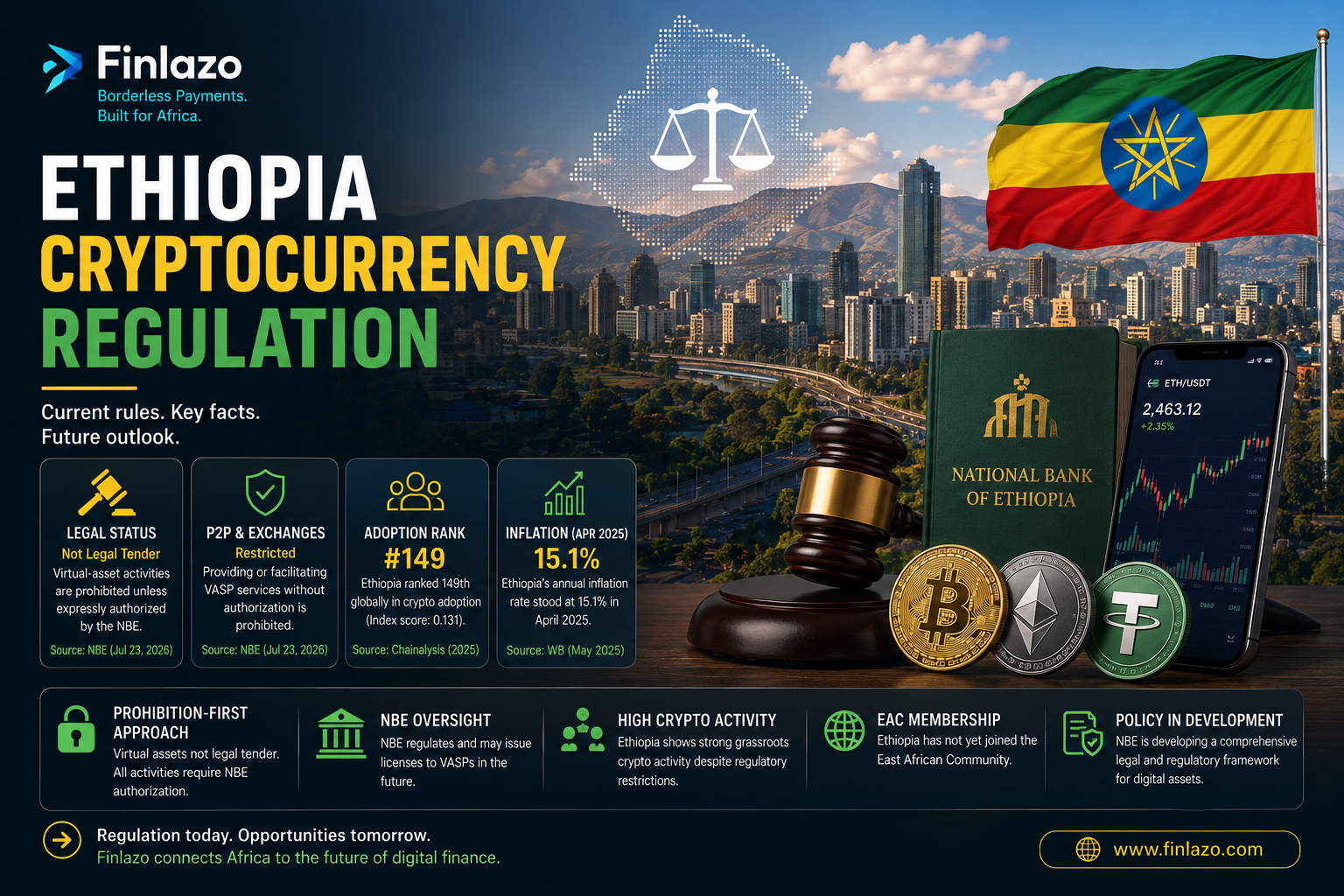
As of July 2026, the National Bank of Ethiopia (NBE) says virtual-asset activity remains prohibited unless the NBE has expressly authorised it.
The position is broad.
The NBE's 23 July 2026 Public Notice on Virtual Assets says the restriction covers the use, purchase, sale, exchange, transfer, trading, settlement and facilitation of transactions involving virtual assets.
The notice also covers exchange between virtual assets and fiat currencies, exchange between different virtual assets, transfers, safekeeping or administration, and financial services connected with the offer or sale of a virtual asset.
This is important because Ethiopia does not currently have a public, dedicated VASP licensing framework comparable to Mauritius or Seychelles.
The NBE has said it is working toward a comprehensive framework.
Until that framework is formally introduced, the prohibition remains.
The market exists despite the restriction. Chainalysis ranked Ethiopia 12th globally in its 2025 Global Crypto Adoption Index. That makes Ethiopia one of the highest-ranked countries in the world for grassroots crypto activity in that dataset.
That creates a striking regulatory contrast.
Ethiopia has strong measured crypto adoption while maintaining a prohibition-first regulatory position.
Ethiopia Cryptocurrency Regulation at a Glance
- 12th globally — Ethiopia's position in the 2025 Chainalysis Global Crypto Adoption Index.
- 16th — Ethiopia's retail centralized-service ranking in the same 2025 index.
- 19th — Ethiopia's overall centralized-service value received ranking.
- 7th — Ethiopia's DeFi value received ranking.
- 20th — Ethiopia's institutional centralized-service ranking.
- 139.5 million — mobile money accounts reported by the NBE at the end of 2025.
- 54 million — mobile banking accounts reported by the NBE at the end of 2025.
- 146% — annual transaction-volume CAGR reported under the first National Digital Payments Strategy.
- 161% — annual transaction-value CAGR reported under the first National Digital Payments Strategy.
- 12.2 million — no, this figure is not a crypto-regulation statistic and should not be used as one. It belongs to a different digital-finance dataset.
The crypto and digital-payment figures measure different things.
They should not be combined into a single estimate of Ethiopia's crypto-user population.
Is Cryptocurrency Legal in Ethiopia?
The current answer needs a qualification.
Virtual-asset activity is not freely permitted in Ethiopia.
The NBE's latest Public Notice on Virtual Assets states that the use, purchase, sale, exchange, transfer, trading, settlement and facilitation of virtual assets are prohibited unless expressly authorised by the NBE under the existing legal framework.
The NBE also says the restriction applies beyond cryptocurrencies.
It covers digital representations of value that can be traded, transferred, exchanged or used for payment, investment or similar purposes.
So the correct description is not simply that "crypto is illegal."
The more precise position is that virtual-asset activity is prohibited unless expressly authorised by the NBE.
What Changed in July 2026?
The July 2026 notice was significant because it clarified the scope of the restriction.
The NBE's 23 July 2026 notice identifies several activities that fall within the prohibition:
- Exchange between virtual assets and fiat currency.
- Exchange between different virtual assets.
- Transfer of virtual assets.
- Safekeeping or administration of virtual assets.
- Provision of financial services connected with an issuer's offer or sale of a virtual asset.
The wording is wider than a simple ban on buying Bitcoin.
It reaches the services and infrastructure around virtual assets as well.
Ethiopia's February 2026 P2P Warning
The July notice followed an earlier warning.
On 27 February 2026, the NBE specifically addressed Birr-paired peer-to-peer cryptocurrency transactions.
The bank said Birr-denominated P2P trading involving cryptocurrencies on exchanges and trading platforms was prohibited unless explicitly authorised.
That notice focused on a specific part of the market.
The July notice was broader.
It moved from a warning about Birr-paired P2P activity to a much wider prohibition covering virtual-asset activity generally.
What Does the NBE Regulate?
The National Bank of Ethiopia is the country's central financial regulator for the activities covered by its monetary, banking, foreign-exchange and payment-system mandates.
The National Bank of Ethiopia Proclamation No. 1359/2025 gives the NBE powers including licensing and supervision of financial institutions, foreign-exchange policy and financial-system oversight.
The 2025 proclamation also created a legal basis for a regulatory sandbox within the financial system.
That matters because the NBE has said it is working toward a more comprehensive framework for emerging digital-asset technologies.
Does Ethiopia Have a Dedicated VASP Licence?
Ethiopia does not currently publish a dedicated VASP licensing regime comparable to the systems in Mauritius, Seychelles or Rwanda.
The NBE instead maintains a prohibition-first position.
In its February 2026 notice, the bank said it was actively working toward a comprehensive regulatory framework through consultations with international peer regulators and domestic stakeholders.
The same notice said the prohibition would remain until that framework was formally introduced.
No current NBE publication reviewed for this article sets out a general application process for licensing retail crypto exchanges or VASPs.
That distinction is important.
A registration, business licence or technology approval from another public institution should not automatically be treated as NBE authorisation for virtual-asset activity.
What About the Ethiopian Capital Market Authority?
The Ethiopian Capital Market Authority (ECMA) is relevant where a digital asset falls within the capital-market framework.
The Capital Market Service Providers Licensing and Supervision Directive No. 980/2024 defines digital assets as anything in digital form with value, ownership and usage rights.
The directive also states that digital assets are regarded as securities in line with the Capital Market Proclamation in the circumstances covered by the framework.
That creates a second regulatory perimeter.
A token that has securities characteristics may raise ECMA questions.
Virtual-asset activity can also raise NBE questions.
The two should not be treated as interchangeable.
Can ECMA Authorisation Replace NBE Authorisation?
No blanket substitution should be assumed.
The NBE's July 2026 notice uses an "expressly authorised by the NBE" test for the prohibited virtual-asset activities.
At the same time, ECMA's capital-market rules can apply to digital assets that fall within the securities framework.
A business therefore needs to identify the actual product and the actual activity.
An approval from one regulator does not automatically remove another regulator's requirements.
Why Does Ethiopia Take a Restrictive Position?
The NBE points to several risks.
Its February 2026 notice highlighted volatility, foreign-exchange price manipulation, fraud, scams and operational risks.
It also pointed to the lack of safeguards commonly associated with regulated financial systems, including AML/CFT protections.
The July 2026 notice again warned about legal, fraud, cyber-related, operational, market-manipulation and financial-loss risks.
The bank's broader policy concern is financial-system integrity.
Foreign-exchange controls also matter.
The National Bank of Ethiopia Proclamation No. 1359/2025 gives the NBE responsibility for formulating and implementing foreign-exchange policy.
That is relevant because crypto transactions can create links between local currency, foreign currency and offshore platforms.
Ethiopia's Crypto Adoption Makes the Regulation More Interesting
The regulatory stance becomes more interesting when viewed alongside adoption data.
Chainalysis ranked Ethiopia 12th globally in its 2025 Global Crypto Adoption Index.
Ethiopia ranked 16th for retail centralized-service value received.
It ranked 7th for DeFi value received.
These are not population surveys.
Chainalysis calculates the index from estimated transaction activity across different services and adjusts rankings using population and purchasing-power characteristics.
Still, the ranking shows that Ethiopia is not a market where crypto use can simply be dismissed as negligible.
Digital Payments Are Growing Rapidly Too
Ethiopia has also expanded its formal digital-payment infrastructure.
The NBE says mobile money accounts grew to 139.5 million by 2025.
Mobile banking accounts reached 54 million.
The NBE also reports annual transaction-volume growth of 146% and transaction-value growth of 161% under its first National Digital Payments Strategy.
These figures do not measure crypto.
They show the pace at which Ethiopia's broader digital financial system is expanding.
That creates an interesting contrast.
The country is opening more of the formal digital-finance economy while maintaining tight restrictions on virtual assets.
The Digital Payments Strategy and Virtual Assets
Ethiopia's National Digital Payments Strategy 2026–2030 includes a specific future workstream on virtual assets and CBDC.
The draft strategy identifies the need for a study and mapping of virtual assets and current use cases in Ethiopia.
It also sets a target of developing a regulatory framework for specific cryptocurrency applications if deemed necessary.
This is not a VASP licensing announcement.
It is a policy-development objective.
That distinction matters.
The strategy shows that Ethiopia is studying digital assets even while current transactions remain restricted.
Is Ethiopia Planning to Allow Crypto?
The NBE has not announced a general legalisation date.
Its February 2026 notice said it was working toward a comprehensive regulatory framework.
The 2026–2030 Digital Payments Strategy also contains future work around virtual assets and CBDC.
But neither document provides a public date for a broad retail crypto licensing regime.
Anyone giving a specific launch date without an official NBE announcement is going beyond the available evidence.
What Does the Regulatory Sandbox Mean?
Ethiopia has a broader financial regulatory sandbox framework.
The Banking Business Proclamation No. 1360/2025 provides for a regulatory sandbox for innovative banking services.
The NBE had already said in 2024 that the proposed banking reforms would create a framework for testing new and innovative financial services.
A sandbox is not the same thing as a general crypto licence.
It allows controlled testing under regulatory oversight.
A crypto business should not assume that simply entering a sandbox would automatically authorise every virtual-asset activity.
Foreign Crypto Exchanges and Ethiopia
The current NBE position creates a difficult environment for international crypto exchanges.
The July 2026 notice says exchange between virtual assets and fiat, exchange between virtual assets, transfers and safekeeping are prohibited unless expressly authorised by the NBE.
That can affect the basic functions of an exchange.
The February 2026 notice had already specifically targeted Birr-paired P2P activity.
International platforms therefore need to assess Ethiopia separately from markets where crypto exchange activity is licensed.
A global exchange licence from another country does not automatically amount to NBE authorisation.
Crypto Custody Is Also Covered
The NBE's July 2026 notice explicitly includes safekeeping and administration of virtual assets.
That matters for custodians and wallet businesses.
Custody is not outside the restriction simply because the business does not facilitate trading.
The same issue applies to instruments that enable control over virtual assets.
For a financial institution considering a wallet or custody service, the regulatory analysis therefore starts with the NBE notice.
What About Stablecoins?
Stablecoins are also relevant.
A stablecoin is still a virtual asset if it falls within the NBE's definition.
The July 2026 notice does not create a special exemption for assets whose value is linked to a fiat currency.
A stablecoin exchange, transfer or custody service can therefore fall within the prohibited activities unless expressly authorised.
The country's policy direction is still developing.
The 2026–2030 Digital Payments Strategy places virtual assets and CBDC within its future research agenda.
That is a sign of study, not a permission to operate.
AML and Financial Crime Considerations
AML/CFT remains a core part of the regulatory discussion.
The NBE's February 2026 notice specifically cited the absence of safeguards such as AML/CFT protections as one of the risks associated with unregulated virtual-asset activity.
The ECMA published AML/CFT guidance in November 2025 for market intermediaries and capital-market service providers.
The NBE also continues to issue and supervise financial-sector rules dealing with financial integrity and risk management.
A business involving virtual assets should therefore assess AML/CFT requirements alongside the core authorisation question.
Ethiopia's Foreign-Exchange Rules Matter Too
Crypto regulation in Ethiopia cannot be separated completely from foreign-exchange regulation.
The NBE controls the country's foreign-exchange policy.
The 2026 amendments to the Foreign Exchange Directive show that the NBE continues to update the foreign-exchange framework.
A virtual-asset transaction that involves conversion between Birr and foreign-denominated value can raise separate foreign-exchange questions.
Using a virtual asset as an intermediary does not automatically create a legal route around foreign-exchange rules.
What Does This Mean for Ethiopian Startups?
The first step is not choosing a crypto licence.
There is no general public VASP licensing path to choose from today.
A startup should instead define the product.
Will it provide payments?
Will it operate a wallet?
Will it facilitate exchange?
Will it issue a token?
Will the token have securities characteristics?
Will the product touch foreign exchange?
Each answer can create a different regulatory question.
For founders comparing African jurisdictions, Mauritius cryptocurrency regulation and Seychelles cryptocurrency regulation show what a dedicated VASP licensing framework looks like.
Ethiopia is currently taking a different route.
A Personal Research Interest in Ethiopia
I first became interested in Ethiopia while researching regulatory affairs for my thesis on the East Africa Court of Justice.
One question kept coming back to me.
Why had Ethiopia not joined the East African Community?
That question pushed me to look more closely at Ethiopia's wider regulatory environment.
I became especially interested in areas where Ethiopia's rules differ sharply from those of its regional neighbours.
Cryptocurrency was one of them.
The more I researched it, the clearer the distinction became.
Ethiopia has a large and active digital economy.
It also has significant measured crypto activity.
Yet the current regulatory position remains restrictive.
That contrast is what brought me back to Ethiopia's crypto rules.
Today, the regulatory picture is much clearer.
What Should Businesses Watch Next?
The most important issue is the NBE's promised comprehensive framework.
The February 2026 notice said the bank was consulting international peer regulators and domestic stakeholders.
The July notice clarified the current restriction.
The 2026–2030 Digital Payments Strategy points toward further study of virtual assets and CBDC.
Businesses should therefore monitor:
- New NBE virtual-asset rules.
- Any consultation papers or draft directives.
- Sandbox announcements.
- Foreign-exchange amendments.
- ECMA rules affecting digital assets or securities.
- AML/CFT developments.
- Any public list of expressly authorised virtual-asset activities.
Until the NBE changes its position, companies should not treat future regulatory work as current authorisation.
Ethiopia Cryptocurrency Regulation: Key Numbers and Dates
- 23 July 2026 — NBE public notice broadly reiterating the prohibition on virtual-asset activity unless expressly authorised.
- 27 February 2026 — NBE notice specifically addressing Birr-paired P2P cryptocurrency transactions.
- 12th globally — Ethiopia's 2025 Chainalysis Global Crypto Adoption Index position.
- 139.5 million — mobile money accounts reported by NBE at the end of 2025.
- 54 million — mobile banking accounts reported by NBE at the end of 2025.
- 146% — annual transaction-volume CAGR under Ethiopia's first National Digital Payments Strategy.
- 161% — annual transaction-value CAGR under the first National Digital Payments Strategy.
- 2025 — year of National Bank of Ethiopia Proclamation No. 1359/2025.
- 2025 — year of Banking Business Proclamation No. 1360/2025.
- 2026–2030 — period covered by the NBE's Digital Payments Strategy 2.0.
- 48 months — timeframe listed for the virtual-assets and CBDC study within the draft strategy.
Frequently Asked Questions
Is cryptocurrency legal in Ethiopia?
Virtual-asset activity is not freely permitted. The NBE's July 2026 notice says the use, purchase, sale, exchange, transfer, trading, settlement and facilitation of virtual assets are prohibited unless expressly authorised by the NBE.
Does Ethiopia have a VASP licence?
Ethiopia does not currently publish a general VASP licensing regime comparable to Mauritius or Seychelles. The NBE has said it is working toward a comprehensive framework for virtual assets.
Can I trade Bitcoin using Ethiopian Birr?
The NBE specifically prohibited Birr-paired P2P cryptocurrency transactions in its February 2026 notice unless expressly authorised. Its July 2026 notice then broadened the restriction to virtual-asset activity generally unless expressly authorised.
Does Ethiopia regulate stablecoins?
Stablecoins can fall within the NBE's broad virtual-asset restriction. The July 2026 notice does not create a general exemption for stablecoins.
Is Ethiopia planning to regulate cryptocurrency?
The NBE says it is working toward a comprehensive regulatory framework. The 2026–2030 Digital Payments Strategy also includes future work on virtual assets and CBDC, but no general crypto-licensing launch date has been announced.
The Bottom Line
Ethiopia has one of the most interesting crypto-regulation stories in Africa.
Its measured adoption is high.
Chainalysis ranked Ethiopia 12th globally in its 2025 adoption index.
Yet the regulatory position remains restrictive.
The NBE's July 2026 notice prohibits a broad range of virtual-asset activity unless the bank has expressly authorised it.
That includes exchange, transfer, trading, settlement and custody-related activity.
The position is not simply a ban with no policy work behind it.
The NBE says it is developing a comprehensive framework.
Its Digital Payments Strategy also includes future work on virtual assets and CBDC.
For now, however, future regulatory development should not be confused with current authorisation.
Ethiopian businesses and international platforms need to work from the rules that exist today.
That makes Ethiopia very different from jurisdictions such as Mauritius and Seychelles, which have moved into dedicated VASP licensing.
The next major development will be the NBE's comprehensive framework.
Until then, the safest conclusion is also the simplest.
Ethiopia is studying the future of digital assets while maintaining strict restrictions on their present use.