Ethiopia Cryptocurrency: Adoption, P2P Trading, Bitcoin Mining and the Digital-Asset Market
Ethiopia has a surprisingly active crypto market despite its restrictive environment. Explore adoption, P2P trading, Bitcoin mining, stablecoins and the digital infrastructure shaping the country's crypto ecosystem.

On this page
Ethiopia has one of Africa's most interesting cryptocurrency stories.
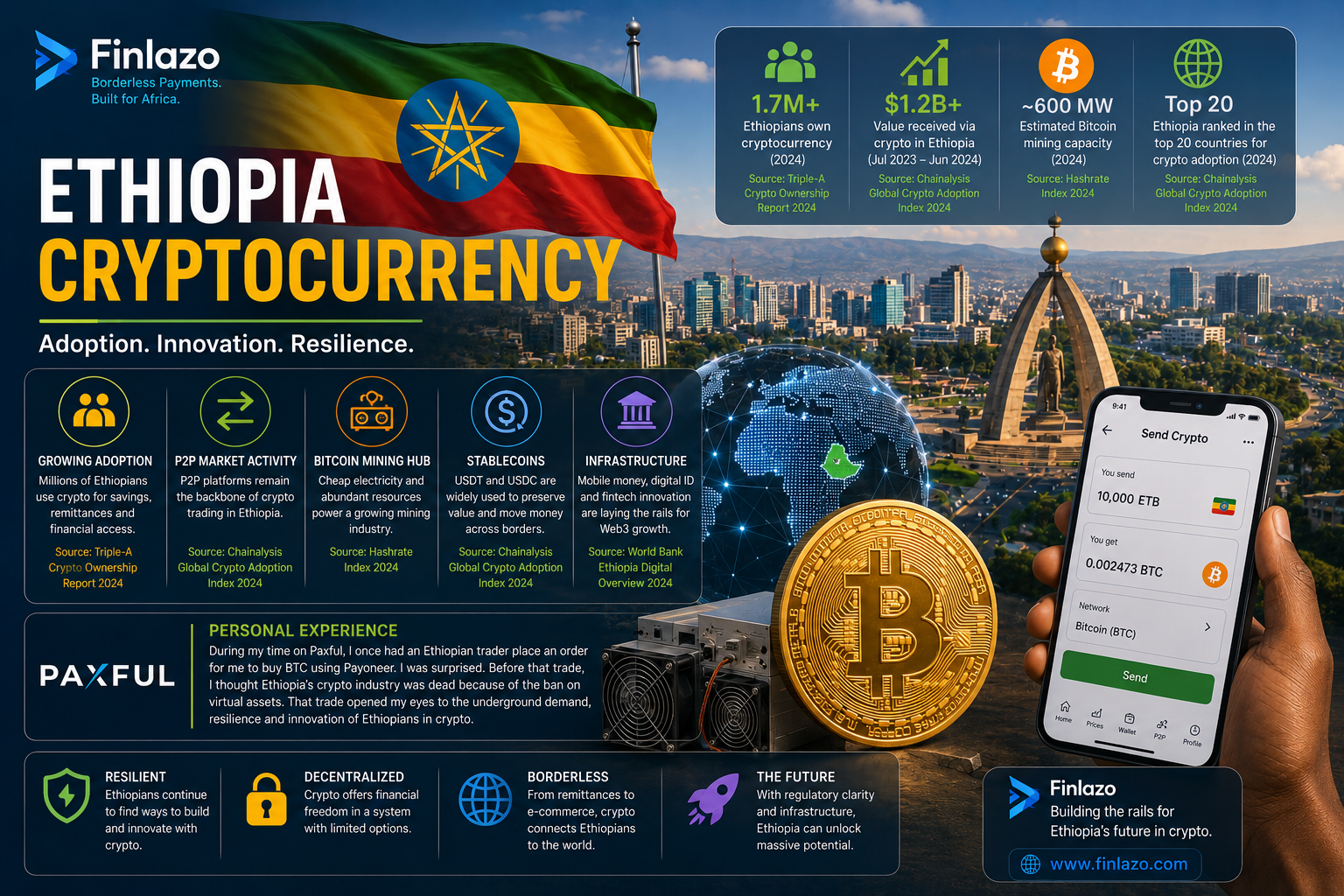
The latest Chainalysis Global Crypto Adoption Index ranked Ethiopia 12th globally.
It placed the country 16th for retail centralized-service activity, 19th for overall centralized-service value received, 7th for DeFi value received and 20th for institutional centralized-service activity.
Those rankings are striking.
They show that Ethiopia has meaningful cryptocurrency activity even though the country's regulatory environment remains restrictive.
The market is also larger than trading alone.
Bitcoin mining has become another important part of Ethiopia's digital-asset story. A 2025 Cambridge Digital Mining Industry Report estimated Ethiopia at 0.1% of surveyed global Bitcoin mining activity, while company disclosures in 2025 showed major mining infrastructure operating in the country.
There is also a strong digital-finance base beneath the crypto market. The National Bank of Ethiopia says mobile money accounts reached 139.5 million in 2025, while mobile banking accounts reached 54 million.
The story is therefore bigger than Bitcoin prices.
It is about P2P markets, stablecoins, mining, digital payments and a population increasingly comfortable with digital financial services.
Ethiopia Cryptocurrency at a Glance
- 12th globally — Ethiopia's position in the latest published Chainalysis Global Crypto Adoption Index for 2025.
- 16th — Ethiopia's retail centralized-service value received ranking.
- 19th — Ethiopia's centralized-service value received ranking.
- 7th — Ethiopia's DeFi value received ranking.
- 20th — Ethiopia's institutional centralized-service ranking.
- 0.1% — Ethiopia's share of surveyed global Bitcoin mining activity in the 2025 Cambridge study.
- 139.5 million — mobile money accounts reported by the NBE in 2025.
- 54 million — mobile banking accounts reported by the NBE in 2025.
- 128.5 million — mobile money accounts reported by the NBE at the end of 2024.
- 9.7 trillion birr — digital transaction value recorded in fiscal 2023/24.
- 3.5 million+ — annual transactions processed by EATS.
- Birr 5 trillion+ — annual value processed by EATS.
These figures measure different parts of Ethiopia's digital economy.
They should not be treated as a count of cryptocurrency users.
How Big Is Cryptocurrency in Ethiopia?
There is no single official figure for the number of Ethiopians who own or use cryptocurrency.
That matters.
A country can rank highly in an adoption index without publishing a national household survey of crypto ownership.
The latest Chainalysis Global Crypto Adoption Index ranked Ethiopia 12th globally.
The same index ranked Ethiopia 16th for retail centralized-service activity.
That is useful because the retail sub-index focuses on activity from smaller transactions. Chainalysis defines retail-sized centralized-service transactions as those below $10,000 worth of cryptocurrency.
The index is not a headcount.
It estimates activity using on-chain transaction data and web-traffic patterns, then adjusts the rankings for population characteristics and purchasing power.
That makes it a strong indicator of grassroots activity, but not a substitute for a national user survey.
Ethiopia's Position in Africa's Crypto Market
Ethiopia sits among Sub-Saharan Africa's more important cryptocurrency markets.
The 2025 Chainalysis regional analysis identified Ethiopia among the region's five largest markets by cryptocurrency transaction value between July 2024 and June 2025.
The region as a whole received more than US$205 billion in on-chain value during that period, representing about 52% year-over-year growth.
Ethiopia's presence in that group matters.
It means the country's crypto activity is not simply a tiny local curiosity.
It is part of a much larger African market.
For a broader look at the continent, see the rise of cryptocurrency in Africa.
A Personal P2P Experience With an Ethiopian Trader
I had a very different impression of Ethiopia before this happened.
I was on Paxful trading crypto when I received a trade request from someone in Ethiopia who wanted to buy Bitcoin using Payoneer.
I was surprised.
At the time, I had assumed Ethiopia's crypto industry was practically dead because of the country's restrictions on virtual assets.
Then I saw the trade.
There was an Ethiopian user actively looking to buy Bitcoin through a P2P marketplace.
That moment changed my perception.
A formal ban does not necessarily mean that demand disappears.
It can simply push activity toward less visible channels.
My experience was one transaction.
It was not a statistical study.
The broader data now show that Ethiopia has significant measured crypto activity despite the restrictive policy environment.
Why P2P Trading Matters in Ethiopia
P2P trading can be important in markets where conventional exchange access is limited.
The buyer and seller can agree on a payment method.
The platform provides the marketplace.
The cryptocurrency changes hands after the payment conditions are satisfied.
That structure can be useful for users who do not have access to the same international banking or card infrastructure as users in larger financial centres.
Ethiopia's P2P market has to be viewed against its current legal position.
The National Bank of Ethiopia's February 2026 notice specifically states that Birr-paired P2P cryptocurrency transactions through trading platforms are not permitted unless explicitly authorised.
For the wider legal position, see Ethiopia cryptocurrency regulation.
That makes the existence of P2P demand particularly notable.
Users can seek crypto even when the formal market is constrained.
Bitcoin Is Still a Major Entry Point
Bitcoin remains one of the main ways users enter the cryptocurrency economy.
The Chainalysis 2025 research found that Bitcoin accounted for more than $1.2 trillion in global fiat inflows on centralized exchanges between July 2024 and June 2025.
That is a global statistic.
It is not an Ethiopia-specific figure.
It does, however, help explain why Bitcoin continues to be central to P2P marketplaces.
A person looking for digital assets often starts with Bitcoin because it is widely supported and highly liquid.
Stablecoins Matter Too
The Ethiopian crypto story is not only about Bitcoin.
Stablecoins are increasingly important in African markets.
The IMF's 2025 analysis of stablecoins found that USDT and USDC together represented about 90% of the global stablecoin market.
The IMF also reported that USDT and USDC trading volume reached $23 trillion in 2024.
Those are global figures.
They matter to Ethiopia because stablecoins can serve functions that are different from Bitcoin.
A stablecoin can provide a digital representation of dollar-denominated value.
It can also act as a trading or settlement asset.
That makes stablecoins relevant in markets where access to foreign currency can be important.
Ethiopia's Crypto Market and the Dollar
The appeal of dollar-linked digital assets should not be overstated.
A stablecoin is not the same thing as a U.S. bank account.
It also does not automatically create a legal route around Ethiopia's foreign-exchange framework.
The National Bank of Ethiopia has been reforming the foreign-exchange market since July 2024.
That means crypto users and businesses operate in a market where the relationship between the birr, foreign currencies and digital assets can be highly relevant.
The combination creates an interesting demand environment.
Users may want digital access to dollar-linked value.
At the same time, regulators remain focused on foreign-exchange controls and financial-system integrity.
Bitcoin Mining Adds Another Layer
Ethiopia has also become an important Bitcoin-mining location.
The country's electricity resources have attracted industrial miners.
The Cambridge Digital Mining Industry Report 2025 estimated Ethiopia at 0.1% of surveyed global Bitcoin mining activity.
The percentage was based on survey data from mining companies, so it should be interpreted carefully.
Cambridge itself warns that country-level percentages are subject to uncertainty because the survey represents part of the global mining industry.
Still, the report identified Ethiopia as an emerging mining location.
Industrial Bitcoin Mining in Ethiopia
Corporate disclosures provide another view.
In April 2025, Canaan reported that two of its active mining projects were in Ethiopia.
Its filing showed 3.97 EH/s of energized computing power in Ethiopia, with 4.22 EH/s of installed computing power.
A later July 2025 disclosure reported 3.55 EH/s energized and 4.22 EH/s installed across two Ethiopian projects.
These are company-specific figures.
They do not represent Ethiopia's entire Bitcoin-mining industry.
They show that industrial-scale mining infrastructure was operating in the country.
Why Ethiopia Attracts Bitcoin Miners
Electricity is a central factor.
Ethiopia has invested heavily in hydropower.
That gives mining operators access to energy at costs that can be competitive by global standards.
But cheap electricity is not enough.
Mining businesses also need reliable connectivity, equipment logistics, regulatory certainty and operational infrastructure.
Ethiopia therefore presents both an opportunity and a challenge.
The country can offer attractive energy economics.
The operating environment remains more complex.
Crypto Mining Is Different From Crypto Trading
This distinction is easy to miss.
A mining company can operate physical computing infrastructure in Ethiopia.
A retail user can trade Bitcoin through an online platform.
These are different activities.
The existence of mining infrastructure does not tell us how many Ethiopian consumers own cryptocurrency.
Likewise, a high adoption ranking does not tell us how much Bitcoin is mined inside the country.
Good analysis keeps the two markets separate.
Ethiopia's Digital-Finance Infrastructure Is Expanding
The broader digital economy is moving quickly.
The NBE reported that mobile money accounts rose from under 1 million in 2020 to more than 128.5 million by December 2024.
The NBE's newer Digital Payments Strategy reports 139.5 million mobile money accounts in 2025.
Mobile banking accounts reached 54 million in 2025.
These figures show enormous expansion in digital access.
They do not prove cryptocurrency adoption.
They show the environment in which digital assets can develop.
Digital Payments and Cryptocurrency Are Different
It is tempting to assume that a country with 139.5 million mobile money accounts must also have massive crypto adoption.
That conclusion would be wrong.
The NBE figures measure mobile-money accounts.
The Chainalysis index measures estimated crypto activity.
They are different datasets.
The useful connection is behavioural.
A population increasingly familiar with mobile wallets and digital transfers may find digital assets less foreign than they once were.
That is an inference, not a direct measurement.
Ethiopia's National Digital Payments Strategy and Crypto
Ethiopia's next digital-payments strategy makes the crypto question even more interesting.
The NBE's National Digital Payments Strategy 2026–2030 includes a dedicated action to study virtual assets such as cryptocurrencies, stablecoins and CBDCs.
The strategy calls for mapping current use cases in Ethiopia.
It also proposes identifying locally viable applications and, if necessary, developing regulatory frameworks and pilot programmes.
That is not current permission to operate a crypto business.
It is a policy-research direction.
But it shows that virtual assets are now part of Ethiopia's formal digital-finance policy conversation.
What Could Ethiopia's Future Crypto Market Look Like?
The answer may depend on how the government balances innovation with monetary and financial stability.
The market already has three visible layers.
Retail users participate in crypto markets.
Industrial operators mine Bitcoin.
Policymakers are studying virtual assets and CBDCs.
A future framework could connect some of those pieces.
It could also restrict some of them.
The direction will depend on the NBE's policy choices.
Risks for Ethiopian Crypto Users
Crypto users face several risks.
The NBE's February 2026 notice warned about volatility, foreign-exchange manipulation, fraud, scams and operational risks.
It also highlighted the absence of safeguards such as AML/CFT protections in unregulated activity.
These are not theoretical concerns.
P2P markets can expose users to payment disputes.
Online platforms can also create counterparty risk.
A user can lose access to funds through fraud, compromised credentials or a failed transaction.
What Makes Ethiopia Different From Other African Crypto Markets?
Ethiopia's combination is unusual.
It has high measured grassroots adoption.
It has industrial Bitcoin mining.
It has rapidly expanding mobile and digital payments.
Yet the formal regulatory position remains restrictive.
That is different from countries that have moved directly into VASP licensing.
For comparison, see Mauritius cryptocurrency regulation.
Seychelles provides another model through its dedicated VASP framework. See Seychelles cryptocurrency regulation.
Ethiopia is still deciding what its formal crypto market should look like.
What Should Businesses Watch?
Businesses interested in Ethiopia should watch several developments.
A Future Virtual-Asset Framework
The NBE's digital-payments strategy calls for research into virtual assets.
That research could eventually inform formal policy.
Foreign-Exchange Rules
Crypto activity can intersect with foreign-currency markets.
Changes to foreign-exchange rules could therefore influence future business models.
P2P Enforcement
The NBE has already issued specific warnings about Birr-paired P2P trading.
Future enforcement could determine how much informal market activity remains accessible.
Bitcoin Mining Policy
Mining has created a separate crypto industry inside Ethiopia.
Its future will depend on electricity policy, infrastructure and regulatory treatment.
Stablecoin Use
Stablecoins may become more important if future policy allows regulated use cases around payments, savings or settlement.
For now, businesses should not assume that future policy research is the same as current authorisation.
Ethiopia Cryptocurrency Statistics
- 12th globally — Ethiopia's overall position in the 2025 Chainalysis Global Crypto Adoption Index.
- 16th — retail centralized-service ranking.
- 19th — centralized-service ranking.
- 7th — DeFi value received ranking.
- 20th — institutional centralized-service ranking.
- 0.1% — Ethiopia's surveyed share of global Bitcoin mining activity in the Cambridge 2025 study.
- 3.97 EH/s — energized computing power in Ethiopia reported by Canaan in April 2025.
- 4.22 EH/s — installed computing power in Ethiopia reported by Canaan in April 2025.
- 3.55 EH/s — energized computing power in Ethiopia reported by Canaan in July 2025.
- 139.5 million — mobile money accounts reported by the NBE in 2025.
- 54 million — mobile banking accounts reported by the NBE in 2025.
- 9.7 trillion birr — digital transaction value recorded in fiscal 2023/24.
- 128.5 million — mobile money accounts reported at the end of 2024.
- US$205 billion+ — on-chain cryptocurrency value received by Sub-Saharan Africa between July 2024 and June 2025.
- 52% — year-over-year growth in Sub-Saharan Africa's on-chain crypto activity during that period.
Frequently Asked Questions
Is cryptocurrency popular in Ethiopia?
Ethiopia has significant measured cryptocurrency activity. The latest Chainalysis Global Crypto Adoption Index ranked Ethiopia 12th globally and 16th for retail centralized-service activity.
How many people in Ethiopia own cryptocurrency?
There is no authoritative current national figure for the total number of Ethiopian cryptocurrency users. Adoption rankings such as Chainalysis measure estimated activity rather than household ownership.
Do Ethiopians use peer-to-peer crypto trading?
Yes. P2P activity has been accessible through trading platforms, although the NBE's February 2026 notice states that Birr-paired P2P cryptocurrency transactions are not permitted unless explicitly authorised.
Is Bitcoin mining popular in Ethiopia?
Ethiopia has developed a significant industrial Bitcoin-mining presence. Cambridge's 2025 mining study estimated Ethiopia at 0.1% of surveyed global mining activity, while Canaan reported multiple active mining projects in the country.
Are stablecoins used in Ethiopia?
Stablecoins are part of the wider African crypto market, and Ethiopia's digital-payments strategy specifically calls for research into stablecoins, cryptocurrencies and CBDCs. Current use and legal availability should be assessed against the NBE's existing rules.
Can Ethiopians legally buy Bitcoin?
The NBE currently maintains restrictions on virtual-asset activity. Its February 2026 notice specifically prohibits Birr-paired P2P cryptocurrency transactions unless explicitly authorised. See Ethiopia cryptocurrency regulation for the detailed legal position.
Why is Ethiopia important to the African crypto market?
Ethiopia ranks highly in global crypto adoption measures and is also a growing Bitcoin-mining location. It is therefore important both as a market for digital-asset activity and as a source of industrial mining infrastructure.
What is Ethiopia doing about cryptocurrency regulation?
The NBE is developing its understanding of virtual assets through its digital-payments strategy. The strategy calls for research into current use cases and the possible development of future regulatory frameworks or pilot programmes.
The Bottom Line
Ethiopia's cryptocurrency story is difficult to reduce to a simple label.
The country has a restrictive regulatory environment.
Yet cryptocurrency activity remains significant.
Chainalysis ranked Ethiopia 12th globally in its latest published adoption index.
The country also ranks among Sub-Saharan Africa's larger crypto markets.
Bitcoin mining adds another dimension.
Cambridge identified Ethiopia as an emerging mining location, while company disclosures show industrial-scale projects operating there.
The domestic digital-finance system is expanding too.
The NBE reported 139.5 million mobile money accounts and 54 million mobile banking accounts in 2025.
Those numbers do not prove crypto adoption.
They show that Ethiopia is rapidly becoming more digital.
My own experience on Paxful gave me an early glimpse of the gap between regulation and actual demand.
I was surprised to receive a Bitcoin trade from an Ethiopian user paying through Payoneer because I had assumed the restrictions meant the country's crypto industry was effectively dead.
It was not.
Today, the data make that much clearer.
Ethiopia has users.
It has traders.
It has miners.
And it has policymakers actively studying what role virtual assets might eventually play in the financial system.
The next chapter will depend on regulation.
It will also depend on whether Ethiopia can turn digital adoption into a financial system that is innovative, secure and trusted.