EFT vs PayShap vs RTC vs Crypto: Comparing Ways to Move Rand in South Africa 2026
Compare EFT, PayShap and crypto transfers in South Africa. Learn what each method moves, how fast they are, the costs, limits and when each option makes the most sense.

On this page
Moving rand in South Africa is no longer just a choice between a standard bank transfer and waiting for it to arrive.
You can use a batch-based EFT, Real-Time Clearing for urgent bank transfers, PayShap for eligible real-time payments, or convert rand into a digital asset and transfer that instead.
These options do not all do the same thing.
EFT, RTC and PayShap move rand through South Africa's payment infrastructure. Crypto starts differently. Your rand is exchanged for an asset such as Bitcoin, USDC or USDT, and that asset is then transferred across a blockchain.
The best option depends on how much you are sending, how quickly it needs to arrive and what the recipient actually needs to receive.
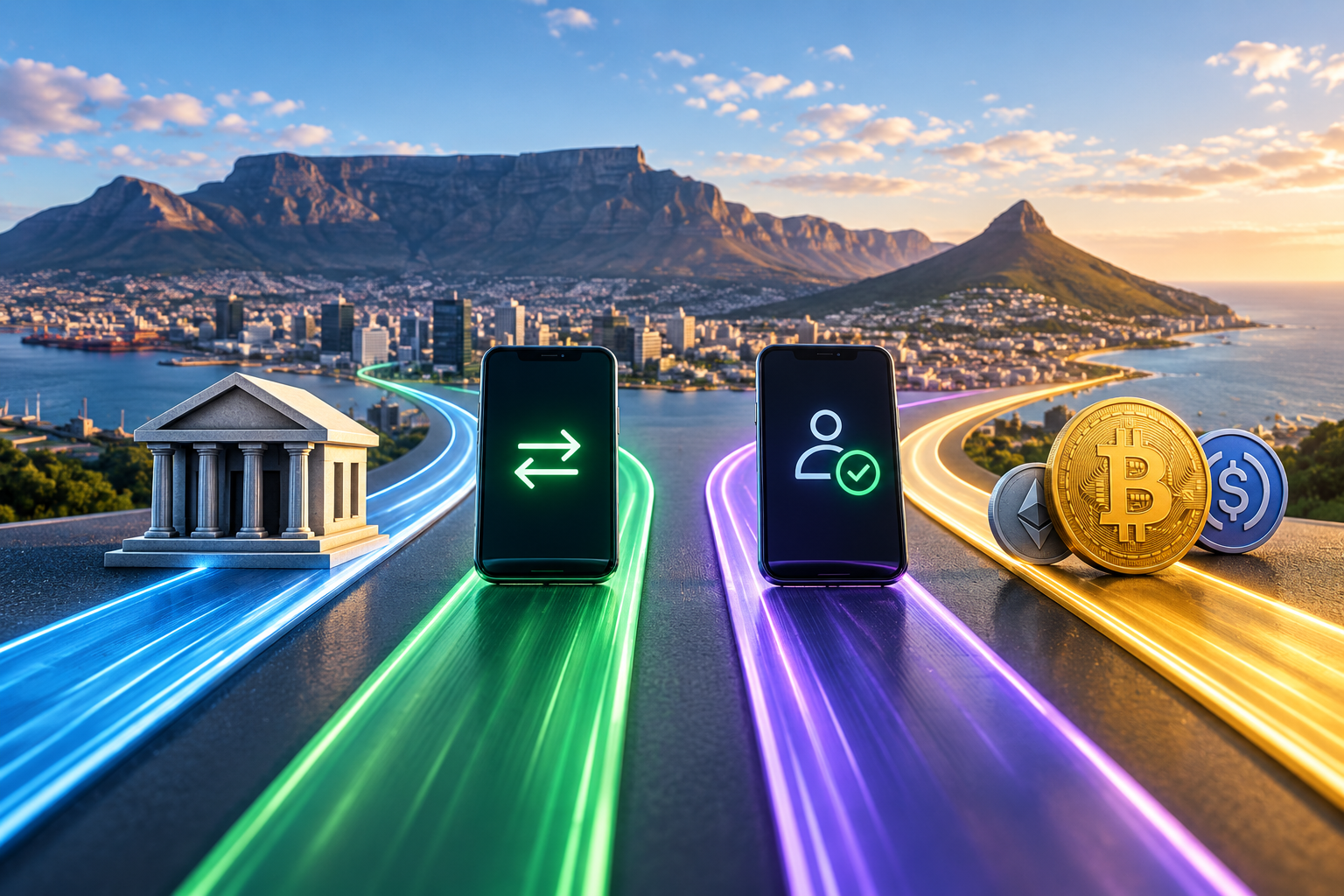
Four Ways to Move Value
EFT: The Standard Bank Transfer
An EFT moves rand between bank accounts.
PASA describes EFT credit payments as batch-based rather than instantaneous. Payments are settled according to same-day, one-day or two-day service levels, depending on the service selected.
EFT remains useful for ordinary payments where immediate availability is not essential.
RTC: Real-Time Clearing for Larger Urgent Payments
Real-Time Clearing, or RTC, is another way to move rand between banks.
PASA says RTC was launched in 2006 and clears qualifying interbank payments within 60 seconds.
The maximum RTC payment is R5 million during the daytime period, while the limit falls to R250,000 overnight, on weekends and public holidays. Banks can also apply lower limits.
That makes RTC particularly useful for larger or urgent domestic transfers that exceed PayShap's R50,000 network ceiling.
PayShap: Real-Time Retail Payments
It can also use Pay by Proxy through a ShapID. This allows a registered proxy, such as a mobile number, to be used instead of entering a traditional bank account number.
The PayShap network ceiling is R50,000 per transaction.
That does not mean every customer can send R50,000.
For example, Standard Bank states that PayShap payments cannot exceed R3,000 per single transaction.
Your bank may apply a different limit, so check what is available before sending money.
Crypto: A Different Type of Transfer
Crypto does not move rand directly from one bank account to another.
You first convert rand into a digital asset.
For example:
ZAR → Bitcoin → Wallet
or:
ZAR → USDC → Wallet
The recipient receives the crypto asset rather than rand.
If they ultimately need rand or another fiat currency, they may need to convert the asset again after receiving it.
EFT vs RTC vs PayShap vs Crypto: The Quick Comparison
| Feature | EFT | RTC | PayShap | Crypto |
|---|---|---|---|---|
| What moves? | Rand | Rand | Rand | Digital asset |
| Main infrastructure | Banking system | Real-time bank payment system | Real-time payment system | Blockchain network |
| Processing model | Batch-based | Real-time | Real-time | Depends on the network |
| Best suited for | Everyday transfers | Larger urgent transfers | Eligible retail payments | Moving digital assets |
| Recipient needs | Bank account | Bank account | Compatible receiving arrangement | Compatible wallet or platform |
| Conversion required? | No | No | No | Yes, when starting with rand |
| Recipient receives rand directly? | Yes | Yes | Yes | No |
| Designed for cross-border transfers? | No | No | No | Yes, to a compatible wallet |
| Main risk | Incorrect beneficiary details | Incorrect beneficiary details | Incorrect details or bank limits | Wrong address or unsupported network |
How Fast Is Each Option?
The speed of the payment rail is only one part of the journey.
EFT Can Take Longer
EFT is less suitable when the recipient needs money immediately because it uses scheduled settlement service levels rather than an instant payment process.
The actual timing depends on the service selected, bank cutoff times and the institutions involved.
RTC Is Built for Urgent Transfers
RTC is designed for urgent domestic bank transfers.
It is particularly useful when the amount is too large for PayShap and the payment needs to reach the recipient quickly.
The maximum available amount also depends on when the payment is made, with PASA listing different daytime and after-hours limits.
PayShap Is Built for Immediate Payments
PayShap supports real-time payment processing between participating institutions.
That does not necessarily mean every business credits the recipient's account at exactly the same moment.
For example, a crypto platform may receive a payment quickly but still need to identify and match it to your account before your ZAR balance becomes available.
Crypto Speed Depends on the Full Journey
A crypto transaction can move quickly across a blockchain, but that is not always the entire journey.
The process may include:
- 1Converting rand into crypto.
- 2Withdrawing the crypto from a platform.
- 3Waiting for the blockchain transaction.
- 4Receiving the asset.
- 5Converting it back into fiat, if necessary.
A fast blockchain transfer does not automatically mean the recipient ends up with usable cash faster.
How Much Does Each Option Cost?
The cheapest-looking payment method is not always the cheapest once the full journey is included.
EFT Costs
EFT fees depend on your bank account and the payment service you use.
Some accounts include electronic payments in their monthly fee. Others charge separately.
Check the cost shown by your bank before confirming the payment.
RTC Costs
RTC can carry a different fee from a standard EFT because it is designed for faster processing.
Banks set their own pricing, so the actual charge depends on the institution and account you use.
PayShap Fees Can Differ Between Banks
There is no single PayShap fee for every South African customer.
For example, Standard Bank's 2026 ACHIEVA PAYT pricing guide lists a R2 fee for an online PayShap payment.
Other banks and account types may charge differently.
The useful comparison is therefore the price your own bank shows for the payment you are making.
Crypto Can Add Several Layers of Cost
Crypto costs depend on the platform, asset and network.
For a concrete example, AltCoinTrader lists a Bitcoin withdrawal fee of 0.00012 BTC.
The rand value of that fee changes with Bitcoin's price. It can therefore be worth checking the BTC/ZAR price at the time of withdrawal to understand what the charge represents in rand.
The full cost of a crypto transfer may include:
- A spread when buying the asset.
- A trading or conversion fee.
- A withdrawal fee.
- A blockchain network fee.
- Another conversion fee if the recipient needs fiat.
A low network fee does not automatically mean the full transfer is cheap.
Compare the total cost from your starting rand to the value the recipient can actually use.
How Much Can You Send?
The limits are different for each payment method.
PASA classifies electronic credit payments of R5 million or less as low-value retail payments.
This is a payment-system category boundary.
It is not a separate R5 million transaction limit specifically for EFT payments.
RTC allows qualifying payments of up to R5 million during the day. The limit is R250,000 overnight, on weekends and public holidays, according to PASA.
PayShap has a R50,000 network ceiling per transaction, although individual banks can apply lower customer limits.
Crypto does not have one universal rand limit built into the blockchain. Exchanges and other platforms can set their own limits on deposits, purchases and withdrawals.
Funding a Crypto Account: Which Option Makes Sense?
If you are buying crypto with rand, EFT, RTC and PayShap can all be relevant before the crypto transaction begins.
The journey usually looks like this:
Bank account → Payment method → Crypto platform → ZAR balance → Crypto purchase
A standard EFT may work when speed is not important.
PayShap can be useful where the platform supports the funding route and the amount fits within the available limit.
RTC may be more relevant for a larger urgent bank transfer, depending on the platform's deposit arrangements.
One important distinction remains:
A fast bank payment does not always mean your crypto balance is credited instantly.
The platform may still need to identify the payment and match it to your account.
For a step-by-step explanation, see how to fund a crypto purchase instantly using PayShap.
Where Crypto Changes the Comparison
Crypto becomes more useful when the goal is not simply to move rand.
If the recipient already has a compatible wallet, a digital asset can be sent to them across a blockchain, including to a recipient outside South Africa.
But crypto does not remove every step.
Someone still needs to convert the original rand into crypto. The recipient may also need to convert the asset into local currency before using it.
That means a blockchain transfer can cross borders without using the traditional banking rail for the transfer itself, while the entry and exit points may still depend on financial institutions, exchanges or other service providers.
PayShap vs Stablecoins: A Different Speed Question
PayShap and stablecoins can both move value quickly, but they solve different problems.
PayShap moves rand through South Africa's participating payment infrastructure.
A stablecoin such as USDC or USDT moves across a blockchain to a compatible wallet.
The comparison becomes more complicated when you include the time needed to convert rand into a stablecoin and, if necessary, convert the stablecoin back into fiat.
For a closer comparison, see PayShap vs Stablecoins: Which Moves Money Faster in South Africa?.
When an EFT Makes More Sense
An EFT can make more sense when:
- The recipient needs rand.
- Immediate availability is not essential.
- You are making a normal bank-to-bank payment.
- You want a familiar domestic transfer method.
When RTC Makes More Sense
RTC can make more sense when:
- The recipient needs rand urgently.
- The transfer is too large for PayShap.
- The payment falls within the available RTC limits.
- The bank supports the required payment arrangement.
When PayShap Makes More Sense
PayShap can make more sense when:
- The recipient needs rand quickly.
- The amount fits within your available bank limit.
- The payment route supports PayShap.
- You want real-time domestic payment processing.
When Crypto Makes More Sense
Crypto can make more sense when:
- The recipient specifically wants crypto.
- You are moving assets between compatible wallets or platforms.
- You need to interact with a blockchain application.
- Both parties understand the asset and network being used.
- The transfer benefits from a blockchain-based settlement layer.
Crypto is not automatically better because it can cross borders.
If the recipient simply needs rand in a South African bank account, converting rand into crypto and then back into rand can add extra cost and complexity.
The Biggest Mistake: Comparing Speed Without Comparing the Destination
These four methods are not identical substitutes.
EFT, RTC and PayShap move rand.
Crypto moves a digital asset after you first convert into it.
Start with what the recipient needs.
If they need rand, compare the available bank and payment options.
If they need Bitcoin, USDC, USDT or another digital asset, compare the cost of buying it, withdrawing it and sending it through the correct network.
For a broader look at purchasing digital assets with rand, see how to buy crypto in South Africa with rand.
Frequently Asked Questions
Is PayShap faster than an EFT?
PayShap supports real-time payment processing, while EFT credit payments are batch-based.
The final time can still depend on the receiving bank, business or platform.
What is faster: RTC or PayShap?
Both support real-time payments.
RTC is better suited to larger urgent bank transfers, while PayShap is designed for lower-value retail payments within its network ceiling.
What is the RTC limit in South Africa?
PASA lists a maximum RTC payment of R5 million during the daytime period.
The limit is R250,000 overnight, on weekends and public holidays. Individual banks may apply lower limits.
Can I send more than R50,000 through PayShap?
The PayShap network ceiling is R50,000 per transaction.
Your own bank may apply a much lower limit.
Is R5 million the maximum EFT limit?
No. The R5 million figure is PASA's boundary for low-value retail payment systems.
It should not be presented as an EFT-specific transaction limit.
Is crypto faster than PayShap?
They move different things.
PayShap moves rand through South Africa's payment infrastructure. Crypto moves a digital asset across a blockchain.
The final speed depends on the full journey, including any conversion into and out of crypto.
Which option is best for funding a crypto account?
It depends on what the platform accepts.
EFT may work for standard funding. PayShap can provide a faster option where supported. RTC may be relevant for larger urgent transfers.
Always check the platform's deposit instructions before sending money.
The Bottom Line
There is no single best way to move rand.
An EFT is useful for standard bank transfers where immediate processing is not essential.
RTC is built for larger urgent domestic payments.
PayShap provides a real-time option for eligible retail payments, subject to its network ceiling and your bank's own limits.
Crypto moves something different altogether: a digital asset rather than rand.
The right choice starts with one question:
What does the recipient actually need to receive?
Once you know that, the comparison becomes much clearer.