Cryptocurrency in Zambia: Bitcoin, Stablecoins, Adoption and the Growing Crypto Market
Explore cryptocurrency in Zambia, including Bitcoin, stablecoins, crypto adoption, mobile money, regulation, cross-border payments and the latest market statistics

On this page
Zambia is becoming a more visible cryptocurrency market in Africa.
TRM Labs ranked Zambia 55th globally in its 2025 Country Crypto Adoption Index. That placed Zambia ahead of several established digital economies.
TRM Labs ranked Zambia 50th globally for stablecoin usage. Zambia's digital base is also expanding. DataReportal recorded 7.29 million internet users and 23.5 million mobile connections in Zambia at the end of 2025.
The Bank of Zambia also reported that mobile money transaction value grew by 83.4% in 2025, while transaction volume increased by 65.5%.
These figures do not measure the number of Zambian crypto owners.
They measure different parts of Zambia's digital and financial environment.
Together, they show why Zambia is becoming a market worth watching.
Crypto adoption is not only about trading Bitcoin.
Stablecoins are becoming part of global payment infrastructure.
Mobile-first financial behaviour is growing.
Regulation is also changing.
The Bank of Zambia began a VASP registration exercise in March 2026. That marked an important step toward a more structured virtual asset framework.
Zambia is therefore entering a new phase.
The market remains smaller than Africa's largest crypto hubs.
But the combination of digital adoption, mobile money growth, stablecoin activity and regulatory development is creating a stronger foundation.
Is Cryptocurrency Popular in Zambia?
Crypto is an emerging market in Zambia.
The strongest recent country-level benchmark comes from TRM Labs' 2025 Country Crypto Adoption Index.
Zambia ranked 55th globally.
That ranking was based on crypto activity between January and July 2025.
TRM adjusts its analysis for local economic conditions.
Its methodology combines on-chain activity linked to major crypto intermediaries with web traffic patterns and GDP-per-capita adjustments.
That means the ranking should not be treated as a direct count of crypto users.
It is a measure of estimated adoption relative to the size of each economy.
Zambia's position is still notable.
The country ranked 50th globally for stablecoin usage in the same TRM report.
That stablecoin ranking was stronger than its overall crypto adoption ranking.
This may suggest that stablecoins are becoming an increasingly relevant part of Zambia's digital asset market.
It does not prove the exact reason why every user holds or transfers stablecoins.
But it is an important market signal.
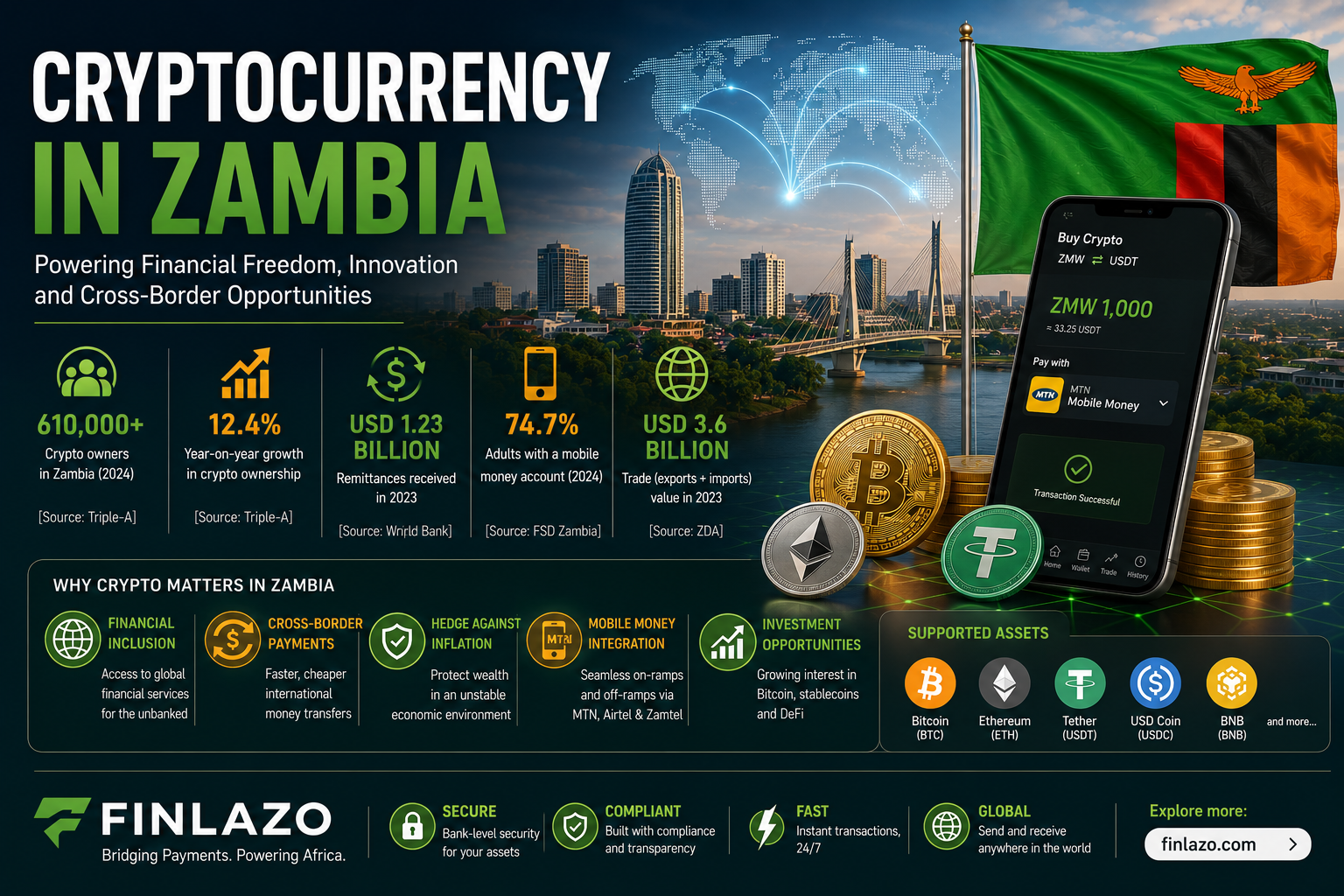
Zambia Crypto Adoption Statistics
Several recent figures help explain Zambia's position:
- 55th globally — Zambia's rank in TRM Labs' 2025 Country Crypto Adoption Index.
- 50th globally — Zambia's stablecoin usage ranking in the same report.
- 7.29 million — internet users in Zambia at the end of 2025.
- 33.0% — internet penetration at the end of 2025.
- 23.5 million — cellular mobile connections active in Zambia in late 2025.
- 106% — mobile connections as a share of the population. One person can hold multiple connections.
- 83.4% — growth in the value of mobile money transactions during 2025.
- 65.5% — growth in mobile money transaction volume during 2025.
- 52% — growth in Sub-Saharan African crypto adoption during the period examined by Chainalysis in its 2025 report.
- More than US$4 trillion — stablecoin transaction volume between January and July 2025, according to TRM Labs.
These figures measure different things.
They should not be combined into a single Zambia crypto market size.
What Is Driving Crypto Interest in Zambia?
Several forces can support cryptocurrency adoption.
Some are specific to crypto.
Others come from Zambia's wider digital economy.
A Growing Digital Population
Crypto requires digital access.
That includes internet connectivity, smartphones and online financial services.
DataReportal recorded 7.29 million internet users in Zambia at the end of 2025.
Internet penetration stood at 33.0%.
The same report recorded 23.5 million cellular mobile connections.
That was equal to 106% of Zambia's population.
The figure exceeds 100% because many people use more than one SIM or mobile connection.
Digital access does not automatically create crypto adoption.
But it expands the addressable market for:
- Exchanges.
- Hosted wallets.
- Self-custody wallets.
- Stablecoin services.
- Blockchain applications.
- Digital payment platforms.
Mobile Money Is Growing Fast
Zambia's financial system is becoming increasingly digital.
The Bank of Zambia's 2025 Annual Report said mobile money remained the dominant digital financial service.
Mobile money transaction value grew by 83.4% in 2025.
Transaction volume increased by 65.5%.
The Bank linked the growth to greater merchant acceptance and wider use of person-to-person transfers.
Crypto is not the same as mobile money.
The technology is different.
The legal framework is different.
The risk profile is also different.
But a population that already uses digital financial services may be more comfortable with app-based money and digital transfers.
That can reduce the educational barrier around new financial technology.
A Young Digital Market
DataReportal reported that Zambia's median age was 17.9 at the end of 2025.
The same report said 13.8% of the population was aged 18 to 24.
Another 15.0% was aged 25 to 34.
Young adults are not automatically crypto users.
But a young population can shape long-term adoption of mobile technology, fintech and digital assets.
Bitcoin in Zambia
Bitcoin is the best-known cryptocurrency.
It is also the largest crypto asset globally by market significance.
For many users, Bitcoin is the first entry point into crypto.
That was roughly 70% more than the fiat inflows recorded for Ethereum during the same period.
Global trends do not describe Zambia alone.
But they help explain why Bitcoin remains central to the wider crypto market.
Why Do People Buy Bitcoin?
People can buy Bitcoin for different reasons.
Some see it as a long-term investment.
Others trade short-term price movements.
Some want exposure to the wider digital asset market.
Others use it as part of a diversified portfolio.
Bitcoin also carries significant risk.
Its price can move sharply.
A limited supply does not mean a stable price.
Users can lose money.
Crypto ownership also creates security risks.
The safest approach is to understand the asset before buying it.
Stablecoins in Zambia
Stablecoins may be one of the most important areas to watch.
TRM Labs ranked Zambia 50th globally for stablecoin usage in 2025.
That was stronger than Zambia's 55th-place overall crypto adoption ranking.
Stablecoins are designed to maintain a more stable value than assets such as Bitcoin.
Many major stablecoins are linked to fiat currencies.
The US dollar is especially important.
TRM Labs reported that more than 90% of fiat-backed stablecoins were pegged to the US dollar.
It also reported that USDT and USDC accounted for 93% of total stablecoin market capitalization.
Stablecoins Are Becoming Major Global Infrastructure
TRM Labs reported that stablecoins accounted for 30% of crypto transaction volume between January and July 2025.
It reported more than US$4 trillion in stablecoin transaction volume during that period.
That was an 83% increase compared with the same period a year earlier.
Stablecoins can support several potential use cases:
- Crypto trading.
- Dollar-denominated digital value.
- Cross-border transfers.
- Treasury operations.
- Blockchain settlement.
- Merchant and payment applications.
The use case does not determine the regulatory status.
A stablecoin service can still trigger licensing, AML, consumer protection and other legal requirements.
For Zambia's latest regulatory position, see Zambia Cryptocurrency Regulation.
Ethereum and Other Cryptocurrencies
Bitcoin is only one part of the crypto market.
Ethereum introduced a large ecosystem of smart contracts and decentralized applications.
Other networks support payments, tokenization, decentralized finance and other blockchain functions.
Not every crypto asset has the same purpose.
A stablecoin is different from Bitcoin.
A major blockchain token is different from a newly issued meme coin.
A utility token is different from a token marketed as an investment.
Users should understand what they are buying.
They should also understand how the asset is stored.
How Do People Access Crypto in Zambia?
Crypto can be accessed through several models.
These include:
- Centralized exchanges.
- Peer-to-peer markets.
- Hosted wallets.
- Self-custody wallets.
- Over-the-counter services.
- Decentralized exchanges.
Each model has different risks.
A centralized platform may simplify buying and selling.
But the user may depend on the platform for custody.
A self-custody wallet can give the user direct control.
But the user becomes responsible for protecting private keys and recovery information.
Availability also does not equal local authorization.
A foreign platform can be accessible from Zambia without holding a local licence.
That distinction is increasingly important.
Buying Crypto With Zambian Kwacha
Buying crypto requires a fiat on-ramp.
The on-ramp connects traditional money with a digital asset.
The exact process depends on the platform.
It can involve:
- A bank transfer.
- A card payment.
- A mobile money route.
- A peer-to-peer transaction.
- Another approved payment method.
The regulatory structure matters.
The Bank of Zambia's March 2026 public notice requested registration from resident and non-resident providers offering covered virtual asset services to people and businesses within Zambia.
The notice covered 5 core VASP activities.
They include crypto-to-fiat exchange, crypto-to-crypto exchange, transfers, custody and certain financial services related to virtual asset issuance or sales.
The Bank said registration was part of work toward a comprehensive regulatory framework.
A user should not assume that a service is licensed merely because it is available online.
A business should also not describe registration as a licence unless it has received an actual licence or approval.
Is Crypto Regulated in Zambia?
Yes, parts of the sector are now subject to a more formal regulatory process.
The framework is still developing.
The major recent change came in March 2026.
The Bank of Zambia required covered VASPs to register by 27 March 2026.
The Bank said the registration exercise was a preliminary step.
It was not itself a licence.
The Bank's March 2026 Zambanker publication said registration did not constitute official approval or an endorsement of a provider's business practices.
The Bank was gathering information to develop a comprehensive and risk-based framework.
From 30 March 2026, the Bank also said its regulated entities would not be allowed to facilitate transactions to or from VASPs that had not registered with the Bank.
That development matters for fiat on-ramps and off-ramps.
Crypto businesses often need access to banks and payment infrastructure.
For the full legal and compliance breakdown, see Zambia Cryptocurrency Regulation.
Zambia's Crypto Market and Cross-Border Payments
Cross-border payments are one area where digital assets could become increasingly relevant.
Stablecoins can move across blockchain networks.
But faster technology does not remove compliance requirements.
A real payment system still needs to address:
- Identity.
- AML and CFT controls.
- Sanctions screening.
- Consumer protection.
- Liquidity.
- Foreign exchange.
- Counterparty risk.
The Bank of Zambia's 2026 VASP notice itself identified reduced transaction costs and faster transfers of value as potential benefits of virtual asset technology.
It also highlighted money laundering, terrorist financing and proliferation financing risks.
The opportunity is therefore not simply to move money on a blockchain.
The opportunity is to build compliant infrastructure around the movement of value.
Zambia already has an important cross-border economy.
For the wider remittance, trade, foreign-exchange and payment-rail picture, see Zambia Cross-Border Payments.
Zambia and the African Crypto Market
Zambia is part of a larger regional trend.
The region has distinct use cases.
Remittances matter.
Payments matter.
Access to foreign currencies can matter.
Inflation and currency volatility can also shape demand in some markets.
Zambia should not be treated as identical to Nigeria, Kenya or Ghana.
Each market has different payment infrastructure and regulations.
But the wider regional growth matters.
For example, Nigeria ranked 6th globally in Chainalysis' 2025 Global Crypto Adoption Index.
Kenya ranked 28th in TRM Labs' 2025 Country Crypto Adoption Index.
Zambia ranked 55th.
That places Zambia within a competitive African digital asset landscape.
What Are the Biggest Opportunities?
Zambia's strongest crypto opportunities may go beyond trading.
Stablecoin Payments
Zambia's 50th-place stablecoin usage ranking is a signal worth watching.
Stablecoins may support settlement and international value transfer.
That depends on legal frameworks and compliant infrastructure.
The global stablecoin market is also expanding quickly.
TRM Labs reported US$4 trillion in stablecoin transaction volume between January and July 2025.
Digital Asset Infrastructure
Infrastructure can include:
- Wallet technology.
- Custody systems.
- Payment APIs.
- Blockchain analytics.
- Identity verification.
- Transaction monitoring.
- Compliance technology.
- Treasury systems.
The Bank of Zambia's regulatory work could create greater demand for businesses that help providers meet compliance obligations.
Cross-Border Settlement
Cross-border commerce creates payment complexity.
Businesses may face multiple banks, currencies and settlement systems.
Blockchain technology can potentially reduce some friction.
But the solution must connect with regulated financial infrastructure.
That is where compliance becomes as important as speed.
Financial Inclusion
Digital finance can expand access.
But crypto should not be presented as a guaranteed solution to financial inclusion.
The technology has risks.
Fees can still apply.
Internet access remains uneven.
DataReportal said 67.0% of Zambia's population remained offline at the end of 2025.
Any crypto growth story must therefore consider the digital divide.
What Are the Biggest Risks?
Crypto can create opportunities.
It also creates major risks.
Price Volatility
Bitcoin and many other assets can rise or fall sharply.
Users can lose a significant amount of money.
Fraud
Scammers can use fake investment platforms.
Guaranteed-return promises are a major warning sign.
The Financial Intelligence Centre has warned about virtual asset-related schemes and fraud risks.
Users should verify a business before sending funds.
Cybersecurity
Exchange accounts can be compromised.
Private keys can be stolen.
Recovery phrases should never be shared.
A lost private key may mean permanent loss of access.
Platform Risk
A user may depend on a third-party platform.
The platform can fail.
Withdrawals can be delayed.
The business can also become insolvent or fraudulent.
The custody model matters.
Regulatory Change
Zambia's framework is developing.
The rules that apply to crypto businesses can change.
That is especially important after the Bank of Zambia's 2026 VASP registration exercise.
Businesses should monitor official notices.
Zambia Crypto Market Statistics to Watch
The following numbers are useful indicators for Zambia's crypto environment:
- 55th — overall crypto adoption rank in TRM Labs' 2025 index.
- 50th — stablecoin usage rank.
- 7.29 million — internet users at the end of 2025.
- 33.0% — internet penetration.
- 23.5 million — mobile connections.
- 83.4% — growth in mobile money transaction value during 2025.
- 65.5% — growth in mobile money transaction volume during 2025.
- 52% — growth in Sub-Saharan African crypto adoption in the period examined by Chainalysis.
- 30% — stablecoins' share of crypto transaction volume between January and July 2025, according to TRM Labs.
- More than US$4 trillion — stablecoin transaction volume during that seven-month period.
- 5 — core VASP activity categories listed in the Bank of Zambia's March 2026 registration notice.
What Could Happen Next?
Zambia's crypto market is still developing.
The next major changes may come from regulation.
The Bank of Zambia has already started mapping the VASP sector.
The registration exercise can help regulators understand who is operating in the market.
The next stage is the comprehensive framework the Bank has said it is developing.
That could affect:
- Exchanges.
- Custodians.
- Wallet providers.
- Payment companies.
- Crypto transfer services.
- Foreign providers serving Zambia.
Stablecoins may also become more important.
Zambia's current 50th-place stablecoin usage ranking gives the country a useful benchmark.
Future rankings will show whether that position rises or falls.
Digital connectivity will matter too.
Zambia had 7.29 million internet users at the end of 2025.
That means a large share of the country remains offline.
Growth in connectivity could expand access to all forms of digital finance.
Not only crypto.
The Bottom Line
Cryptocurrency in Zambia is an emerging market with stronger signals than many people may expect.
TRM Labs ranked Zambia 55th globally for crypto adoption in 2025.
It ranked Zambia 50th for stablecoin usage.
Zambia's wider digital economy is also growing.
The country had 7.29 million internet users and 23.5 million mobile connections at the end of 2025.
The Bank of Zambia reported 83.4% growth in mobile money transaction value during 2025.
Crypto remains risky.
Prices can be volatile.
Fraud and cybersecurity risks are real.
Regulation is also evolving.
The Bank of Zambia's 2026 VASP registration exercise marked a major shift toward more structured oversight.
The long-term opportunity may extend beyond buying Bitcoin.
Stablecoins, cross-border settlement and digital asset infrastructure could become increasingly important.
The future will depend on technology.
It will also depend on trust, compliance and clear rules.