Zambia Cross-Border Payments: Remittances, SADC-RTGS, COMESA REPSS and PAPSS
Explore Zambia's cross-border payments market, including remittances, mobile money, regional payment systems, trade, foreign exchange, fintech and the latest payment statistics

On this page
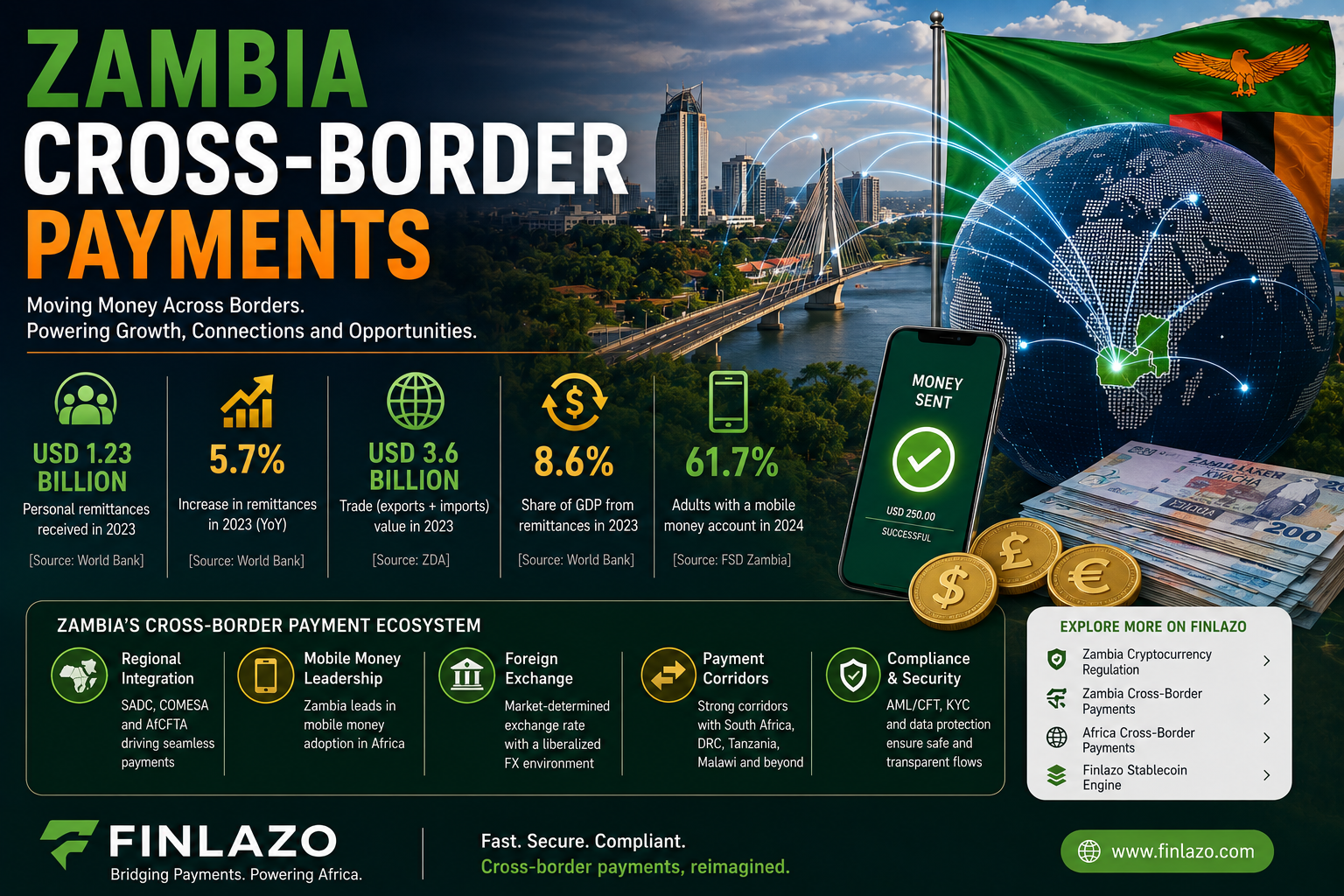
Zambia's cross-border payment market is becoming more important as regional trade, remittances and African payment integration expand.
The latest Bank of Zambia 2025 Annual Report shows that Zambian commercial banks processed 52,653 outbound payments worth ZAR 13.9 billion through the SADC Real-Time Gross Settlement system during 2025.
That was a 10.5% increase in payment volume and a 3.3% increase in payment value. Zambia also received 9,454 SADC-RTGS payments worth ZAR 13.7 billion. The value of Zambia's payments represented 1.0% of the total SADC-RTGS system in 2025.
Remittances remain another important cross-border flow. The World Bank's latest Zambia personal remittances data records US$334.3 million in personal remittances received in 2024.
The Bank of Zambia's 2025 report also said the United States and United Kingdom accounted for 55.0% of Zambia's inbound remittances through money transfer operators during 2025.
Zambia is also positioning itself inside Africa's changing payment infrastructure.
The Bank of Zambia identifies SADC-RTGS, COMESA REPSS and PAPSS as Zambia's regional cross-border payment systems. PAPSS is especially important for the future.
It is designed to support instant or near-instant payments across African borders in local currencies. PAPSS says its instant payment service can process cross-border payments within a maximum of 120 seconds.
The result is a market with several layers.
Traditional banks remain important.
Money transfer operators remain important.
Regional settlement systems are expanding.
Mobile and digital payment infrastructure are growing.
And new African networks are attempting to reduce dependence on expensive correspondent banking and hard currencies.
Zambia Cross-Border Payments at a Glance
The latest figures and infrastructure developments include:
- 52,653 — outbound SADC-RTGS payments processed by Zambian commercial banks in 2025, according to the Bank of Zambia.
- ZAR 13.9 billion — value of those outbound payments.
- 9,454 — inbound SADC-RTGS receipts into Zambia during 2025.
- ZAR 13.7 billion — value of those inbound receipts.
- 1.0% — Zambia's share of total SADC-RTGS transaction value in 2025.
- US$334.3 million — Zambia's personal remittances received in 2024 in the latest World Bank data series.
- 55.0% — share of inbound MTO remittances from the United States and United Kingdom in 2025, according to the Bank of Zambia.
- 120 seconds — maximum processing time stated by PAPSS for instant cross-border payments.
- 3 major regional payment systems — SADC-RTGS, COMESA REPSS and PAPSS, listed by the Bank of Zambia.
These figures measure different payment flows.
They should not be combined into one market-size figure.
Together, they show how Zambia connects with regional and global payment networks.
How Cross-Border Payments Work in Zambia
Cross-border payments can move through several channels.
The route depends on the sender, receiver, country and transaction type.
Common channels include:
- Commercial banks.
- Correspondent banking networks.
- Money transfer operators.
- Mobile money and digital wallets.
- Regional payment systems.
- Fintech platforms.
- Card networks.
- Trade finance and corporate payment systems.
The infrastructure behind the transaction matters.
A payment from Zambia to South Africa can follow a different route from a payment to Kenya.
A family remittance can follow a different route from a corporate import payment.
A high-value bank transaction can follow a different settlement system from a small consumer transfer.
SADC-RTGS and Zambia's Southern African Payment Corridor
The SADC Real-Time Gross Settlement system is one of Zambia's most important regional payment systems.
The Bank of Zambia describes SADC-RTGS as a platform for South African rand-denominated cross-border payments within the Southern African Development Community.
The system was designed to reduce transaction costs and improve efficiency.
It also reduces reliance on traditional correspondent banking arrangements for relevant regional transfers.
Zambia's SADC-RTGS Payments in 2025
The latest official figures show active use.
According to the Bank of Zambia 2025 Annual Report, Zambian commercial banks processed 52,653 outbound payments through SADC-RTGS during 2025.
The payments were worth ZAR 13.9 billion.
Payment volume increased 10.5%.
Payment value increased 3.3%.
Zambia also received 9,454 transactions worth ZAR 13.7 billion.
Receipt volume fell 4.0%.
Receipt value fell 1.3%.
The figures show an important point.
Cross-border payment growth is not always uniform.
Outbound and inbound flows can move differently.
Trade patterns matter.
Currency demand matters.
Business activity matters.
Zambia's Share of the Regional System
The Bank of Zambia said Zambian commercial banks accounted for 1.0% of total SADC-RTGS transaction value in 2025.
Zambia's share of total transaction volume was 3.4%.
The volume share had fallen from 6.2% in 2024.
The figures show that Zambia is connected to a much larger regional settlement network.
That matters for companies moving money through Southern African trade corridors.
COMESA REPSS and Zambia
Zambia is also part of the COMESA region.
The COMESA Regional Electronic Payments and Settlement System, known as REPSS, supports regional payments.
The Bank of Zambia lists REPSS among Zambia's regional payment systems.
The Bank says REPSS can help reduce foreign correspondent banking charges through pre-funding.
It can also provide access to a wider market across the COMESA region.
REPSS is important because Zambia's trade relationships are not limited to Southern Africa.
The country also trades across East and Central African corridors.
The Bank of Zambia's Q4 2025 Direction of Trade Report recorded Zambia's COMESA trade across markets including Kenya, Rwanda, Uganda and other member economies.
Regional payment infrastructure can become more valuable as these trade relationships grow.
REPSS Is Not Only About Speed
The value of a regional system is broader than faster processing.
A regional payment network can also:
- Reduce correspondent banking complexity.
- Improve regional settlement efficiency.
- Support local and regional currencies.
- Improve payment visibility.
- Create infrastructure for intra-regional trade.
The Bank of Zambia's regional payment strategy reflects this broader objective.
PAPSS and Zambia's Pan-African Payment Future
PAPSS is one of the most significant developments in African cross-border payments.
The Bank of Zambia says PAPSS is a centralized payment and settlement infrastructure established by Afreximbank to support intra-African trade and commerce.
Zambia ratified the AfCFTA in February 2021, according to the Bank.
PAPSS is intended to help the continent move money more efficiently as African trade expands.
How PAPSS Works
PAPSS supports three main processes:
- Instant payment.
- Pre-funding.
- Net settlement.
A customer initiates a payment in local currency.
The instruction moves through the participating financial infrastructure.
Required validation and compliance checks are performed.
The receiving participant then credits the beneficiary in local currency.
PAPSS says instant payments can process within a maximum of 120 seconds.
That does not mean every African bank is already connected.
Network availability depends on participating central banks, banks and payment providers.
Why PAPSS Matters for Zambia
The Bank of Zambia says PAPSS can connect with existing regional systems, including SADC-RTGS and COMESA REPSS.
This is important.
The future does not necessarily require Zambia to abandon existing infrastructure.
The objective is greater interoperability.
The Bank identifies several expected benefits:
- Instant payments and settlement in local currencies.
- Reduced need for foreign currencies.
- Net settlement between central banks.
- Flexibility to connect national and regional systems.
- Enhancement of existing infrastructure.
That creates a potentially powerful model.
SADC can remain relevant.
COMESA can remain relevant.
A wider Pan-African layer can connect regional networks.
Zambia and PAPSS Access
The PAPSS June 2026 network coverage document lists Zambia with Access Bank and UBA as participant access channels.
Network availability can change.
Businesses and consumers should verify the latest participating institutions before initiating a payment.
Remittances to Zambia
Remittances are another major part of cross-border payments.
They support households.
They also connect Zambia with its diaspora and international labour markets.
The latest World Bank data records US$334.3 million in personal remittances received by Zambia in 2024.
The Bank of Zambia provides additional insight into MTO flows.
Its 2025 Annual Report said the United States and United Kingdom accounted for 55.0% of total inbound remittances through money transfer operators during 2025.
India and Tanzania were the main destinations for Zambia's outbound MTO remittances.
Together, they accounted for 39.0% of outbound MTO remittances in 2025.
Why Remittance Infrastructure Matters
A remittance is not only an international transfer.
For many recipients, speed and access matter.
The money may be used for:
- Household expenses.
- School fees.
- Healthcare.
- Housing.
- Business support.
- Family emergencies.
The cost of sending small transfers also matters.
That is one reason digital payment infrastructure and regional payment networks are attracting more attention.
Mobile and Digital Cross-Border Payments
Zambia's domestic payment ecosystem has become increasingly digital.
The Bank of Zambia's 2024 National Payment Systems Annual Report recorded 199 total National Financial Switch use cases across production, pilot and user-acceptance testing at the end of 2024.
The report included:
- 31 bank-to-wallet use cases.
- 33 wallet-to-bank use cases.
- 20 bank-to-bank use cases.
- 18 wallet-to-wallet use cases.
- 35 KYC use cases.
Domestic interoperability can support the next stage of payment development.
Cross-border interoperability is more difficult.
It requires coordination between different currencies, regulations, institutions and payment systems.
But the direction is clear.
Africa is building more infrastructure for faster digital transfers.
The Role of Foreign Exchange
Cross-border payments often involve more than sending money.
They also involve currency conversion.
A Zambian importer may need to pay in dollars.
A regional supplier may accept rand.
A customer may send money in kwacha.
The beneficiary may receive another currency.
Foreign exchange can therefore add:
- Cost.
- Time.
- Liquidity requirements.
- Exchange-rate risk.
- Operational complexity.
This is one reason local-currency settlement systems are important.
The Bank of Zambia says PAPSS is designed to reduce reliance on hard currencies.
PAPSS also aims to conserve foreign exchange at final settlement because central-bank settlement is conducted on a net basis.
That does not eliminate foreign-exchange risk.
It changes the infrastructure used to manage settlement.
Cross-Border Payments and Zambia's Trade
Payment infrastructure follows trade.
Zambia is a land-linked economy with important regional trade relationships.
Efficient payments can support imports and exports.
The Bank of Zambia's Q4 2025 Direction of Trade Report shows active trade relationships across COMESA markets.
In Q4 2025 alone, Zambia's reported exports to COMESA markets totaled US$21.7 million in the report's COMESA appendix.
Imports totaled US$105.0 million.
These figures cover the specific COMESA table and should not be treated as Zambia's total global trade.
They do show why regional payment systems matter.
Trade creates invoices.
Invoices create payment obligations.
Payment friction can affect working capital.
The Tanzania-Zambia Payment Connection
Tanzania is a relevant regional comparison.
The two countries are connected through trade, transport and wider Southern and East African markets.
The Bank of Zambia's 2025 report identified Tanzania as one of the main destinations for Zambia's outbound MTO remittances.
For more detail on Tanzania's payment infrastructure, see Tanzania cross-border payments.
Tanzania uses regional and international payment infrastructure including EAPS, SADC-RTGS and other digital payment channels.
The comparison is useful.
Both markets show why Africa's payment future may depend on interoperability rather than a single system.
Zambia Cross-Border Payments and Cryptocurrency
Crypto and traditional cross-border payments should not be treated as the same market.
Traditional payment systems are already heavily regulated.
Crypto creates additional questions around custody, licensing and AML compliance.
However, stablecoins and blockchain settlement are increasingly discussed as potential infrastructure for international payments.
That opportunity depends on regulation.
Zambia's crypto framework has changed rapidly.
For the latest position, see Zambia cryptocurrency regulation.
The Bank of Zambia's March 2026 VASP registration exercise shows that virtual asset infrastructure is moving toward more structured oversight.
A future payment model could combine:
- Bank rails.
- Mobile money.
- Regional settlement systems.
- Local-currency payments.
- Regulated digital-asset infrastructure.
But those connections must be designed within the applicable regulatory framework.
Speed alone is not enough.
Compliance and consumer protection matter.
How Businesses Can Improve Cross-Border Payments
Businesses moving money into or out of Zambia should compare the entire transaction.
The exchange rate is only one factor.
Compare the Total Cost
The relevant cost can include:
- Transfer fees.
- Foreign-exchange spreads.
- Correspondent bank charges.
- Receiving fees.
- Intermediary charges.
A low headline fee can still produce a poor final exchange rate.
Compare Settlement Time
Speed can affect working capital.
A supplier waiting several days for confirmation may delay delivery.
A faster payment can improve certainty.
Actual customer availability still depends on participating institutions and the payment route.
Check Currency Availability
Not every corridor supports every local currency.
A business should check:
- Sending currency.
- Receiving currency.
- Conversion method.
- Rate source.
- Liquidity.
Check Compliance Requirements
Cross-border payments can require:
- Customer identification.
- Source-of-funds information.
- Invoice or trade documents.
- Beneficiary details.
- Sanctions screening.
- Transaction monitoring.
The larger or more complex the transaction, the more documentation may be required.
Zambia Cross-Border Payment Statistics
The most useful current figures include:
- **52,653** — SADC-RTGS outbound payments from Zambia in 2025.
- **ZAR 13.9 billion** — value of those payments.
- **10.5%** — growth in Zambia's SADC-RTGS payment volume during 2025.
- **3.3%** — growth in payment value during 2025.
- **9,454** — SADC-RTGS receipts into Zambia during 2025.
- **ZAR 13.7 billion** — value of those receipts.
- **1.0%** — Zambia's share of SADC-RTGS transaction value in 2025.
- **3.4%** — Zambia's share of SADC-RTGS transaction volume in 2025.
- **US$334.3 million** — personal remittances received by Zambia in 2024.
- **55.0%** — share of inbound MTO remittances from the United States and United Kingdom during 2025.
- **39.0%** — share of outbound MTO remittances going to India and Tanzania during 2025.
- **120 seconds** — maximum instant payment processing time stated by PAPSS.
- **199** — National Financial Switch use cases across production, pilot and UAT at the end of 2024.
- **3** — major regional payment systems listed by the Bank of Zambia for Zambia: SADC-RTGS, COMESA REPSS and PAPSS.
These figures measure different systems and payment categories.
They should not be added together.
What Is Next for Zambia's Cross-Border Payment Market?
The biggest trend is integration.
Zambia is already connected to regional infrastructure.
SADC-RTGS supports an important Southern African corridor.
REPSS connects the COMESA region.
PAPSS is building a wider African layer.
The Bank of Zambia says PAPSS can connect existing regional platforms.
That could make interoperability increasingly important.
The future market may also involve:
- More instant payments.
- More local-currency settlement.
- Greater mobile and wallet interoperability.
- Lower reliance on correspondent banking.
- More digital trade payments.
- Better payment data.
- Stronger AML and compliance technology.
- Regulated digital-asset infrastructure.
The direction is promising.
But infrastructure rollout takes time.
A network is only as useful as its participants and supported corridors.
The Bottom Line
Zambia's cross-border payment market is moving toward greater regional integration.
The latest Bank of Zambia figures show 52,653 outbound SADC-RTGS payments worth ZAR 13.9 billion in 2025.
Zambia also received 9,454 SADC-RTGS payments worth ZAR 13.7 billion.
Remittances remain important.
The latest World Bank data records US$334.3 million in personal remittances received in 2024.
The United States and United Kingdom accounted for 55.0% of Zambia's inbound MTO remittances in 2025.
The infrastructure story is equally important.
Zambia has access to SADC-RTGS.
It participates in COMESA REPSS.
It is also connected to the wider PAPSS strategy.
That creates an increasingly interesting environment for banks, fintech companies, payment providers, traders and consumers.
The long-term opportunity is not one payment rail replacing every other rail.
It is interoperability.
The strongest cross-border payment systems may be the ones that connect local, regional and continental infrastructure while keeping payments fast, compliant and affordable.