Rwanda Cross-Border Payments: Costs, Mobile Money, PAPSS and the Next Phase of Regional Transfers
Rwanda is building faster connections with Africa through mobile money, eKash and regional payment infrastructure. Explore the costs, challenges and new systems shaping cross-border transfers.

On this page
Rwanda has one of Africa's deepest digital-finance ecosystems.
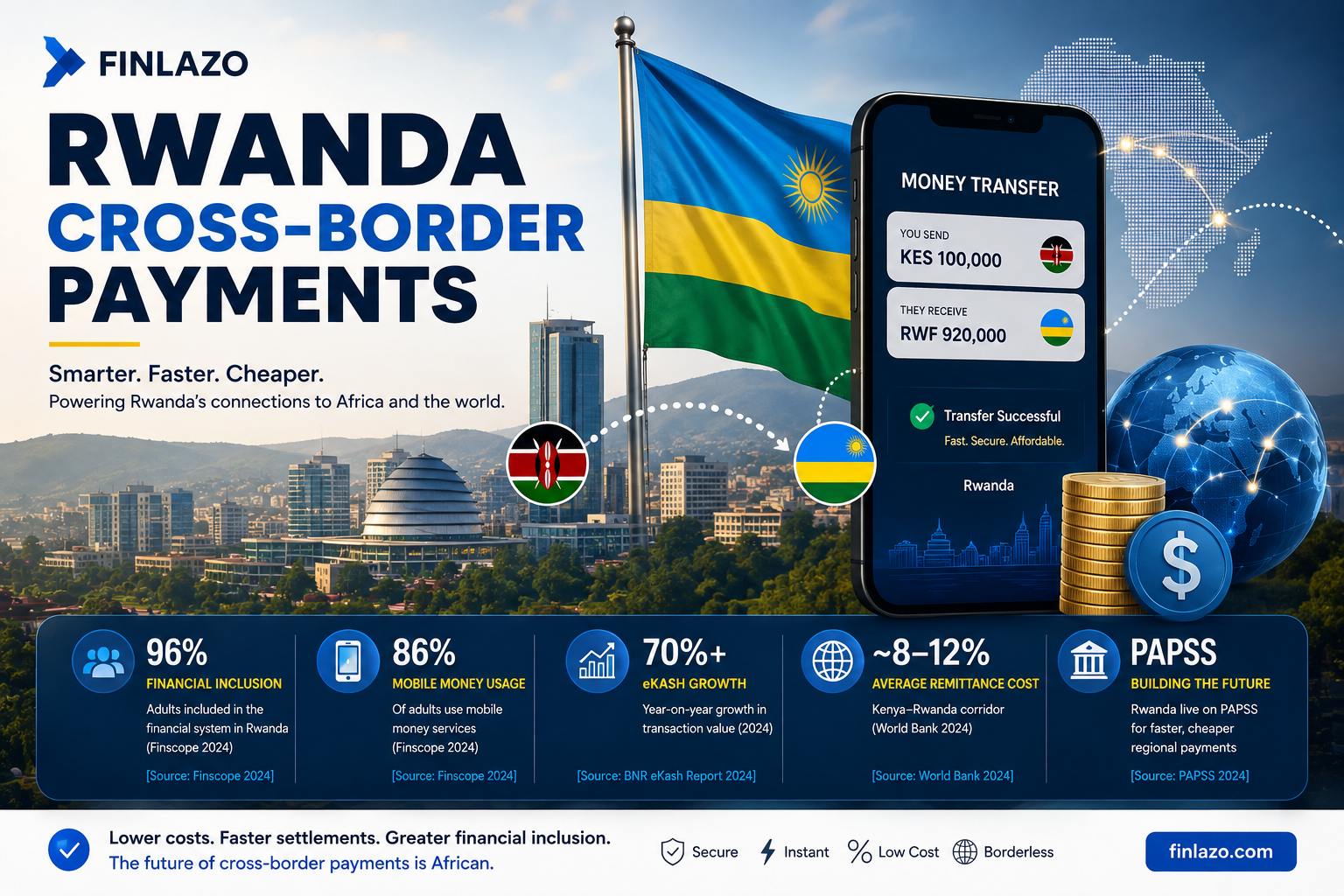
FinScope 2024 found that 96% of adults, or about 7.8 million people, were financially included. About 86%, or 6.9 million adults, had owned or used mobile money.
Yet cross-border payments can still be expensive and fragmented.
The challenge is visible in the Kenya–Rwanda corridor. The World Bank's Remittance Prices Worldwide data collected between 14 August and 3 September 2025 showed a third-quarter corridor average total cost of 7.46% for sending the equivalent of US$200.
Individual providers varied sharply. One low-cost option in the published comparison was 2.85%, while some routes and delivery methods were far more expensive.
That gap matters for workers, families, traders and small businesses moving money between Rwanda and neighbouring markets.
Rwanda is also pushing its domestic payment infrastructure further. The National Bank of Rwanda's 2024/25 Annual Report said retail e-payments reached 321% of GDP by June 2025, while the eKash retail interoperability system recorded a 219% increase in volume.
The next question is whether the same digital progress can reduce friction across borders. Bank of Kigali joined the Pan-African Payment and Settlement System in a 2025 launch alongside KCB Group in Kenya.
PAPSS is designed to support cross-border payments in African currencies and says near-instant payments can be processed within 120 seconds.
Rwanda's cross-border payments market is therefore changing on several fronts at once. Mobile money remains central to everyday transfers. Banks are joining regional infrastructure. Interoperability is expanding.
New virtual asset rules also create a clearer legal environment for businesses exploring blockchain and stablecoin-based services. For the regulatory background, see Rwanda cryptocurrency regulation.
Rwanda Cross-Border Payments at a Glance
- 96% — financial inclusion in Rwanda in 2024, equal to about 7.8 million adults.
- 86% — adults who had owned or used mobile money, or about 6.9 million people.
- 77% — adults with a mobile wallet registered in their own name.
- 7.46% — average total cost published for the Kenya-to-Rwanda corridor in Q3 2025 for the World Bank comparison.
- 321% of GDP — retail e-payment value in Rwanda by June 2025.
- 219% — increase in eKash transaction volume reported by the National Bank of Rwanda.
- 2.1 million — active P2P users on eKash by June 2025.
- 2025 — year Bank of Kigali formally launched PAPSS participation.
Why Cross-Border Payments Matter to Rwanda
Cross-border payments are not only about international remittances. Rwanda is a land-linked economy connected commercially and socially with East Africa and the wider region. Families send money across borders.
Students and workers support relatives. Traders pay suppliers. Businesses collect payments from customers in other countries.
Domestic payments can now be fast even when the cross-border journey remains complicated.
A sender may have to move money out of one wallet or bank, convert currencies, use an intermediary and then wait for the receiving institution to make funds available. Each layer can add cost or delay.
The cost is also not always limited to a visible transfer fee. The exchange-rate margin can be a major part of the total price. That is why the World Bank's corridor methodology measures total cost using both the fee and the exchange-rate margin.
A First-Hand Look at the Problem
Around 2021, I met two Rwandan women in Kilimani, Nairobi. We had been introduced through my friend, Chris.
They were trying to send money to their families in Rwanda. The high transfer fees were frustrating them.
They were emotional about the problem. The experience was not a market survey and should not be treated as evidence of the cost paid by every sender. It was a personal encounter.
But it illustrated a wider problem that still appears in formal pricing data: the same regional corridor can produce very different costs depending on the provider, funding method and delivery method.
That distinction matters. A cross-border payment market can have strong digital adoption and still leave users comparing several services before finding a reasonable price.
How Expensive Is It to Send Money Between Kenya and Rwanda?
The Kenya–Rwanda corridor is a useful example.
Both countries have mature digital-payment ecosystems. The World Bank comparison published data collected from 14 August to 3 September 2025 for a US$200 equivalent transfer.
The published Q3 2025 average total cost for the corridor was 7.46%. That average hides large differences.
One listed Dahabshiil option showed a total cost of 2.85%. Another provider and method could be materially higher.
The same World Bank data also show that exchange-rate margins can meaningfully change the final amount received.
The practical lesson is simple. 'No transfer fee' does not automatically mean a cheap transfer. Users should look at the final amount the recipient receives.
Why the Corridor Average Matters
A 7.46% average total cost is above the United Nations Sustainable Development Goal target of reducing remittance transaction costs to less than 3%.
The World Bank's global Remittance Prices Worldwide platform reported a global average cost. This was 6.36% in its latest published update. Its data catalogue was updated again in May 2026.
Corridor averages should not be treated as a permanent price. Providers change fees. Exchange rates move. New rails can change the market.
The value of the statistic is that it shows why payment infrastructure and competition remain important.
Rwanda's Mobile Money Foundation
Rwanda enters the cross-border payments race with a strong domestic digital-finance base.
According to FinScope 2024, 77% of adults had a mobile wallet registered in their own name. About 86% had owned or used mobile money.
The same financial-inclusion data show how normal digital transfers have become. In the FinScope microdata, mobile money accounted for 91.8% of reported responses to the question on how people mostly send money.
That does not mean 91.8% of all cross-border transfers use mobile money. The statistic relates to the survey question on how respondents mostly send money. It does show the strength of the mobile-money habit inside the market.
For a wider regional comparison, see Tanzania's cross-border payments market, where mobile money also plays a major role but cross-border interoperability faces its own regulatory and infrastructure challenges.
eKash and Rwanda's Domestic Payment Interoperability
Rwanda's payment infrastructure is also becoming more connected internally. The National Bank of Rwanda describes the Rwanda National Digital Payments System, or RNDPS/eKash, as part of the country's core financial market infrastructure.
In its 2024/25 Annual Report, the central bank said eKash transaction volume increased by 219%. Retail e-payments reached 321% of GDP by June 2025, compared with 211% a year earlier.
A related central-bank report said 20 participating institutions had been onboarded for P2P services by June 2025, with 2.1 million active users. More than 99% of eKash transactions were completed through licensed e-money issuers.
Domestic interoperability does not automatically solve cross-border payments. It does provide an important base. A country that can connect banks, wallets and payment providers at home is better positioned to connect those systems to regional infrastructure.
PAPSS: A New Regional Payment Rail
One of the most important recent developments for Rwanda is participation in PAPSS. In March 2025, Afreximbank announced the official launch of PAPSS by Bank of Kigali in Rwanda and KCB Group in Kenya.
PAPSS was developed by Afreximbank in collaboration with the African Union Commission and the AfCFTA Secretariat. Its purpose is to make it easier for participating institutions to move money across African borders without relying on multiple correspondent banking steps for every transaction.
According to PAPSS, its instant-payment process can handle validation, compliance, legal and sanctions checks within the system, with near-instant payments processing within 120 seconds. The system is designed to support payments in local currencies, followed by settlement arrangements between participating institutions.
The important word is participating. PAPSS is infrastructure, not a guarantee that every bank account or mobile wallet in Rwanda can instantly send money to every African destination. Availability depends on the institutions, countries, products and corridors connected to the service.
#Why Local-Currency Settlement Matters
Traditional cross-border payments can involve an indirect currency path. A Rwandan franc payment may be converted into a hard currency before another conversion takes place at the destination. Each conversion can create cost and operational complexity.
Regional settlement infrastructure aims to reduce unnecessary steps. The long-term opportunity is straightforward: let the sender pay in the currency they know, let the recipient receive in the currency they need and reduce avoidable friction between them.
The East African Cross-Border Payments Agenda
PAPSS is not the only regional project relevant to Rwanda. The National Bank of Rwanda also publishes the EAC Cross-Border Payment System Masterplan among its payment-system documents.
That signals a broader policy direction. East African payments are moving toward greater interoperability, faster settlement and deeper regional financial integration.
The challenge is implementation. Countries have different currencies, financial regulations, AML controls, payment providers and foreign-exchange rules. Technical connectivity alone is not enough. The legal and compliance layers must also work across borders.
Banks, Mobile Money and Money Transfer Operators
Rwanda's cross-border payments market is not likely to be won by one payment type. Different users need different rails.
- Banks remain important for corporate payments, trade, larger-value transfers and customers who need account-to-account settlement.
- Mobile money is important for accessibility and everyday transfers, especially where users already rely on wallets.
- Money transfer operators remain important for cash access, international reach and customers who do not want to use a bank account.
- Regional payment systems can reduce the infrastructure friction behind participating bank and payment-provider transfers.
- Blockchain and stablecoin infrastructure may create additional options where legal, regulated and connected to reliable fiat on-ramp and off-ramp services.
The future is therefore likely to be multi-rail. The best route may depend on the amount, urgency, recipient, location and compliance requirements.
Where Do Stablecoins Fit Into Rwanda's Cross-Border Payments?
Stablecoins are increasingly discussed as a settlement technology because a blockchain transfer can move a digital asset between addresses without using the same chain of correspondent banks as a conventional international transfer.
But moving a stablecoin is only one part of the payment journey. The user still needs a compliant way to enter and leave the system. That means identity checks, custody, liquidity, conversion, local payment rails and consumer protection remain critical.
Rwanda is especially interesting because its new virtual asset framework expressly addresses stablecoins, reserve assets and virtual asset business. That gives the market a more defined legal starting point than an environment with no dedicated framework. See Rwanda cryptocurrency regulation for the detailed legal structure.
Stablecoins should not be presented as a magic solution. A fast blockchain transfer can still be followed by a slow or expensive cash-out. The strongest use case may come from combining digital settlement infrastructure with efficient local payment rails.
Could Crypto Reduce the Cost of Rwanda's Cross-Border Transfers?
Potentially, but only under the right model.
A business could use digital assets or stablecoins in the background as part of settlement infrastructure while the customer experiences a familiar fiat payment. For example, funds could be collected in one local currency, converted through regulated liquidity infrastructure and settled through another local payout rail.
The potential advantage is fewer settlement layers. The difficulty is that compliance and liquidity cannot be skipped.
- Customer identity and risk controls still matter.
- The provider needs sufficient liquidity in both markets.
- Foreign-exchange rules still matter.
- The legal status of each activity must be assessed.
- Custody and reserve risk must be managed.
- The final local payout must be reliable.
That is why the strongest opportunity is not simply 'send crypto instead of money.' It may be better described as using new settlement rails behind a familiar payment experience.
Cross-Border Payments and Rwanda's New Virtual Asset Law
Rwanda's Law Nº 023/2026, published in the Official Gazette on 28 May 2026, created a dedicated framework for virtual asset business.
That does not mean every cross-border payment can now be routed through crypto. It means businesses working with virtual assets have a clearer framework to assess licensing, supervision, stablecoin activity, consumer protection and AML/CFT obligations.
The Capital Market Authority of Rwanda is the main authority under the virtual asset law. Payment products may also raise separate questions under the National Bank of Rwanda's payment-system framework.
A company building a Rwanda-facing product should therefore assess the complete flow. Calling something a technology platform does not remove regulatory obligations if the underlying activity involves regulated payments, custody, exchange or virtual asset services.
What Still Makes Cross-Border Transfers Difficult?
Technology is improving, but several structural problems remain.
- Currency conversion: East African markets use different national currencies.
- Fragmented networks: A wallet in one country may not connect directly to a wallet in another.
- Compliance: Cross-border transactions require AML, sanctions and other controls.
- Liquidity: Faster settlement requires money to be available where it is needed.
- Consumer access: A technically advanced system is not useful if the recipient cannot easily receive the funds.
- Pricing transparency: The visible fee may not show the full exchange-rate cost.
- Regulatory differences: Payment and virtual-asset rules differ between countries.
Rwanda Cross-Border Payments Statistics
- 96% — financial inclusion in 2024.
- 7.8 million — financially included adults.
- 92% — formally served adults.
- 86% — adults who had owned or used mobile money.
- 77% — adults with a mobile wallet in their own name.
- 91.8% — share of valid survey responses reporting mobile money as the main way they send money.
- 7.46% — Q3 2025 average total cost in the Kenya-to-Rwanda corridor comparison.
- 2.85% — one low-cost provider option in the published US$200 corridor comparison.
- 321% of GDP — retail e-payment value by June 2025.
- 219% — growth in eKash transaction volume reported for the period.
- 2.1 million — active eKash P2P users by June 2025.
- 120 seconds — PAPSS states near-instant payments can process within this time.
What Happens Next?
The next phase will depend on adoption as much as infrastructure. Rwanda already has strong domestic digital-finance usage. The bigger opportunity is connecting that base to cheaper and more efficient regional payment networks.
Key developments to watch include wider participation in PAPSS, progress under the EAC cross-border payment agenda, additional bank and payment-provider interoperability, remittance pricing, and the implementation of Rwanda's virtual asset framework.
Competition will also matter. If more providers can access efficient regional rails, pricing pressure could improve outcomes for consumers and businesses.
For a comparison with another market moving toward formal virtual asset oversight, see Zambia cryptocurrency regulation. The regulatory models differ, but the broader African trend is clear: digital payments, virtual assets and cross-border settlement are becoming more closely connected to formal financial infrastructure.
The Bottom Line
Rwanda has already built a strong digital-finance foundation. FinScope 2024 recorded 96% financial inclusion, while 86% of adults had owned or used mobile money. The National Bank of Rwanda reported rapid growth in eKash and retail e-payments through June 2025.
Cross-border payments remain a harder problem. The Kenya–Rwanda corridor data show that costs can vary sharply by provider and that the total price can remain well above the global development target of less than 3%.
The good news is that the infrastructure is changing. Bank of Kigali's PAPSS launch creates a new regional rail. Rwanda's EAC payment agenda points toward deeper interoperability. The country's 2026 virtual asset law creates a clearer framework for businesses exploring regulated digital-asset services.
The biggest opportunity may not come from replacing every existing payment system. It may come from connecting them better.
For the people sending money home, that is the outcome that matters most: lower costs, faster delivery and a reliable amount arriving on the other side.