Cross-Border Payments in Nigeria 2026: Remittances, Trade and Digital Transfers
Explore cross-border payments in Nigeria, including remittances, IMTOs, PAPSS, diaspora transfers, trade payments, foreign exchange and the latest digital payment infrastructure.

On this page
Nigeria is one of Africa's largest cross-border payments markets.
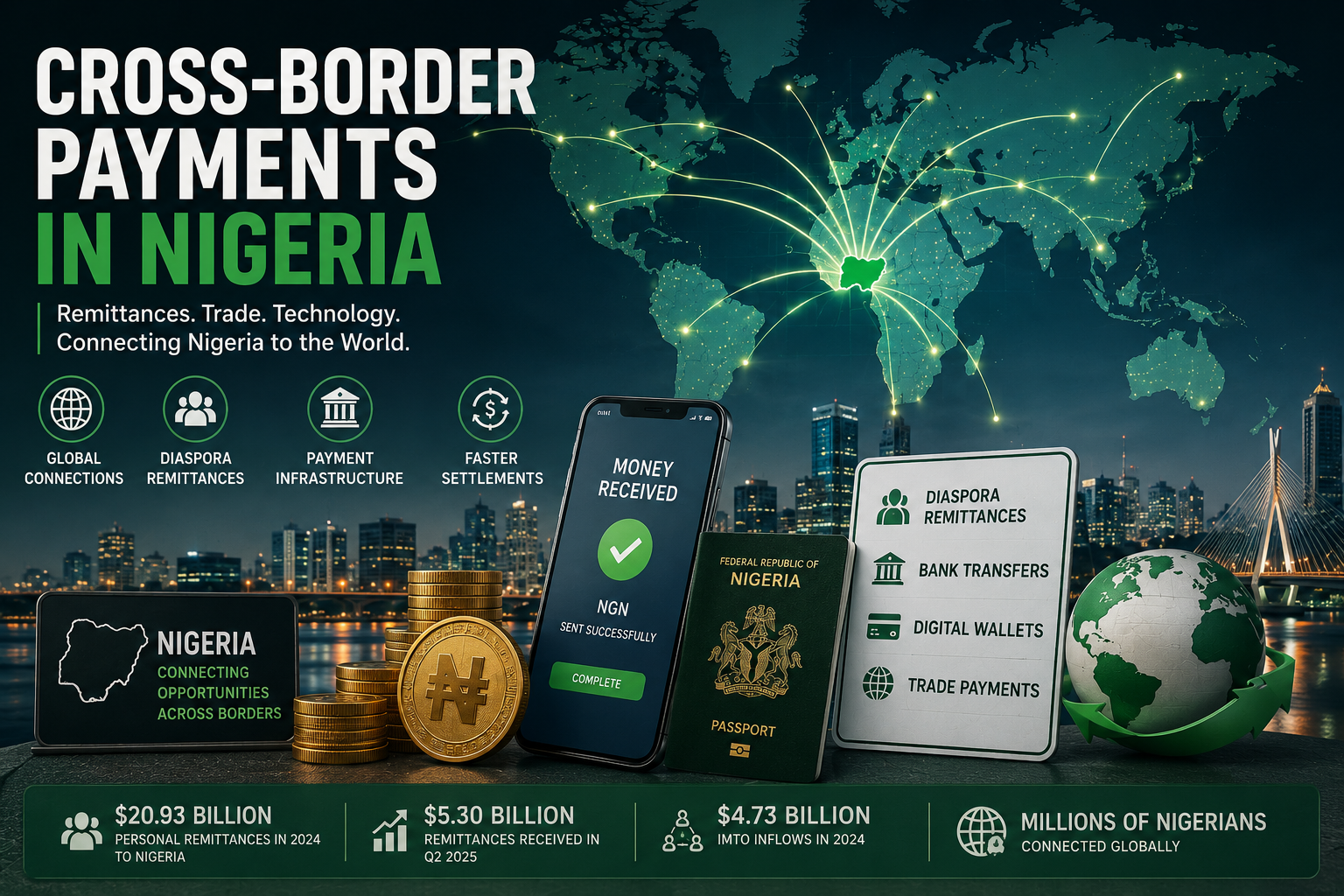
The latest detailed Central Bank of Nigeria data showed US$5.30 billion in workers' remittances in the second quarter of 2025. That was up 7.5% from US$4.93 billion in the first quarter.
For the full 2024 year, the CBN reported that personal remittances reached US$20.93 billion, while International Money Transfer Operator inflows rose 43.5% to US$4.73 billion.
Cross-border payments therefore matter far beyond sending money home.
They connect Nigeria with its diaspora. They support imports and exports. They make it possible for anyone to send money to Nigeria instantly.
They allow businesses to pay suppliers. They help families receive international transfers. They also sit at the centre of Nigeria's effort to connect more deeply with African and global financial markets.
The market is changing.
Banks remain important. SWIFT remains part of international payments. International Money Transfer Operators continue to handle inbound remittances.
But Nigeria is also building new routes.
The Pan-African Payment and Settlement System is expanding local-currency payments across Africa. The CBN launched new diaspora products and a remote BVN platform for non-resident Nigerians in 2025. In March 2026, it introduced additional rules for how IMTO remittance settlements must be handled in Nigeria.
This is the story of cross-border payments in Nigeria today.
Why Cross-Border Payments Matter in Nigeria
Nigeria's size makes international money movement strategically important.
The World Bank's latest country data shows Nigeria's economy reached US$290.79 billion in 2025.
The same World Bank data puts personal remittances received at 7.8% of GDP in 2025.
That creates a large and continuous flow of money into the country.
But remittances are only one part of the market.
Nigerian businesses also make international payments for inventory, technology, professional services and other imports.
Exporters need to receive payments from customers abroad.
African trade creates another layer.
The challenge has historically been that moving money between African countries could require several banks, several currencies and, in some cases, a hard currency in the middle of the transaction.
Nigeria's Remittance Market
US$20.93 Billion in Personal Remittances in 2024
The CBN reported that personal remittances increased 8.9% to US$20.93 billion in 2024.
That figure gives Nigeria one of the largest remittance markets in Africa.
The latest detailed quarterly CBN report also shows that workers' remittances reached US$5.30 billion in Q2 2025.
The previous quarter recorded US$4.93 billion.
The 7.5% quarter-on-quarter increase shows how quickly these flows can move.
Please note: State-backed initiatives attempt to map cross-border flows. But the free market has built alternative financial systems entirely out of stablecoin networks. Review our deep-dive analysis on Nigeria's stablecoin shadow currency infrastructure to see how commercial enterprises bypass central clearing blocks entirely.
IMTO Inflows Reached US$4.73 Billion
The CBN separately reported that IMTO inflows rose 43.5% to US$4.73 billion in 2024, compared with US$3.30 billion in 2023.
That was a significant increase.
The CBN linked stronger flows to deeper engagement with the Nigerian diaspora.
International Money Transfer Operators remain an important part of the official inbound remittance system.
The CBN maintains a public list of licensed IMTOs.
This matters because remittance customers need to distinguish regulated providers from informal channels.
How Nigerians Send and Receive Money Across Borders
Nigeria does not have one cross-border payment rail. Families, friends and businesses send money to Nigeria instantly through different payment types using different infrastructure.
A family remittance can move through an IMTO. A bank transfer can move through correspondent banking and SWIFT. An African payment can potentially use PAPSS through a connected financial institution.
The CBN notes that Nigeria's licensed banks are connected to the SWIFT network.
That gives Nigerian banks access to the global financial messaging system used for international payments.
However, SWIFT is not itself a single consumer payment product.
The actual cost, speed and foreign-exchange process depend on the banks and other institutions involved.
In addition to Nigeria, our experts have prepared a report about Cross-Border Payments in Uganda
The CBN's Remittance Rules
The 2024 IMTO Guidelines
Nigeria's current framework for international money transfer services is shaped by the CBN's Revised Guidelines for International Money Transfer Services.
The guidelines define what IMTOs can do in the Nigerian market.
One important point is that IMTO operations are focused on inbound international money transfers to persons resident in Nigeria.
Banks can act as agents for IMTOs under the framework, but the guidelines state that banks cannot themselves operate international money transfer services.
The rules are therefore designed around a specific regulatory structure rather than allowing every payments company to perform every international transfer function.
New Diaspora Remittance Measures in 2026
The regulatory framework continued to evolve in 2026.
The CBN announced additional rules for diaspora remittances in March 2026.
Under the updated direction, IMTOs must open designated naira settlement accounts with Authorised Dealer Banks in Nigeria.
Remittance-related transactions, including beneficiary payments and settlements, must be processed through those designated accounts.
IMTOs can maintain multiple settlement accounts with different Authorised Dealer Banks depending on business needs.
The CBN presented the changes as measures to deepen diaspora remittances while improving transparency and compliance.
Nigeria's Diaspora Payment Infrastructure Is Expanding
Remote BVN Access for Nigerians Abroad
In May 2025, the CBN and the Nigeria Inter-Bank Settlement System launched the Non-Resident Bank Verification Number platform.
The platform allows eligible Nigerians abroad to obtain a BVN remotely.
That matters for cross-border payments because identity and onboarding can be a major barrier when customers are outside Nigeria.
The same CBN reform programme introduced the Non-Resident Nigerian Ordinary Account and Non-Resident Nigerian Investment Account in January 2025.
The accounts were designed to give non-resident Nigerians a route to remit foreign earnings, manage funds and invest in Nigerian assets.
Cross-border payments are therefore increasingly connected with the wider question of how Nigeria serves its diaspora digitally.
PAPSS and Intra-African Payments
One of the biggest changes in African cross-border infrastructure is the Pan-African Payment and Settlement System.
PAPSS was introduced to support faster cross-border payments within Africa.
The CBN describes PAPSS as a centralised financial market infrastructure introduced in January 2022 to support fast and secure cross-border payments and settlement, including retail payments in local currencies.
The system addresses a long-standing problem.
A payment from Nigeria to another African country has historically not always moved directly from naira into the beneficiary's local currency.
A transaction could require conversion through a major external currency.
That can add cost, foreign-exchange friction and additional settlement steps.
PAPSS in Nigeria
PAPSS now has a dedicated Nigeria payment page.
The platform says it operates across 18 countries and four African regions.
For Nigerian users, the goal is straightforward.
A participant can initiate an eligible payment in naira and the beneficiary can receive funds in the relevant local currency.
PAPSS says cross-border payments can be processed within a maximum of 120 seconds.
Availability still depends on the participating banks and payment providers connected to the network.
That is an important distinction.
PAPSS is infrastructure.
Consumers and businesses access it through participating financial institutions rather than opening a generic PAPSS consumer account directly.
Nigeria's PAPSS Rules Were Simplified
The CBN also reduced documentation friction for some PAPSS payments.
Its 2025 update stated that basic KYC and AML documents would be sufficient for PAPSS payments up to US$2,000 per month for individuals and US$5,000 for companies.
The CBN said the change was intended to reduce unnecessary paperwork and make intra-African payments more accessible.
The same update said Nigerian commercial banks could source foreign exchange for PAPSS transactions through the official foreign-exchange market.
At the time of the CBN's May 2025 update, PAPSS had more than 150 commercial banks connected across its network, including 22 banks in Nigeria.
Network figures can change as PAPSS expands, so current availability should always be checked with the participating institution.
Cross-Border Trade Payments
Nigeria's cross-border payments market is also a trade infrastructure story.
A business importing goods needs a reliable way to pay a foreign supplier.
An exporter needs to receive money.
A small business trading within Africa can face particularly high friction when banks and currencies do not connect efficiently.
That is one reason PAPSS has become strategically important.
The CBN's Payments System Vision 2028, launched in June 2026, explicitly prioritises stronger cross-border integration and alignment with international standards.
The vision is not only about faster domestic payments.
It places Nigeria's payment system within a wider regional and global financial architecture.
What Cross-Border Payments Cost
There is no single Nigeria-to-world transfer price.
The cost depends on the corridor and the method.
A sender may pay an explicit transfer fee.
Foreign exchange can also create a separate cost.
The exchange rate offered to the customer may differ from a market reference rate.
Banks may charge intermediary or correspondent fees.
The receiving institution may also have charges.
That is why the cheapest option cannot be identified from the headline transfer fee alone.
The full cost includes the fee, the exchange rate and any additional deductions.
For businesses, payment certainty can matter as much as the visible price.
A low-cost transfer that is delayed by documentation, compliance reviews or correspondent banking issues can still create operational problems.
The Role of Foreign Exchange
Foreign exchange is central to Nigeria's cross-border payments market.
Most international transactions involve more than one currency.
That creates conversion risk and liquidity requirements.
The CBN's 2025 reform updates included measures affecting diaspora accounts, foreign-exchange market rules and PAPSS transactions.
By the end of 2025, the CBN reported that remittances and foreign capital inflows reached US$20.57 billion from January to October 2025, compared with US$3.90 billion in 2023.
That is a combined figure.
It should not be described as remittances alone.
The distinction matters because foreign capital inflows can include several categories beyond money sent by the diaspora.
Mobile Money, Fintechs and Digital Cross-Border Payments
Digital payments are changing the customer experience.
But cross-border infrastructure is harder than domestic payments.
A domestic fintech may move money instantly inside Nigeria because local payment rails are already connected.
An international transfer can involve exchange controls, foreign exchange, sanctions screening, anti-money-laundering checks and several financial institutions.
That is why cross-border expansion often requires partnerships.
A fintech may provide the customer interface while a bank, IMTO or licensed payment provider handles regulated parts of the transaction.
The growth of open banking, payment APIs and regional infrastructure could make these connections easier over time.
However, the underlying regulatory and settlement requirements still matter.
Stablecoins and Crypto in Cross-Border Payments
Stablecoins are increasingly part of the global conversation about cross-border payments.
They can move value across blockchain networks without using the same correspondent-banking chain as a conventional international wire.
But a blockchain transfer is not automatically the same as a regulated fiat payment.
A customer may still need to convert naira into a digital asset.
The recipient may later need to convert the digital asset into local currency.
Those entry and exit points can be regulated.
Nigeria's SEC and CBN frameworks therefore matter to companies building products that combine digital assets with payment services.
For Finlazo and other infrastructure businesses, the opportunity is not simply to move a token across a blockchain.
The harder problem is connecting digital liquidity with compliant local payment rails at both ends of a transaction.
The Main Challenges
Foreign Exchange Liquidity
Cross-border payments depend on access to currency.
Even when a payment network is technically fast, foreign-exchange availability can affect whether a transaction can be completed smoothly.
This is one reason local-currency settlement systems are strategically important for African trade.
Compliance and Documentation
International transfers must meet compliance requirements.
Customer identification, transaction monitoring and sanctions controls can add friction.
The CBN's 2025 PAPSS documentation changes were significant because they reduced requirements for lower-value transactions within specified thresholds while maintaining basic KYC and AML requirements.
Fragmented African Payment Infrastructure
Africa still has many currencies and payment systems.
A business can trade across the continent while its payment infrastructure remains fragmented.
PAPSS is designed to reduce some of that fragmentation.
Its success, however, depends on continued participation by central banks, commercial banks, payment providers and users.
Key Nigeria Cross-Border Payment Numbers
- US$20.93 billion — personal remittances received in 2024, according to the CBN.
- 8.9% — year-on-year growth in personal remittances in 2024.
- US$4.73 billion — IMTO inflows in 2024.
- 43.5% — growth in IMTO inflows in 2024.
- US$5.30 billion — workers' remittances in Q2 2025.
- 7.5% — quarter-on-quarter increase in workers' remittances in Q2 2025.
- 7.8% of GDP — personal remittances received in Nigeria in 2025, according to World Bank data.
- US$2,000 per month — PAPSS documentation threshold cited by the CBN for individuals under the simplified requirements.
- US$5,000 per month — PAPSS documentation threshold cited by the CBN for companies under the simplified requirements.
- 120 seconds — maximum processing time stated by PAPSS for cross-border payments.
- May 2025 — launch of Nigeria's remote BVN platform for non-resident Nigerians.
- March 2026 — additional CBN rules announced for IMTO diaspora remittance settlements.
- June 2026 — launch of the CBN's Payments System Vision 2028.
Each figure refers to a specific metric or framework. They should not be added together or treated as measuring the same type of payment flow.
The Outlook for Cross-Border Payments in Nigeria
Nigeria's cross-border payments market is becoming more digital and more structured.
Diaspora remittances remain a major source of foreign currency.
The CBN is updating the framework for IMTO settlements.
Non-resident Nigerians now have more digital routes into the financial system.
PAPSS is creating a new option for African local-currency payments.
The Payments System Vision 2028 puts stronger regional and global integration directly inside Nigeria's payment strategy.
The next phase will depend on execution.
Infrastructure needs more connected institutions.
Businesses need reliable foreign-exchange access.
Consumers need transparent pricing.
Regulators need to balance innovation with financial integrity.
The direction is clear.
Nigeria is moving beyond a cross-border payments system built around only traditional banks and international wires.
The future market will likely combine banks, IMTOs, fintechs, regional payment infrastructure and, where regulation permits, digital-asset infrastructure.
For users, the choice will increasingly be about the right rail for the right transaction.
For businesses, cross-border payments are becoming part of product design, not simply a back-office function.