Cross-Border Payments in Uganda: Remittances, Mobile Money and the 2026 Market
Explore cross-border payments in Uganda in 2026, including remittances, mobile money, digital transfers, stablecoins, regional payment infrastructure and the latest market data.

On this page
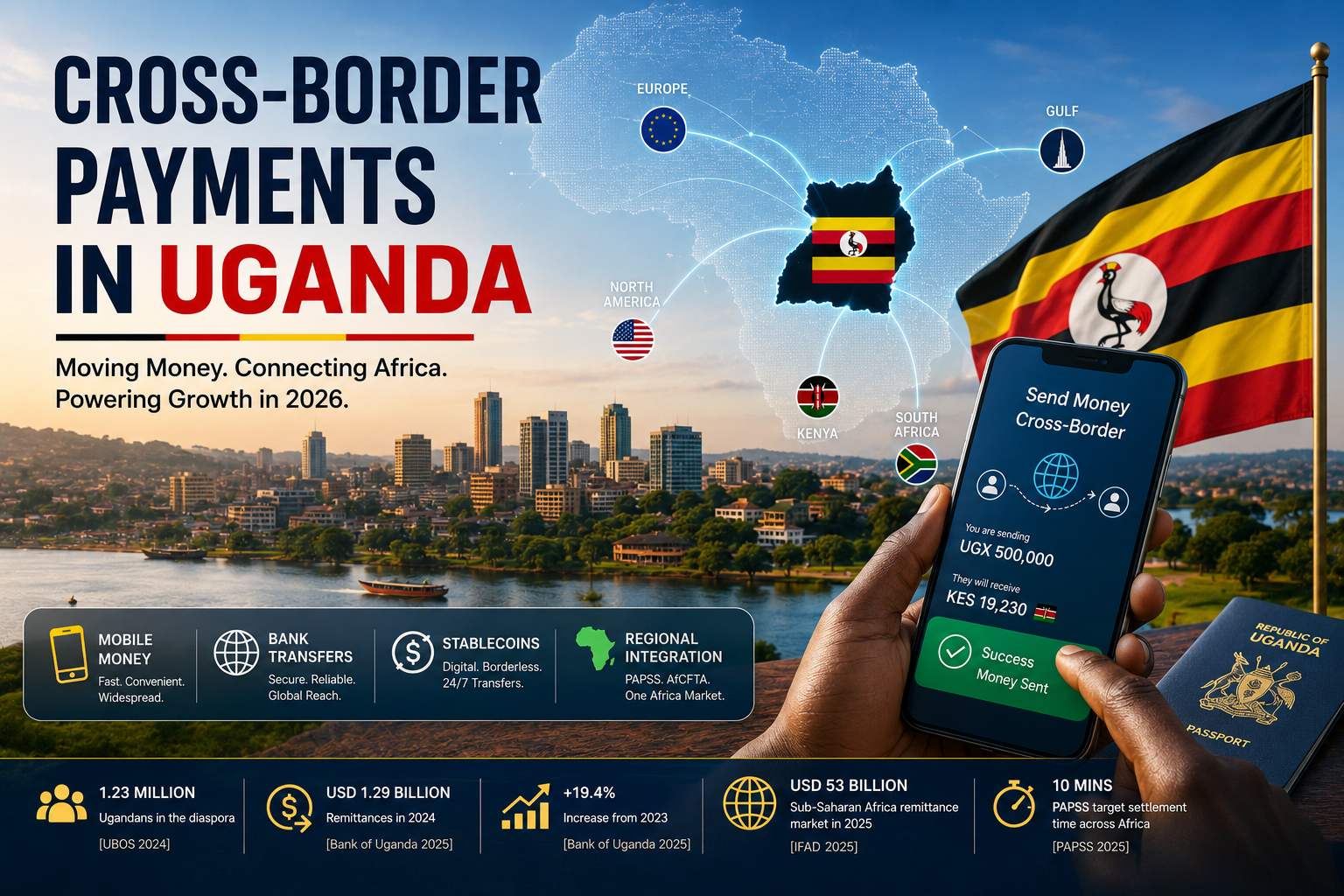
Uganda's cross-border payments market is becoming more digital, more measurable and more important to the wider economy.
New Bank of Uganda and IFAD data shows that Uganda received US$2.5 billion in remittances in 2025. That was equal to about 3.8% of GDP.
The country recorded more than 16 million remittance transactions. The average transfer was US$152.
Digital channels handled 73% of inbound remittances. Mobile money alone accounted for nearly 61% of remittance receipts.
Uganda also sent US$402 million abroad in 2025. The main destination countries included India, Kenya, the United States, the United Kingdom and Canada.
These figures show why cross-border payments matter.
Uganda is not simply a market receiving money from its diaspora. Businesses, workers, families and institutions are moving money in both directions.
The infrastructure is also growing. The Uganda Communications Commission reported 47.1 million active mobile subscriptions and 36.3 million active mobile-money subscriptions at December 2025.
Cross-border payments are therefore entering a market where digital money is already part of everyday life.
Uganda's Cross-Border Payments Market Is Getting Clearer
For years, remittance data was often fragmented.
Policymakers could measure broad inflows. But detailed information about corridors, transaction channels and payment behaviour was harder to see.
That is beginning to change.
In April 2026, the Bank of Uganda and IFAD launched an interactive remittance dashboard.
The system is based on more detailed reporting from licensed remittance service providers.
That matters because better data changes how a market can be understood.
Uganda can now see more clearly where money is coming from, where it is going and how it reaches the final recipient.
US$2.5 Billion Came Into Uganda in 2025
Remittance inflows reached US$2.5 billion in 2025.
The United States was the largest source. It sent US$702 million, or 28% of total inflows.
Saudi Arabia, the United Kingdom, the United Arab Emirates and Canada followed among the major sending markets.
More than 16 million inbound remittance transactions were recorded during the year.
The average transaction was US$152.
That detail is important.
Uganda's remittance market is not built only around large transfers. It also processes millions of smaller payments.
These transfers can support household expenses, education, healthcare and other everyday needs.
Uganda Also Sends Money Abroad
Uganda is a net recipient of remittances. But outbound payments are still significant.
The Bank of Uganda's 2025 remittance data recorded US$402 million in outflows.
The main destinations included India, Kenya, the United States, the United Kingdom and Canada.
That creates a different set of payment needs.
A person sending money abroad may need to pay family, tuition, suppliers or service providers.
A business may need to settle invoices across borders.
The payment problem is therefore broader than diaspora remittances.
Mobile Money Is Changing How Uganda Receives International Payments
One of the clearest findings from the new data is the role of digital channels.
In 2025, 73% of Uganda's inbound remittance value was received digitally.
Only 27% was received through cash-based channels.
Mobile money was the largest digital channel. It accounted for nearly 61% of remittance receipts.
That is a major shift from the traditional model.
For many years, receiving money from abroad often meant collecting cash from an agent location.
The recipient had to travel to a branch or outlet. Opening hours could matter. Location could matter.
Digital delivery changes that journey.
The money can move from an international payment provider into a digital financial account.
Uganda Already Has a Large Mobile-Money Base
The domestic infrastructure behind this shift is substantial.
The Uganda Communications Commission reported 36.3 million active mobile-money subscriptions at December 2025.
Uganda also had 47.1 million active mobile subscriptions and 18.5 million internet subscriptions.
Those figures do not mean every subscription belongs to a unique person.
They do show the scale of the infrastructure.
A cross-border payment provider entering Uganda does not need to teach the entire market how digital balances work.
Mobile money is already familiar.
The harder challenge is connecting international payment networks efficiently to local rails.
Why Cross-Border Payments Still Have Friction
Sending money across a border is more complicated than sending money domestically.
A domestic transfer can remain inside one currency, one payment system and one regulatory environment.
An international transfer may involve several.
The sender's payment provider may first collect funds in one country.
A correspondent bank, payment network or other intermediary may then move the value.
Currency conversion may happen before or after the transfer.
The recipient's provider must finally deliver the funds into a local account, bank or mobile wallet.
Each step can add friction.
Foreign Exchange Is Part of the Problem
A transfer fee is only one part of the cost.
Foreign-exchange conversion can also affect the final amount received.
The sender may see one exchange rate. The recipient may receive another effective rate after spreads and charges.
That is why a low advertised transfer fee does not always mean the cheapest total transaction.
The complete payment needs to be considered.
That includes the collection cost, foreign-exchange rate, transfer fee and the cost of the final payout.
Speed Depends on the Whole Payment Journey
A payment can be processed quickly on one network while the overall journey remains slow.
The receiving institution may have cut-off times.
Compliance checks may delay a transfer.
The final payout rail may not operate at the same speed as the first leg.
This distinction is increasingly important as new payment technologies enter the market.
The relevant question is not simply how fast money moves through one system.
It is how long it takes from the sender's account to the recipient's usable balance.
Uganda's Digital Payment Market Is Growing
Cross-border payments are entering a domestic market with rapidly expanding electronic transactions.
In February 2026, the Bank of Uganda's Deputy Governor said electronic-money transaction value rose 28% in 2025.
The value increased from Shs285.9 trillion in the 12 months to December 2024 to Shs366 trillion in the year to December 2025.
Transaction volume rose 17.3%.
It increased from 7.8 billion to 9.1 billion transactions.
These are domestic electronic-money figures. They should not be confused with cross-border remittance flows.
But they provide important context.
Uganda is processing more digital payments overall.
That creates a larger foundation for payment providers that want to connect local and international money movement.
The Main Ways Money Moves Into and Out of Uganda
There is no single cross-border payment rail.
Different transactions use different systems.
International Money Transfer Operators
Traditional remittance providers remain important.
They can offer cash collection, bank deposits, digital wallet delivery or combinations of these methods.
Their strength is reach.
The challenge can be cost, foreign-exchange spreads and the complexity of maintaining physical distribution networks.
Bank Transfers
Banks remain essential for larger payments and business transactions.
International bank transfers can support trade, supplier payments and institutional transfers.
They may also provide stronger integration with business accounts.
But correspondent banking and foreign-exchange processes can add cost and time.
Mobile Money
Mobile money has become a major destination for inbound remittances.
Its biggest advantage is local reach.
A recipient can receive value into an account already used for domestic payments.
This reduces the need for a separate cash-collection trip.
The next opportunity is deeper interoperability between international payment providers and mobile-money systems.
Fintech Payment Networks
Fintech companies are building new ways to collect, convert and deliver funds.
Some focus on specific remittance corridors.
Others build business payment infrastructure.
The strongest products are usually not defined only by technology.
They solve a complete payment problem.
They handle collection, compliance, foreign exchange and final delivery.
Stablecoin-Based Settlement
Stablecoins are another possible settlement layer.
A provider can potentially use blockchain infrastructure to move value between markets before converting it into local currency.
That does not automatically make the consumer payment instant or cheap.
The complete transaction still depends on liquidity, compliance, conversion and the final payout rail.
For Uganda, the Bank of Uganda has noted the use of stablecoins for remittances and cross-border payments.
The technology is therefore already relevant to the policy discussion.
Regional Payment Infrastructure Could Change African Transfers
Uganda's cross-border payment future is also connected to regional infrastructure.
Africa has historically operated through fragmented national payment systems.
Moving money from one African country to another can sometimes require routing through external currencies or multiple correspondent relationships.
That creates cost and complexity.
The Pan-African Payment and Settlement System was designed to address part of this problem.
PAPSS connects participating banks, payment service providers and financial intermediaries.
Its objective is to support cross-border payments in local currencies.
The system can enable an originator to initiate a payment in one African currency while the beneficiary receives funds in another local currency.
Why Local-Currency Settlement Matters
A regional payment does not always need to pass through a third currency in the same way as a conventional international transfer.
Reducing unnecessary conversion steps could lower friction.
It could also simplify settlement for businesses trading across African markets.
The practical impact depends on participation.
Infrastructure only becomes useful when banks, payment providers and countries connect to it.
Uganda's broader opportunity will therefore depend on the development of both regional systems and local access points.
Cross-Border Payments Matter for Trade Too
Remittances receive much of the public attention.
Trade payments are equally important.
A Ugandan importer may need to pay a supplier in Kenya, China, the United Arab Emirates or another market.
An exporter may need to receive payment from abroad.
Small and medium-sized businesses often face the same cross-border payment problems as large companies.
They need reliable collection.
They need foreign-exchange access.
They need predictable settlement.
They also need payment records that support accounting and compliance.
This is where payment infrastructure can have a broader economic impact.
Better consumer remittances are valuable.
Better business payments can also support regional trade and commerce.
What a Good Cross-Border Payment Experience Looks Like
The best payment experience is not simply the fastest transaction on paper.
It should solve several problems at once.
Clear Pricing
The sender should understand the total cost.
That includes the transfer fee and the effective exchange rate.
Hidden costs create mistrust.
Reliable Delivery
The recipient should receive the payment through a usable rail.
In Uganda, that can mean a bank account, mobile-money account or another regulated payment channel.
Strong Compliance
Cross-border payments cannot operate without controls.
Providers need to identify customers, monitor transactions and comply with applicable anti-money-laundering requirements.
Poor compliance can delay payments or create larger risks for the entire network.
Fast Final Settlement
Speed should be measured from start to finish.
The payment is not complete simply because an intermediary has processed its part.
The recipient must actually be able to use the funds.
The Role of Crypto and Stablecoins
Crypto is unlikely to replace every cross-border payment rail.
That is not necessary for the technology to matter.
Stablecoins could become one settlement option inside a broader payment stack.
For example, a payment provider could collect local currency from a sender.
The provider could use a digital asset as part of the international settlement process.
The recipient could then receive local currency through a bank or mobile-money rail.
The customer may never need to hold the stablecoin directly.
That model is different from asking consumers to replace their local currency with crypto.
The focus is infrastructure.
The Challenge Is the On-Ramp and Off-Ramp
Moving value on a blockchain can be quick.
Entering and leaving the system is often the harder part.
A provider needs reliable local collection.
It needs liquidity.
It needs compliant conversion.
It needs a final payout network.
Uganda's large mobile-money ecosystem could become important here.
The value of a new settlement layer increases when it connects efficiently to a payment method people already use.
Uganda's Cross-Border Payment Numbers in 2026
- US$2.5 billion — remittance inflows in 2025.
- 3.8% of GDP — approximate economic value of those inflows.
- 16 million+ — remittance transactions recorded in 2025.
- US$152 — average remittance transaction value.
- 73% — share of inbound remittances received through digital channels.
- Nearly 61% — share of remittance receipts delivered through mobile money.
- US$402 million — remittance outflows from Uganda in 2025.
- 36.3 million — active mobile-money subscriptions at December 2025.
- 47.1 million — active mobile subscriptions at December 2025.
- Shs366 trillion — electronic-money transaction value in Uganda during 2025.
- 9.1 billion — electronic-money transactions recorded during 2025.
The Outlook
Uganda's cross-border payments market is becoming more digital.
The latest official data makes that clear.
Remittances reached US$2.5 billion in 2025. Most inbound value arrived through digital channels.
Mobile money has become a major part of the final delivery system.
At the same time, outbound payments show that Uganda is connected to multiple international corridors.
The next stage will be about better infrastructure.
Providers will compete on cost, foreign exchange, speed and local reach.
Regional systems could reduce some of the friction around African payments.
Stablecoins could become another settlement tool.
But technology alone will not solve the problem.
The winning systems will still need liquidity, compliance and reliable local payout.
That is Uganda's real cross-border payment opportunity.
Not simply moving money faster.
Building a system where money can move across borders and arrive where people and businesses actually need it.