Mauritius Cross-Border Payments: Remittances, Trade, Banking and Regional Payment Infrastructure
Mauritius moves substantial value across borders through tourism, trade, remittances and financial services. Explore its payment networks, transfer costs, local-currency settlement and digital infrastructure.

On this page
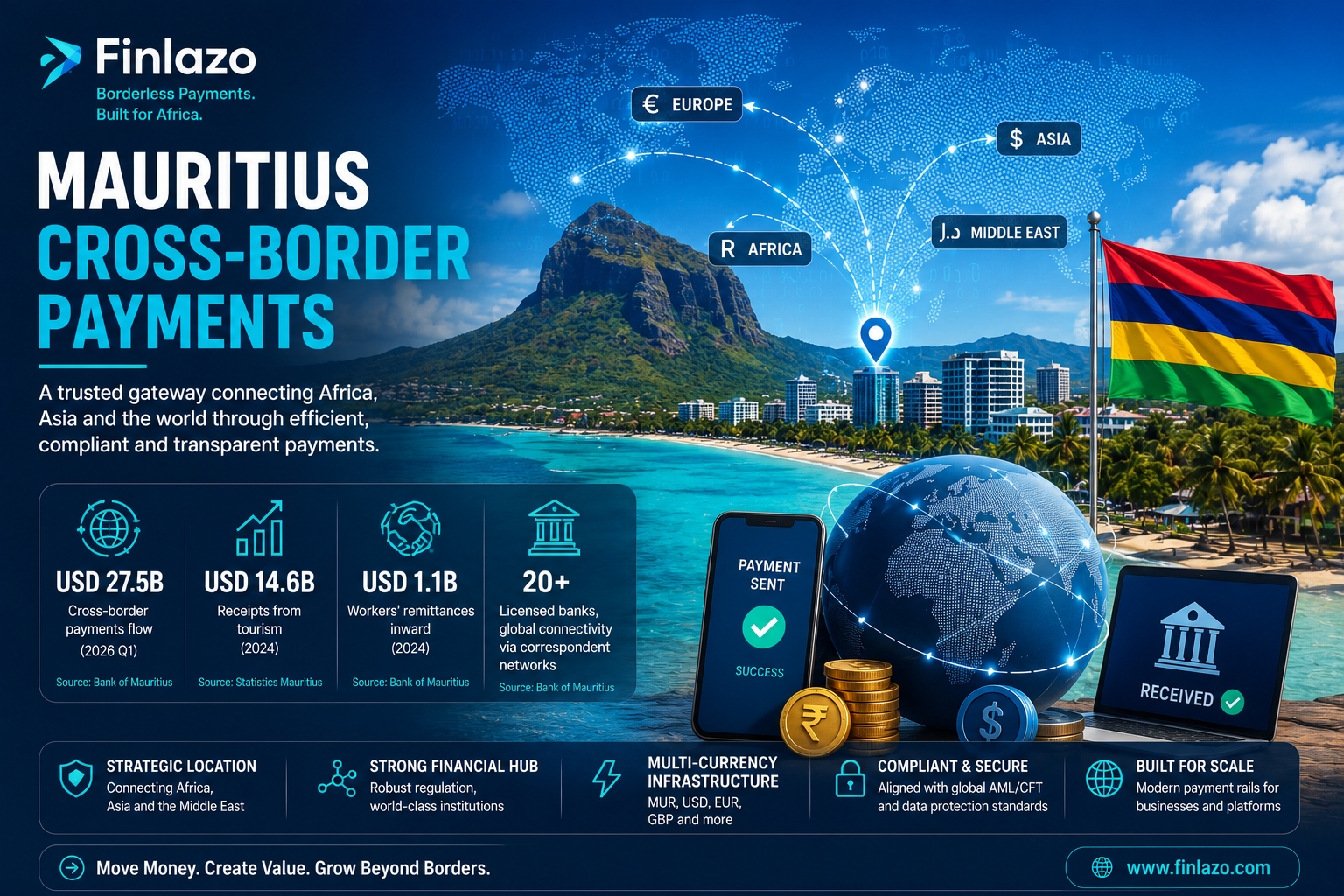
Mauritius is deeply connected to international money flows.
In the first quarter of 2026, the Bank of Mauritius recorded Rs98.6 billion in services credits and Rs65.9 billion in goods imports on a balance-of-payments basis.
Remittances add another layer. Inward workers' remittances reached Rs702 million in 2026Q1, while outward workers' remittances reached Rs2.786 billion.
Tourism is another major source of international payments. Statistics Mauritius recorded 348,445 tourist arrivals in the first quarter of 2026, up 6.8% from the same period in 2025.
These flows all depend on payment infrastructure.
A visitor pays a hotel.
A company settles an overseas invoice.
A worker sends money home.
A Mauritian business receives money from another country.
The customer sees a payment.
Behind it sits a network of banks, foreign-exchange providers, payment systems and settlement infrastructure.
Mauritius Cross-Border Payments at a Glance
- Rs702 million — inward workers' remittances in the first quarter of 2026.
- Rs2.786 billion — outward workers' remittances in the first quarter of 2026.
- Rs98.6 billion — services credits in the first quarter of 2026.
- Rs65.9 billion — goods imports on a balance-of-payments basis in the first quarter of 2026.
- Rs30.2 billion — travel-service credits in the first quarter of 2026.
- Rs33.6 billion — financial-services credits in the first quarter of 2026.
- 348,445 — tourist arrivals in the first quarter of 2026.
- 6.8% — annual increase in tourist arrivals in the first quarter of 2026.
- 1.1% — average commission charged by domestic banks and foreign-exchange dealers on outward workers' remittances in 2026Q1.
- 0.05% — overall average charge on inward workers' remittances in 2026Q1.
- 124.8 million — mobile-banking transactions in June 2025.
- Rs292.7 billion — value of mobile-banking transactions in June 2025.
These figures describe different parts of Mauritius' international payment economy.
They should not be added together as a single measure of cross-border payment volume.
A Personal Reason I Started Looking at Mauritius
I became interested in Mauritius while looking for a two- or three-day holiday destination along the Indian Ocean.
The beaches immediately caught my attention.
I wanted to visit.
At the same time, I started thinking about something more practical.
I wondered how I would pay my small business team while I was there.
Would I be able to make cross-border payments easily?
Could I send money from Mauritius to Kenya without creating unnecessary steps?
Those questions pushed me to look more closely at the country's payment infrastructure.
I did not end up making the trip.
Political developments at the time also made me reconsider the plans.
But the payment question stayed with me.
It is a useful reminder that cross-border payments are not only a banking issue.
They are also a real-world user-experience issue.
A person can have money available and still struggle to get it to the right account or wallet.
Why Cross-Border Payments Matter to Mauritius
Mauritius is an island economy with strong international links.
It imports goods.
It sells services abroad.
It receives tourists.
It hosts businesses with international operations.
Money therefore crosses the country's borders in both directions.
The Bank of Mauritius recorded a Rs40.8 billion goods-account deficit in the first quarter of 2026.
At the same time, the services account generated a Rs35.0 billion surplus.
That contrast matters.
Mauritius needs efficient channels for both incoming and outgoing international payments.
Tourism Creates a Large Payment Flow
Tourism is one of the clearest examples.
Statistics Mauritius recorded 348,445 tourist arrivals during the first quarter of 2026.
That was 6.8% higher than the 326,389 arrivals recorded in the first quarter of 2025.
Tourists pay for accommodation, transport, food, activities and other services.
Those transactions create foreign-currency inflows.
The Bank of Mauritius recorded Rs30.2 billion in travel-service credits in the first quarter of 2026.
The tourism payment chain can involve international cards, banks, payment gateways and foreign-exchange conversion.
The visitor may see one card transaction.
The underlying settlement can involve several institutions.
Trade Also Depends on Cross-Border Payments
Tourism brings money into Mauritius.
Trade sends large amounts back out.
In the first quarter of 2026, goods debits reached Rs65.9 billion.
Imports create payment obligations for Mauritian companies.
An importer may need to pay a supplier in another currency.
The company may use a commercial bank for the transfer.
The bank may then rely on correspondent-banking infrastructure and foreign-exchange markets.
A delay can affect inventory and working capital.
A poor exchange rate can increase the cost of the underlying goods.
Remittances Are Another Cross-Border Flow
Workers' remittances provide a more direct example of person-to-person international payments.
The latest Bank of Mauritius data show that inward workers' remittances reached Rs702 million in 2026Q1.
Outward workers' remittances were much larger at Rs2.786 billion.
The bank said inward remittances mainly originated from France, the United Kingdom and the United States.
India and Bangladesh were the top two destinations for outward workers' remittances.
The data cover formal channels.
The Bank of Mauritius notes that its remittance statistics exclude transfers made in kind or carried by hand.
The Cost of Sending Money From Mauritius
Mauritius performs relatively well on formal remittance pricing.
The Bank of Mauritius reported an overall average charge of 1.1% on outward workers' remittances in 2026Q1.
Individual reporting entities ranged from zero to 2.2%.
For inward workers' remittances, the overall average charge was just 0.05%.
Individual reporting entities ranged from zero to 0.3%.
These figures measure formal remittance charges reported by banks and foreign-exchange dealers.
They should not be treated as a universal price for every international transfer from Mauritius.
Fees Are Not the Whole Cost
A low transfer fee does not automatically mean a cheap international payment.
The exchange rate also matters.
A provider can charge a small visible fee while offering a less favourable conversion rate.
Correspondent charges can add another cost.
Receiving institutions can also impose their own fees.
That is why the useful comparison is the amount the recipient finally receives.
The Bank of Mauritius specifically tracks remittance charges as part of its work on the UN Sustainable Development Goal of reducing migrant-remittance costs below 3%.
Mauritius Has a Strong Digital-Banking Base
Cross-border payment infrastructure works better when the domestic system is already digital.
Mauritius has a relatively developed banking environment.
The Bank of Mauritius Annual Report 2024/25 recorded 124.8 million mobile-banking transactions in June 2025.
The value of those transactions reached Rs292.7 billion.
That was a 37.1% increase in mobile-banking transaction volume from June 2024.
Transaction value increased 49.2% over the same period.
These are domestic and banking-system figures.
They are not cross-border transactions.
They show the digital infrastructure that consumers and businesses already use before they make an international payment.
Mauritius and Regional Payment Systems
Mauritius is not dependent on one international payment rail.
The Bank of Mauritius says it serves as the settlement bank for the COMESA Regional Payment and Settlement System, or REPSS.
Mauritius also participates in SADC payment infrastructure.
The SADC-RTGS system supports regional wholesale settlement between participating financial institutions.
The TCIB scheme provides instant or near-real-time clearing for eligible low-value transactions within participating SADC markets.
These systems address different payment needs.
REPSS supports regional settlement across COMESA.
SADC-RTGS focuses on wholesale settlement.
TCIB is designed for lower-value real-time payments.
Mauritius and PAPSS
PAPSS is another important part of Africa's changing payments landscape.
The Pan-African Payment and Settlement System is designed to support cross-border payments in African local currencies.
The Bank of Mauritius now places PAPSS alongside REPSS, SADC-RTGS and TCIB as complementary components of the regional payment ecosystem.
In a 2026 speech on cross-border payments, the Governor described these systems as building blocks for a broader African payments ecosystem.
That matters for Mauritius because the country sits between African, Asian and international financial networks.
A more connected African payment system can create additional routes for trade and settlement.
Mauritius and India: Local-Currency Settlement
India is one of Mauritius' most important international financial partners.
In March 2025, the Bank of Mauritius and Reserve Bank of India signed an MoU to promote the use of the Mauritian rupee and Indian rupee in bilateral transactions.
The planned INR-MUR Local Currency Settlement System is intended to reduce dependence on hard currencies for eligible cross-border transactions.
The framework can support trade settlement, investment, remittances and financial-market development.
Local-currency settlement can reduce unnecessary conversion steps.
It can also create a more direct payment relationship between two economies.
Mauritius Has Also Strengthened RMB Infrastructure
China is another important financial connection.
In June 2025, Bank of China (Mauritius) was officially launched as the RMB clearing bank in Mauritius.
The Bank of Mauritius said the arrangement was intended to support trade, investment and cross-border transactions denominated in renminbi.
This expands the range of currencies that can be supported through dedicated financial infrastructure.
It also reinforces Mauritius' role as an international financial centre.
Cross-Border Banking Is Material to Mauritius
The country's banking sector itself has substantial international exposure.
The Bank of Mauritius Financial Stability Report reported that cross-border funding accounted for 26.5% of banks' total funding at end-June 2025.
About 59% of cross-border funds were deployed in advanced economies.
The remaining funds were distributed across Africa, Asia and the Middle East.
This matters because cross-border payments do not operate independently from the banking system.
Banks need funding.
They need liquidity.
They need correspondent relationships.
They also need controls for external financial risks.
What Happens Between the Sender and Recipient?
A conventional cross-border payment can involve several layers.
The sender's bank receives the instruction.
The bank checks the transaction.
Foreign exchange may be applied.
A correspondent or regional settlement system may carry the payment.
The receiving bank then credits the beneficiary.
Each layer has a role.
Each can also introduce delay, cost or compliance requirements.
Modern payment infrastructure aims to simplify that chain.
The customer should not need to understand every institution involved.
Why Interoperability Matters
Mauritius has several payment systems.
That is useful.
But it can also create fragmentation if the systems cannot connect efficiently.
The Bank of Mauritius has warned that more payment infrastructures can sometimes increase fragmentation rather than reduce it.
Its 2026 cross-border payments speech emphasised interoperability, common standards and regulatory coordination.
That is the bigger challenge.
Building a payment rail is only the first step.
Connecting payment rails is what makes a cross-border ecosystem useful.
Where Mobile Money Could Fit
Mobile money can make the receiving side easier for consumers.
A recipient may prefer funds in a mobile wallet rather than a bank account.
That is particularly relevant across Africa.
Kenya provides one of the strongest examples. See Kenya cross-border payments for the country's remittance, mobile-money and regional-payment ecosystem.
For Mauritius, the opportunity would be to connect international payment infrastructure with the destination account or wallet.
The customer experience then becomes much simpler.
Send.
Receive.
Use.
Could Digital Assets Add Another Settlement Layer?
Stablecoins are increasingly discussed as a possible settlement technology.
They can move value on blockchain networks without following every traditional correspondent-banking step.
But blockchain settlement does not eliminate the need for fiat infrastructure.
The sender still needs an on-ramp.
The recipient may need an off-ramp.
Liquidity is required.
Compliance is required.
The legal framework also matters.
For the wider African picture, see why stablecoins could transform cross-border payments in Africa.
Mauritius is particularly interesting because it has both a developed financial sector and an established virtual-asset regulatory framework.
That creates the possibility of connecting traditional finance with new settlement technologies.
What Businesses Should Look For
A business sending money internationally should compare more than one variable.
Look at:
- Total transfer cost.
- Exchange-rate spread.
- Settlement time.
- Payment destination.
- Supported currencies.
- Compliance requirements.
- Transaction limits.
- Availability of local payout rails.
- Payment confirmation and reconciliation.
A cheaper headline fee is not enough.
A faster transaction is not enough either.
The best payment route is the one that balances cost, speed, reliability and compliance.
Mauritius Cross-Border Payments Statistics
- Rs702 million — inward workers' remittances in 2026Q1.
- Rs2.786 billion — outward workers' remittances in 2026Q1.
- 1.1% — average commission on outward workers' remittances in 2026Q1.
- 0.05% — overall average charge on inward workers' remittances in 2026Q1.
- Rs98.6 billion — services credits in 2026Q1.
- Rs65.9 billion — goods debits in 2026Q1.
- Rs30.2 billion — travel-service credits in 2026Q1.
- Rs33.6 billion — financial-services credits in 2026Q1.
- 348,445 — tourist arrivals in 2026Q1.
- 6.8% — growth in tourist arrivals year on year in 2026Q1.
- 124.8 million — mobile-banking transactions in June 2025.
- Rs292.7 billion — mobile-banking transaction value in June 2025.
- 26.5% — share of banks' total funding represented by cross-border funding at end-June 2025.
- 59% — share of cross-border funds deployed in advanced economies at end-June 2025.
Frequently Asked Questions
What are cross-border payments in Mauritius?
Cross-border payments are transactions that move money between Mauritius and another country. They include remittances, trade payments, tourism-related transactions, business transfers, salaries and investment-related flows.
How much does it cost to send money from Mauritius?
Costs vary by provider, destination and payment method. The Bank of Mauritius reported an average commission of 1.1% for outward workers' remittances in the first quarter of 2026, although individual entities ranged from zero to 2.2%.
Can I send money from Mauritius to Kenya?
Yes, depending on the bank or regulated payment provider and the payment route available. Customers should compare the exchange rate, fees, destination account or wallet and expected delivery time.
What payment systems connect Mauritius to other countries?
Mauritius participates in regional and international payment infrastructure including REPSS, SADC-RTGS and TCIB. It is also part of the growing African payment ecosystem around PAPSS.
Does Mauritius support local-currency cross-border payments?
Mauritius is developing more local-currency settlement arrangements. In 2025, the Bank of Mauritius and Reserve Bank of India signed an MoU to promote the use of the Mauritian rupee and Indian rupee for eligible bilateral transactions.
The Bottom Line
Mauritius has a highly international economy.
The numbers make that clear.
In the first quarter of 2026, services credits reached Rs98.6 billion. Tourist arrivals reached 348,445.
Inward workers' remittances were Rs702 million.
Outward workers' remittances were Rs2.786 billion.
These are different payment flows.
They share one requirement.
Money has to move reliably across borders.
Mauritius already has several pieces of that infrastructure.
Its banking system connects to international networks.
The country participates in REPSS and SADC payment systems.
It is developing stronger local-currency links with India.
It has also strengthened its RMB clearing infrastructure.
The next challenge is interoperability.
Customers should not have to understand which network processes their payment.
They should know the cost.
They should know the exchange rate.
They should know when the money will arrive.
That is what a truly efficient cross-border payment system should deliver.