Cross-Border Payments in Egypt: Remittances, International Transfers and Digital Settlement
Explore cross-border payments in Egypt, including record remittances, international money transfers, digital wallets, InstaPay, foreign exchange, payment costs and the future of digital settlement.

On this page
Egypt is one of Africa's most important cross-border payments markets.
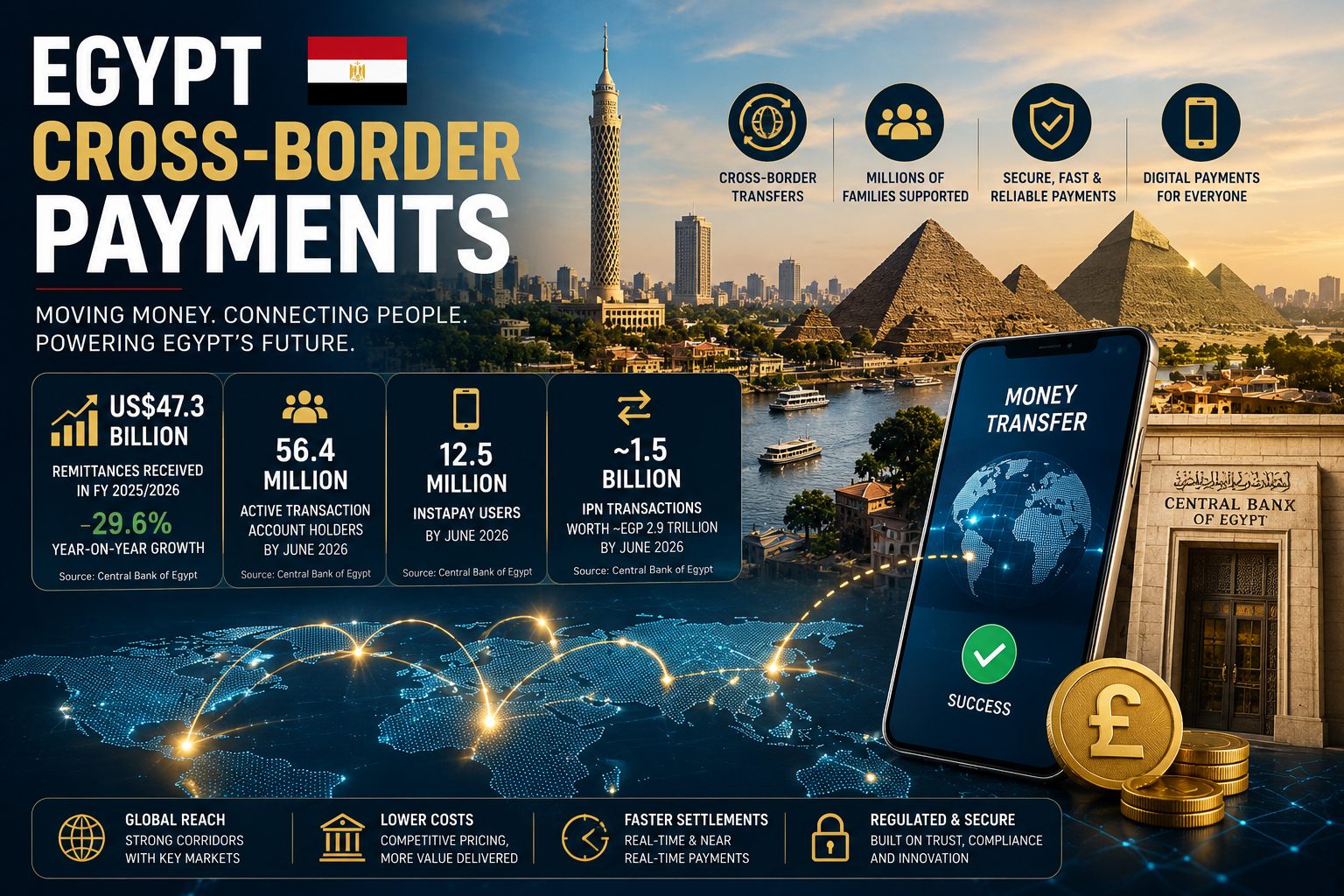
The latest figures show why. Remittances from Egyptians working abroad reached a record US$47.3 billion during FY 2025/2026, up 29.6% from US$36.5 billion in FY 2024/2025, according to the Central Bank of Egypt.
The flow continued to grow even at the end of the fiscal year. In June 2026 alone, remittances reached approximately US$4.2 billion, up 15.6% year on year.
Egypt's domestic payment infrastructure is also becoming increasingly digital. By the end of June 2026, 79% of eligible Egyptians — 56.4 million people — owned active transaction accounts, including bank accounts, postal accounts, mobile wallets and prepaid cards, according to the Central Bank of Egypt.
These figures matter because cross-border payments do not begin and end at an international transfer.
The sender needs a way to pay. The payment needs to cross borders. Foreign currency may need to be exchanged. The recipient needs a way to receive and use the money.
Egypt's cross-border payments market therefore sits at the intersection of remittances, banks, exchange companies, payment networks, digital wallets, instant payments, foreign exchange and international trade.
Why Egypt Is One of Africa's Biggest Cross-Border Payments Markets
Egypt has a large population, a substantial diaspora and workforce living abroad, major foreign-currency inflows from remittances, and extensive trade relationships with Europe, the Gulf, Asia and Africa.
That creates several different cross-border payment flows.
Remittances Into Egypt
The most visible flow is money sent home by Egyptians working abroad.
The Central Bank of Egypt reported record remittance inflows of US$47.3 billion during FY 2025/2026, compared with US$36.5 billion during FY 2024/2025.
That US$10.8 billion increase shows how important formal international payment channels have become to Egypt's foreign-currency economy.
International Trade Payments
Cross-border payments are also essential to Egyptian importers and exporters.
Businesses need to settle invoices with suppliers in foreign currencies and collect payments from customers abroad.
The Central Bank of Egypt's balance-of-payments data showed that Egypt's transactions with the external world remained substantial during July to March of FY 2025/2026, when the current-account deficit reached US$14.6 billion while the capital and financial account recorded net inflows of US$9.9 billion.
Diaspora and Personal Payments
Cross-border flows are not only about workers sending money to families.
Egyptians abroad may also pay for property, maintain bank accounts, support relatives, fund businesses or transfer savings.
Egyptian residents can also make legitimate payments abroad for education, travel, business, family support and international purchases, subject to applicable banking, foreign-exchange and regulatory requirements.
Egypt Received US$47.3 Billion in Remittances During FY 2025/2026
A Record-Breaking Year for Inbound Transfers
According to the Central Bank of Egypt, Egyptians working abroad sent approximately US$47.3 billion home during FY 2025/2026.
The previous fiscal year recorded approximately US$36.5 billion.
That means remittances increased by 29.6%.
For comparison, the Central Bank also reported that remittances during calendar year 2025 reached an all-time high of approximately US$41.5 billion, up 40.5% from US$29.6 billion in calendar year 2024, according to the Central Bank's February 2026 release.
The fiscal-year and calendar-year figures measure different periods, so they should not be compared as if they were the same dataset.
Together, however, they show a powerful trend: formal remittance inflows into Egypt have grown sharply.
June 2026 Added US$4.2 Billion
The latest full fiscal-year release also reported that remittances reached approximately US$4.2 billion in June 2026.
That was a 15.6% increase from approximately US$3.6 billion in June 2025.
One monthly figure does not determine the future direction of the market, but it confirms that the increase was continuing late into the fiscal year.
Why Remittances Matter So Much to Egypt
Remittances are a direct source of foreign currency entering the country.
Families may use the money for food, housing, education, healthcare, savings, small-business investment and other everyday financial needs.
At the national level, remittances also contribute to Egypt's wider external financial position.
That is why payment infrastructure matters.
If formal channels are convenient, competitively priced and trusted, more money can move through regulated systems.
If cross-border transfers are slow, expensive or difficult to access, senders may look for alternatives.
The customer experience of international payments is therefore a broader economic issue, not simply a fintech feature.
The Gulf Is Central to Egypt's Cross-Border Payments Economy
A large number of Egyptians live and work outside the country, particularly in Gulf Cooperation Council markets and other major destination countries.
That creates important payment corridors between Egypt and countries such as Saudi Arabia, the United Arab Emirates, Kuwait, Qatar, the United States and European markets.
The exact ranking of sending countries can change over time and official corridor-by-corridor remittance data is not always published in one current central-bank table.
But the importance of Gulf-to-Egypt payment corridors is visible in global remittance pricing data.
The World Bank's Remittance Prices Worldwide database tracked providers and pricing on the United Arab Emirates-to-Egypt corridor using data collected between August and September 2025.
For a US$200 equivalent transfer, the database showed that total costs could vary significantly by provider and delivery method.
When a country receives tens of billions of dollars in remittances, even relatively small changes in average transfer costs can affect how much value reaches households.
Digital Payments Are Changing How Egypt Receives and Moves Money
Egypt's domestic financial infrastructure has become significantly more digital.
The Central Bank of Egypt reported that 56.4 million citizens owned active transaction accounts by the end of June 2026.
That represented 79% of the eligible population aged 15 and above.
The accounts counted by the Central Bank include bank accounts, Egypt Post accounts, mobile wallets and prepaid cards.
This matters for cross-border payments.
An international transfer becomes much more useful when the recipient can receive the funds digitally and immediately use them within the local economy.
The recipient may not need to travel to collect physical cash.
See how East Africa compares to Egypt's cross-border market: Kenya's Cross-border payments
Egypt's Instant Payment Infrastructure
Instant Payments Are Now Part of the Domestic System
Egypt has developed a national Instant Payment Network, known as IPN.
The Central Bank of Egypt describes the network as infrastructure that allows customers of banks operating in Egypt to make financial transactions instantly between different electronic payment tools and methods.
The InstaPay application provides customers with direct access to participating accounts and supports instant transactions around the clock.
The growth of this infrastructure has been significant.
According to a Central Bank of Egypt announcement, the IPN processed nearly 1.5 billion transactions worth approximately EGP 2.9 trillion during 2024.
The same release said InstaPay had approximately 12.5 million registered users.
These are domestic-payment figures, not a measurement of international remittances.
But they demonstrate the scale of the digital infrastructure that can receive, distribute and move money after it enters Egypt.
International Remittances Can Connect With the Instant Payments System
The Central Bank's official IPN information also describes a service for receiving international transfers through the Instant Payment Network.
That is important because it connects Egypt's domestic instant-payment infrastructure with the cross-border payments journey.
A sender abroad can use an international provider, while domestic infrastructure can help deliver value quickly once the funds reach the Egyptian financial system.
This does not mean every international transfer is settled end-to-end instantly.
Cross-border payments can still involve foreign-exchange conversion, compliance checks, correspondent banks and other intermediaries.
But instant domestic delivery can reduce delays at the final stage.
How International Money Transfers to Egypt Work
The exact process depends on the provider and the payment corridor.
A typical transfer may involve several stages.
1. The Sender Pays
The sender can fund a transfer using a bank account, debit card, another eligible payment method or cash through an authorised provider.
2. The Provider Performs Required Checks
Cross-border payments operate within anti-money-laundering, sanctions and other compliance frameworks.
The provider may verify customer identity, source of funds where required, transaction details and recipient information.
3. Currency Conversion May Take Place
If the sender is paying in US dollars, Saudi riyals, UAE dirhams, euros or another currency, the value may need to be converted before final delivery.
The exchange rate is therefore an important part of the total cost.
A transfer with a low upfront fee is not automatically the cheapest option if the exchange-rate margin is high.
4. The Money Moves Through Payment Networks
The payment may move through banks, correspondent banking relationships, money transfer operators, licensed exchange companies, payment networks and other regulated financial infrastructure.
5. The Recipient Receives the Money
The final delivery method may include a bank account, digital wallet, cash collection or another supported payment channel.
The last stage is increasingly important as Egypt's financial inclusion and digital-account ownership continue to grow.
The Cost of Sending Money to Egypt
Transfer fees are only one part of the cost.
A sender should consider the visible transfer fee, the exchange rate offered, any exchange-rate margin, possible intermediary charges, delivery speed and the amount the recipient will actually receive.
The World Bank's Remittance Prices Worldwide database is useful because it separates the transfer fee from the exchange-rate margin.
For the UAE-to-Egypt corridor, data collected between 15 August and 2 September 2025 showed substantial variation among providers.
The database reported a total average cost of 2.14% for the corridor in the third quarter of 2025 for the measured US$200 equivalent transfer.
Individual providers and delivery methods could be above or below that average.
The lesson is not that one provider will always be cheapest.
Prices change, payment methods differ and exchange rates move.
But senders should compare the full cost rather than looking only at the advertised fee.
The United States-to-Egypt Corridor Shows Why Comparison Matters
The World Bank's US-to-Egypt corridor data collected on 20 August 2025 also showed that the total cost of sending money could vary substantially by provider.
The database records both transfer fees and exchange-rate margins.
That is important because a company can advertise a low fee while recovering part of its revenue through the conversion rate.
The right comparison is therefore simple:
How much does the sender pay, and how much value does the recipient receive?
That is the number that matters.
Cross-Border Payments for Egyptian Businesses
Consumer remittances are only one side of the market.
Egyptian businesses also make and receive international payments.
An importer may need to pay an overseas supplier.
An exporter may need to collect funds from customers in another country.
A technology company may pay foreign software providers.
A manufacturer may import equipment or raw materials.
These transactions can involve invoice documentation, foreign-exchange requirements, bank compliance reviews, trade documentation, counterparty verification, settlement timing, multiple currencies and correspondent banking arrangements.
The Central Bank of Egypt's balance-of-payments release reported a current-account deficit of US$14.6 billion during July to March of FY 2025/2026, underlining the continuing importance of international trade and external financial flows.
Foreign Currency and Cross-Border Payments
Foreign exchange is central to Egypt's international payments market.
A cross-border transaction often involves at least two currencies, such as USD to EGP, AED to EGP, SAR to EGP or EUR to EGP.
The exchange process can affect both the final cost and the amount received.
This is particularly important for remittances because small exchange-rate differences can become meaningful over repeated transfers.
It is also important for businesses managing larger invoices.
Currency volatility can change the local-currency cost of an international payment between the time an invoice is issued and the time it is settled.
That is why cross-border payments and foreign-exchange infrastructure are closely connected.
Egypt's Payment System Is Becoming More Account-Based
By June 2026, the Central Bank said 56.4 million citizens had active transaction accounts.
That represented 79% of the eligible population.
This is a major increase in the number of people who can potentially receive and use money digitally.
A more account-based financial system can support faster crediting of funds, lower dependence on cash collection, better transaction records, easier integration with digital services and more convenient payments after a transfer arrives.
The exact customer experience still depends on the provider, but the infrastructure base is becoming much larger.
Could Stablecoins Change Egypt's Cross-Border Payments Market?
Stablecoins are increasingly discussed globally as settlement infrastructure.
A stablecoin is a digital asset designed to maintain a relatively stable value relative to a reference asset, often the US dollar.
In theory, a cross-border provider could use a stablecoin or another blockchain-based asset behind the scenes to move value between jurisdictions.
The customer does not necessarily need to receive crypto.
A possible model could involve:
- 1Fiat currency from the sender.
- 2Conversion into a digital settlement asset.
- 3Blockchain-based transfer between regulated liquidity providers.
- 4Conversion into the destination currency.
- 5Delivery through a bank account or another supported payment method.
The potential benefit is faster settlement between financial institutions.
The challenge is that cross-border payments involve much more than moving a token.
A real system still needs regulatory permission, liquidity, foreign-exchange conversion, compliance, custody infrastructure and reliable fiat on-ramps and off-ramps.
Egypt's current cross-border payments market remains heavily based on conventional regulated financial infrastructure. Despite tight rules, stablecoins show increased interest within Egypt cryptocurrency markets.
Blockchain-based settlement could eventually become an additional technology layer, but it would need to operate within Egypt's applicable laws and regulatory requirements.
Egypt and Regional African Payments
Egypt's geographic position makes it relevant to African financial integration as well as Middle Eastern and global payment corridors.
The Pan-African Payment and Settlement System was created by Afreximbank in collaboration with the African Union Commission and the AfCFTA Secretariat to support faster and more efficient cross-border payments in Africa.
The wider objective of regional payment infrastructure is important for Egyptian businesses trading across the continent.
Africa's cross-border trade can be complicated when a payment must move through multiple foreign currencies and banks outside the immediate trading relationship.
Regional systems aim to reduce some of that friction.
Egypt's long-term cross-border payments opportunity is therefore not limited to receiving remittances.
It also includes supporting trade between North Africa, the rest of Africa, the Gulf, Europe and Asia.
The Biggest Challenges in Egypt's Cross-Border Payments Market
Despite major progress, international transfers remain more complicated than domestic instant payments.
Foreign-Exchange Complexity
Currency conversion is a central part of many transactions.
The customer needs a transparent exchange rate and clear information about the final amount.
Cost Differences Between Providers
The World Bank's corridor data shows that prices can vary significantly between providers.
Customers need to compare total costs.
Compliance and Documentation
Cross-border transactions require more checks than a simple domestic transfer.
That can create additional friction, particularly for business payments.
Settlement Time
Domestic instant payment systems can move money quickly once funds enter the local system.
International settlement may still take longer depending on the corridor, provider and compliance process.
Access and Digital Integration
Financial inclusion has expanded dramatically, but not every person or business uses the same type of account or payment service.
The market needs interoperability and multiple delivery options.
What Could Drive the Next Stage of Growth?
More Digital Remittance Delivery
As more Egyptians hold active transaction accounts, providers can expand account-based and wallet-based delivery.
Better International-to-Domestic Integration
Connecting global payment providers with local instant-payment infrastructure could improve the final stage of remittance delivery.
More Competition on Major Corridors
Competition can put pressure on both visible fees and foreign-exchange margins.
Stronger Regional Payment Infrastructure
African trade integration may create new demand for efficient settlement between Egyptian businesses and partners across the continent.
New Settlement Technologies
Banks, fintech companies and payment providers may explore blockchain, tokenisation and other technologies where they offer real advantages.
The key question will be whether these technologies reduce cost or settlement friction without creating new regulatory or liquidity problems.
Key Cross-Border Payments in Egypt Numbers
- US$47.3 billion — remittances from Egyptians working abroad during FY 2025/2026.
- 29.6% — year-on-year growth in FY 2025/2026 remittances.
- US$36.5 billion — remittances during FY 2024/2025.
- US$4.2 billion — remittances recorded in June 2026.
- 15.6% — year-on-year growth in June 2026 remittances.
- US$41.5 billion — remittances during calendar year 2025.
- 40.5% — growth in calendar-year 2025 remittances compared with calendar year 2024.
- 56.4 million — Egyptians with active transaction accounts by the end of June 2026.
- 79% — financial inclusion rate among the eligible population by the end of June 2026.
- Nearly 1.5 billion — transactions processed through Egypt's Instant Payment Network during 2024.
- Approximately EGP 2.9 trillion — value of those IPN transactions during 2024.
- 12.5 million — InstaPay users reported by the Central Bank at the end of 2024.
- 2.14% — total average cost reported by the World Bank for the UAE-to-Egypt corridor in Q3 2025 for the measured US$200 equivalent transfer.
These figures measure different parts of Egypt's payments ecosystem.
They should not be added together.
Remittance flows, domestic instant-payment volumes, financial-inclusion rates and transfer prices answer different questions.
Together, however, they show the size and increasing digitalisation of Egypt's cross-border payments market.
The Bottom Line
Egypt's cross-border payments market is one of the most important in Africa.
The latest official figures are striking.
Remittances reached a record US$47.3 billion during FY 2025/2026, rising 29.6% from the previous fiscal year.
June 2026 alone added approximately US$4.2 billion.
At the same time, Egypt's domestic payment infrastructure is expanding rapidly.
By June 2026, 79% of eligible citizens, or 56.4 million people, owned active transaction accounts.
The country's Instant Payment Network had already processed nearly 1.5 billion transactions worth approximately EGP 2.9 trillion during 2024.
The next stage of the market will be about connecting these pieces more efficiently.
International providers need to move money across borders.
Banks and payment networks need to manage foreign exchange and compliance.
Domestic infrastructure needs to deliver the money quickly to the recipient.
Businesses need reliable settlement for trade.
And new technologies will need to prove that they can reduce friction without creating new risks.
Egypt's future in cross-border payments will therefore be shaped by more than remittances alone.
It will depend on how successfully the country connects its huge diaspora flows, growing digital-account infrastructure, international trade relationships and emerging payment technologies into a faster and more efficient financial network.