Cryptocurrency in Egypt: Adoption, Bitcoin, Stablecoins and the Crypto Market
Explore cryptocurrency in Egypt, including crypto adoption, Bitcoin, stablecoins, exchanges, wallets, scams and Egypt's strict regulatory position on digital assets

On this page
Egypt has one of the most interesting cryptocurrency stories in Africa and the Middle East.
This is because market activity exists alongside one of the region's strictest official positions on crypto.
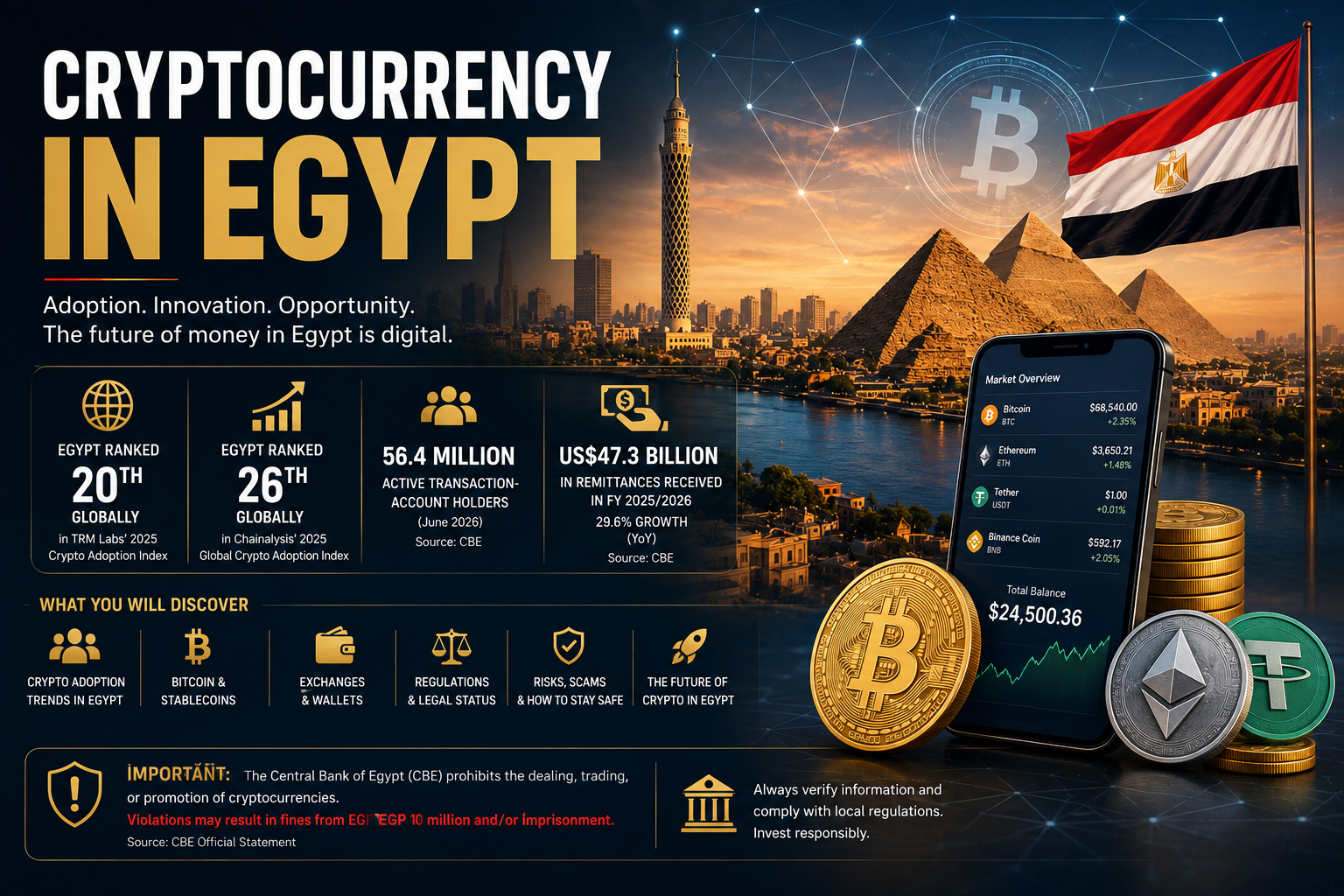
The latest major adoption datasets show Egypt remains a meaningful digital-asset market. Surprisingly, the Central Bank of Egypt has repeatedly warned against dealing in cryptocurrencies. In the 2025 TRM Labs Crypto Adoption and Stablecoin Usage Report, Egypt ranked 20th globally in TRM's crypto adoption index.
At the same time, Egypt ranked 26th in the 2025 Chainalysis Global Crypto Adoption Index.
The difference between those rankings is important. They come from different methodologies and should not be treated as interchangeable measurements of the exact number of Egyptian crypto users.
What is clear is that Egypt has a large enough digital market to remain visible in global adoption research.
The wider MENA region is also growing. Chainalysis reported 33% period-over-period growth in cryptocurrency activity in the region covered by its 2025 Geography of Crypto Report, with monthly regional transaction volumes reaching more than US$60 billion in December 2024.
Egypt's digital infrastructure provides another important part of the picture. The Central Bank of Egypt reported that 56.4 million Egyptians, representing 79% of the eligible population, owned active transaction accounts by the end of June 2026.
But crypto is not the same as ordinary digital payments in Egypt.
The Central Bank of Egypt has stated that Banking Law No. 194 of 2020 prohibits issuing, trading or promoting cryptocurrencies, creating or operating cryptocurrency trading platforms, and carrying out related activities without the approvals contemplated by the law. The CBE warning says violations can carry imprisonment and/or a fine of between EGP 1 million and EGP 10 million.
That creates the central question behind Egypt's crypto market:
How can there be visible crypto adoption and demand when the official regulatory position remains so restrictive?
The answer is that technology, user demand, internet access and global platforms can develop faster than local regulation.
Let us throw our eyes at how the market appears to be developing, the role of Bitcoin and stablecoins, why Egyptians may be interested in digital assets, and what the current regulatory environment means for users and businesses.
Is Cryptocurrency Legal in Egypt?
The simplest answer is that Egypt's official position is highly restrictive.
The Central Bank of Egypt's warning statement says that Law No. 194 of 2020 prohibits issuing, trading, promoting or operating platforms for cryptocurrencies and carrying out related activities without the approvals specified by the law.
The CBE also said it had not issued licences for cryptocurrency-related activities in the Egyptian market in its March 2023 warning.
The Central Bank's published position should therefore be taken seriously.
This means Egypt is not comparable to markets that have introduced a broad licensing framework allowing regulated exchanges and virtual-asset providers to openly offer retail services.
Users should also distinguish between three different questions:
- 1Is there demand for crypto?
- 2Can Egyptians technically access global crypto services?
- 3Are crypto activities formally authorised under Egyptian law?
Those are not the same question.
A country can have significant interest in a technology while its regulators maintain restrictions on how that technology can legally be issued, marketed, traded or operated.
What Does the EGP 1 Million to EGP 10 Million Penalty Refer To?
The Central Bank's published warning says that violating the relevant prohibition can result in imprisonment and a fine of no less than EGP 1 million and no more than EGP 10 million, or one of those penalties.
The exact application of the law can depend on the facts of a particular case and the relevant legal provisions.
This article is not legal advice.
Anyone planning to operate a cryptocurrency business, exchange, custody service, payment product, mining operation or other digital-asset activity connected to Egypt should obtain advice from a qualified Egyptian lawyer and engage directly with the relevant regulators before launching.
Egypt Still Appears in Global Crypto Adoption Research
A restrictive regulatory environment does not automatically mean there is zero user interest.
That is visible in international adoption research.
TRM Labs ranked Egypt 20th globally in its 2025 Crypto Adoption and Stablecoin Usage Report.
Chainalysis ranked Egypt 26th globally in its 2025 Global Crypto Adoption Index.
These rankings should be read carefully.
They do not mean Egypt has the 20th or 26th largest crypto market by absolute dollar volume.
They are adoption indices built using methodologies that consider different forms of activity and weight them differently.
The Chainalysis methodology uses multiple sub-indices, including centralised-service activity, retail activity, DeFi activity and institutional activity, with adjustments designed to measure adoption relative to economic characteristics.
TRM Labs uses its own methodology and ranking system.
The important point is not to force the two rankings into one number.
The important point is that both major datasets place Egypt inside the global top tier of crypto-adoption markets they measure.
That is significant for a country where the official position on crypto remains restrictive.
Why Is There Interest in Cryptocurrency in Egypt?
There is no single reason why people become interested in crypto.
Different users may have very different motivations.
Access to Global Digital Markets
Crypto is global by design.
Bitcoin and other blockchain networks can be accessed through internet-connected infrastructure rather than through a single domestic bank.
For a digitally connected population, that creates exposure to global markets and financial products.
DataReportal reported that Egypt had 96.3 million internet users at the start of 2025, equivalent to 81.9% internet penetration. Its report also recorded 116 million cellular mobile connections.
Those figures do not measure crypto ownership.
But they help explain why Egypt has the technical base for a large digital financial market.
Investment and Speculation
Some users are interested in Bitcoin, Ether and other digital assets as investments.
They may believe prices will rise.
Others trade cryptocurrencies actively.
These uses carry substantial risk.
Crypto prices can move sharply in either direction.
A digital asset can also lose liquidity, fail technically or be affected by fraud, hacking or the collapse of a service provider.
The Central Bank of Egypt has specifically highlighted volatility and financial-crime risks in its warnings.
Access to Dollar-Denominated Digital Assets
Stablecoins create a different use case from Bitcoin.
A stablecoin is generally designed to maintain a relatively stable value relative to a reference asset or currency, although that does not guarantee that it will always maintain its peg.
Dollar-linked stablecoins have become important globally for trading, settlement and moving digital value.
Chainalysis reported in its 2025 research that stablecoins continue to play an important role in global crypto use cases, including remittances, commerce and access to dollar-denominated value.
That does not mean stablecoin activity is formally authorised in Egypt.
It means the global technology exists and is part of the broader digital-asset ecosystem that Egyptian users may encounter.
Cross-Border Financial Interest
Egypt has one of Africa's largest remittance markets.
The Central Bank of Egypt reported record remittances from Egyptians working abroad of approximately US$47.3 billion during FY 2025/2026, up 29.6% from the previous fiscal year.
That does not mean those remittances are moving through cryptocurrency.
The overwhelming point is different: Egypt has a very large economy for international money movement.
Whenever a country has major cross-border flows, people and businesses are likely to pay attention to technologies promising faster settlement, lower costs or more global access.
Whether a particular crypto-based solution can legally operate is a separate regulatory question.
For a deeper look at this side of the market, see our analyses for cross-border payments in Egypt.
Bitcoin in Egypt
Bitcoin is the best-known cryptocurrency globally and is likely to be the first digital asset many Egyptians encounter when researching crypto.
Bitcoin was designed as a decentralised digital network that allows value to be transferred without relying on one central issuer.
However, owning Bitcoin, trading Bitcoin and operating a business around Bitcoin are very different activities from a legal and regulatory perspective.
Egypt's central bank has warned against dealing in all forms of encrypted virtual currencies and has linked its position to the restrictions in Banking Law No. 194 of 2020.
That means users should not assume that because Bitcoin is technically accessible through the internet, it is therefore officially approved for trading or promotion in Egypt.
Why Bitcoin Attracts Attention
Bitcoin's appeal can include:
- Its global recognition.
- Its fixed maximum supply of 21 million bitcoin.
- The ability to transfer value through a decentralised blockchain.
- Its high liquidity relative to many other crypto assets.
- Interest from global investors and institutions.
But those features come with risks.
Bitcoin can be highly volatile.
The price can change significantly in a short period.
Users also face risks related to custody, scams, phishing, fake investment schemes and platform failures.
The CBE's warnings repeatedly emphasise these concerns.
Stablecoins and Egypt
Stablecoins deserve separate attention because they are increasingly used for purposes beyond speculation.
A stablecoin may be used by global market participants as:
- A trading pair.
- A settlement asset.
- A way to move value between platforms.
- A digital representation of dollar-linked value.
- Infrastructure for some cross-border payment systems.
Chainalysis' 2025 Geography of Crypto Report highlighted the growing role of stablecoins in remittances, commerce and inflation-hedging use cases globally.
But Egypt's restrictive position applies to encrypted virtual currencies broadly.
Users and businesses should therefore not interpret the global growth of stablecoins as evidence that stablecoin issuance, trading or services are authorised locally.
The technology trend and the local regulatory position are separate issues.
What Does Egypt's Regulatory Position Mean for Crypto Exchanges?
The CBE's March 2023 warning said that it had not issued licences for cryptocurrency-related activities in the Egyptian market.
The earlier warning also said the law prohibits creating or operating cryptocurrency trading platforms and related activities without the required approvals.
For a crypto exchange, this creates a major compliance question.
An exchange is not simply a website where users buy and sell assets.
A serious exchange may involve:
- Customer onboarding.
- Identity verification.
- Anti-money-laundering controls.
- Custody.
- Market surveillance.
- Cybersecurity.
- Asset listing.
- Consumer disclosures.
- Payment integration.
- Fiat conversion.
- Record keeping.
A company considering Egypt as a market should not assume that an offshore registration or a foreign licence automatically permits it to solicit customers, advertise or operate locally.
The legal analysis can depend on how the service is structured and where specific activities take place.
Crypto Advertising and Promotion in Egypt
Promotion is one of the areas explicitly mentioned in the Central Bank's warning.
The CBE said the law prohibits promoting cryptocurrencies as well as issuing and trading them and creating or operating platforms for trading them, subject to the relevant legal framework.
That matters for:
- Influencers.
- Affiliate marketers.
- Crypto media businesses.
- Exchanges.
- Trading groups.
- Investment promoters.
- Companies targeting Egyptian consumers.
A marketing campaign can create regulatory exposure even if the underlying company is based outside Egypt.
This is especially important because crypto advertising often moves faster than regulation.
Companies should not rely on generic global marketing practices without considering Egyptian legal requirements.
Crypto Scams Are a Major Risk
The technology itself is only one part of the risk.
Fraud is another.
The Central Bank of Egypt's March 2023 warning followed reports about an electronic platform allegedly taking large sums from citizens by claiming it would invest the money in cryptocurrency-related activities and generate large, rapid profits.
The CBE urged citizens not to respond to such fraudulent invitations.
This is an important lesson for the market.
Crypto scams often use the same promises:
- Guaranteed returns.
- Extremely high daily profits.
- Secret trading systems.
- AI trading bots.
- Celebrity endorsements.
- Urgent investment deadlines.
- Referral commissions.
- Pressure to deposit more money.
A blockchain transaction does not make an investment legitimate.
A professional-looking website does not make a company licensed.
And a token with a rising price does not guarantee that it can later be sold at that price.
How Big Is Egypt's Crypto Market?
There is no single official Egyptian government figure that accurately states the total number of crypto users or the exact value of all cryptocurrency activity in Egypt.
That is an important limitation.
Crypto activity can occur across:
- Centralised exchanges.
- Decentralised protocols.
- Self-custody wallets.
- Offshore platforms.
- Peer-to-peer transactions.
- Blockchain networks that do not publish a user's physical location.
Researchers therefore estimate geography using different datasets and methodologies.
The strongest current approach is to look at multiple indicators rather than inventing a precise user count.
Indicator 1: Global Adoption Rankings
Egypt ranked:
- 20th in the 2025 TRM Labs crypto adoption index.
- 26th in the 2025 Chainalysis Global Crypto Adoption Index.
These rankings indicate meaningful adoption activity under the methodologies used by those firms.
Indicator 2: Crypto App Activity
Sensor Tower's Egypt market snapshots also showed substantial activity around major cryptocurrency apps.
Its Q4 2025 unified Egypt analysis reported that Binance's active users moved from approximately 452,700 at the start of October to 374,800 by the end of December, while Bybit's active users increased from approximately 99,700 to 142,200 during the quarter.
These are platform analytics estimates, not official Egyptian government figures and not a count of unique crypto owners.
One person can use multiple apps.
An app user can also stop trading or hold no assets.
The data should therefore be used as an indicator of market engagement rather than a precise national ownership figure.
Indicator 3: Egypt's Digital Financial Infrastructure
By June 2026, the Central Bank of Egypt reported:
- 56.4 million citizens with active transaction accounts.
- 79% financial inclusion among the eligible population.
This does not measure cryptocurrency use.
But it shows that Egypt has a large and increasingly digital financial base.
The ability to use bank accounts, prepaid cards and mobile wallets can influence how people interact with digital financial services generally.
Egypt's Position in the Wider MENA Crypto Market
Egypt should also be viewed within the Middle East and North Africa.
Chainalysis reported that the MENA region recorded 33% period-over-period growth in the period covered by its 2025 report.
The firm said monthly regional transaction volume reached more than US$60 billion in December 2024 before activity moderated during 2025.
MENA is not one market.
Regulatory approaches differ dramatically.
Some jurisdictions have built specialised virtual-asset regulatory systems.
Others maintain restrictions or prohibitions.
That means a regional crypto company cannot assume that one MENA licence or business model works across every country.
Egypt's approach should be analysed separately.
Can Egyptians Use Global Crypto Platforms?
Technically accessing a website or application is not the same as having regulatory permission to provide or promote a service in Egypt.
This distinction matters.
A global crypto platform may be available on the internet.
Users may discuss it online.
An application may appear in an app store.
None of those facts alone establishes that the service is licensed or authorised in Egypt.
The Central Bank's published warnings remain the key official source for understanding its position.
Consumers should also be cautious about unofficial claims that a platform is "approved" or "legal" unless the relevant Egyptian regulator has clearly confirmed that status.
Self-Custody and Crypto Wallets
A crypto wallet can refer to software or hardware used to manage cryptographic keys associated with blockchain addresses.
Self-custody can reduce dependence on a centralised exchange.
But it creates another responsibility: the user controls the security.
If a private key or recovery phrase is lost, the assets may become inaccessible permanently.
If a recovery phrase is stolen, an attacker can potentially take control of the assets.
Users should never share a seed phrase or private key with:
- Customer support.
- A friend.
- A social-media contact.
- A "recovery company."
- A website asking for wallet verification.
Legitimate wallet providers do not need a user's seed phrase to provide ordinary customer support.
DeFi and Egypt
Decentralised finance, usually called DeFi, refers to blockchain-based applications that can provide functions such as trading, borrowing, lending or other financial activity through smart contracts.
DeFi introduces additional complexity.
Users may face:
- Smart-contract risk.
- Protocol exploits.
- Oracle failures.
- Liquidity risk.
- Impermanent loss.
- Token volatility.
- Phishing.
- Fake applications.
- Regulatory uncertainty.
A protocol being decentralised does not automatically remove legal obligations or make every use legal in every jurisdiction.
For Egyptian users and businesses, the restrictive official position on encrypted virtual currencies remains highly relevant.
Could Egypt Eventually Change Its Crypto Policy?
It is possible for regulatory positions to evolve, but future policy should not be assumed.
The global crypto market has changed significantly since Banking Law No. 194 of 2020 and the CBE's published warnings.
More jurisdictions now have dedicated rules for exchanges, stablecoins, custody and market conduct.
Institutional participation has also expanded internationally.
Chainalysis' 2025 Global Crypto Adoption Index added an institutional activity component to its methodology, reflecting the growing role of larger professional participants.
Egypt could eventually choose to:
- Maintain the current restrictive position.
- Create a licensing framework.
- Permit limited institutional activities.
- Develop rules for specific asset classes.
- Regulate stablecoins separately.
- Focus on central-bank or tokenised financial infrastructure rather than open retail crypto markets.
But these are possibilities, not current policy.
Until an official regulatory change is published, businesses should work from the rules and warnings that currently exist.
Blockchain Is Not the Same as Cryptocurrency
One important distinction is between blockchain technology and cryptocurrencies.
A blockchain is a technology for recording and validating data across a network.
A cryptocurrency is one possible application of blockchain technology.
Blockchain can also be used for:
- Supply-chain records.
- Tokenisation.
- Digital identity.
- Trade documentation.
- Settlement infrastructure.
- Asset registries.
- Other enterprise systems.
Egypt's restrictive position on cryptocurrencies should therefore not be interpreted as a blanket rejection of every blockchain-related technology.
A company developing blockchain software without issuing, trading or promoting a cryptocurrency may raise a different set of regulatory questions.
The legal structure and actual function of the product matter.
Cryptocurrency Mining in Egypt
Crypto mining should not be treated as a simple hobby without considering legal and practical issues.
Mining can involve:
- High electricity consumption.
- Specialised hardware.
- Heat management.
- Internet infrastructure.
- Hardware importation.
- Business registration.
- Tax and customs issues.
- Potential regulatory restrictions.
The broader restrictions in the CBE's published position mean anyone considering a mining operation or related commercial activity should obtain specialist legal advice before investing in equipment or infrastructure.
The Main Risks for Crypto Users in Egypt
Regulatory Risk
The official position remains restrictive.
Rules can also change.
Users should not rely on outdated social-media advice.
Price Volatility
Bitcoin and other cryptocurrencies can rise or fall sharply.
A portfolio can lose value quickly.
Platform Risk
An exchange can suffer a hack, insolvency, withdrawal freeze or operational failure.
Custody Risk
Self-custody gives users control but also makes them responsible for key security.
Scam Risk
Fake investments and high-return promises remain a major danger.
Stablecoin Risk
Stablecoins are designed to be more stable than many cryptocurrencies, but they can still face de-pegging, reserve, liquidity, issuer and regulatory risks.
Key Cryptocurrency in Egypt Numbers
- 20th globally — Egypt's ranking in the 2025 TRM Labs crypto adoption index.
- 26th globally — Egypt's ranking in the 2025 Chainalysis Global Crypto Adoption Index.
- 33% — period-over-period growth reported by Chainalysis for the MENA region in its 2025 geography research.
- More than US$60 billion — MENA monthly crypto transaction volume reported by Chainalysis for December 2024.
- 56.4 million — Egyptians with active transaction accounts by the end of June 2026.
- 79% — financial inclusion rate among Egypt's eligible population by the end of June 2026.
- EGP 1 million to EGP 10 million — fine range cited by the Central Bank of Egypt in its published warning regarding violations of the cryptocurrency restrictions, alongside possible imprisonment.
- US$47.3 billion — remittances received from Egyptians working abroad during FY 2025/2026.
These numbers measure different things.
Adoption rankings, regional transaction growth, financial inclusion, legal penalties and remittance flows should not be combined into a single market-size figure.
Together, however, they help explain Egypt's unusual crypto environment: a large, digitally connected financial market with visible global crypto activity indicators but a restrictive official position on cryptocurrency.
The Bottom Line
Cryptocurrency in Egypt is a market of contradiction.
International research firms continue to place Egypt among important global crypto-adoption markets.
Egypt ranked 20th in TRM Labs' 2025 index and 26th in Chainalysis' 2025 Global Crypto Adoption Index.
The country also has a rapidly expanding digital financial system, with 56.4 million people holding active transaction accounts by June 2026.
But the official regulatory position remains strict.
The Central Bank of Egypt has repeatedly warned against dealing in encrypted virtual currencies and has linked its position to Banking Law No. 194 of 2020, which it says prohibits issuing, trading, promoting or operating cryptocurrency platforms and related activities without the required approvals.
That means the future of Egypt's crypto market will depend heavily on regulation.
Demand for global digital assets may continue.
Bitcoin, stablecoins and blockchain technology will continue to develop internationally.
But any large-scale local crypto business will need to navigate Egypt's current legal framework rather than assuming that global adoption automatically creates local regulatory permission.
For users, the most important principles are simple:
Understand the law.
Do not trust guaranteed returns.
Do not confuse technical access with regulatory approval.
Protect private keys and account credentials.
And never invest more than you can afford to lose.