Cryptocurrency Regulation in Egypt: Laws, Restrictions and the Current Legal Framework
Explore cryptocurrency regulation in Egypt, including Banking Law No. 194 of 2020, CBE restrictions, penalties, licensing, crypto exchanges, stablecoins and the current legal framework.

On this page
Egypt has one of the strictest official positions on cryptocurrency in Africa and the Middle East.
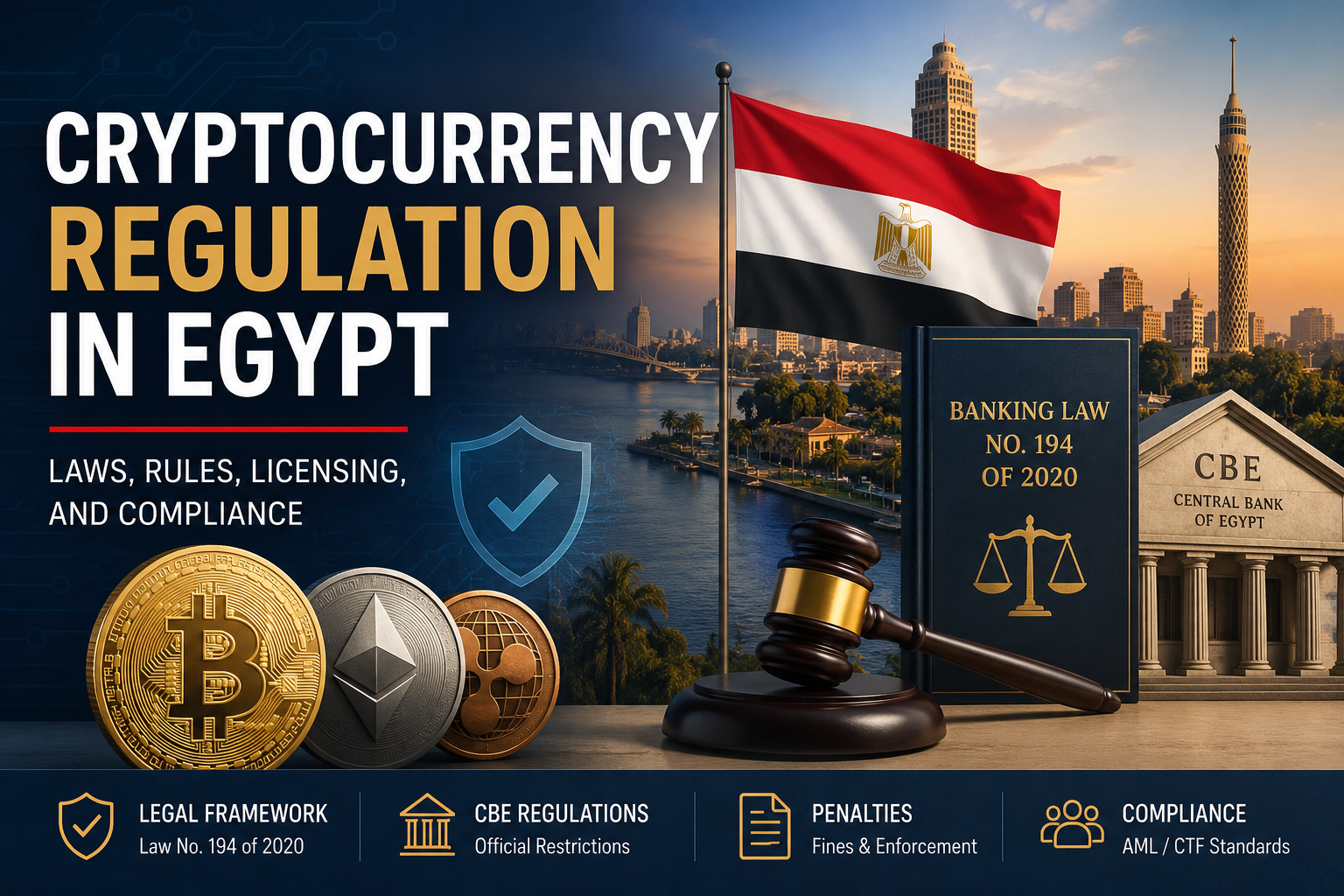
The core legal reference is Central Bank and Banking System Law No. 194 of 2020. The Central Bank of Egypt said the law prohibits issuing, trading or promoting cryptocurrencies. It also prohibits creating or operating cryptocurrency trading platforms and carrying out related activities.
The same CBE warning says violations can result in imprisonment and a fine of no less than EGP 1 million and no more than EGP 10 million, or one of those penalties.
The CBE repeated its position in March 2023. It said that no licence had ever been issued or granted for cryptocurrency trading activities in the Egyptian market.
Egypt's wider financial system is becoming more digital. The CBE reported that 56.4 million Egyptians held active transaction accounts by the end of June 2026. That represented 79% of the eligible population.
But digital payments and cryptocurrency are different regulatory questions.
Egypt supports financial technology, instant payments and digital financial inclusion. Its official position on cryptocurrencies remains restrictive.
Is Cryptocurrency Legal in Egypt?
Egypt's official position is restrictive.
The Central Bank of Egypt's September 2022 warning states that Law No. 194 of 2020 prohibits issuing, trading or promoting cryptocurrencies in Egypt. The warning also covers creating or operating cryptocurrency trading platforms and carrying out related activities.
The CBE said trading in Egypt should be limited to official currencies approved by the Central Bank.
The legal position is therefore very different from countries that have created dedicated licensing regimes for crypto exchanges, custodians and other virtual-asset businesses.
Technical Access Is Not Regulatory Approval
A cryptocurrency website can be accessible from Egypt.
A mobile application can also be available online.
That does not establish that the service is licensed or authorised to operate in Egypt.
The same distinction applies to marketing.
A company may have a global website. That does not automatically mean it can promote cryptocurrency services to Egyptian customers.
Businesses should assess the actual legal framework before offering services connected to Egypt.
What Does Banking Law No. 194 of 2020 Say?
Law No. 194 of 2020 is the foundation of the CBE's published position.
The Central Bank's official banking laws page lists CBE Law No. 194 of 2020 among Egypt's banking laws.
The CBE's September 2022 warning explains how it applies the law to cryptocurrency activities.
According to the CBE, the law prohibits:
- Issuing cryptocurrencies.
- Trading cryptocurrencies.
- Promoting cryptocurrencies.
- Creating cryptocurrency trading platforms.
- Operating cryptocurrency trading platforms.
- Carrying out related activities.
The CBE also warned that cryptocurrencies carry risks linked to price volatility, financial crime and electronic piracy.
The Law Covers More Than Exchanges
The wording in the CBE's warning is important.
The restriction is not limited to one type of business.
The CBE refers to issuing, trading and promoting cryptocurrencies. It also refers to creating or operating trading platforms and carrying out related activities.
That means businesses should not assume they fall outside the framework simply because they do not operate a traditional exchange.
A crypto payment service may raise different questions.
So may a wallet provider.
So may a stablecoin business.
The legal analysis should depend on the product and its actual activities.
What Are the Penalties for Violating Egypt's Crypto Restrictions?
The CBE's September 2022 warning says a violation can result in imprisonment and a fine of no less than EGP 1 million and no more than EGP 10 million. The warning says either penalty may also apply.
That figure should be read in the context of the specific legal provisions and facts of a case.
It should not be treated as a substitute for legal advice.
The application of criminal law can depend on the conduct involved.
A business considering any crypto-related activity in Egypt should obtain advice from a qualified Egyptian lawyer before launching.
Did the Central Bank of Egypt Licence Any Crypto Businesses?
The CBE gave a clear answer in its March 2023 warning.
It said that no licence had ever been issued or granted for cryptocurrency trading activities in the Egyptian market.
That statement is important.
It means businesses should not assume that a foreign registration or offshore licence gives them local approval.
A licence from another jurisdiction can be relevant to a company's wider compliance profile.
It does not automatically create permission to conduct regulated activities in Egypt.
Why the March 2023 Warning Was Issued
The CBE's March 2023 statement followed reports about a digital platform that allegedly took large sums from Egyptian citizens.
The platform reportedly claimed the money would be invested in cryptocurrency-related activities.
It also promised large and rapid returns.
The CBE warned citizens against participating in fraudulent activity.
The episode shows why crypto regulation and consumer protection are closely connected.
A regulatory framework must address more than technology.
It must also address fraud, marketing and misleading investment claims.
Which Regulator Oversees Cryptocurrency in Egypt?
The Central Bank of Egypt is the main authority behind Egypt's published cryptocurrency warnings.
Its role is particularly important because the restrictions are linked to Law No. 194 of 2020.
Egypt also has other financial authorities with responsibilities across banking, non-bank financial services, securities, capital markets and anti-money-laundering controls.
That does not mean every authority regulates cryptocurrency in the same way.
The legal classification of a product matters.
A tokenised security may raise different questions from Bitcoin.
A payment product may raise different questions from an investment product.
A company should therefore identify the exact service it plans to offer before deciding which regulators may be relevant.
Is Egypt Creating a Crypto Licensing Framework?
As of August 2026, the CBE's public English archive still shows its September 2022 warning and its March 2023 warning as the key published CBE statements on cryptocurrency.
The March 2023 warning says no licence had been issued for cryptocurrency trading activities.
The current public record should therefore not be confused with a broad exchange-licensing regime.
A company should not claim to be an officially licensed Egyptian crypto exchange unless it can point to a valid approval from the relevant authority.
Future regulation is possible.
But future regulation should not be presented as current law.
Regulation Can Change
Crypto policy has changed rapidly around the world.
Some countries have introduced VASP licensing.
Others have created stablecoin rules.
Some have adopted specific rules for custody or market conduct.
Egypt could also change its framework.
But businesses should work from published rules and official statements.
Speculation is not a compliance strategy.
Egypt and FATF Virtual-Asset Standards
Egypt's crypto position also exists within a wider global anti-money-laundering framework.
The FATF's 2025 targeted update on virtual assets and VASPs tracked how jurisdictions were implementing global standards for virtual assets.
The report was based partly on a 2025 survey conducted between February 21 and April 30.
FATF Recommendation 15 addresses risks linked to new technologies.
It includes virtual assets and virtual-asset service providers.
Countries can use different regulatory approaches.
They can regulate and supervise VASPs.
They can also prohibit certain activities.
Egypt's AML Framework Is Still Evolving
Egypt remains in enhanced follow-up under the FATF process.
The FATF's October 2025 follow-up report says Egypt had 11 recommendations rated compliant and 26 rated largely compliant. Three recommendations remained partially compliant.
That means 37 of the 40 technical recommendations were rated compliant or largely compliant.
These ratings do not mean Egypt has a licensed crypto market.
They measure technical compliance across the wider AML/CFT framework.
The distinction matters.
Why Egypt's Crypto Regulation Is So Restrictive
The CBE has repeatedly highlighted risk.
Its September 2022 warning identified high price volatility and possible use in financial crimes and electronic piracy.
The CBE also noted that cryptocurrencies are not issued by the Central Bank or another official central issuing authority.
Regulators must balance several concerns.
Consumer Protection
Crypto prices can change quickly.
Retail users can lose money.
Fraud can also be disguised as crypto investment.
Financial Crime
Digital assets can create new compliance challenges.
Providers may need systems for identity verification, transaction monitoring and suspicious-activity reporting.
Market Integrity
Trading platforms need reliable controls.
That can include custody, cybersecurity, conflict management and market surveillance.
Monetary and Financial Stability
Large-scale use of privately issued digital currencies can raise broader policy questions.
Those questions can include foreign exchange, capital flows and the role of official money.
Crypto Regulation and Egypt's Digital Payments Strategy
Egypt's restrictive crypto position does not mean the country rejects financial technology.
The domestic payments market is becoming more digital.
The CBE reported that 56.4 million citizens had active transaction accounts by June 2026.
That represented 79% of the eligible population.
The CBE also reported that Egypt's Instant Payment Network processed nearly 1.5 billion transactions worth about EGP 2.9 trillion during 2024. InstaPay had about 12.5 million registered users.
Those are domestic payment figures.
They are not crypto figures.
But they show that Egypt is investing in digital financial infrastructure while keeping a separate and restrictive position on cryptocurrencies.
What About Bitcoin?
Bitcoin is a cryptocurrency.
The CBE's warnings refer broadly to encrypted virtual currencies and cryptocurrency activities.
Users should therefore not assume that Bitcoin has a special exemption.
The fact that Bitcoin is globally recognised does not change Egypt's official position.
The same principle applies to other major crypto assets.
A large market capitalisation is not regulatory approval.
What About Stablecoins?
Stablecoins are often discussed separately from volatile crypto assets.
Many are designed to track the value of a reference asset, such as the US dollar.
But the CBE's published restrictions should not be ignored simply because a token is described as stable.
A stablecoin can raise questions about issuance, trading, payments, custody and foreign exchange.
Its legal treatment depends on the applicable framework.
Businesses should not assume that global stablecoin use creates automatic permission to offer stablecoin services in Egypt.
Can Crypto Companies Advertise in Egypt?
The CBE's September 2022 warning specifically refers to promoting cryptocurrencies.
That creates an important issue for:
- Exchanges.
- Influencers.
- Affiliate marketers.
- Media publishers.
- Trading communities.
- Investment promoters.
- Crypto payment companies.
A global advertising campaign can still have local consequences.
Companies should review their marketing strategy before targeting Egyptian users.
What Does This Mean for Crypto Exchanges?
A crypto exchange needs more than a website.
It may involve customer onboarding, identity checks, payments, custody, cybersecurity and market operations.
Egypt's current published position creates serious regulatory questions around each of those activities.
The CBE said in March 2023 that no licence had been issued for cryptocurrency trading activities in the Egyptian market.
A company should therefore avoid presenting an offshore service as locally approved without clear evidence.
That includes claims such as:
- "Licensed in Egypt."
- "CBE approved."
- "Official Egyptian exchange."
Such claims should only be made where the company has verifiable regulatory approval.
What Should Egyptian Crypto Users Know?
Users should understand the difference between market access and legal approval.
A platform being online does not mean it is licensed in Egypt.
Users should also be cautious about investment scams.
The CBE's March 2023 warning followed allegations involving a platform that promised large and rapid returns from cryptocurrency-related activity.
Warning signs can include:
- Guaranteed profits.
- Extremely high returns.
- Pressure to invest quickly.
- Referral rewards.
- Fake celebrity endorsements.
- Requests to send money to a personal wallet.
- Requests for a wallet recovery phrase.
No legitimate investment can guarantee profits.
A seed phrase should never be shared.
What Could Egypt's Future Crypto Framework Look Like?
There is no reason to assume a future model before an official proposal is published.
If Egypt changes course, policymakers could consider several approaches.
A Full VASP Licensing Regime
This could cover exchanges, custodians and other service providers.
It could include capital, governance, AML and cybersecurity requirements.
A Limited Institutional Framework
Egypt could allow selected institutions to provide narrowly defined services.
Retail activity could remain restricted.
Stablecoin-Specific Rules
Policymakers could create separate rules for fiat-backed digital assets.
Such a framework could focus on reserves, redemption and issuer oversight.
Tokenised Financial Assets
Regulation could distinguish between open crypto markets and regulated tokenisation.
The exact direction would depend on future Egyptian policy.
None of these models should be treated as current Egyptian law.
Key Egypt Crypto Regulation Numbers
- Law No. 194 of 2020 — the law cited by the CBE as the basis for its cryptocurrency restrictions.
- EGP 1 million to EGP 10 million — the fine range cited by the CBE, alongside possible imprisonment.
- No licence had ever been issued for cryptocurrency trading activities in Egypt, according to the CBE's March 2023 warning.
- 56.4 million citizens — active transaction-account holders by June 2026.
- 79% — financial inclusion among the eligible population by June 2026.
- Nearly 1.5 billion transactions — transactions processed through Egypt's Instant Payment Network during 2024.
- About EGP 2.9 trillion — value of those IPN transactions.
- About 12.5 million users — registered InstaPay users reported by the CBE at the end of 2024.
- 11 compliant and 26 largely compliant recommendations — Egypt's technical compliance ratings in the FATF's October 2025 follow-up report.
These figures measure different parts of Egypt's legal and financial system.
They should not be combined into one market-size number.
Together, they show a clear contrast.
Egypt has a fast-growing digital payments ecosystem.
Its official cryptocurrency position remains restrictive.
The Bottom Line
Egypt's cryptocurrency regulation is defined by restriction.
The Central Bank of Egypt links that position to Law No. 194 of 2020.
The CBE says the law prohibits issuing, trading and promoting cryptocurrencies.
It also covers creating and operating cryptocurrency trading platforms and related activities.
The CBE's published warning cites possible imprisonment and fines from EGP 1 million to EGP 10 million.
In March 2023, the CBE said no licence had been issued for cryptocurrency trading activities in the Egyptian market.
At the same time, Egypt is building a much larger digital financial system.
By June 2026, 56.4 million citizens had active transaction accounts.
Financial inclusion reached 79% of the eligible population.
Egypt's Instant Payment Network processed nearly 1.5 billion transactions during 2024.
That contrast is central to understanding Egypt.
The country is not rejecting digital finance.
It is taking a restrictive position on cryptocurrency.
Any future change will need an official legal or regulatory basis.
Until then, crypto businesses should not treat global access as Egyptian regulatory approval.