Cross-Border Payments in Ghana: Remittances, Trade, Mobile Money and African Transfers
Explore cross-border payments in Ghana, including remittances, mobile money, PAPSS, international transfers, trade payments, foreign exchange and the latest digital payment infrastructure.

On this page
Ghana is one of Africa's most important cross-border payments markets.
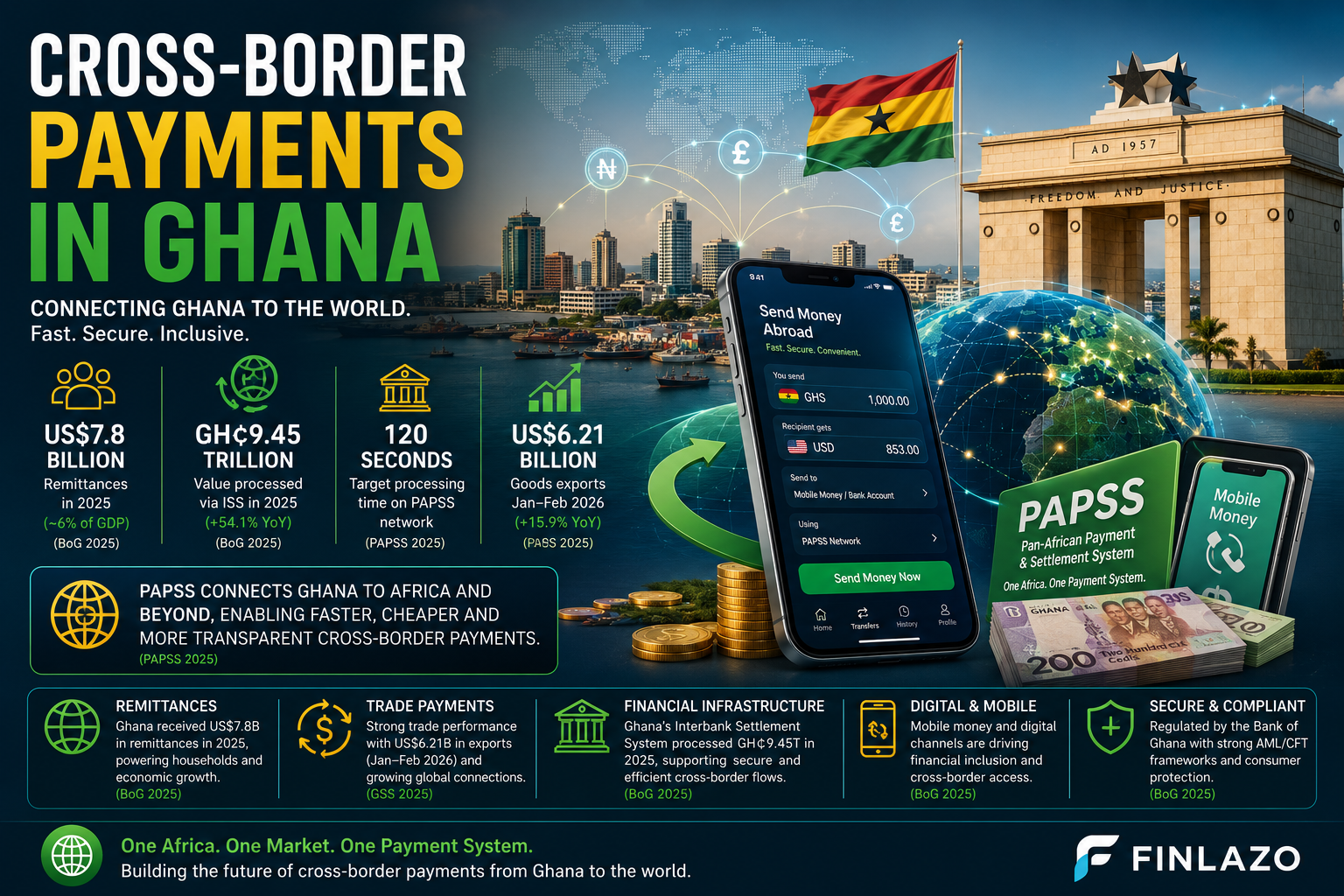
The latest official and government-backed figures show that Ghana received about US$7.8 billion in remittances in 2025. That was a major increase from roughly US$4.6 billion in 2024 and represented nearly 6% of GDP.
The latest Bank of Ghana data also shows how large the country's wider payments infrastructure has become. In 2025, the value of transactions on the Ghana Interbank Settlement system reached GH₵9.45 trillion, up 54.1% from GH₵6.13 trillion in 2024.
Cross-border payments are therefore part of a much larger financial system.
Ghanaians abroad send billions of dollars home. Importers pay suppliers overseas. Exporters receive money for gold, cocoa, oil and other products. Businesses increasingly trade across Africa. Banks, fintechs and mobile-money operators are building more digital ways to move money.
And the infrastructure is changing.
Ghana is one of the countries already live on the Pan-African Payment and Settlement System, or PAPSS. The network is designed to support cross-border payments in African local currencies and says eligible transfers can be processed within a maximum of 120 seconds.
In August 2026, the Bank of Ghana also published updated guidelines for inward remittance services by Payment Service Providers, showing that the regulatory framework is continuing to evolve around a market that is becoming increasingly digital.
This is the story of cross-border payments in Ghana today.
Why Cross-Border Payments Matter in Ghana
Cross-border money movement affects almost every part of Ghana's economy.
The most visible flow is remittances.
Millions of Ghanaians have family members, businesses or financial connections outside the country. Money sent from abroad can support food, rent, education, healthcare, construction and investment.
The Bank of Ghana describes remittances as a significant source of external financing and national income in its 2026 inward remittance guidelines.
But remittances are only one part of the picture.
Ghana also has major international trade flows.
The Bank of Ghana's March 2026 Monetary Policy Report recorded US$6.21 billion in merchandise exports during January and February 2026 alone, against US$2.52 billion in imports, producing a US$3.69 billion trade surplus for the two-month period.
Gold accounted for US$4.26 billion of those exports.
Every export and import creates a payment and settlement question.
How does the buyer pay?
Which currency is used?
How long does settlement take?
How much does foreign exchange cost?
Which bank or payment provider sits between the two parties?
These questions are becoming increasingly important as Ghana connects its domestic digital-payment infrastructure with African and global markets.
Ghana's Remittance Market
US$7.8 Billion Received in 2025
The latest figure widely reported by Ghanaian government institutions is approximately US$7.8 billion in remittances received in 2025.
The National Development Planning Commission said the inflows represented nearly 6% of Ghana's GDP.
The figure was also publicly attributed to Bank of Ghana data by government officials in 2026.
That makes remittances one of Ghana's most important external financial flows.
The scale is even clearer when compared with the previous year.
Government statements reported that remittances rose from about US$4.6 billion in 2024 to US$7.8 billion in 2025.
That is a very large increase.
However, remittance figures should always be read carefully.
Different sources can use different definitions, reporting periods and channels.
Some measures focus on transfers recorded through formal providers. Others refer more broadly to private transfers or balance-of-payments categories.
For a current Ghana market picture, the most useful approach is to identify the exact statistic and source rather than mixing different remittance series together.
What the Money Is Used For
The Bank of Ghana's 2026 inward remittance guidelines explain why these flows matter beyond the headline number.
The central bank notes that Ghanaian families depend on remittances for expenses including:
- Education.
- Health.
- Rent.
- Housekeeping.
- Utilities.
The guidelines also note that members of the diaspora send money to finance residential and commercial construction.
That makes the remittance market both a consumer-payments market and an economic-financing channel.
A single transfer may be small.
But millions of transfers across a year can create a major source of foreign exchange and household support.
Ghana's Remittance Infrastructure Is Becoming More Digital
The old remittance model was built heavily around physical cash collection.
A sender abroad initiated a transfer.
The recipient then travelled to a branch, agent or cash pickup location.
Digital payments are changing that experience.
Money can increasingly be delivered into bank accounts, wallets and other electronic channels.
The Bank of Ghana's 2025 Financial Stability Review said non-cash payment streams performed strongly during the year as electronic payment alternatives became more widely adopted.
The central bank reported that mobile banking transaction value grew 130.5% in 2025.
The same review said 53 new products and services were approved for regulated financial institutions during 2025, including inbound remittance services.
That matters for cross-border payments.
The faster Ghana's domestic digital rails become, the easier it can be for an international transfer to move through the final mile after entering the country.
Mobile Money Is Part of the Payment Backbone
Ghana's mobile-money infrastructure is already enormous.
Bank of Ghana data for April 2025 recorded 75.2 million registered mobile-money accounts and 24.2 million active accounts.
The same month recorded 778 million mobile-money transactions worth GH₵365 billion.
Those figures come from the Bank of Ghana's payment systems data.
The numbers do not mean that all of those transactions were cross-border.
Most mobile-money activity is domestic.
But the scale of the infrastructure matters.
Cross-border payment systems work best when the sender and recipient already have efficient local rails at both ends.
A transfer from abroad still needs a destination.
That destination may be a bank account, a wallet or another regulated payment instrument.
Ghana's strong domestic digital-payment adoption therefore provides an important foundation for future international payment products.
How Cross-Border Payments Work in Ghana
Ghana does not have one international payment rail.
Different transactions move through different systems.
International Bank Transfers
Businesses and individuals can use banks for international transfers.
The process may involve correspondent banking relationships and global financial messaging infrastructure.
The Bank of Ghana provides an overview of the country's payment systems and continues to develop an integrated electronic payments infrastructure.
For international payments, the actual speed and cost can depend on several institutions.
A sending bank may use an intermediary.
Foreign-exchange conversion may be required.
Compliance checks can delay a transaction.
The beneficiary bank may also have its own processing procedures.
International Money Transfer Operators
International Money Transfer Operators remain important for inward remittances.
They provide a dedicated route for people sending money from another country into Ghana.
The Bank of Ghana's inward remittance framework for Payment Service Providers is particularly important because it addresses how regulated non-bank payment companies can participate in receiving remittances.
The August 2026 update shows that Ghana is adapting its rules as payment technology changes.
The market is no longer built only around banks and physical cash agents.
Digital Wallets and Payment Service Providers
Payment Service Providers can increasingly play a role in the receiving side of cross-border transfers.
The regulatory framework matters here.
A company may offer a digital customer experience while another regulated institution handles foreign exchange, settlement or other parts of the transaction.
That division of responsibilities is common in modern payments.
The customer sees one app.
Behind the scenes, the payment can involve banks, payment processors, foreign-exchange providers and settlement infrastructure.
The Bank of Ghana's New Remittance Rules
August 2026 Guidelines for Payment Service Providers
One of the most important recent developments is the Bank of Ghana's Updated Guidelines for Inward Remittance Services by Payment Service Providers, published in August 2026.
The timing is important.
This is current regulatory infrastructure for the Ghana cross-border payments market, not an old policy document from several years ago.
The guidelines recognise remittances as a major source of external financing and national income.
They also address the participation of Payment Service Providers in the inward-remittance ecosystem.
That matters because fintech companies increasingly want to connect international payment services with domestic wallets and digital accounts.
The regulatory challenge is making that possible while maintaining:
- Anti-money-laundering controls.
- Customer due diligence.
- Transaction monitoring.
- Foreign-exchange compliance.
- Consumer protection.
- Clear accountability between providers.
The details of each provider's permissions depend on its licence and the specific Bank of Ghana rules.
A company should not assume that being licensed for domestic payments automatically gives it authority to perform every international payment function.
PAPSS Is Changing Intra-African Payments
The Pan-African Payment and Settlement System is one of the most important pieces of new infrastructure for Ghana's regional payment future.
PAPSS was developed and is operated by Afreximbank in collaboration with the AfCFTA Secretariat to support cross-border payments across Africa.
Its core idea is simple.
A customer should be able to initiate an eligible payment in one African currency while the beneficiary receives funds in another African local currency.
Historically, an African cross-border payment could require both currencies to be converted through a major external currency.
That could add time, cost and foreign-exchange complexity.
PAPSS is designed to reduce that friction.
Ghana's regional payment future is also part of a wider African shift toward faster digital settlement. For a closer look at Africa's largest economy and one of the continent's most important payment corridors, see Nigeria's cross-border payments analysis
Payments Can Be Processed Within 120 Seconds
PAPSS says its instant-payment infrastructure can process eligible cross-border payments within a maximum of 120 seconds.
The system performs validation checks before forwarding the payment to the beneficiary's bank or payment provider.
The beneficiary can then receive funds in local currency.
This does not mean every Ghana-to-Africa transaction will automatically take exactly two minutes.
Availability depends on the participating institutions, the currencies involved, regulatory requirements and the specific payment channel.
But the infrastructure represents a major change from the traditional model of waiting days for funds to move through multiple correspondent banks.
Ghana Is Already a Major PAPSS Market
Ghana is not simply waiting for PAPSS to arrive.
It is already one of the live markets listed by the network.
The current PAPSS participant information lists Ghanaian banks including:
- Absa Bank.
- Access Bank.
- Bank of Africa.
- CALBank.
- Consolidated Bank Ghana.
- Ecobank.
- FBNBank.
- Fidelity Bank.
- First Atlantic Bank.
- GCB.
- GT Bank.
- OmniBSIC.
- Prudential Bank.
- Stanbic Bank.
- UBA.
- UMB.
- Zenith Bank.
More recent PAPSS network coverage documents also show a broader Ghana list, including Agricultural Development Bank and National Investment Bank, as well as payment access through selected mobile-wallet partners.
The network continues to expand, so availability should be checked directly with the customer's bank or payment provider.
The important point is that Ghana already has a substantial number of institutions connected to the regional infrastructure.
That gives Ghana a stronger starting position for local-currency African payments.
What PAPSS Could Mean for Ghanaian Businesses
The biggest opportunity may be trade.
A Ghanaian business buying goods from another African country traditionally needs to solve several problems.
It may need foreign currency.
It may need a bank relationship capable of processing the transfer.
The supplier may receive payment only after several intermediaries process the transaction.
PAPSS is designed to create another option.
According to PAPSS, corporates, SMEs and individuals can use the system through participating institutions to send and receive eligible payments across Africa in local currencies.
For businesses, the potential benefits include:
- Reduced dependence on hard-currency invoicing.
- Faster settlement.
- Fewer payment intermediaries.
- Simpler regional trade.
- Greater visibility over the payment process.
The actual foreign-exchange and pricing outcome still depends on the participating financial institutions and the transaction.
PAPSS does not eliminate every cross-border cost.
It changes the infrastructure through which eligible payments can move.
Ghana's Trade Economy Creates Huge Payment Demand
Cross-border payments are closely connected to Ghana's trade economy.
The Bank of Ghana's March 2026 Monetary Policy Report recorded:
- US$6.21 billion in total exports in January and February 2026.
- US$2.52 billion in total imports during the same period.
- US$3.69 billion trade surplus.
- US$4.26 billion in gold exports.
Those are only two months of activity.
They show why reliable international settlement matters.
An exporter needs to receive money safely and predictably.
An importer needs to know how much the payment will cost.
A trade business may also need to manage currency risk between signing a contract and settling an invoice.
Cross-border payment infrastructure is therefore not only a consumer product.
It is part of national economic infrastructure.
Foreign Exchange Is Central to Ghana's Cross-Border Payments
Most international payments involve currency conversion.
That creates one of the most important questions for customers.
What is the real exchange rate?
The visible transfer fee is only part of the cost.
A provider can advertise a low fee while applying a wider foreign-exchange spread.
The customer therefore needs to consider:
- The transfer fee.
- The exchange rate offered.
- The amount the recipient actually receives.
- Any intermediary deductions.
- Any receiving-bank charges.
- The speed of settlement.
For businesses, exchange-rate risk can be even more important.
A company may agree to pay a supplier in dollars, euros or another currency.
If the local currency moves before the payment is made, the final cost can change significantly.
That is one reason regional local-currency infrastructure has strategic importance.
Reducing unnecessary currency conversions can potentially reduce some forms of foreign-exchange friction for eligible intra-African transactions.
Ghana's Domestic Payment Infrastructure Is a Strength
Ghana enters the cross-border payments race with a relatively advanced domestic payments environment.
The Bank of Ghana's 2025 Financial Stability Review reported strong growth across several payment channels.
The Ghana Interbank Settlement system processed GH₵9.45 trillion in 2025, up 54.1% from GH₵6.13 trillion in 2024.
The review also said the GhIPSS Instant Pay platform continued to grow strongly as a major instant-payment option.
Mobile and internet banking transaction value also expanded significantly.
This matters because cross-border payments have two layers.
The first layer is international or regional settlement.
The second layer is local distribution.
A payment arriving in Ghana is more useful when the recipient can receive and spend it digitally.
A merchant can benefit more from cross-border commerce when incoming funds can be integrated into local banking and payment systems.
Mobile Money and the Cross-Border Opportunity
Ghana's mobile-money ecosystem creates another potential growth channel.
The Bank of Ghana's 2025 fintech sector data shows how deeply mobile payments are integrated into the economy.
In 2025, transaction value was spread across several use cases, with agent-to-agent transfers accounting for the largest share of value at 41%.
Third-party transfers accounted for 15%.
Wallet-to-bank and bank-to-wallet transfers each represented 7%.
The domestic ecosystem is therefore already used for moving money between people, agents, banks and businesses.
The next opportunity is interoperability beyond Ghana's borders.
That will depend on regulation, participating institutions and the development of regional payment rails.
It is not enough to connect two mobile wallets technically.
The providers also need settlement, compliance and foreign-exchange arrangements behind the transaction.
Ghana Is Also Exploring the Future of Digital Trade
Cross-border payments are evolving beyond conventional bank transfers.
In August 2026, the Bank of Ghana and the Monetary Authority of Singapore announced successful completion of a proof of concept under Project DESFT.
The project demonstrated the use of digital credentials for international trade and cross-border payment.
This was a proof of concept.
It should not be described as a nationwide commercial payment network.
But it is significant because it shows the direction of innovation.
Future cross-border trade may increasingly connect:
- Digital identities.
- Electronic trade documents.
- Payment instructions.
- Compliance checks.
- Settlement systems.
The goal is to reduce paperwork and friction without reducing trust.
For Ghana, that could eventually make cross-border commerce more automated.
What Cross-Border Payments Cost in Ghana
There is no single cost for sending money to or from Ghana.
The price depends on the corridor.
Sending money from Ghana to Nigeria is different from sending money from Ghana to the United Kingdom.
The payment method also matters.
A bank wire can have a different cost structure from an IMTO transfer.
A regional payment using PAPSS may have a different pricing model from a conventional correspondent-bank payment.
Customers should compare the total amount delivered to the recipient.
That is often more useful than comparing only the headline fee.
For example, a transfer with a low visible fee can still be expensive if the exchange rate is poor.
Likewise, a transfer with a higher fee may result in more money reaching the recipient if the exchange rate is better.
Transparency will become increasingly important as more providers compete in the Ghana market.
The Main Challenges
Foreign Exchange Availability
Cross-border payments require currency.
A payment can be technologically fast while the foreign-exchange process remains difficult.
Liquidity and market conditions can therefore affect real-world payment availability.
Compliance Requirements
International transfers are subject to stronger compliance requirements than many domestic transactions.
Financial institutions need to consider customer identity, source of funds, transaction monitoring and other financial-crime risks.
The challenge is to maintain those controls without making legitimate payments unnecessarily slow.
Fragmented African Infrastructure
Africa has dozens of currencies and separate national payment systems.
PAPSS is designed to reduce fragmentation, but the network still depends on participating institutions and continued expansion.
Not every bank, wallet or country is connected in the same way.
Pricing Transparency
Consumers can find it difficult to compare the true cost of international payments.
The transfer fee alone does not tell the full story.
Exchange rates and intermediary charges matter too.
Key Ghana Cross-Border Payment Numbers
- US$7.8 billion — remittances received by Ghana in 2025, according to government reporting based on Bank of Ghana figures.
- Nearly 6% of GDP — the approximate economic weight of those 2025 remittance inflows.
- About US$4.6 billion — remittances reported for 2024 in government comparisons.
- GH₵9.45 trillion — Ghana Interbank Settlement transaction value in 2025.
- 54.1% — growth in Ghana Interbank Settlement transaction value in 2025.
- 75.2 million — registered mobile-money accounts reported for April 2025.
- 24.2 million — active mobile-money accounts reported for April 2025.
- 778 million — mobile-money transactions recorded in April 2025.
- GH₵365 billion — value of mobile-money transactions recorded in April 2025.
- US$6.21 billion — Ghana's merchandise exports in January and February 2026.
- US$2.52 billion — merchandise imports during the same two-month period.
- US$3.69 billion — trade surplus during January and February 2026.
- US$4.26 billion — gold export value during the same period.
- 120 seconds — maximum processing time stated by PAPSS for eligible cross-border instant payments.
- August 2026 — publication of updated Bank of Ghana guidelines for inward remittance services by Payment Service Providers.
- August 2026 — announcement of the Ghana-Singapore Project DESFT cross-border trade proof of concept.
These figures measure different things.
Remittances, domestic payment-system value, mobile-money activity and trade flows should not be added together or presented as one cross-border payments market-size number.
Each statistic answers a different question.
The Outlook for Cross-Border Payments in Ghana
Ghana's cross-border payments market is entering a more digital phase.
The remittance market remains enormous.
The latest government-backed figure of about US$7.8 billion in 2025 shows how important the diaspora is to the country's external finances.
At the same time, Ghana's domestic payments infrastructure continues to grow.
The value moving through major local payment systems is increasing.
Mobile money is deeply embedded in the economy.
Banks and payment providers are adding digital services.
The next major opportunity is connecting those domestic rails with international and African payment infrastructure.
PAPSS is already live in Ghana through a growing network of participating institutions.
The Bank of Ghana is updating remittance rules for Payment Service Providers.
Ghana is also participating in experiments around digital trade credentials and cross-border payment innovation.
The market will not become frictionless overnight.
Foreign exchange, compliance, pricing and network participation will continue to matter.
But the direction is clear.
Ghana is moving beyond a cross-border payments model built only around international bank wires and physical cash pickup.
The future will increasingly combine banks, IMTOs, Payment Service Providers, mobile wallets and regional settlement infrastructure.
For consumers, that could mean more ways to send and receive money.
For businesses, it could mean faster and more integrated African trade.
For Ghana's financial system, the biggest opportunity is to connect one of Africa's strongest domestic digital-payment ecosystems with the wider global economy.