Botswana Cross-Border Payments: Remittances, Trade, SADC-RTGS and Digital Payment Infrastructure
https://finlazo.com/blog/botswana-cross-border-payments

On this page
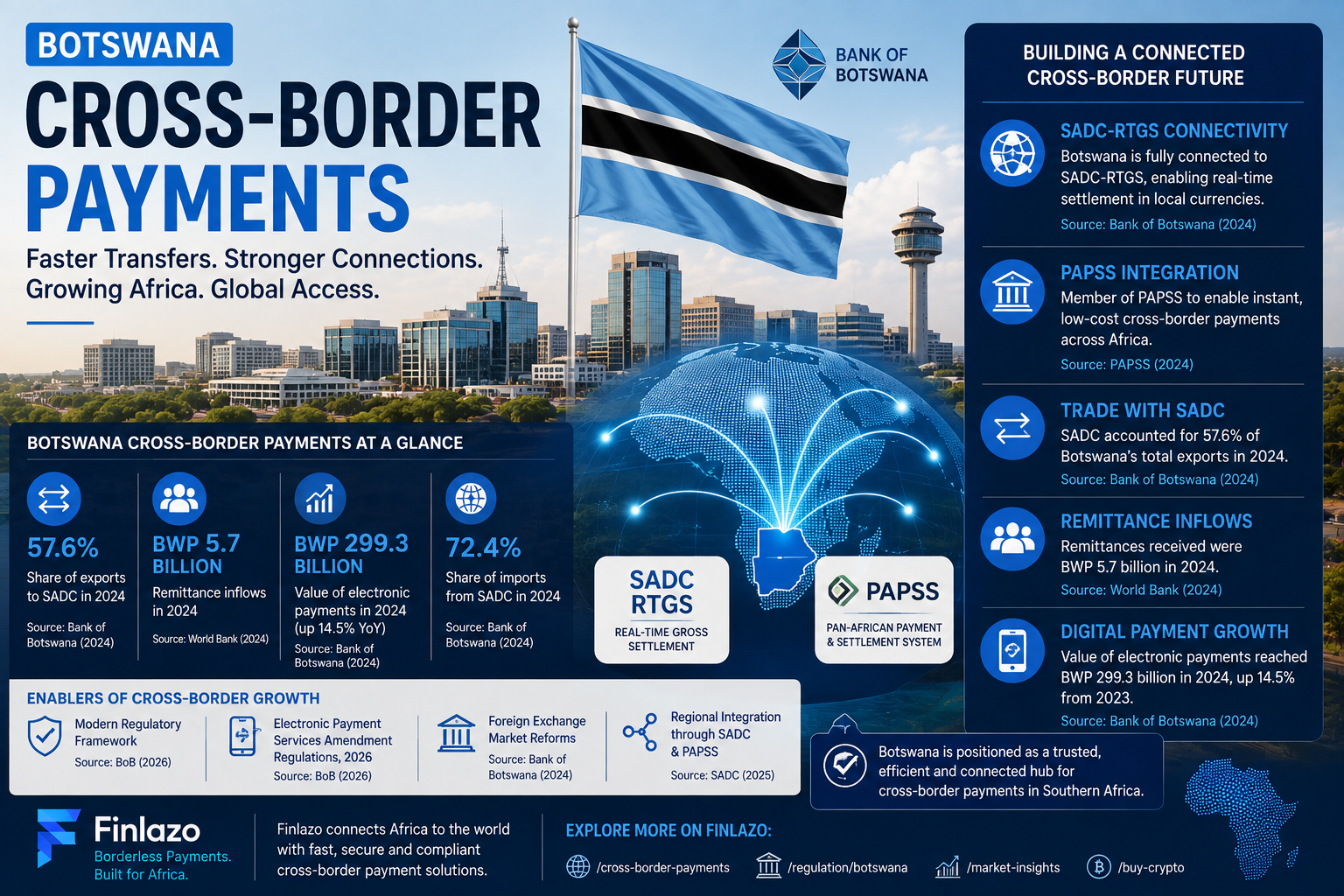
Botswana's cross-border payment system is being modernised around regional settlement, domestic digital payments and stronger interoperability.
At the end of 2024, four commercial banks in Botswana participated directly in SADC-RTGS, settling 56,452 transactions worth P117.7 billion.
The domestic payment system is also large.
In 2024, Botswana's BISS real-time gross settlement system handled 223,520 transactions worth P1.57 trillion.
Electronic funds transfers through BACH reached 12.5 million transactions worth P333.6 billion.
The latest regulatory changes are aimed at making those rails more responsive. On 22 July 2026, the Bank of Botswana published its implementation notice for the Electronic Payment Services (Amendment) Regulations, 2026.
Regional integration is moving too.
On 28 July 2026, SADC announced that the Angolan kwanza had become the second settlement currency in SADC-RTGS, while the Botswana pula was identified as one of the currencies intended to be onboarded in due course. The SADC announcement said the system was processing about R250.7 billion in transactions per month.
Botswana is therefore at an important point.
Its domestic payment infrastructure is already substantial.
Its regional connections are expanding.
The next challenge is making those systems work together more efficiently for businesses and individuals.
Botswana Cross-Border Payments at a Glance
- 56,452 — SADC-RTGS transactions settled by Botswana commercial-bank participants in 2024.
- P117.7 billion — value of those SADC-RTGS transactions in 2024.
- 4 — commercial banks participating in SADC-RTGS in Botswana at the end of 2024.
- P1.57 trillion — value of BISS transactions in 2024.
- 223,520 — BISS transactions in 2024.
- 12.5 million — BACH electronic-funds-transfer transactions in 2024.
- P333.6 billion — BACH EFT value in 2024.
- P48.1 billion — estimated foreign-exchange reserves at December 2024.
- 24.5% — decline in Botswana's foreign-exchange reserves between December 2023 and December 2024.
- P35.5 billion — merchandise trade deficit reported for 2024 in the Botswana economic outlook cited by the Bank's reporting.
- 22 July 2026 — date of the Bank of Botswana's implementation notice for the Electronic Payment Services (Amendment) Regulations, 2026.
- 15 countries — countries currently participating in SADC-RTGS as of July 2026.
- R250.7 billion per month — transaction value SADC said the regional system was processing monthly in July 2026.
These figures describe different parts of the payment and external-sector system.
They should not be added together as one measure of Botswana's cross-border payment volume.
Why Cross-Border Payments Matter to Botswana
Botswana is deeply integrated with Southern Africa.
Businesses trade with neighbouring markets.
Workers and families move money across borders.
Companies pay overseas suppliers.
Investors move capital.
Tourists spend money inside the country.
Each activity depends on payment infrastructure.
Botswana's 2024 balance of payments recorded an overall deficit of P20.9 billion.
That was a sharp change from the revised surplus recorded in 2023.
The underlying reason was a deterioration in the current account.
That matters for payments because external-sector imbalances ultimately affect foreign-exchange availability and settlement conditions.
Trade Creates Two-Way Payment Demand
Botswana exports valuable goods.
Diamonds remain particularly important.
The Bank of Botswana reported that diamond exports stood at P9.6 billion in the first quarter of 2025, accounting for 66% of goods exports in that quarter.
The same report said diamond exports had fallen 27.8% from P13.3 billion in the corresponding quarter of 2024.
The figures are from the first quarter of 2025.
They demonstrate the sensitivity of Botswana's cross-border payment flows to commodity markets.
When export receipts change, foreign-currency inflows change too.
Imports Also Require Reliable Settlement
Botswana imports machinery, fuel, food and other goods.
In the first quarter of 2025, goods imports reached P20.5 billion.
Goods exports were P14.6 billion.
The resulting quarterly trade deficit was P5.9 billion.
Importers therefore depend on reliable channels for foreign-currency payments.
A payment can involve the importer, a domestic bank, foreign exchange and one or more correspondent institutions.
Any weakness in the chain can create delays.
Remittances Are Part of the Payment Picture
Remittances are another cross-border flow.
The Bank of Botswana's external-sector statistics provide data on transfers and other international transactions.
However, Botswana's official publications do not always present remittance figures in the same format or period as the payment-system reports.
That is why remittance data should be quoted from the relevant external-sector release rather than inferred from banking-system transaction values.
The distinction is important.
SADC-RTGS settlement is not the same thing as household remittances.
One is a regional settlement infrastructure.
The other is an economic transfer category.
South Africa Is Especially Important
Botswana's regional payment story is closely connected to South Africa.
The two economies are geographically integrated.
The pula also trades alongside a regional currency environment in which the South African rand is highly important.
The Bank of Botswana has described SADC-RTGS participation as a way to reduce reliance on third-party currencies and improve regional settlement.
In its 2024 Annual Report, the Bank specifically linked the planned onboarding of the pula to lower foreign-exchange risks and transaction costs associated with correspondent banking.
That discussion is especially relevant for Botswana businesses trading with South Africa.
SADC-RTGS Is a Key Regional Rail
Botswana has participated in SADC-RTGS for years.
The latest detailed country-level figure published by the Bank of Botswana shows that four commercial banks settled 56,452 SADC-RTGS transactions worth P117.7 billion in 2024.
The same Bank of Botswana report said another four banks had expressed interest in joining the system, with two in the final stages of onboarding at the end of 2024.
That creates a potential path toward broader participation.
More participating banks can increase the reach of the regional settlement infrastructure.
The Botswana Pula and SADC-RTGS
One of the most important developments is currency settlement.
For years, SADC-RTGS transactions settled in South African rand.
That is changing.
The SADC announced on 28 July 2026 that the Angolan kwanza had become the second settlement currency.
The same announcement said the Botswana pula is intended to be onboarded in due course.
That matters because direct settlement in local currencies can reduce the need for unnecessary foreign-exchange conversions.
It can also reduce some of the costs associated with correspondent banking.
The pula had not yet been added as a settlement currency in that July 2026 announcement.
Why Local-Currency Settlement Matters
Imagine a Botswana company buying from a supplier elsewhere in SADC.
Under a multi-currency system, the transaction can potentially settle more directly in the currencies involved.
That reduces one layer of currency conversion.
The SADC Committee of Central Bank Governors said greater use of local and regional currencies can lower transaction costs and reduce dependence on non-SADC currencies.
The benefit is not automatic.
Banks still need liquidity.
They need pricing.
They need customer adoption.
They also need operational connectivity.
Botswana's Domestic RTGS System
Cross-border payments eventually interact with domestic settlement.
Botswana's BISS is its domestic real-time gross settlement system.
At the end of 2024, BISS had processed 223,520 transactions worth P1.57 trillion.
The Bank describes BISS as an electronic system that settles funds between participating institutions on an irrevocable and real-time basis.
That provides the domestic banking system with an important settlement backbone.
Electronic Transfers Are Growing
Botswana's lower-value payment infrastructure is also active.
BACH EFT transactions increased to 12.5 million in 2024, up from 11.3 million in 2023.
The value increased to P333.6 billion, from P300.9 billion.
Those are domestic electronic-fund-transfer figures.
They are not cross-border payments.
But they show the scale of the local electronic payment infrastructure that receives and distributes funds.
Botswana Is Adding More Settlement Windows
The Bank of Botswana announced another important change at the end of 2025.
The 31 December 2025 notice said BISS and BACH would move from three weekday settlement windows to four.
The additional window is scheduled for 1700 hours.
The goal is to reduce settlement backlogs and improve the speed at which customers receive funds.
For cross-border businesses, faster domestic settlement can make the receiving side of an international payment more efficient.
Electronic Payment Services Rules Changed in 2026
The Bank of Botswana published the Electronic Payment Services (Amendment) Regulations, 2026 implementation notice on 22 July 2026.
The amendment sits within a wider effort to modernise Botswana's national payments system.
The Bank's fintech framework also recognises cross-border funds transfer as a regulated digital-payment activity.
The 2025 Fintech Analytical Assessment Framework specifically lists remittances, including domestic funds transfer and cross-border funds transfer, among payment-service categories.
That matters for fintechs.
A cross-border payments company may need payment-service authorisation even if it does not operate a bank.
Botswana's Fintech Framework Is Becoming More Formal
The Bank of Botswana's fintech framework uses a "same activity, same risks, same regulation" approach.
The Fintech Analytical Assessment Framework says fintech payment services can include account issuance, e-money, remittances, merchant acquisition and virtual-asset payment services.
The framework also identifies the existing laws that can apply to these activities.
That creates a clearer route for payment startups.
It also means a fintech needs to understand the regulatory perimeter before launching.
Regional Instant Payments Still Matter
Botswana is part of the wider SADC payments modernisation project.
One important system is TCIB, or Transactions Cleared on an Immediate Basis.
TCIB was designed for low-value cross-border payments, including remittance-style transfers.
The Bank of Botswana has previously described TCIB as a way to provide efficient processing for higher-volume, day-to-day, lower-value regional payments.
This is different from SADC-RTGS.
SADC-RTGS is regional real-time gross settlement between participating financial institutions.
TCIB targets lower-value payments.
PAPSS and Botswana
Botswana is also connected to PAPSS.
PAPSS describes itself as a cross-border financial-market infrastructure that enables payments between African countries in local currencies.
Its current participant-connection framework allows eligible commercial banks, payment service providers and other financial intermediaries to connect.
Botswana's central bank was listed among PAPSS's connected central banks as the system expanded across Africa.
PAPSS is not a replacement for every domestic payment rail.
It is another layer of regional interoperability.
PAPSS Is Part of a Larger African Payments Shift
The African payment market is increasingly focused on local-currency settlement.
PAPSS says participants can make cross-border payments without relying on multiple correspondent-banking relationships within the participating network.
The PAPSS platform is designed to support instant or near-instant payments between originators and beneficiaries across Africa.
That is especially relevant to Botswana because its businesses already trade heavily within the Southern African region.
The Cost of Sending Money to Botswana
The cost of a cross-border remittance depends on the corridor.
The World Bank's Remittance Prices Worldwide database provides a detailed South Africa-to-Botswana comparison.
The data collected in August and September 2025 show that providers can differ in their fees, exchange-rate margins, receiving methods and delivery speeds.
The World Bank defines total remittance cost as the sender fee plus the exchange-rate margin.
That is the number customers should compare.
South Africa-to-Botswana Is an Important Corridor
South Africa is Botswana's immediate regional neighbour and a major source of economic interaction.
The World Bank's South Africa-to-Botswana corridor data cover transfers in both ZAR and USD.
The database also shows different payout methods.
This matters because "the cost of sending money to Botswana" is not one universal number.
A cash payout, bank deposit and digital transfer can have different economics.
Exchange Rates Can Matter More Than Fees
Cross-border payment costs have two layers.
The first is the visible fee.
The second is the exchange-rate margin.
The World Bank explicitly includes both in its total-cost calculation.
A provider charging a small flat fee can still be expensive if it applies a wide exchange-rate margin.
Customers should therefore compare how much the recipient actually gets.
Botswana's Foreign-Exchange Reserves Also Matter
Botswana's external payment capacity is linked to foreign-exchange reserves.
The Bank of Botswana estimated reserves at P48.1 billion in December 2024.
That represented a 24.5% decline from P63.7 billion in December 2023.
The decline was linked to the weaker external position and subdued diamond receipts.
Foreign reserves are not a measure of payment-system quality.
They provide the foreign-currency buffer that supports external transactions and the exchange-rate regime.
Botswana's Exchange-Rate Framework Is Also Relevant
Botswana operates a crawling-peg exchange-rate system.
In July 2025, the Bank and the government changed the rate parameters.
The annual downward crawl was increased from 1.51% to 2.76%.
The trading margin was widened from approximately 0.5% to 7.5%.
These changes affect the foreign-exchange environment in which cross-border payments are priced.
They do not directly change the fee charged by a remittance provider.
They can influence the exchange-rate component of a payment.
A Cross-Border Payment Is More Than a Transfer
A person may think of a cross-border payment as simply sending money from one account to another.
The actual process is broader.
The sender must have access to an appropriate payment channel.
The provider needs foreign-exchange liquidity.
The transaction must pass required compliance checks.
The receiving institution must be able to accept and settle the payment.
The funds then need to become usable by the beneficiary.
Each stage can create friction.
Why Interoperability Matters
Botswana has several payment layers.
There is BISS.
There is BACH.
There is SADC-RTGS.
There are electronic payment-service providers.
There are mobile and digital payment services.
There is PAPSS.
The Bank of Botswana has said the national payment-system modernisation programme aims to improve interoperability.
Interoperability is important because multiple systems are useful only when they can connect efficiently.
What Better Cross-Border Payments Could Mean for Businesses
A Botswana exporter should be able to invoice a regional customer.
The customer should know the amount to pay.
The exchange rate should be clear.
The settlement time should be predictable.
The money should arrive in the right account.
The business should be able to reconcile the transaction quickly.
The same principle applies to importers.
They need certainty over how much the supplier will receive.
What Better Cross-Border Payments Could Mean for Individuals
Individuals care about the same fundamentals.
How much does the recipient receive?
How long does the transfer take?
Can the recipient receive it into a bank account?
Can it reach a wallet?
Is the exchange rate transparent?
Are there hidden intermediary charges?
Modern regional payment systems are increasingly designed around those questions.
Could Stablecoins Become Part of the Settlement Layer?
Stablecoins could theoretically provide another way to move value between countries.
But the technology does not remove the need for regulated financial infrastructure.
The sender still needs a compliant conversion route.
The recipient needs an off-ramp.
Liquidity is required.
Foreign-exchange rules remain relevant.
For the broader African picture, see crypto and stablecoins in Africa.
Botswana is particularly interesting because it is building digital-payment infrastructure while separately developing a regulated framework for virtual assets.
Botswana Cross-Border Payments and Financial Inclusion
Cross-border payments affect financial inclusion when recipients can access funds through familiar channels.
The Bank of Botswana's fintech framework explicitly recognises remittances and cross-border transfers as payment-service activities.
The 2025 Fintech Analytical Assessment Framework also includes merchant acquisition and virtual-asset payment services within its broader fintech assessment.
This creates room for new payment models.
It also creates a clear regulatory responsibility.
Botswana Compared With Other African Payment Markets
Botswana's payment architecture differs from Kenya's.
Kenya has deep mobile-money penetration and a mature domestic instant-payment environment.
See Kenya cross-border payments for that market.
Botswana's regional strength comes more from its integration with Southern Africa and its participation in SADC payment infrastructure.
That makes the country's cross-border opportunity especially regional.
Botswana and the Future of African Local-Currency Payments
The direction of travel is clear.
SADC is adding settlement currencies.
PAPSS is expanding its network.
Botswana is strengthening domestic payment interoperability.
The SADC announcement in July 2026 said the regional system is intended to support greater use of local and regional currencies and reduce reliance on non-SADC currencies.
That could eventually make intra-African payments more direct.
The challenge will be execution.
Banks need liquidity.
Fintechs need connectivity.
Regulators need coordination.
Customers need simple user experiences.
Botswana Cross-Border Payments Statistics
- 56,452 — SADC-RTGS transactions settled by Botswana commercial-bank participants in 2024.
- P117.7 billion — SADC-RTGS value settled by Botswana commercial-bank participants in 2024.
- 4 — Botswana commercial banks participating in SADC-RTGS at end-2024.
- 223,520 — BISS transactions in 2024.
- P1.57 trillion — BISS transaction value in 2024.
- 12.5 million — BACH EFT transactions in 2024.
- P333.6 billion — BACH EFT value in 2024.
- P48.1 billion — foreign-exchange reserves in December 2024.
- 24.5% — decline in foreign-exchange reserves from December 2023 to December 2024.
- P9.6 billion — diamond exports in Q1 2025.
- 66% — diamond share of total goods exports in Q1 2025.
- 27.8% — annual decline in diamond exports in Q1 2025.
- P20.5 billion — goods imports in Q1 2025.
- P14.6 billion — goods exports in Q1 2025.
- P5.9 billion — trade deficit in Q1 2025.
- P20.9 billion — overall balance-of-payments deficit in 2024.
- 1.51% to 2.76% — change in the annual downward crawl of Botswana's exchange-rate framework in July 2025.
- 0.5% to 7.5% — change in the trading margin announced in July 2025.
- 15 — countries participating in SADC-RTGS as of July 2026.
- R250.7 billion per month — monthly transaction value cited by SADC for SADC-RTGS in July 2026.
Frequently Asked Questions
What payment systems does Botswana use for cross-border payments?
Botswana participates in regional infrastructure such as SADC-RTGS and PAPSS, while domestic settlement is supported by BISS and BACH. The Bank of Botswana also regulates electronic payment-service providers and other payment activities.
How many SADC-RTGS transactions did Botswana process?
At the end of 2024, four commercial banks in Botswana had settled 56,452 SADC-RTGS transactions worth P117.7 billion.
Will the Botswana pula become a SADC-RTGS settlement currency?
The SADC Committee of Central Bank Governors said in July 2026 that the Botswana pula is intended to be onboarded as an additional settlement currency in due course. It had not yet been added in that July announcement.
How much does it cost to send money to Botswana?
The cost depends on the sending country, provider, amount, payment method and exchange rate. The World Bank's Remittance Prices Worldwide database tracks fees and exchange-rate margins for individual remittance corridors, including South Africa to Botswana.
Can international money be received into Botswana through digital payment services?
The available route depends on the licensed provider and payment channel. Botswana's fintech framework expressly recognises remittances and cross-border funds transfer as regulated payment activities.
What is PAPSS and can it help Botswana?
PAPSS is a pan-African payment and settlement infrastructure designed to support cross-border payments in African local currencies. Botswana is part of the wider PAPSS ecosystem, while specific customer access depends on participating financial institutions and connected payment channels.
Why does SADC-RTGS matter for Botswana?
SADC-RTGS provides regional settlement between participating financial institutions. Botswana's participation supports regional trade and can reduce reliance on correspondent-banking routes for eligible transactions.
The Bottom Line
Botswana's cross-border payment story is increasingly about connectivity.
The country already has a substantial domestic payment infrastructure.
BISS handled 223,520 transactions worth P1.57 trillion in 2024.
BACH processed 12.5 million electronic-funds-transfer transactions worth P333.6 billion in the same year.
At the regional level, four Botswana commercial banks settled 56,452 SADC-RTGS transactions worth P117.7 billion in 2024.
The regional system is now evolving.
SADC introduced the Angolan kwanza as its second settlement currency in July 2026.
The same SADC announcement said the Botswana pula is intended to follow.
Botswana is also modernising domestic payment rules.
The Bank of Botswana published its Electronic Payment Services (Amendment) Regulations, 2026 implementation notice on 22 July 2026.
The direction is encouraging.
But infrastructure alone is not enough.
Payment systems need interoperability.
Businesses need transparent pricing.
Banks need liquidity.
Fintechs need regulatory certainty.
Customers need simple ways to send and receive money.
Botswana has many of the building blocks.
The next stage is making those pieces work together across borders.