Zimbabwe Cryptocurrency: Adoption, P2P Trading, Stablecoins and the Digital-Asset Market
Zimbabwe has a growing crypto ecosystem shaped by P2P trading, stablecoins and changing financial conditions. Explore adoption trends, Bitcoin use, digital assets and the forces shaping the local market.

On this page
Zimbabwe's cryptocurrency market is more active than its formal financial rules once suggested.
The latest Chainalysis Global Crypto Adoption Index ranked Zimbabwe 100th globally in 2025. The same index placed Zimbabwe 86th for retail centralized-service activity.
A separate Triple-A estimate counted about 238,138 cryptocurrency owners in Zimbabwe in 2023, equivalent to 1.43% of the country's population in that dataset.
These figures measure different things.
The Chainalysis index measures estimated crypto activity.
Triple-A estimates ownership.
Neither should be treated as an official government count of Zimbabwean crypto users.
Zimbabwe's own 2024 Virtual Assets and Virtual Asset Service Providers Risk Assessment describes a market shaped by informal trading, P2P activity, wallets, exchanges and investment.
It also found a strong preference for stablecoins such as USDT and USDC, alongside Bitcoin and Ethereum.
The market is therefore bigger than a simple Bitcoin story.
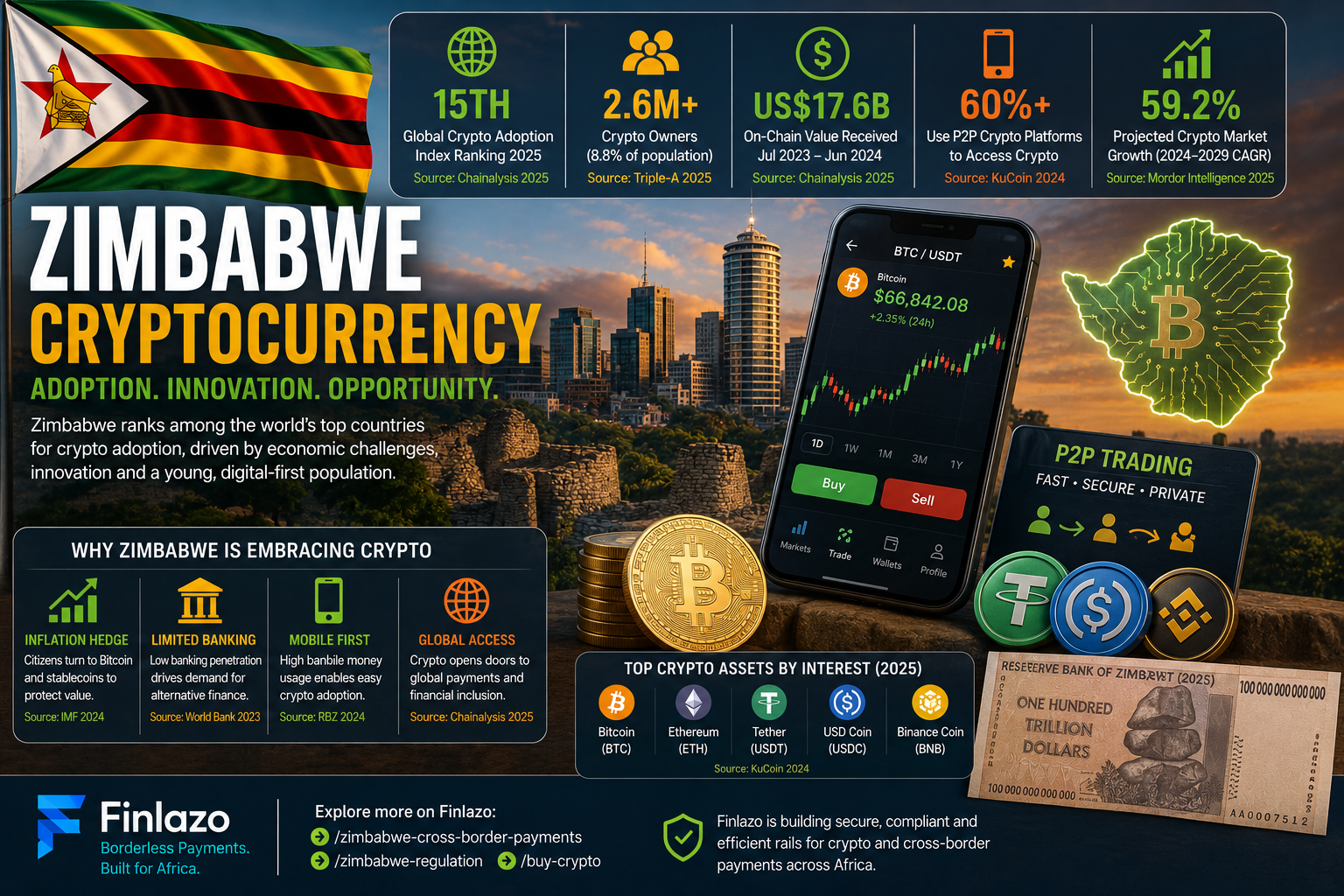
Zimbabwe Cryptocurrency at a Glance
- 100th globally — Zimbabwe's position in the 2025 Chainalysis Global Crypto Adoption Index.
- 86th — Zimbabwe's retail centralized-service ranking in the 2025 index.
- 238,138 — estimated cryptocurrency owners in Zimbabwe in Triple-A's 2023 dataset.
- 1.43% — estimated share of Zimbabwe's population represented by those crypto owners in the same dataset.
- 6 — cryptocurrency exchanges identified as having originated from Zimbabwe since 2018 in the 2024 national risk assessment.
- 3,000 — maximum number of subscribers reported for each of those Zimbabwe-originated exchanges at their peak.
- 4 — VASPs identified in the assessment as having customer bases between 10,000 and 100,000, primarily operating outside Zimbabwe while serving Zimbabweans.
- US$13.9 million — value of cryptocurrency involved in a kidnapping case cited by the assessment.
- US$205 billion+ — on-chain cryptocurrency value received by Sub-Saharan Africa between July 2024 and June 2025.
- 52% — year-over-year increase in Sub-Saharan Africa's on-chain crypto value during that period.
These figures come from different methodologies and reporting periods.
They should not be combined into one estimate of Zimbabwe's current crypto market size.
How Big Is Cryptocurrency in Zimbabwe?
There is no single official number for the total value of Zimbabwe's cryptocurrency market.
That is not unusual.
Crypto markets are difficult to measure because users can trade on international exchanges, P2P marketplaces, self-custody wallets and social platforms.
Zimbabwe's national risk assessment recognised this problem.
The 2024 assessment described the domestic market as limited and largely informal. It also found that some providers serving Zimbabweans were based outside the country.
The latest Chainalysis ranking gives another view.
Zimbabwe placed 100th globally in 2025.
Its retail centralized-service ranking was higher at 86th.
That suggests individual activity is more important than the country's overall position might imply.
The figures do not mean Zimbabwe has a large institutional crypto sector.
They show that ordinary users are participating in crypto markets.
What Does Crypto Adoption Mean in Zimbabwe?
Crypto adoption in Zimbabwe has several layers.
Some users trade.
Some hold digital assets as an alternative store of value.
Some use P2P platforms.
Some use cryptocurrency for transfers.
Businesses and technology operators have also experimented with crypto services.
The national risk assessment says Zimbabwe's crypto market grew out of a combination of economic instability, remittance needs and technological access.
The assessment specifically links adoption to economic challenges and the need for efficient remittance options.
It also says crypto-based remittance activity remained small and fragmented, often operating through informal channels such as WhatsApp groups.
That is an important distinction.
Crypto can be visible without being fully formalised.
Zimbabwe's First Crypto Exchanges
Zimbabwe's formal crypto journey started earlier than many people realise.
The national risk assessment says the country's adoption remained limited until a virtual-asset exchange was established around 2017.
That event marked a turning point.
It gave local users a way to interact with digital currencies through an exchange infrastructure.
The market remained small.
The same assessment identified six cryptocurrency exchanges that had originated from Zimbabwe since 2018.
At their peak, none had more than 3,000 subscribers.
Most later ceased operations.
The history shows how difficult it can be to build a domestic exchange in a market with regulatory, banking and liquidity constraints.
International Platforms Became More Important
When domestic exchange infrastructure is limited, international platforms become more important.
Zimbabwe's risk assessment found that some VASPs serving Zimbabweans operated mainly outside Zimbabwe.
Four entities had customer bases between 10,000 and 100,000, primarily operating from outside the country while serving Zimbabwean users.
That is a useful reminder.
A country can have a meaningful crypto user base even when few domestic exchanges are large.
Users can simply access platforms elsewhere.
Peer-to-Peer Trading in Zimbabwe
P2P trading is one of the most important parts of Zimbabwe's cryptocurrency story.
The national risk assessment identified P2P transactions as a significant part of the ecosystem.
It also noted that crypto transactions could be conducted through formal banking channels, mobile-money operators and cash, with much activity taking place informally.
P2P trading solves a practical problem.
The buyer and seller can agree on a local payment method while the crypto moves through a digital platform or wallet.
That can be valuable in a market where international payment access is not always straightforward.
It also creates risks.
Fraud can occur.
Payment disputes can arise.
Accounts can be frozen.
The counterparty may not be who they claim to be.
Bitcoin in Zimbabwe
Bitcoin remains one of the major cryptocurrencies used in Zimbabwe.
The national risk assessment lists Bitcoin alongside Ethereum, USDT and USDC among the most traded virtual assets.
The report says the market's focus was more on investment and trading gains than on direct payment solutions.
That is important.
Bitcoin is often discussed as a payment technology.
In Zimbabwe, the evidence suggests that trading and investment have played a larger role.
Cross-border transfers still matter.
But the country's crypto market is not simply a digital replacement for conventional payments.
Stablecoins Have a Special Role
Stablecoins are particularly relevant to Zimbabwe because they attempt to maintain a stable reference value, often against the U.S. dollar.
The Zimbabwe national risk assessment found a high preference for stablecoins such as USDT and USDC.
The same assessment identified them alongside Bitcoin and other prominent assets.
That matters because stablecoins can serve several functions.
A trader can use them as a trading pair.
A user can hold them as a digital dollar-linked asset.
They can also be transferred across borders.
The final use case depends on the user's access to an exchange, wallet, liquidity and a way to move between crypto and local currency.
Why Stablecoins Matter in an Unstable Currency Environment
Zimbabwe's monetary history helps explain why dollar-linked digital assets attract attention.
The country's currency system has gone through repeated changes.
That has made the preservation and transfer of value a persistent financial concern.
The latest IMF assessment of Zimbabwe noted that the economy remained exposed to exchange-rate and inflation risks even as the authorities worked to stabilise the monetary system.
Crypto is not a guaranteed hedge.
Bitcoin can be highly volatile.
Stablecoins carry issuer, custody and platform risks.
But the demand for dollar-denominated digital value helps explain why stablecoins appear prominently in Zimbabwe's crypto ecosystem.
A Market Built Around Access
Zimbabwe's crypto market has often been shaped by access.
If a conventional financial product is difficult to obtain, users look for alternatives.
That does not automatically make cryptocurrency better.
It simply changes the incentives.
P2P marketplaces can connect buyers and sellers.
International exchanges can provide liquidity.
Self-custody wallets can allow users to hold assets without relying on a local intermediary.
Each option comes with trade-offs.
The result is a market that can function even when domestic infrastructure remains limited.
The Role of Mobile Money
Zimbabwe has a strong mobile-money ecosystem.
The Reserve Bank of Zimbabwe's Q2 2026 National Payment Systems Report recorded 236.7 million mobile-money transactions in the quarter.
The total value reached ZiG98.1 billion.
Mobile money accounted for 89.09% of national payment-system transaction volume in that quarter.
These are domestic payment figures.
They are not crypto numbers.
But they help explain why wallet-based financial services can be attractive in Zimbabwe.
A consumer who already uses a mobile wallet may find digital asset services easier to understand when the final payment step connects to familiar local infrastructure.
Crypto and Remittances
Remittances are an important part of Zimbabwe's financial system.
The Reserve Bank reported US$2.453 billion in diaspora remittances in 2025.
Crypto can offer another route for value transfer.
The national virtual-asset assessment, however, described crypto-based remittance use in Zimbabwe as small and fragmented.
That is an important qualification.
Crypto should not be presented as the dominant remittance rail.
It is better described as one of the alternatives that some users explore.
For the wider payment picture, see Zimbabwe cross-border payments.
The Crypto Market and Financial Inclusion
Zimbabwe's crypto market also intersects with financial inclusion.
The national risk assessment linked adoption to technological access and the search for alternatives during economic difficulty.
But cryptocurrency ownership is not the same thing as financial inclusion.
A person can own crypto and still lack reliable banking access.
A person can also be fully banked and use crypto for trading.
The two concepts should remain separate.
Risks in Zimbabwe's Crypto Market
The market has real risks.
Zimbabwe's national risk assessment recorded scams, fraudulent investment schemes and other crypto-related cases.
One case involved a cryptocurrency loss of US$108,000.
Another case cited by the assessment involved a businessman who was kidnapped in connection with cryptocurrency worth US$13.9 million.
These are case studies.
They do not measure the overall crime rate in Zimbabwe's crypto market.
They do show why security and due diligence matter.
Crypto Scams and Investment Schemes
The national assessment also discussed fraudulent crypto websites and investment schemes.
It described cases where scammers collected deposits by promising cryptocurrency investment returns.
The operators then disappeared.
This is a familiar risk in markets where consumers are still learning how crypto works.
A legitimate-looking website is not proof of legitimacy.
A high promised return is not proof of a sound investment.
Users should verify the identity and regulatory status of a provider before sending money.
For the legal framework now applying to Zimbabwe's VASPs, see Zimbabwe cryptocurrency regulation.
What Happened to Zimbabwe's Exchange Infrastructure?
The history of domestic exchanges is revealing.
The 2024 national assessment identified six Zimbabwe-originated exchanges since 2018.
At their peak, none had more than 3,000 subscribers.
Most later ceased operations.
That suggests the market has not followed a simple path from one successful local exchange to a mature domestic ecosystem.
Instead, activity has moved between local projects, international platforms, P2P markets and self-custody.
Zimbabwe's Crypto Market Is Becoming More Formal
The regulatory picture changed in 2026.
Zimbabwe introduced VASP registration through the Financial Intelligence Unit.
The FIU's current VASP information provides registration and compliance materials for virtual asset service providers.
This does not automatically mean that every crypto activity is now licensed.
Registration sits within a wider framework that can involve other authorities.
But it does create a formal entry point for businesses that previously operated in a largely informal environment.
That change is likely to affect the shape of the market.
What Does Regulation Mean for Users?
Formal regulation can change the market in several ways.
It can make legitimate businesses easier to identify.
It can strengthen AML and customer-protection controls.
It can also increase compliance costs.
For users, the most useful change may be greater clarity.
A company should be able to explain what it does and which authority supervises the relevant activity.
The detailed legal position is covered in Zimbabwe cryptocurrency regulation.
Zimbabwe and the Wider African Crypto Market
Zimbabwe is part of a much larger African trend.
Chainalysis estimates that Sub-Saharan Africa received more than US$205 billion in on-chain crypto value between July 2024 and June 2025.
That represented 52% year-over-year growth.
The region's users increasingly use crypto for trading, remittances, savings and other financial needs.
Zimbabwe fits into that picture, but with its own characteristics.
Currency instability and the structure of the financial system have influenced demand.
For a broader regional view, see the rise of cryptocurrency in Africa.
Zimbabwe Compared With Other African Crypto Markets
Zimbabwe's 2025 Chainalysis position was lower than some major African markets.
Nigeria ranked 6th.
Ethiopia ranked 12th.
South Africa ranked among the top global markets as well.
Zimbabwe ranked 100th.
These rankings come from the same Chainalysis methodology and therefore provide a useful comparison.
They also show that Zimbabwe should not be presented as one of Africa's very largest crypto markets.
Its importance comes from the particular needs its users have and from the role of P2P and stablecoins in the ecosystem.
What Could Shape Zimbabwe's Crypto Market Next?
Several factors could change the market.
Stablecoin Access
If stablecoin liquidity improves, users may have more options for trading and transferring value.
P2P Markets
P2P will likely remain important while users continue to value flexible payment methods.
Banking Connections
Better links between regulated crypto businesses and the banking system could reduce friction.
Regulation
The new VASP registration framework may push more businesses toward formal operations.
Consumer Education
Stronger understanding of wallets, private keys, scams and investment risk can reduce losses.
Zimbabwe Cryptocurrency Statistics
- 100th globally — Zimbabwe's 2025 Chainalysis Global Crypto Adoption Index ranking.
- 86th — Zimbabwe's retail centralized-service ranking in the 2025 index.
- 238,138 — estimated cryptocurrency owners in Zimbabwe in the 2023 Triple-A dataset.
- 1.43% — estimated population share represented by those owners.
- 6 — Zimbabwe-originated exchanges identified since 2018.
- 3,000 — maximum subscribers reported for those exchanges at their peak.
- US$13.9 million — cryptocurrency value involved in a kidnapping case cited by the national assessment.
- US$2.453 billion — diaspora remittances in 2025.
- 236.7 million — mobile-money transactions in Q2 2026.
- ZiG98.1 billion — mobile-money transaction value in Q2 2026.
- 89.09% — mobile money's share of national payment-system transaction volume in Q2 2026.
- US$205 billion+ — Sub-Saharan Africa on-chain crypto value received between July 2024 and June 2025.
- 52% — year-over-year growth in Sub-Saharan Africa's on-chain crypto activity during that period.
Frequently Asked Questions
Is cryptocurrency popular in Zimbabwe?
Zimbabwe has an active cryptocurrency ecosystem, although it is not one of the world's largest retail markets. Chainalysis ranked Zimbabwe 100th globally in its 2025 adoption index, while Triple-A estimated 238,138 crypto owners in its 2023 dataset.
How many people in Zimbabwe own cryptocurrency?
Triple-A estimated 238,138 cryptocurrency owners in Zimbabwe in 2023, representing 1.43% of the population in that dataset. There is no equivalent current official government figure confirming the country's total crypto-user population.
What cryptocurrencies are most used in Zimbabwe?
Zimbabwe's 2024 national virtual-asset risk assessment identified Bitcoin, Ethereum, USDT and USDC among the most traded assets. The assessment also noted a high preference for stablecoins.
Is peer-to-peer crypto trading common in Zimbabwe?
P2P trading is an important part of Zimbabwe's crypto ecosystem. The national risk assessment identified P2P transactions as a significant feature of the market and noted that informal trading channels were widely used.
Do Zimbabweans use stablecoins?
Yes. Zimbabwe's national virtual-asset risk assessment found a high preference for stablecoins such as USDT and USDC. Stablecoins can be used for trading, holding dollar-linked value and transferring digital assets.
Why do Zimbabweans use cryptocurrency?
The national risk assessment linked crypto adoption to economic instability, remittance needs and access to digital technology. These factors can encourage users to explore alternative ways to store or transfer value.
Can people buy Bitcoin in Zimbabwe?
Access depends on the platform and the current regulatory environment. Zimbabwe has historically had users accessing international exchanges and P2P platforms, while the country's regulatory framework has been developing.
Does Zimbabwe have a large crypto market?
Zimbabwe has a meaningful crypto ecosystem but should not be described as one of the world's largest markets. Its 2025 Chainalysis ranking was 100th globally, while its domestic market has historically been characterised by P2P trading and international platforms.
The Bottom Line
Zimbabwe's cryptocurrency market is a story of demand meeting constraints.
The country has experienced long periods of monetary and financial instability.
Users have looked for alternative ways to trade, store and move value.
P2P markets became one answer.
Stablecoins became another.
International exchanges filled some of the gaps left by a limited domestic exchange ecosystem.
The latest Chainalysis ranking places Zimbabwe 100th globally.
That does not make Zimbabwe a crypto giant.
It does show that the market is real.
Triple-A's 2023 estimate of 238,138 owners provides another indication of participation, although it is not a current official count.
Zimbabwe's own 2024 national assessment adds useful detail.
It found Bitcoin, Ethereum, USDT and USDC among the most traded assets.
It identified P2P trading as an important channel.
It also found that much of the ecosystem remained informal.
The market is now entering a different phase.
Zimbabwe introduced a formal VASP registration framework in 2026.
That creates a path toward greater visibility and oversight.
The next question is whether formal regulation can preserve the practical utility that made P2P and stablecoins attractive in the first place.
That will determine where Zimbabwe's crypto market goes next.