Zimbabwe Cross-Border Payments: Remittances, SADC-RTGS, PAPSS and Digital Payment Infrastructure
https://finlazo.com/blog/zimbabwe-cross-border-payments

On this page
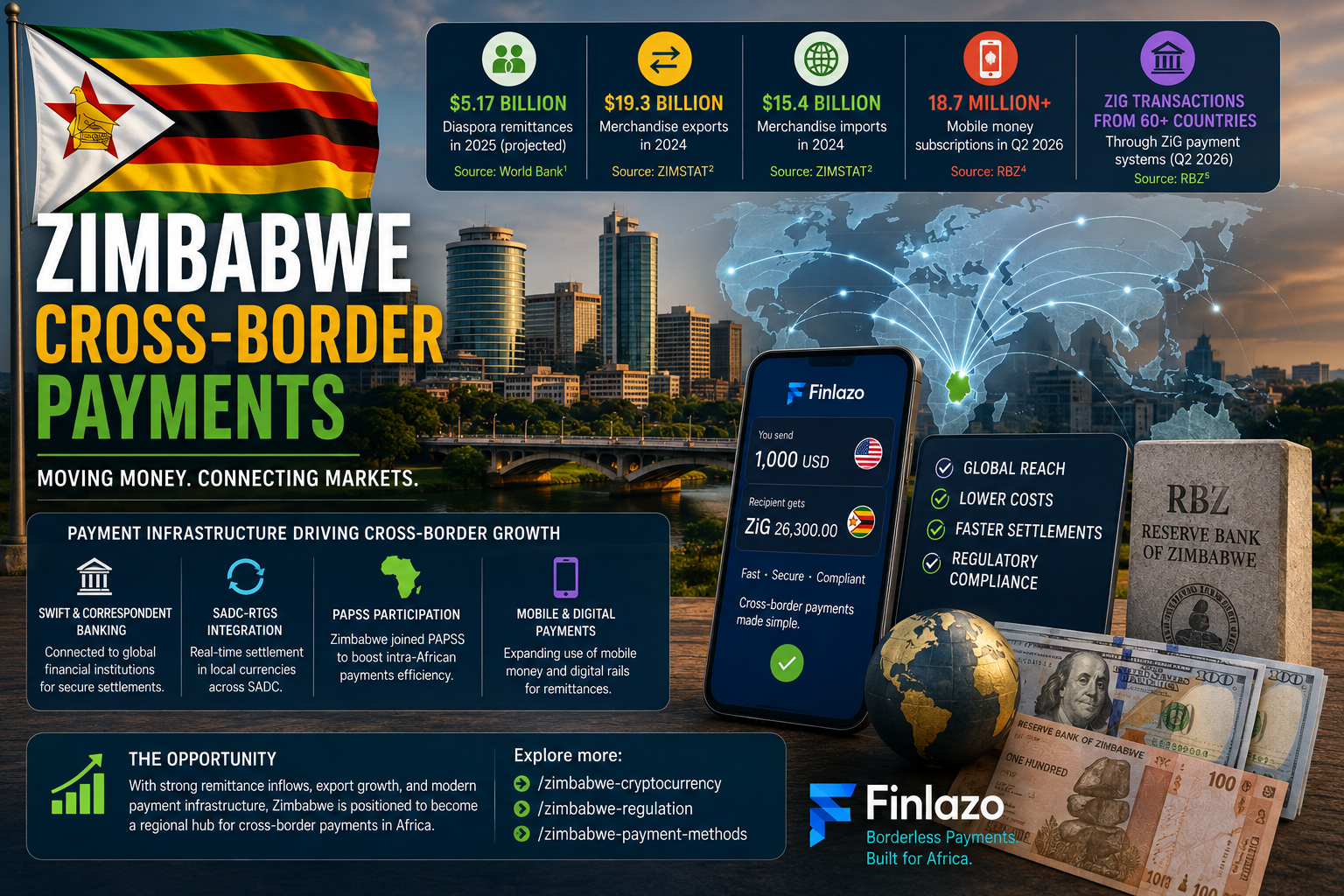
Zimbabwe's cross-border payment economy is growing alongside a broader recovery in foreign-currency flows.
The Reserve Bank of Zimbabwe reported total foreign-currency receipts of US$16.194 billion in 2025, up 21.6% from US$13.316 billion in 2024.
Diaspora remittances contributed US$2.453 billion in 2025, representing 15.1% of total foreign-currency receipts.
The latest available 2026 data show that foreign-currency inflows remained strong. The Reserve Bank reported US$8.3 billion in inflows by 31 May 2026, compared with US$6 billion during the same period in 2025.
Payments infrastructure is also becoming more connected.
In 2025, Zimbabwean banks processed 4,038 SADC-RTGS transactions worth ZAR3.51 billion.
Zimbabwe also increased local participation in PAPSS. The RBZ 2025 Annual Report says local PAPSS participation increased from banks beginning onboarding in January 2025 to six banks.
The picture is therefore changing.
Zimbabwe still relies heavily on established banking and foreign-exchange channels.
But regional payment systems and digital infrastructure are becoming increasingly important.
Zimbabwe Cross-Border Payments at a Glance
- US$16.194 billion — total foreign-currency receipts in 2025.
- 21.6% — annual increase in Zimbabwe's total foreign-currency receipts in 2025.
- US$2.453 billion — diaspora remittances in 2025.
- 15.1% — share of 2025 foreign-currency receipts represented by diaspora remittances.
- US$8.3 billion — foreign-currency inflows by 31 May 2026.
- 39.1% — increase in foreign-currency inflows by 31 May 2026 compared with the same period in 2025.
- US$5.9 billion — total foreign payments realised by 31 May 2026.
- 4,038 — SADC-RTGS transactions processed by Zimbabwean banks in 2025.
- ZAR3.51 billion — value of those SADC-RTGS transactions in 2025.
- 6 banks — local banks participating in PAPSS by the point described in the RBZ's 2025 Annual Report.
- 3.5 million+ — annual transactions processed through Zimbabwe's EATS system.
- ZiG520.34 billion — ZiG value processed through RTGS during 2025.
- US$36.98 billion — US-dollar value processed through RTGS during 2025.
These figures cover different parts of Zimbabwe's international and domestic payment ecosystem.
They should not be added together as though they represent one cross-border payment total.
Why Cross-Border Payments Matter to Zimbabwe
Zimbabwe is strongly connected to the regional and global economy.
The country imports goods and services.
It exports minerals, tobacco and other products.
Its diaspora sends money home.
Companies also make payments to suppliers and service providers outside Zimbabwe.
The RBZ reported US$9.675 billion in export earnings in 2025.
Diaspora remittances added another US$2.453 billion.
These flows require reliable foreign-currency settlement.
A payment can begin in South Africa, the United Kingdom, the United States or another market and end in a Zimbabwean bank account or wallet.
The efficiency of that connection matters to households and businesses alike.
Diaspora Remittances Are Central to the Market
Remittances are one of Zimbabwe's most important cross-border financial flows.
The RBZ recorded US$2.453 billion in diaspora remittances in 2025.
That was 14.0% higher than in 2024, when diaspora remittances were US$2.153 billion.
The increase matters because remittances support households, but they also contribute to the formal foreign-exchange market.
The RBZ said diaspora remittances accounted for 15.1% of Zimbabwe's total foreign-currency receipts in 2025.
Formal Channels Matter
The Reserve Bank encourages Zimbabweans to use registered remittance operators and banks.
The 2026 foreign-exchange guidelines state that inward diaspora remittances can be received in foreign currency through money-transfer agencies, individual foreign-currency bank accounts and mobile-money platforms.
That creates several possible receiving channels.
A recipient may prefer a bank account.
Another may want a mobile wallet.
The important requirement is that the transfer uses a recognised and compliant channel.
Outward Remittances From Zimbabwe
Zimbabwe also permits certain person-to-person outward remittances.
The current RBZ foreign-exchange guidelines allow individuals residing in Zimbabwe to send up to US$5,000 per transaction and US$50,000 per year in person-to-person remittances.
Those limits apply to the stated remittance category.
They are not a universal cap on every type of cross-border payment.
Business payments and other external obligations can follow different rules.
The Cost of Sending Money to Zimbabwe
The cost of a remittance depends on the corridor, provider, amount, payment method and exchange rate.
The World Bank's Remittance Prices Worldwide database provides corridor-level comparisons.
For Zimbabwe, users should look beyond the transfer fee.
The exchange rate can affect how much the recipient finally receives.
A provider with a low headline fee can still be more expensive if the exchange-rate margin is larger.
The final amount received is therefore the most useful comparison.
Zimbabwe's Foreign-Exchange Market Has Been Changing
Cross-border payments are closely linked to Zimbabwe's foreign-exchange market.
The RBZ's 2026 Monetary Policy Statement said the ZiG exchange rate remained broadly stable between ZiG25 and ZiG27 per U.S. dollar after the September 2024 market-driven adjustment.
The bank also said foreign-currency inflows reached US$16.2 billion in 2025, representing a 21.6% increase from 2024.
The exchange-rate environment matters because many cross-border transactions are priced or settled in foreign currency.
A sender can therefore face both a transfer charge and a currency-conversion cost.
SADC-RTGS Is an Important Regional Rail
Zimbabwe participates in SADC-RTGS, the Southern African regional real-time gross settlement system.
The platform supports settlement between participating financial institutions across the region.
In 2025, Zimbabwean banks processed 4,038 transactions worth ZAR3.51 billion on SADC-RTGS.
That represented a decline in value from 2024, when Zimbabwean commercial banks processed 4,103 transactions worth ZAR5.55 billion.
The difference shows that cross-border payment volumes and values can move differently.
A system can process fewer or similar numbers of payments while the underlying value changes substantially.
Zimbabwe and PAPSS
The Pan-African Payment and Settlement System offers another route.
PAPSS is designed to support cross-border payments in African local currencies and reduce dependence on hard-currency intermediation.
Zimbabwe has been increasing its local participation.
The RBZ's 2025 Annual Report says local PAPSS participation increased from banks beginning onboarding in January 2025 to six banks.
That is important for the country's regional payment strategy.
It means PAPSS is moving from policy discussion toward practical institutional connectivity.
What PAPSS Could Mean for Zimbabwe
The attraction of local-currency settlement is straightforward.
A Zimbabwean business could potentially make or receive an eligible African cross-border payment through a participating financial institution without every transaction following the traditional hard-currency route.
That can reduce some settlement complexity.
PAPSS also provides a regional framework that can complement domestic payment systems.
For the broader African context, see digital payment infrastructure in Africa.
Zimbabwe's Domestic Payment Infrastructure Is Growing
Cross-border payments depend partly on the quality of the domestic system receiving the funds.
Zimbabwe's digital payment infrastructure is expanding.
The RBZ's second-quarter 2026 National Payment Systems report shows that electronic transactions processed through national payment-system infrastructure reached ZiG757.1 billion in Q2 2026.
Transaction volume reached 265.7 million.
Both figures increased from Q1 2026.
The value rose 23.7%.
The volume rose 13.2%.
These are national payment-system figures rather than cross-border figures.
They show the domestic infrastructure available once international money reaches Zimbabwe.
Mobile Money Is a Major Part of the System
Mobile money accounted for the largest share of transaction volume in Zimbabwe's second-quarter 2026 national payment-system data.
The RBZ recorded 236.7 million mobile-money transactions in Q2 2026.
The value reached ZiG98.1 billion.
Mobile money represented 89.09% of national payment-system transaction volume in that quarter.
The figures do not mean 89.09% of cross-border transfers were mobile money.
They show how important mobile wallets are inside the domestic payment system.
Could International Transfers Reach Mobile Wallets More Directly?
This is one of the biggest opportunities in cross-border payments.
The RBZ's foreign-exchange guidelines explicitly recognise mobile wallets as a channel for receiving inward diaspora remittances.
That means the legal framework already recognises wallet-based receipt of remittances.
The remaining question is connectivity.
A sender abroad needs a provider connected to Zimbabwe.
The provider needs a compliant payout route.
The recipient then needs a wallet or account that can accept the funds.
The fewer unnecessary steps in that chain, the better the customer experience.
EATS and the Move to ISO 20022
Zimbabwe's high-value payment infrastructure has also been modernised.
Zimbabwe's EATS system processes more than 3.5 million transactions annually.
The system processes more than ZiG5 trillion in aggregate annual value.
ISO 20022 is a messaging standard.
It does not itself guarantee instant payments.
Its value is richer and more structured payment data.
Zimbabwe's RTGS System Handles Large Values
The RTGS system remains central to high-value transactions.
During 2025, the RBZ reported ZiG520.34 billion of RTGS value and US$36.98 billion of RTGS value.
The corresponding volumes were 4.48 million ZiG transactions and 6.48 million U.S.-dollar transactions.
These numbers are not cross-border-only.
They show the scale of the domestic settlement infrastructure that supports the banking sector.
Cross-Border Payments for Businesses
Businesses experience cross-border payments differently from individuals.
An importer may need to settle a supplier invoice.
An exporter may need to receive payment from an overseas buyer.
A company may pay an international software provider.
A hotel may pay a foreign supplier.
Each transaction can involve foreign exchange, documentation and compliance.
The RBZ's approval requirements for payment systems require applicants for cross-border payment systems to address exchange-control compliance and other regulatory requirements.
The framework also expects risk management, clearing and settlement arrangements, customer due diligence and AML controls.
Why Exchange Control Matters
Zimbabwe's foreign-exchange rules are closely linked to external payments.
The current RBZ foreign-exchange guidelines state that individuals' external payments should be processed through normal banking channels and in accordance with AML/CFT requirements.
For cross-border businesses, that means the payment method is only one part of the equation.
The underlying transaction must also fit the applicable foreign-exchange rules.
The Role of Correspondent Banking
Correspondent banking remains important for international payments.
A Zimbabwean bank may need a banking relationship in another jurisdiction to process a transaction denominated in a foreign currency.
That adds another institutional layer.
The more institutions involved, the more important payment information becomes.
This is one reason the move to ISO 20022 matters.
Better structured information can help banks process, reconcile and screen payments more effectively.
Can Stablecoins Play a Role?
Stablecoins are increasingly discussed as a possible settlement layer for African payments.
They can transfer value over blockchain networks without following exactly the same route as a conventional correspondent-bank payment.
But that does not eliminate the need for compliant fiat conversion.
A sender needs an on-ramp.
A recipient needs an off-ramp.
Liquidity is required.
AML/CFT and foreign-exchange rules remain relevant.
For Zimbabwe, the regulatory context is especially important.
The Financial Intelligence Unit's VASP framework now registers virtual asset service providers for AML/CFT purposes, but that registration is not automatically a licence to conduct every type of financial activity.
For more context, see Zimbabwe cryptocurrency regulation.
Zimbabwe and Regional African Payment Integration
Zimbabwe is participating in multiple regional payment initiatives.
The country participates in SADC-RTGS.
It is increasing PAPSS connectivity.
It also participates in COMESA's regional payment and settlement arrangements.
The RBZ's 2025 Annual Report describes regional payment integration as part of its payments-system strategy.
The objective is larger than any one system.
It is to make regional financial connections easier.
What Would Better Cross-Border Payments Look Like?
A customer should not need to understand the settlement network.
A Zimbabwean sender should be able to enter the destination.
A recipient abroad should be able to provide a bank account or wallet.
The system should show the exchange rate.
It should show the fee.
It should show the expected arrival time.
The infrastructure can then handle compliance, conversion, settlement and reconciliation underneath.
That is the direction in which regional payment connectivity is moving.
Zimbabwe Cross-Border Payments Statistics
- US$16.194 billion — total foreign-currency receipts in 2025.
- US$2.453 billion — diaspora remittances in 2025.
- 14.0% — increase in diaspora remittances from 2024 to 2025.
- US$8.3 billion — foreign-currency inflows by 31 May 2026.
- 39.1% — year-on-year increase in foreign-currency inflows by 31 May 2026.
- 4,038 — Zimbabwean-bank SADC-RTGS transactions in 2025.
- ZAR3.51 billion — SADC-RTGS value in 2025.
- 6 — banks participating in PAPSS at the point described in the 2025 Annual Report.
- ZiG757.1 billion — electronic transaction value through national payment-system infrastructure in Q2 2026.
- 265.7 million — electronic transaction volume through national payment-system infrastructure in Q2 2026.
- 236.7 million — mobile-money transactions in Q2 2026.
- ZiG98.1 billion — mobile-money transaction value in Q2 2026.
- 89.09% — mobile money's share of national payment-system transaction volume in Q2 2026.
- ZiG520.34 billion — ZiG RTGS transaction value in 2025.
- US$36.98 billion — U.S.-dollar RTGS transaction value in 2025.
- US$5,000 per transaction — person-to-person outward remittance limit for individuals under the stated NBE rules.
- US$50,000 per year — annual person-to-person outward remittance limit under the stated rules.
Frequently Asked Questions
How much money does Zimbabwe receive in remittances?
The Reserve Bank of Zimbabwe recorded US$2.453 billion in diaspora remittances in 2025, an increase of 14.0% from 2024.
Can people receive international remittances into a Zimbabwean mobile wallet?
Yes. The RBZ's current foreign-exchange guidelines recognise mobile wallets as one of the formal channels through which residents can receive inward diaspora remittances.
What is SADC-RTGS?
SADC-RTGS is a regional real-time gross settlement system used by participating financial institutions in Southern Africa. Zimbabwean banks processed 4,038 transactions worth ZAR3.51 billion through SADC-RTGS in 2025.
Is Zimbabwe connected to PAPSS?
Yes. The RBZ's 2025 Annual Report says local PAPSS participation increased to six banks during the period described.
How much can an individual send out of Zimbabwe as a person-to-person remittance?
The RBZ's 2026 foreign-exchange guidelines allow qualifying individuals to send up to US$5,000 per transaction and US$50,000 per year under the stated person-to-person remittance rules.
The Bottom Line
Zimbabwe's cross-border payments market is being shaped by three forces.
Remittances are large.
Digital payments are growing.
Regional payment integration is expanding.
The RBZ reported US$16.194 billion in total foreign-currency receipts in 2025, including US$2.453 billion in diaspora remittances.
By 31 May 2026, foreign-currency inflows had reached US$8.3 billion.
The payment infrastructure is also becoming more regional.
Zimbabwean banks processed 4,038 SADC-RTGS transactions worth ZAR3.51 billion in 2025.
PAPSS participation has expanded to six local banks according to the RBZ's 2025 Annual Report.
At home, mobile money continues to dominate payment volume.
The RBZ recorded 236.7 million mobile-money transactions in Q2 2026.
That gives Zimbabwe a strong domestic receiving layer.
The bigger opportunity is connection.
A person sending money across borders should not have to understand correspondent banks, foreign-exchange conversions or settlement networks.
The system should do that work.
Zimbabwe is moving in that direction through domestic digital-payment growth, SADC-RTGS, PAPSS and upgrades to the country's core payment infrastructure.